Siteimprove Review 2026
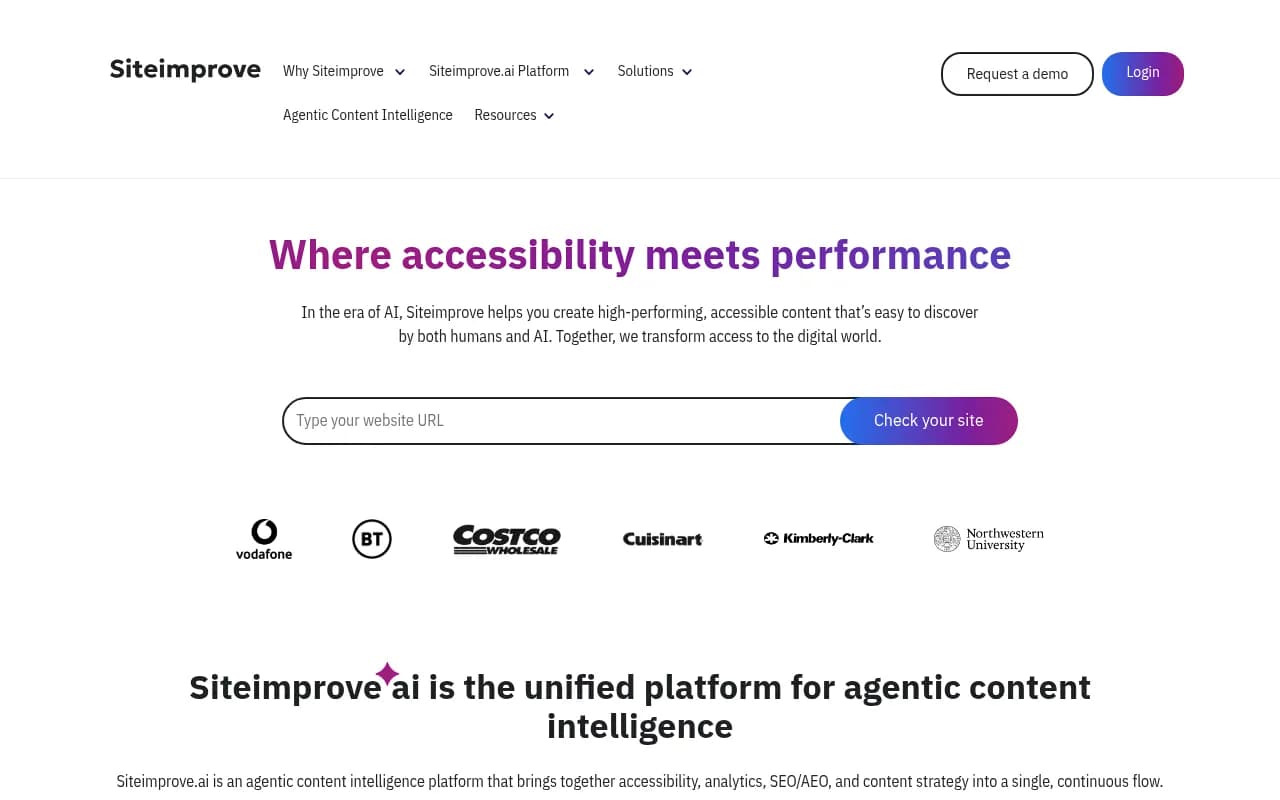
Siteimprove is an enterprise content intelligence platform that combines accessibility compliance, SEO/AEO optimization, analytics, and content strategy into a unified workflow. Used by Fortune 500 brands like Vodafone, BT, and Costco, it deploys AI agents that work alongside teams to ensure WCAG co
Key Takeaways:
• Unified platform approach: Siteimprove combines accessibility, SEO/AEO, analytics, and content strategy in one system—eliminating the need for multiple point solutions and fragmented workflows • AI agents, not replacement: The platform deploys specialized AI agents that assist teams rather than replace them, helping ensure compliance and optimization throughout the content lifecycle • Enterprise-grade accessibility: Comprehensive WCAG compliance monitoring across web, mobile, social, documents, and applications with real-time guidance for designers, developers, and editors • Strong for large organizations: Best suited for enterprise teams, government agencies, and universities managing complex multi-site digital properties with strict compliance requirements • Pricing barrier for smaller teams: Custom enterprise pricing model (no public rates) makes it inaccessible for startups, small agencies, or individual practitioners
Siteimprove has positioned itself as an enterprise-grade content intelligence platform at a time when organizations face mounting pressure from multiple directions: accessibility lawsuits are at record highs, AI search engines like ChatGPT and Perplexity are reshaping how content gets discovered, and teams are drowning in disconnected tools that don't talk to each other. Founded in Denmark and now serving over 7,000 customers globally—including household names like Vodafone, BT, Costco, Cuisinart, Kimberly-Clark, and Northwestern University—Siteimprove has built its reputation on solving the compliance and optimization challenges that keep enterprise digital teams up at night.
What sets Siteimprove apart in 2026 is its "agentic content intelligence" approach. Rather than offering separate tools for accessibility, SEO, and analytics that teams have to manually connect, Siteimprove deploys specialized AI agents that work within a unified platform. These agents don't replace human expertise—they amplify it by surfacing insights, removing guesswork, and automating repetitive tasks throughout the content creation and optimization process.
Accessibility Agents: Compliance by Design, Not by Accident
Siteimprove's accessibility capabilities are arguably its strongest differentiator. The platform monitors WCAG 2.1 and 2.2 compliance across web pages, mobile apps, social media content, PDF documents, and applications. This multi-channel approach matters because accessibility lawsuits increasingly target organizations across all digital touchpoints, not just websites.
The accessibility agents provide real-time guidance as designers, developers, and content editors work. Before a page goes live, the system flags issues like missing alt text, insufficient color contrast, keyboard navigation problems, or improperly structured headings. The agents don't just identify problems—they explain why each issue matters and suggest specific fixes. For a developer, that might mean code snippets. For a content editor, it's plain-language guidance on writing better alt text or restructuring content for screen readers.
Siteimprove's team includes Certified Professionals in Web Accessibility (CPWAs) and Certified Professionals in Accessibility Core Competencies (CPACC) through the International Association of Accessibility Professionals (IAAP). One team member serves as a National Expert for Denmark in the AccessibleEU initiative from the European Commission, and multiple staff members hold active community chairs in the W3C. This isn't marketing fluff—it means the people building the software are the same people shaping accessibility standards globally.
The platform generates detailed compliance reports that legal and procurement teams can use to demonstrate due diligence. For organizations facing Section 508 requirements (US federal agencies), ADA Title III obligations (private businesses), or European Accessibility Act mandates, these reports are essential documentation.
One limitation: while Siteimprove excels at automated testing, it doesn't replace manual accessibility audits. Complex interactive components, dynamic content, and certain ARIA implementations still require human review. The platform identifies potential issues but can't definitively say whether every implementation meets the spirit of accessibility guidelines.
SEO & AEO Agents: Visibility for Humans and AI Search
Siteimprove's SEO capabilities have evolved significantly to address the rise of AI search engines. The platform now explicitly covers AEO (Answer Engine Optimization)—optimizing content to appear in ChatGPT, Claude, Perplexity, Google AI Overviews, and other LLM-powered search experiences.
The SEO agents provide real-time optimization guidance as content creators work. Type a headline, and the agent suggests improvements for clarity, keyword inclusion, and AI-friendliness. Write a paragraph, and it flags opportunities to add structured data, improve semantic relevance, or answer common questions more directly. This in-the-moment feedback helps content teams build SEO and AEO best practices into their workflow rather than treating optimization as a post-publication cleanup task.
The platform tracks traditional SEO metrics: keyword rankings, backlink profiles, technical issues like broken links or slow page speeds, mobile usability, and Core Web Vitals. It also monitors how content performs in AI search results—which is increasingly where high-intent queries happen. For brands trying to appear in ChatGPT's recommendations or Perplexity's cited sources, this visibility is critical.
Siteimprove integrates with Google Search Console, Google Analytics, and major CMS platforms (WordPress, Drupal, Adobe Experience Manager, Sitecore). This means SEO data flows into the same dashboard where teams manage accessibility and content strategy, eliminating the need to context-switch between tools.
One gap: Siteimprove doesn't offer the depth of competitive keyword research or backlink analysis that dedicated SEO platforms like Ahrefs or Semrush provide. It's strong on on-page optimization and technical SEO, but agencies running aggressive link-building campaigns or conducting deep competitor analysis will likely need a supplementary tool. For brands focused on content optimization and AI search visibility rather than link acquisition, Siteimprove's SEO capabilities are more than sufficient.
Analytics Agents: Conversational Insights, Not Raw Dashboards
Siteimprove's analytics agents translate traffic data, user behavior, and page performance into clear, prioritized recommendations. Instead of staring at a dashboard full of metrics and trying to figure out what matters, teams get conversational insights tied to business goals.
Ask the analytics agent "Why did traffic drop last week?" and it surfaces the likely causes—maybe a technical issue, a drop in search rankings, or a change in user behavior. Ask "Which pages should we optimize first?" and it prioritizes based on traffic volume, conversion potential, and current performance gaps.
The platform tracks standard web analytics: page views, bounce rates, time on page, conversion funnels, traffic sources, and user journeys. It also monitors content performance at a granular level—which headlines drive engagement, which CTAs convert, which page layouts keep users on site longer. For content strategists trying to understand what works and what doesn't, this level of detail is invaluable.
Siteimprove's analytics integrate with Google Analytics and Adobe Analytics, pulling data from those platforms into the unified Siteimprove dashboard. This means teams can correlate analytics insights with accessibility issues, SEO opportunities, and content strategy recommendations without jumping between tools.
One limitation: Siteimprove isn't a replacement for a full-featured analytics platform. It's designed to surface actionable insights for content and marketing teams, not to provide the deep segmentation, custom reporting, or advanced attribution modeling that data analysts need. Think of it as a layer on top of your existing analytics that makes the data more accessible and actionable for non-analysts.
Content Strategy Agents: Research, Planning, and Optimization
Siteimprove's content strategy agents help teams move from reactive content creation to strategic planning. The agents automate content research by analyzing search trends, competitor content, audience questions, and gaps in your existing content library. They suggest topics, angles, and formats that align with business goals and audience needs.
During the planning phase, the agents help build content briefs that include target keywords, recommended structure, accessibility requirements, and SEO best practices. Writers get clear guidance before they start drafting, reducing the back-and-forth revisions that slow down content production.
After publication, the agents monitor content performance and suggest optimizations. Maybe a high-traffic page has accessibility issues that are hurting user experience. Maybe a well-written article isn't ranking because it's missing structured data. The agents surface these opportunities and prioritize them based on potential impact.
One standout feature: Siteimprove helps teams build brand authority in an era of AI-generated content. As more organizations use ChatGPT or Jasper to churn out generic articles, the platform emphasizes differentiation—creating content that's genuinely useful, well-researched, and reflective of your unique expertise. The agents guide teams toward content that establishes authority rather than just filling keyword gaps.
The content strategy capabilities integrate with the rest of the platform, so teams can see how content decisions impact accessibility compliance, SEO performance, and analytics metrics. This closed-loop approach—plan, create, publish, measure, optimize—is what makes Siteimprove a true content intelligence platform rather than a collection of disconnected tools.
Who Is Siteimprove For?
Siteimprove is built for enterprise organizations, government agencies, and large universities managing complex digital properties with strict compliance requirements. The typical customer is a Fortune 500 brand, a federal or state government agency, a major healthcare system, or a university with tens of thousands of pages across multiple sites.
Specific personas who benefit:
Digital accessibility managers at organizations facing ADA lawsuits or Section 508 audits. They need comprehensive compliance monitoring, detailed reporting for legal teams, and tools that help developers and content editors fix issues before they become liabilities.
SEO and content teams at enterprise brands managing 50+ sites or complex multi-brand portfolios. They need a platform that scales across properties, integrates with enterprise CMS platforms, and provides consistent optimization guidance for distributed teams.
Government digital teams required to meet WCAG 2.1 AA or AAA standards. They need audit trails, compliance documentation, and tools that work within strict procurement and security requirements.
Marketing operations leaders tired of managing a Frankenstein stack of accessibility tools, SEO platforms, analytics dashboards, and content management systems. They want a unified platform that reduces tool sprawl and improves cross-functional collaboration.
Siteimprove is NOT a good fit for:
Startups and small businesses without dedicated accessibility or SEO teams. The platform's enterprise focus and custom pricing make it overkill (and likely unaffordable) for companies with simple websites and limited compliance requirements.
Freelance SEO consultants or small agencies managing 5-10 client sites. The pricing model doesn't work for agencies that need per-site flexibility, and the feature set is broader than most small clients need.
Organizations that only need one capability—just accessibility testing, just SEO, or just analytics. If you only need accessibility monitoring, dedicated tools like Axe DevTools or WAVE might be more cost-effective. If you only need SEO, Ahrefs or Semrush offer deeper competitive analysis.
Integrations & Ecosystem
Siteimprove integrates with major CMS platforms including WordPress, Drupal, Adobe Experience Manager, Sitecore, and Contentful. These integrations allow teams to see accessibility and SEO recommendations directly within their content editing workflows.
The platform connects to Google Search Console, Google Analytics, and Adobe Analytics to pull in traffic and performance data. It also integrates with project management tools like Jira and Asana, allowing teams to turn Siteimprove recommendations into trackable tasks.
Siteimprove offers browser extensions for Chrome, Firefox, and Edge that let teams check accessibility and SEO issues on any page, even outside their own websites. This is useful for competitive analysis or auditing third-party content.
The platform provides an API for custom integrations and data exports. Enterprise customers can build custom dashboards, automate reporting, or connect Siteimprove data to business intelligence tools like Tableau or Looker Studio.
One gap: Siteimprove doesn't have native integrations with social media management platforms like Hootsuite or Sprout Social. Teams managing social accessibility need to use Siteimprove's standalone social media monitoring features rather than integrating with their existing social tools.
Pricing & Value
Siteimprove uses a custom enterprise pricing model with three service tiers: Essential, Expert, and Enterprise. Pricing is not publicly listed—you need to request a demo and speak with sales to get a quote.
Based on industry reports and user reviews, pricing typically starts in the low five figures annually for smaller enterprise deployments and scales into six figures for large organizations with multiple sites and advanced features. The exact price depends on the number of pages monitored, the modules purchased (accessibility, SEO, analytics, content strategy), and the service level selected.
The Essential tier includes core platform access with standard support. The Expert tier adds priority support, advanced training, and dedicated account management. The Enterprise tier includes custom SLAs, white-glove onboarding, and strategic consulting.
Siteimprove offers a free trial, but it's gated—you need to request a demo and provide company information. There's no self-service free tier or freemium option.
For the target audience—enterprise organizations with significant compliance risk and complex digital properties—Siteimprove delivers strong value. The platform consolidates multiple tools into one, reducing total cost of ownership and improving team efficiency. Customers report reducing time spent on accessibility fixes by 50% or more, and several case studies show measurable revenue improvements from better SEO and content optimization.
For smaller organizations, the value proposition is harder to justify. If you're a 10-person company with a single website and no legal compliance requirements, you can achieve similar results with a combination of free and low-cost tools: Google Analytics for traffic data, Screaming Frog for technical SEO, Axe DevTools for accessibility testing, and Promptwatch for AI search visibility. The total cost would be a fraction of Siteimprove's enterprise pricing.
Strengths
Unified platform eliminates tool sprawl: Teams manage accessibility, SEO, analytics, and content strategy in one place instead of juggling 5-10 separate tools. This reduces context switching, improves collaboration, and makes it easier to see how decisions in one area impact others.
Enterprise-grade accessibility monitoring: Comprehensive WCAG compliance tracking across web, mobile, social, documents, and applications. Real-time guidance for developers and editors. Detailed reporting for legal and procurement teams. This is Siteimprove's core strength and where it outshines most competitors.
AI agents that assist, not replace: The agentic approach—deploying specialized AI agents that work alongside teams—strikes the right balance between automation and human expertise. Teams get intelligent guidance without losing control or context.
Strong for AEO and AI search visibility: Explicit focus on optimizing content for ChatGPT, Perplexity, Google AI Overviews, and other LLM-powered search experiences. As AI search grows, this capability becomes increasingly valuable.
Deep expertise on staff: Team includes IAAP-certified professionals, W3C community chairs, and EU accessibility experts. This expertise shows in the quality of the platform's recommendations and the depth of its compliance features.
Limitations
Custom pricing is a barrier: No public pricing, no self-service trial, no freemium tier. Small businesses and agencies can't easily evaluate whether Siteimprove fits their budget. The sales-driven approach adds friction for buyers who want to try before they commit.
Not a replacement for specialized tools: Siteimprove is broad but not always deep. SEO professionals may still need Ahrefs or Semrush for competitive analysis. Data analysts may still need full-featured analytics platforms for advanced segmentation. Accessibility auditors may still need manual testing for complex components.
Learning curve for distributed teams: The platform is powerful but complex. Getting distributed teams—developers, content editors, marketers, accessibility specialists—all trained and using it effectively takes time and ongoing change management.
Bottom Line
Siteimprove is the right choice for enterprise organizations, government agencies, and large universities that need a unified platform for accessibility compliance, SEO/AEO optimization, analytics, and content strategy. If you're managing complex multi-site properties, facing legal compliance requirements, and tired of juggling disconnected tools, Siteimprove delivers strong value despite its premium pricing.
Best use case in one sentence: Enterprise digital teams managing 50+ sites who need to ensure WCAG compliance, optimize for AI search visibility, and improve content performance—all within a single platform that reduces tool sprawl and improves cross-functional collaboration.
For startups, small agencies, or individual practitioners, the custom enterprise pricing and broad feature set make Siteimprove overkill. You'll get better value from a combination of specialized tools tailored to your specific needs.
Tags:
Similar and alternative tools to Siteimprove