Diib Review 2026
AI-powered SEO analyzer that provides automated website audits, growth recommendations, and easy-to-understand insights for improving rankings.
Key Takeaways:
• Best for small business owners and non-technical users who want SEO insights without the complexity — syncs with Google Analytics in 60 seconds and delivers plain-English recommendations • Automated monitoring across SEO, speed, security, social media, and local rankings with daily health scores and instant alerts when issues arise • Includes Rank Guard technology (Pro plans) that notifies you immediately when keyword rankings drop and tells you exactly which page was affected • Limitations: Content creation still requires manual work or hiring writers; lacks advanced features like log file analysis or enterprise-level API access that larger SEO platforms offer • Pricing is accessible at $14.99/month for Pro (significantly cheaper than Ahrefs, Semrush, or Moz), with a functional free tier for basic monitoring
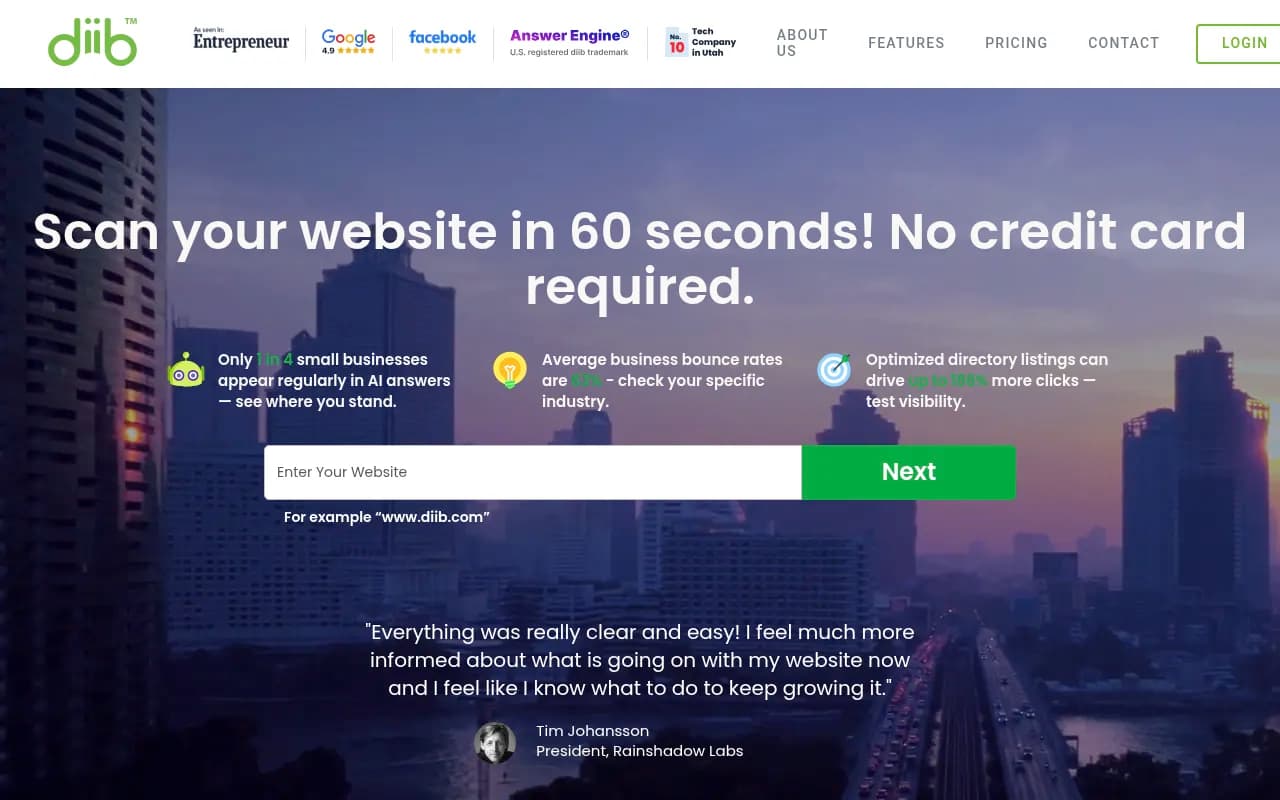
Diib positions itself as the "anti-complexity" SEO tool — a platform built specifically for business owners who don't have time to become SEO experts but still need to grow their online presence. Founded by Daniel Urmann, a digital marketing veteran with nearly 20 years of experience, Diib has grown to serve over 500,000 members across 160 countries since its launch. The core promise is simple: connect your Google Analytics, wait 60 seconds, and get a personalized growth plan written in plain English.
Unlike traditional SEO platforms that overwhelm users with data dashboards and assume technical knowledge, Diib takes an "Answer Engine" approach. It analyzes your actual analytics data, compares it against competitors and industry benchmarks, then tells you exactly what to do next. The platform doesn't just show you problems — it prioritizes them based on potential impact and provides step-by-step instructions for fixing them.
The Answer Engine & Growth Plan
The heart of Diib is its proprietary Answer Engine, which runs 24/7 analyzing your website across multiple dimensions. After the initial 60-second scan, you receive a comprehensive growth plan broken into actionable objectives across four main areas:
SEO & Keywords: Diib tracks your current keyword rankings and actively searches for new ranking opportunities. The platform monitors up to six competitors simultaneously, showing you which keywords they rank for that you don't. When your rankings change, you get immediate alerts specifying which page was affected and what changed in Google's algorithm or your competitor landscape. The Rank Guard feature (included in all Pro accounts) is particularly valuable — it catches ranking drops within hours and provides context about what triggered the change, whether it's a technical issue on your site, new competitor content, or a broader algorithm update.
The keyword explorer helps you discover content opportunities by showing search volume and difficulty scores for terms related to your business. Unlike enterprise tools that dump thousands of keyword suggestions, Diib focuses on realistic opportunities — keywords you can actually rank for given your current domain authority and competitive landscape.
Social Media Integration: Diib syncs directly with Facebook and Instagram to analyze your social performance alongside your website data. It tracks engagement rates, identifies when your followers are most active, and recommends optimal posting schedules. The platform benchmarks your social metrics against similar businesses, so you know if your engagement rate of 2.3% is good or terrible for your industry.
Mobile & User Experience: With mobile traffic dominating most industries, Diib continuously monitors your mobile speed score, Core Web Vitals, and mobile usability issues. The platform tests your site from actual mobile devices and provides specific recommendations for improving load times — compressing images, enabling browser caching, minifying CSS/JavaScript. It also tracks bounce rates by device type and compares them to industry averages, so you know if your 63% bounce rate is normal or a red flag.
Website Monitoring & Security: Diib automates the tedious work of website health monitoring. It checks your SSL certificate status, scans for security vulnerabilities, monitors uptime, and tests email deliverability (ensuring your transactional emails don't end up in spam folders). Pro accounts can monitor up to 30 websites, making it valuable for agencies or business owners with multiple properties.
Daily Health Score
One of Diib's most addictive features (according to user testimonials) is the Daily Health Score — a single number from 0-100 that summarizes your website's overall performance. This score combines 12 different metrics including traffic trends, keyword rankings, social engagement, mobile speed, security status, and more. The algorithm adapts to seasonality and day-of-week variations, so a traffic dip on Sunday doesn't tank your score if that's normal for your industry.
The Health Score provides an at-a-glance way to monitor progress without diving into detailed reports. Users report checking it daily like a fitness tracker for their website.
Benchmarking & Competitive Intelligence
Diib's benchmarking capabilities set it apart from basic SEO checkers. The platform compares your metrics against similar websites in your industry and traffic tier. You'll see how your bounce rate, average session duration, pages per session, and return visitor percentage stack up against the competition. This context is crucial — a 54% bounce rate might be excellent for a news site but terrible for an e-commerce store.
For competitor tracking, you can monitor up to six competitors' keyword rankings, backlink profiles, and traffic estimates. Diib shows you their new backlinks (potential outreach targets for your own link building) and alerts you when they start ranking for valuable keywords you're missing. The backlink analysis includes spam detection, warning you if toxic links are pointing to your site and potentially hurting your rankings.
Platform Compatibility & Integrations
Diib works with virtually every website platform: WordPress, Shopify, Wix, BigCommerce, Squarespace, Magento, Weebly, and dozens of others. The core integration is with Google Analytics — you authorize access during signup, and Diib pulls your historical data to establish baselines and trends. For local businesses, it also integrates with Google My Business to track local map rankings and monitor calls/direction requests.
The platform supports multiple languages and provides localized insights for businesses operating in different countries. However, it lacks API access or advanced integrations with tools like Slack, Zapier, or data warehouses — features that larger SEO platforms offer for enterprise users.
Weekly Snapshot & Alerts
For busy business owners, Diib sends a Weekly Snapshot email summarizing your performance: traffic changes, ranking movements (both local and national), social media stats, new growth opportunities, and any security or speed issues detected. The email format is designed for quick scanning — you can assess your week's performance in under two minutes.
Beyond the weekly summary, Diib sends real-time alerts for critical issues: sudden ranking drops, security vulnerabilities, site downtime, or significant traffic changes. These alerts include enough context to understand what happened and what action to take.
Growth Expert Support
All Pro plan members get access to Diib's team of Growth Experts — SEO and digital marketing specialists with an average of 10+ years of experience. You can ask questions via email or chat about keyword selection, technical issues, competitor strategies, or platform-specific problems (WordPress, Shopify, etc.). This human support layer bridges the gap between DIY SEO and hiring a full-service agency.
Diib also offers wholesale SEO services for members who want help executing the recommendations — content creation, link building, technical fixes. The company emphasizes that it has no salespeople and doesn't pay commissions, so 100% of your budget goes toward actual work rather than sales overhead.
Real User Results
Diib's website showcases detailed case studies of actual users:
David M (Toy Store Owner, Sacramento): Started with 13 keyword rankings and a 71% bounce rate. After following Diib's recommendations for several months, he improved mobile speed from 43/100 to 79/100, lowered bounce rate to 54%, added 75+ new keyword rankings, and increased Google My Business visibility — resulting in 70-80 new in-person shopping appointments per month.
Kevin C (Law Firm Partner, Birmingham, UK): Inherited a 17-year-old website with high domain authority (67/100) but only 2,169 keyword rankings. Diib identified that they were dramatically underutilizing their authority. After fixing security issues, disavowing bad backlinks, and adding 60+ optimized articles, the firm started ranking for major legal terms across the UK, including searches originating from London.
Michael S (Ecommerce Store Owner, Amplifiers): Invested $45k in a beautiful Shopify store that generated zero sales. Diib's analysis revealed he needed to focus on SEO and Facebook ads simultaneously. He launched targeted Facebook campaigns (first sale within 2 days) while building content for long-term organic growth. Today he ranks for 3,100+ keywords with 225+ articles on his site.
Who Should Use Diib
Diib is purpose-built for specific user types:
Small Business Owners (1-10 employees): The primary audience. If you're running a local service business, e-commerce store, or professional practice and don't have a dedicated marketing team, Diib translates SEO complexity into actionable tasks you can handle yourself or delegate to a VA.
Solopreneurs & Freelancers: Consultants, coaches, and service providers who need to maintain SEO without it becoming a second job. The automated monitoring and weekly snapshots keep you informed without requiring daily attention.
Web Designers & Small Agencies: The Pro plan's ability to monitor up to 30 websites makes Diib valuable for agencies managing multiple client sites. The white-label-friendly reports and Growth Expert support help you deliver ongoing value without building an in-house SEO team.
Ecommerce Store Owners: Shopify, WooCommerce, and BigCommerce users benefit from Diib's focus on conversion metrics alongside traffic. The platform tracks bounce rates, pages per session, and return visitor rates — all critical for online stores.
Who Should NOT Use Diib:
Enterprise SEO Teams: If you're managing 50+ websites or need advanced features like log file analysis, custom API integrations, or white-label reporting, enterprise platforms like Semrush, Ahrefs, or BrightEdge are better fits.
Technical SEO Specialists: If you're comfortable with Google Search Console, Screaming Frog, and server log analysis, Diib's simplified approach may feel limiting. The platform prioritizes accessibility over depth.
Content-Heavy Publishers: Sites with thousands of pages and complex content strategies need more granular page-level analytics than Diib provides.
Pricing & Value
Diib offers two tiers:
Free Plan: Includes basic SEO scanning, limited keyword tracking, website monitoring (reduced frequency), and access to the Daily Health Score. You'll get insights and recommendations, but monitoring is less frequent and some advanced features are locked.
Pro Plan ($14.99/month): Unlocks full functionality including Rank Guard (instant ranking drop alerts), up to 30 website monitoring, Growth Expert support, competitor tracking (6 competitors), full backlink analysis, social media integration, and priority scanning. Annual billing offers a discount.
Compared to competitors, Diib is significantly cheaper: Semrush starts at $139.95/month, Ahrefs at $129/month, Moz Pro at $99/month. The trade-off is depth — those platforms offer more granular data, larger keyword databases, and advanced features. But for small businesses that need actionable insights rather than data overload, Diib's pricing is compelling.
Diib also offers wholesale SEO services (content creation, link building) for members who want help executing recommendations, though pricing is custom quoted.
Strengths
Accessibility: The platform's greatest strength is making SEO understandable for non-experts. The plain-English explanations and step-by-step instructions lower the barrier to entry dramatically.
Automated Monitoring: Set-it-and-forget-it tracking across SEO, speed, security, and social media saves hours of manual checking each week.
Rank Guard Technology: Immediate alerts when rankings drop, with context about what changed, is genuinely valuable for catching and fixing issues before they crater your traffic.
Competitive Pricing: At $14.99/month, it's accessible for bootstrapped small businesses that can't justify $100+/month for enterprise SEO tools.
Real Data Integration: Unlike tools that only crawl your public website, Diib uses your actual Google Analytics data to provide personalized insights based on real user behavior.
Limitations
Content Creation Still Manual: Diib tells you what keywords to target and what content to create, but you still need to write it (or hire someone). Unlike newer AI-powered platforms like Promptwatch that generate optimized content automatically, Diib stops at recommendations.
Limited Advanced Features: No log file analysis, limited API access, no custom reporting for agencies, and smaller keyword databases than enterprise platforms.
Social Media Limited to Facebook/Instagram: No Twitter, LinkedIn, TikTok, or YouTube integration for social monitoring.
Backlink Data Less Comprehensive: While Diib shows your backlinks and competitors' links, the database isn't as extensive as Ahrefs or Majestic.
Bottom Line
Diib succeeds at its core mission: making SEO accessible and actionable for small business owners who don't have time to become experts. The automated monitoring, plain-English recommendations, and affordable pricing make it an excellent choice for solopreneurs, local businesses, and small e-commerce stores. The Rank Guard feature alone justifies the Pro plan cost for businesses that depend on organic traffic.
However, if you're managing large-scale SEO campaigns, need advanced technical analysis, or want AI-powered content generation to close the loop from insight to execution, you'll outgrow Diib quickly. For those users, enterprise platforms or newer AI-native tools offer more depth.
Best use case in one sentence: Diib is ideal for non-technical small business owners who want to improve their SEO without hiring an agency or becoming SEO experts themselves.
Tags:
Similar and alternative tools to Diib