Synthetic Users Review 2026
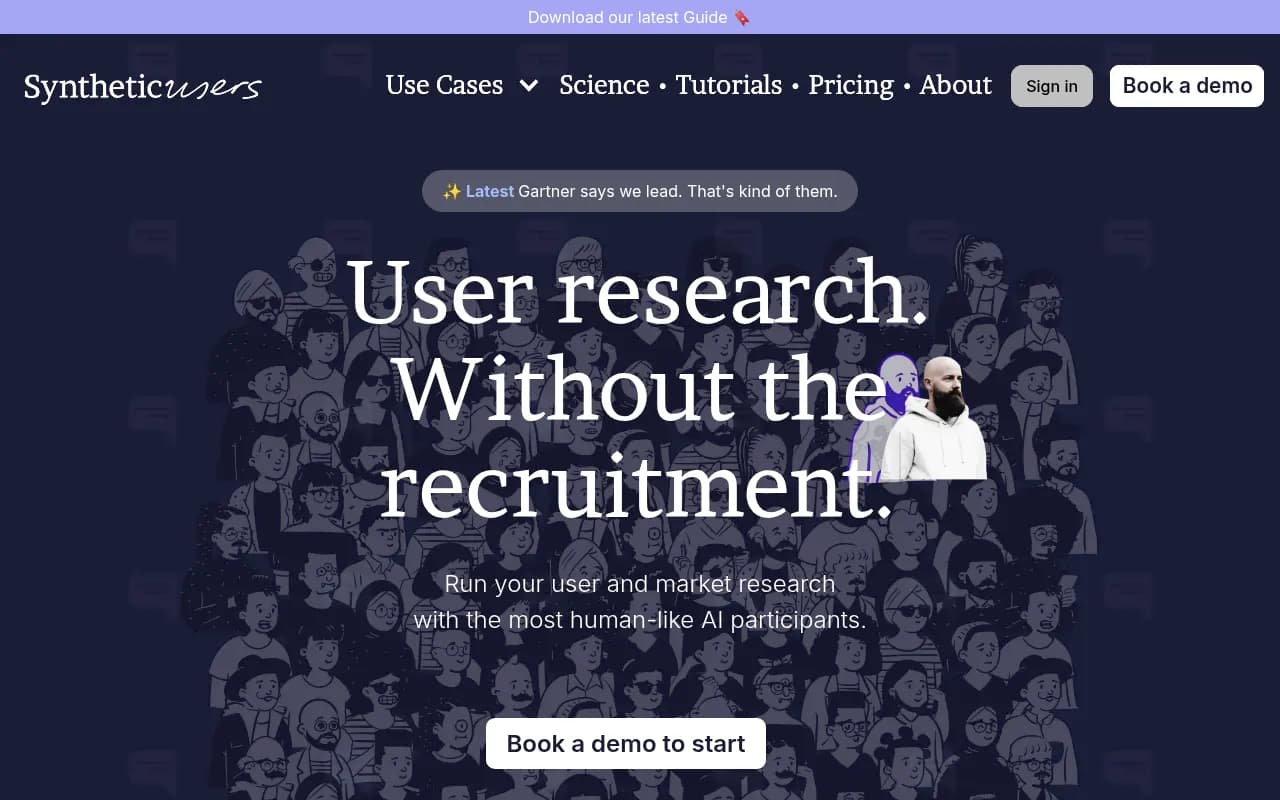
Synthetic Users uses advanced AI to simulate realistic user interviews and surveys at scale. Built for product teams, researchers, and agencies who need fast qualitative insights without the cost and delays of traditional user recruitment. Run problem exploration, concept testing, and market researc
Summary
- Best for: Product teams, UX researchers, and agencies who need qualitative insights fast without the recruitment overhead of traditional user research
- Standout capability: Multi-agent AI architecture that generates diverse, contextually aware synthetic users with proprietary "Synthetic Organic Parity" validation showing 95%+ alignment with real human responses
- Pricing: Starts at $99/month with a 7-day free trial; priced per interview, not per seat
- Limitation: Still an emerging category -- some teams may need to run parallel real-user validation for high-stakes decisions, especially in regulated industries
- Bottom line: If you're tired of waiting weeks for user research panels and burning budget on recruitment, Synthetic Users delivers qualitative depth in minutes instead of months
Synthetic Users is an AI-powered user research platform that replaces traditional participant recruitment with synthetic AI users capable of conducting in-depth interviews, surveys, and concept tests. Founded by a team with studios in Los Angeles, Lisbon, and London, the platform has been featured in Science Magazine, The Atlantic, and Le Monde for its work on using large language models as human behavior emulators. The company is SOC 2 compliant and serves enterprise clients, agencies, and product teams who need qualitative research insights without the typical 2-4 week recruitment timelines.
The core promise: run user research studies in seconds instead of weeks. You define your target audience (demographics, psychographics, behaviors), choose an interview type, and the platform generates synthetic users who respond to your questions with the nuance and variability you'd expect from real people. The company claims 95%+ alignment between synthetic and organic user responses based on internal validation studies, though they're transparent that this is an evolving metric they actively track and publish.
How it actually works (the multi-agent architecture)
Synthetic Users doesn't just feed your questions into ChatGPT and call it research. The platform uses a multi-agent AI framework where each synthetic user is built from a "personality profile" -- essentially a simulated reptilian brain reconstructed from the billions of parameters in foundation models like GPT, LLaMA, and Mistral. These agents interact with each other in a simulated environment, making decisions and evolving based on their interactions. This creates behavioral diversity and contextual continuity across multiple touchpoints, which is critical for longitudinal studies or multi-stage research.
The architecture is model-agnostic, meaning the platform selects the most appropriate foundation model for each task rather than locking into a single LLM. This reduces bias and improves output quality. You can also enrich your synthetic users with proprietary data via RAG (Retrieval-Augmented Generation) -- upload customer interview transcripts, support tickets, or internal research docs, and the platform will incorporate that context into the synthetic user profiles. This makes the users "truly yours" rather than generic personas pulled from public training data.
Four interview types (and when to use each)
Problem Exploration Interviews: Use this when you're in the discovery phase and need to understand user pain points, behaviors, and unmet needs. The AI probes for context and follows up on interesting threads, much like a skilled qualitative researcher would. Good for early-stage product teams validating a problem space or agencies scoping a new client engagement.
Custom Script Interviews: Bring your own questions (up to 10) and the platform will run them across your synthetic user panel. This is the closest analog to traditional user interviews -- you control the script, the AI handles the execution. Useful when you have a specific hypothesis to test or need to replicate a study you've run before with real users.
Concept Testing Interviews: Show synthetic users a product concept, feature mockup, or marketing message and get feedback on comprehension, appeal, and perceived value. The platform can test multiple concepts in parallel and surface which resonates best with different audience segments. Faster and cheaper than running concept tests through UserTesting or Respondent.
Research Goal Interviews: Set a high-level research objective (e.g. "Understand why SaaS buyers churn in the first 90 days") and let the multi-agent system design and execute the study autonomously. The AI determines which questions to ask, how to probe deeper, and when to pivot based on emerging themes. This is the most hands-off option and works well for exploratory research where you don't yet know what you're looking for.
There's also Prisma Multi-Study Research Planner, which lets you run multiple studies simultaneously and compare results across different audience segments or concept variations. Think of it as A/B testing for qualitative research.
Quantitative surveys at scale
While the platform is built around qualitative depth, it also supports large-scale surveys. You can run thousands of survey responses in minutes, then alternate between survey data and interview follow-ups to triangulate insights. This is useful for validating themes that emerge from interviews or quickly testing messaging variations across a broad audience.
Proprietary data and RAG enrichment
The RAG feature is where Synthetic Users differentiates itself from generic LLM prompting. Upload your own customer data -- interview transcripts, support tickets, CRM notes, product usage logs -- and the platform will use that context to make synthetic users more representative of your actual customer base. This is critical for B2B companies or niche verticals where public training data doesn't capture the specificity of your audience.
For example, if you're building a fintech product for CFOs at mid-market SaaS companies, you can upload past customer interviews and the synthetic users will reflect the language, priorities, and pain points specific to that persona. Without RAG, you're relying on the foundation model's generic understanding of "CFOs," which may not match your reality.
Validation and "Synthetic Organic Parity"
Synthetic Users is unusually transparent about how they measure accuracy. They track "Synthetic Organic Parity" -- the degree to which synthetic user responses align with real human responses on the same questions. The company publishes case studies and validation data on their website, including comparisons showing 95%+ alignment in certain contexts.
They also maintain a science section with links to peer-reviewed research on LLMs as human emulators, including studies published in Science Magazine and SAGE journals. This is important because synthetic user research is still an emerging category and many researchers are (rightly) skeptical. The company's willingness to engage with the academic community and publish validation data builds credibility.
That said, 95% alignment doesn't mean synthetic users are a perfect replacement for real users in every context. The platform works best for exploratory research, concept validation, and hypothesis generation. For high-stakes decisions (e.g. launching a $10M product, regulatory compliance, medical device testing), you'll still want to validate findings with real users. Synthetic Users is a complement to traditional research, not a full replacement.
Who this is for (and who it's not for)
This platform is built for product teams, UX researchers, and agencies who need qualitative insights fast. Specific use cases:
- Early-stage startups validating problem-solution fit before building anything. Run 50 problem exploration interviews in an afternoon instead of spending 3 weeks recruiting and scheduling participants.
- Product managers at mid-stage companies testing feature concepts or messaging variations. Get directional feedback in hours, then validate with real users if the concept shows promise.
- UX researchers who need to supplement small-N qualitative studies with broader coverage. Run 10 real user interviews, then use Synthetic Users to test whether the themes hold across 100+ synthetic users.
- Marketing teams testing ad copy, landing page messaging, or positioning statements across different audience segments. Faster and cheaper than running focus groups or hiring a research agency.
- Agencies who bill clients for research but struggle with the economics of traditional recruitment. Synthetic Users lets you deliver insights faster and at higher margin.
Who should NOT use this: Teams in regulated industries (healthcare, finance, legal) where you need documented evidence of real user participation for compliance purposes. Companies making irreversible, high-stakes decisions (e.g. pivoting the entire business) based solely on synthetic data. Researchers who are philosophically opposed to AI-generated insights and want only real human voices.
Integrations and ecosystem
The platform is largely self-contained, but it does offer:
- API access for custom workflows and integrations with internal tools
- Looker Studio integration for exporting data into custom dashboards
- Discord community for users to share best practices and feature requests
- Developer docs at docs.syntheticusers.com for teams building on the API
No native integrations with tools like Notion, Slack, or Airtable yet, but the API makes it possible to build those yourself if needed.
Pricing and value
Synthetic Users charges per interview, not per seat, which is unusual in SaaS. Pricing starts at $99/month with a 7-day free trial. There are three tiers (Essential, Professional, Business) with custom Enterprise pricing available. The company doesn't publish exact tier breakdowns on the homepage, but the pricing page (syntheticusers.com/pricing) has full details.
Compared to traditional user research: recruiting 10 participants for 30-minute interviews typically costs $1,500-$3,000 (at $150-$300 per participant) plus 2-4 weeks of scheduling overhead. Synthetic Users delivers 10 interviews in minutes for a fraction of the cost. Even if you only use it for directional research and still validate with real users, the time savings alone justify the cost.
Compared to other AI research tools: most competitors (like Maze's AI features or Sprig's AI analysis) focus on analyzing existing user data, not generating synthetic participants. Synthetic Users is in a category of its own here.
Strengths
- Speed: Run 50 interviews in the time it takes to schedule one real user call. This is the killer feature.
- Multi-agent architecture: More sophisticated than just prompting ChatGPT. The diversity and contextual continuity are noticeably better.
- RAG enrichment: Upload your own data to make synthetic users representative of your actual customer base, not generic personas.
- Transparency: The company publishes validation data and engages with academic research on LLM accuracy. This builds trust in an emerging category.
- Pricing model: Per-interview pricing is more predictable than per-seat SaaS, especially for agencies or teams with variable research volume.
Limitations
- Still emerging: Synthetic user research is a new category and many researchers are skeptical. You'll need to educate stakeholders and validate findings with real users for high-stakes decisions.
- Limited integrations: No native Slack, Notion, or Airtable integrations yet. You'll need to use the API or export data manually.
- Not a full replacement: Works best for exploratory research and concept validation, not final go/no-go decisions. You'll still need real users for certain contexts (regulated industries, high-stakes launches, etc.).
Bottom line
Synthetic Users is the fastest way to get qualitative user research insights without the recruitment overhead. If you're a product team that needs to validate ideas quickly, an agency that wants to deliver research faster, or a researcher who wants to supplement small-N studies with broader coverage, this platform will save you weeks of time and thousands of dollars. The multi-agent architecture and RAG enrichment make it more sophisticated than just prompting ChatGPT, and the company's transparency around validation builds credibility in an emerging category. Just remember: it's a complement to real user research, not a full replacement. Use it for directional insights and hypothesis generation, then validate with real users when the stakes are high.
Tags:
Frequently asked questions
What is Synthetic Users and what does it do?
How much does Synthetic Users cost?
Who should use Synthetic Users?
How accurate are Synthetic Users compared to real user research?
Does Synthetic Users offer a free trial?
What types of research can you conduct with Synthetic Users?
Is Synthetic Users suitable for enterprise companies?
What are the limitations of using Synthetic Users?
Similar and alternative tools to Synthetic Users