Key takeaways
- If you need AI search visibility and brand monitoring (not web automation), Airtop isn't really the right tool -- look at Promptwatch, Profound, or Peec AI instead
- Promptwatch is the strongest all-in-one option for brands that want to track and improve their AI search presence, with built-in content generation, crawler logs, and citation analysis
- Surfer SEO and Clearscope are the go-to choices if content optimization for traditional search (with some AI search coverage) is your main need
- Semrush and Ahrefs make sense if you want a single platform covering SEO, PPC, content, and AI visibility -- but their AI tracking features are less specialized than dedicated GEO tools
- Moz Pro is the budget-friendly SEO option, though it has minimal AI search capabilities
- Otterly.AI and Peec AI are solid monitoring-only options for smaller teams or tighter budgets
There's a bit of a mismatch worth addressing upfront. Airtop is primarily a web automation platform -- it lets you build browser agents that scrape sites, fill forms, extract data, and connect to tools like Slack and Google Sheets, all without writing code. Its tagline about "SEO visibility and AI search tracking" is a secondary use case at best. Most people looking for Airtop alternatives are either:
- Looking for web automation tools that can handle browser-based workflows, or
- Searching for AI search visibility and brand monitoring tools (which is what Airtop's marketing sometimes implies)
This guide focuses on the second group -- teams who want to track and improve how their brand appears in ChatGPT, Perplexity, Gemini, and other AI search engines. If that's you, read on. These are the tools actually built for that job.
The alternatives
Promptwatch

Promptwatch is the most complete AI search visibility platform available right now, and it's the one I'd point most teams toward first. The core difference between Promptwatch and most competitors is that it doesn't stop at showing you data -- it helps you act on it.
The workflow goes like this: Promptwatch's Answer Gap Analysis shows you exactly which prompts your competitors are appearing in that you're not. You see the specific topics and questions AI models want to answer but can't find on your site. Then the built-in AI writing agent generates content -- articles, listicles, comparisons -- grounded in real citation data from over 880 million citations analyzed. After you publish, you track whether your visibility scores improve and which pages are getting cited by which models.
That loop (find gaps, create content, track results) is what separates Promptwatch from monitoring-only tools. Most competitors show you a dashboard and leave you to figure out what to do next.
Other things worth knowing: Promptwatch tracks 10 AI models including ChatGPT, Claude, Perplexity, Gemini, Grok, DeepSeek, Copilot, and Google AI Overviews. It has real-time AI crawler logs showing which pages ChatGPT and Perplexity are actually reading on your site. It tracks Reddit and YouTube discussions that influence AI recommendations -- a channel most tools ignore entirely. And it includes ChatGPT Shopping tracking for brands that sell products.
Pricing starts at $99/month for the Essential plan (1 site, 50 prompts, 5 articles), $249/month for Professional (2 sites, 150 prompts, crawler logs, state/city tracking), and $579/month for Business (5 sites, 350 prompts). A 7-day free trial is available.
Compared to Airtop's web automation focus, Promptwatch is purpose-built for AI search visibility. If that's what you actually need, this is where I'd start.
Best for: Marketing and SEO teams at brands or agencies who want to both monitor and actively improve their AI search presence.
Surfer SEO
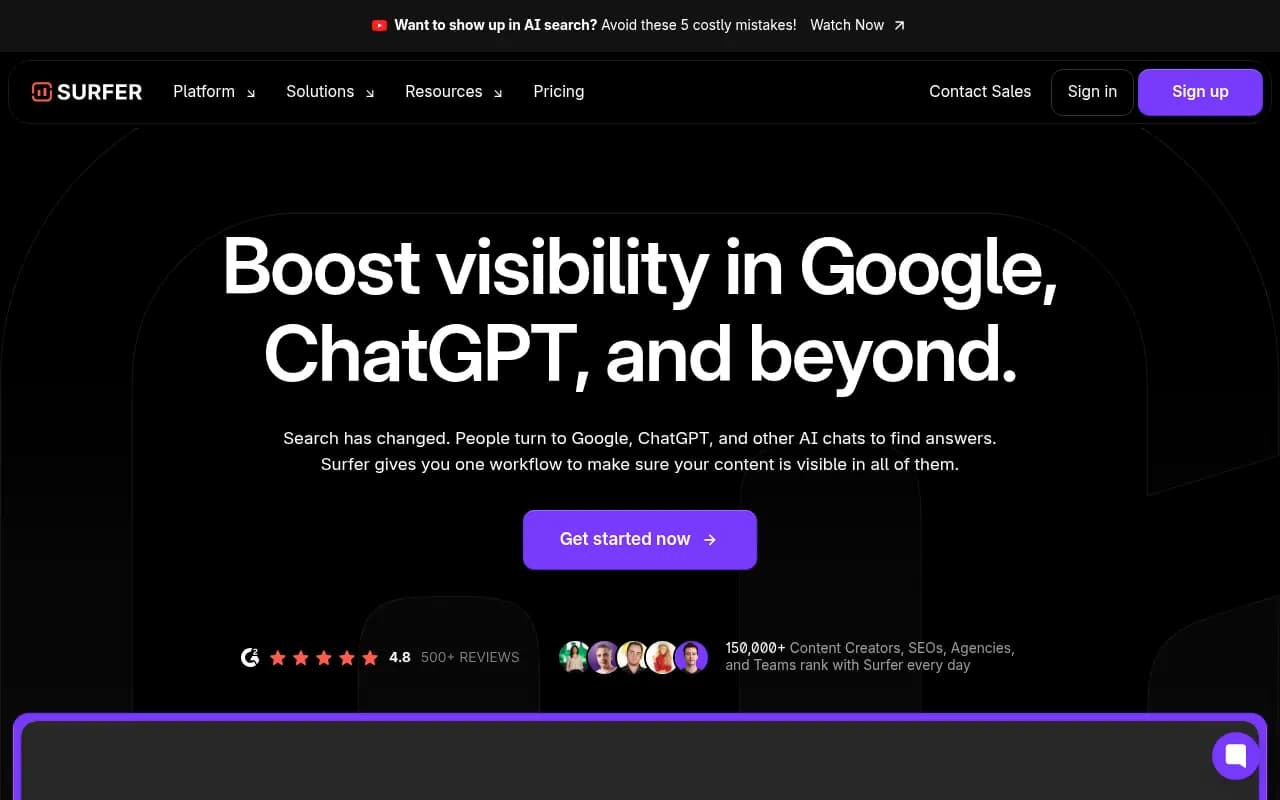
Surfer has been one of the dominant content optimization tools for traditional SEO for years, and it's now making a genuine push into AI search territory. The core product analyzes top-ranking pages and gives you a real-time content score as you write, telling you which terms to include, how long your content should be, and how it stacks up against competitors.
The AI search angle is newer. Surfer now positions itself as a tool for boosting visibility in ChatGPT and other LLMs, not just Google. The logic makes sense -- content that's well-structured, comprehensive, and semantically rich tends to get cited by AI models. Surfer's content editor helps you write that kind of content.
Where Surfer falls short compared to dedicated GEO tools: it doesn't actually monitor your brand mentions in AI responses, track which AI models are citing you, or show you crawler logs. It's an optimization tool, not a monitoring platform. You'd use Surfer to write better content, then use something like Promptwatch to track whether that content is getting picked up by AI search engines.
Pricing starts at $99/month (Essential), $179/month (Advanced), and $299/month (Max), billed annually. Surfer AI articles cost additional credits on top of the base plan.
Best for: Content teams that primarily care about Google rankings but want their content to also be AI-search-friendly. Not a replacement for dedicated AI visibility monitoring.
Semrush
Semrush is the Swiss Army knife of digital marketing tools. It covers keyword research, backlink analysis, site audits, rank tracking, content optimization, PPC research, social media management, and now AI visibility monitoring. If you want one platform that does everything, Semrush is the obvious candidate.
The AI Visibility toolkit tracks how your brand appears in ChatGPT, Perplexity, and Gemini responses, with sentiment analysis and competitor benchmarking. There's also an AI PR feature for finding media outlets trusted by LLMs and launching outreach campaigns.
The honest trade-off: Semrush's AI visibility features are solid but not as deep as specialized GEO platforms. It uses fixed prompt sets rather than letting you define custom prompts based on your actual customers' queries. It doesn't have AI crawler logs, Reddit/YouTube tracking, or the kind of content gap analysis that Promptwatch offers. For teams that already live in Semrush and want "good enough" AI monitoring without adding another tool, it works. For teams where AI search visibility is a primary concern, you'll probably want something more specialized.
Pricing starts at $165/month (Starter), $290/month (Pro+), and $580/month (Advanced). A 7-day free trial is available.
Best for: Teams that need a full digital marketing suite and want AI visibility as one feature among many, rather than as their primary focus.
Profound
Profound

Profound is the closest competitor to Promptwatch in the enterprise space. It tracks brand mentions across ChatGPT, Perplexity, Claude, Gemini, Grok, Copilot, Meta AI, DeepSeek, and Google AI Overviews. It has prompt volume data, AI crawler analytics, and content generation agents. Customers include MongoDB, Ramp, and Mercury.
The feature set is genuinely strong. Profound's agent analytics show how AI crawlers interact with your site, and its prompt volume data helps you prioritize which queries to target. The content agents can generate AEO-optimized FAQs and other content types.
The main friction point is pricing and accessibility. Profound's Lite tier starts around $499/month with no free trial -- you need to book a demo to get started. That's a meaningful commitment before you've had a chance to evaluate the product. Promptwatch offers a 7-day free trial starting at $99/month, which is a much lower barrier to entry.
Profound is also more enterprise-focused in its positioning (SOC 2 compliance, custom enterprise contracts), which is great if you're a large organization with procurement requirements, but overkill for most marketing teams.
Best for: Enterprise marketing teams with larger budgets who need SOC 2 compliance and dedicated account management.
Peec AI

Peec AI is a clean, focused AI search analytics platform aimed at marketing teams. It tracks visibility, position, and sentiment across ChatGPT, Perplexity, Claude, and Gemini, with competitor benchmarking and citation source analysis.
The interface is well-designed and the core metrics are easy to understand. Peec tracks which brands get mentioned in AI responses, where your brand ranks within those responses, and how AI models perceive your brand's sentiment. You can add custom prompts, organize them with tags, and track across countries.
What Peec doesn't have: content generation, AI crawler logs, Reddit/YouTube tracking, ChatGPT Shopping monitoring, or the kind of deep prompt intelligence (volume estimates, difficulty scores, query fan-outs) that more comprehensive platforms offer. It's a monitoring tool, not an optimization platform. That's fine if monitoring is all you need, but most teams eventually want to do something with the data.
Pricing starts at €89/month (~$103) for the Starter plan (50 prompts, 10 models), with a Growth plan at €199/month (150 prompts, 2 workspaces). A free trial is available.
Best for: Smaller marketing teams that want straightforward AI visibility monitoring without the complexity or cost of a full-featured platform.
Otterly.AI
Otterly.AI

Otterly.AI is one of the more affordable options in the AI search monitoring space. It tracks brand mentions and website citations across ChatGPT, Perplexity, Google AI Overviews, Google AI Mode, Gemini, and Copilot -- six platforms in total. It also has a GEO Audit tool that analyzes 25+ on-page factors to identify what's holding your site back from earning more citations.
The keyword research feature helps you discover what your audience is actually asking on AI platforms, which is useful for content planning. Automated reporting and competitive benchmarking are included.
The limitations are similar to Peec AI: no content generation, no AI crawler logs, no Reddit/YouTube tracking, and no prompt volume data. The GEO Audit is a nice touch that goes slightly beyond pure monitoring, but it's still a diagnostic tool rather than an action-taking one. At $29/month for the Lite plan (15 prompts) and $189/month for Standard (100 prompts), it's one of the more accessible entry points in this category.
The 14-day free trial with no credit card required is a genuine plus -- you can evaluate it properly before committing.
Best for: Smaller teams or individuals who want affordable AI search monitoring and are comfortable doing the optimization work themselves.
Clearscope

Clearscope sits in a similar space to Surfer SEO -- it's primarily a content optimization tool for traditional search, with growing capabilities around AI search visibility. The content editor grades your writing against top-ranking pages and suggests terms to include. The topic exploration feature helps you build content clusters and identify high-impact opportunities.
The AI search angle: Clearscope now tracks visibility across Google and AI chatbots like ChatGPT and Gemini, and shows you which sources LLMs are using to compile their answers. This is more transparency than most content tools offer, though it's still not as deep as dedicated GEO platforms.
Clearscope's pricing is on the higher end for a content tool -- $189/month for the Essentials plan, with Business and Enterprise plans at custom pricing. There's no free trial, though demos are available. The month-to-month billing (no long-term contracts) is a nice flexibility.
Where Clearscope genuinely shines is the quality of its content grading. Teams that produce a lot of content and need a reliable, consistent way to optimize it tend to stick with Clearscope. The interface is clean and the recommendations are actionable.
Best for: Content-heavy teams that prioritize writing quality and want a premium content optimization tool with some AI search visibility features.
Ahrefs
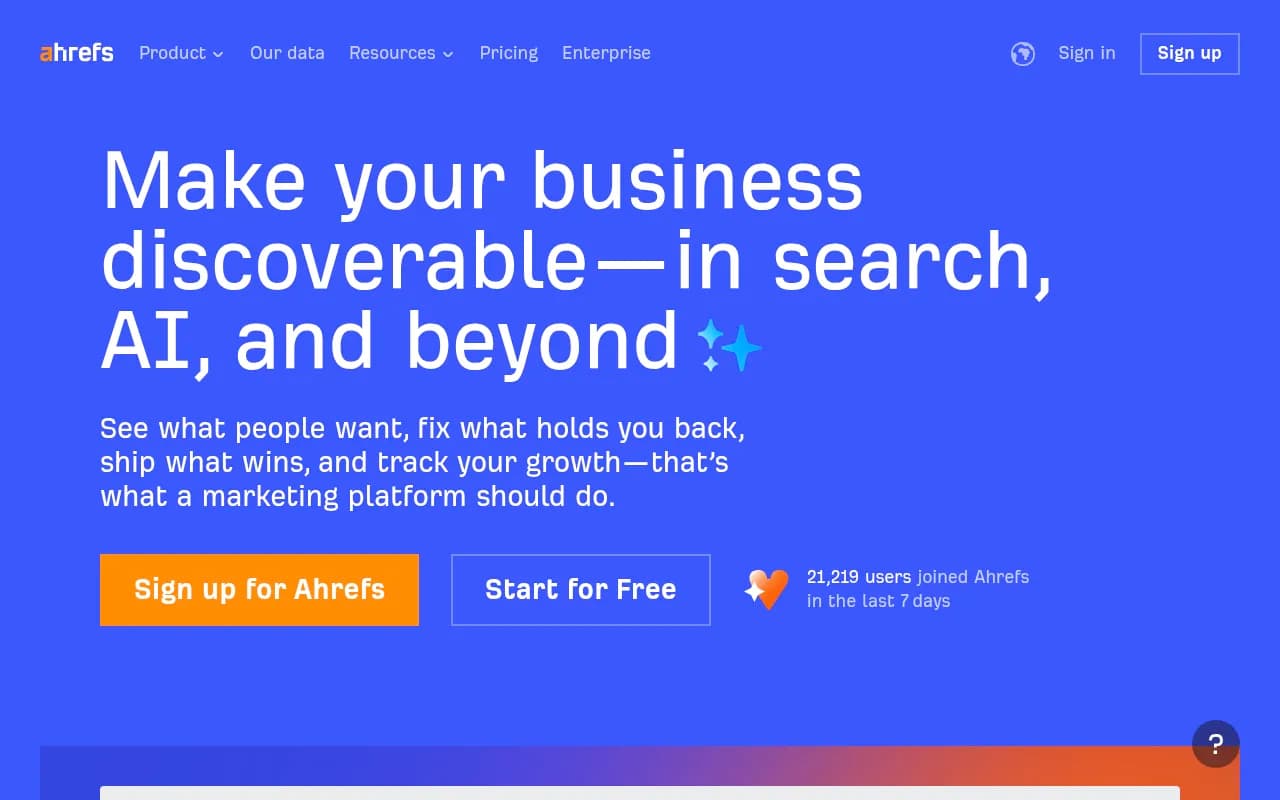
Ahrefs is one of the two dominant traditional SEO platforms (alongside Semrush), and it's been expanding into AI search monitoring with its Brand Radar feature. The core product is exceptional for backlink analysis, keyword research, site audits, and rank tracking -- Ahrefs has the largest backlink index online and its keyword database is genuinely massive.
The AI search monitoring through Brand Radar tracks how your brand appears in AI-generated responses, but it uses fixed prompts rather than custom ones, and there's no AI traffic attribution to connect visibility to actual revenue. For teams where traditional SEO is the primary job and AI monitoring is a nice-to-have, Ahrefs makes sense. For teams where AI search visibility is a strategic priority, the Brand Radar feature alone won't cut it.
Pricing starts at $83/month (Lite), $166/month (Standard), $333/month (Advanced), with Enterprise at custom pricing. Annual billing saves 20%. A free trial is available.
Best for: SEO teams that need world-class traditional SEO tools and want basic AI brand monitoring included, without switching to a new platform.
Moz Pro
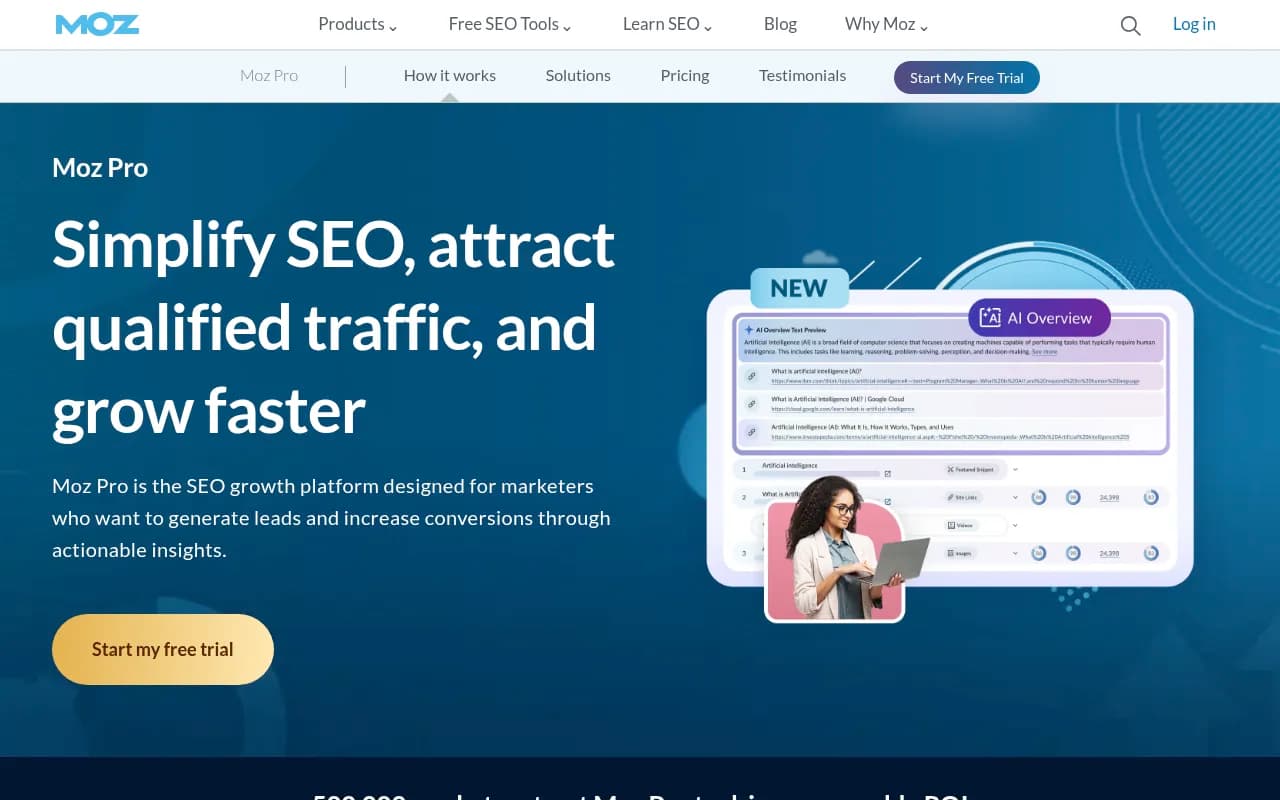
Moz Pro is the most established name in SEO software, and it's the most affordable option among the traditional SEO platforms on this list. The Keyword Explorer, On-Page Grader, site audits, and rank tracker are all solid. Moz's proprietary metrics (Domain Authority, Brand Authority) are widely recognized in the industry.
The honest assessment on AI search: Moz Pro has minimal AI search visibility capabilities compared to the other tools here. It's primarily a traditional SEO platform, and while it's added some AI-powered features to its existing tools, it doesn't have the kind of LLM monitoring, citation tracking, or GEO optimization features that dedicated platforms offer.
If your primary need is traditional SEO and budget is a constraint, Moz Pro at $49/month (or $39/month with current promotions) is a reasonable choice. If AI search visibility is important to you, you'd need to pair it with a dedicated GEO tool.
Best for: SEO teams on a budget who primarily care about Google rankings and don't need AI search monitoring.
How to choose
The right tool depends on what you're actually trying to do:
If AI search visibility is your primary concern and you want to both monitor and improve your presence in ChatGPT, Perplexity, Claude, and other LLMs, Promptwatch is the most complete option. It's the only platform in this list that closes the full loop from gap identification to content creation to results tracking. Profound is a strong alternative if you need enterprise-grade compliance and have the budget.
If you want AI monitoring without the full optimization suite, Peec AI and Otterly.AI are both reasonable choices at lower price points. Peec is slightly more polished; Otterly has a better free trial policy.
If you need a full digital marketing platform that covers SEO, PPC, content, and AI visibility in one place, Semrush or Ahrefs are the obvious choices. Neither is as specialized for AI search as the dedicated GEO tools, but both are improving their AI features.
If content optimization is your main job, Surfer SEO and Clearscope are the two best options. Surfer is more affordable and has broader AI search positioning; Clearscope is more premium and has slightly better topic research tools.
If budget is tight and traditional SEO is the priority, Moz Pro at $49/month is hard to beat for the core SEO toolkit.
One thing worth noting: for most teams, the question isn't which single tool to use, but which combination makes sense. A common setup is pairing a traditional SEO tool (Ahrefs or Semrush) with a dedicated AI visibility platform (Promptwatch or Profound) to cover both search channels properly.