Key takeaways
- Jasper is the best pick for enterprise marketing teams that need brand governance, multi-channel content pipelines, and AI agents -- but it's expensive and overkill for solo operators.
- Surfer SEO is the go-to for teams that want data-driven content optimization grounded in what's actually ranking, with growing AI search support.
- Promptwatch is the strongest option if your goal is to actually improve AI search visibility -- not just monitor it. It tracks citations, identifies content gaps, and generates content engineered to get cited by ChatGPT, Claude, and Perplexity.
- Profound is a serious enterprise AEO platform with deep prompt volume data, but it starts at $499/mo and has no free trial.
- Frase and MarketMuse are solid mid-market choices for content strategy and optimization, with Frase leaning more toward GEO and MarketMuse toward topical authority.
- Otterly.AI and Clearscope are good entry points -- Otterly for AI monitoring, Clearscope for content grading -- but both stop short of full optimization workflows.
CapGo AI has carved out a specific niche: programmatic content generation at scale. The pitch is simple -- connect your data, pick a template, generate thousands of pages. For teams running large affiliate sites, local SEO plays, or product-heavy catalogs, that kind of volume-first approach has real appeal. The free tier makes it easy to test, and the $18/mo entry price is genuinely low.
But CapGo AI's limitations become obvious quickly for teams with more complex needs. There's no meaningful AI visibility tracking -- you can generate content, but you can't see whether it's actually getting cited by ChatGPT or Perplexity. The content generation is template-driven rather than research-driven, which means you can produce a lot of pages that don't necessarily answer the questions AI models are pulling from. And for teams that need brand governance, competitive intelligence, or GEO-specific optimization (not just production), CapGo AI doesn't go deep enough.
The alternatives below cover a wide range: from enterprise AI marketing platforms to lean monitoring tools to full GEO optimization suites. Here's how they actually compare.
The alternatives
Promptwatch

Promptwatch approaches the problem from a different angle than CapGo AI. Where CapGo AI is about generating content volume, Promptwatch is about generating the right content -- specifically, content that AI models will cite in their responses.
The core workflow is: find the prompts where competitors are visible but you're not (Answer Gap Analysis), generate content grounded in real citation data to fill those gaps, then track whether that content starts getting cited. It's a closed loop that most tools in this space don't offer. Most stop at monitoring.
What makes Promptwatch stand out technically: it logs actual AI crawler activity on your site (which pages ChatGPT, Claude, and Perplexity are reading, how often, what errors they hit), tracks citations across 10 AI models including DeepSeek and Grok, surfaces Reddit and YouTube discussions that influence AI recommendations, and includes prompt volume and difficulty scoring so you can prioritize the gaps worth closing. The built-in content agent generates articles and comparisons based on 880M+ citations analyzed -- not generic filler.
Compared to CapGo AI, Promptwatch is less about raw page volume and more about strategic content that earns AI visibility. If you're generating thousands of pages with CapGo AI but none of them are showing up in ChatGPT responses, Promptwatch is what tells you why -- and what to write instead.
Pricing: Essential at $99/mo (1 site, 50 prompts, 5 articles), Professional at $249/mo (2 sites, 150 prompts, 15 articles, crawler logs), Business at $579/mo. Free trial available.
Best for: Marketing and SEO teams that want to actually improve their AI search visibility, not just track it. Agencies managing multiple brands. Anyone who's been generating content at scale and wondering why AI models still aren't citing them.
Jasper
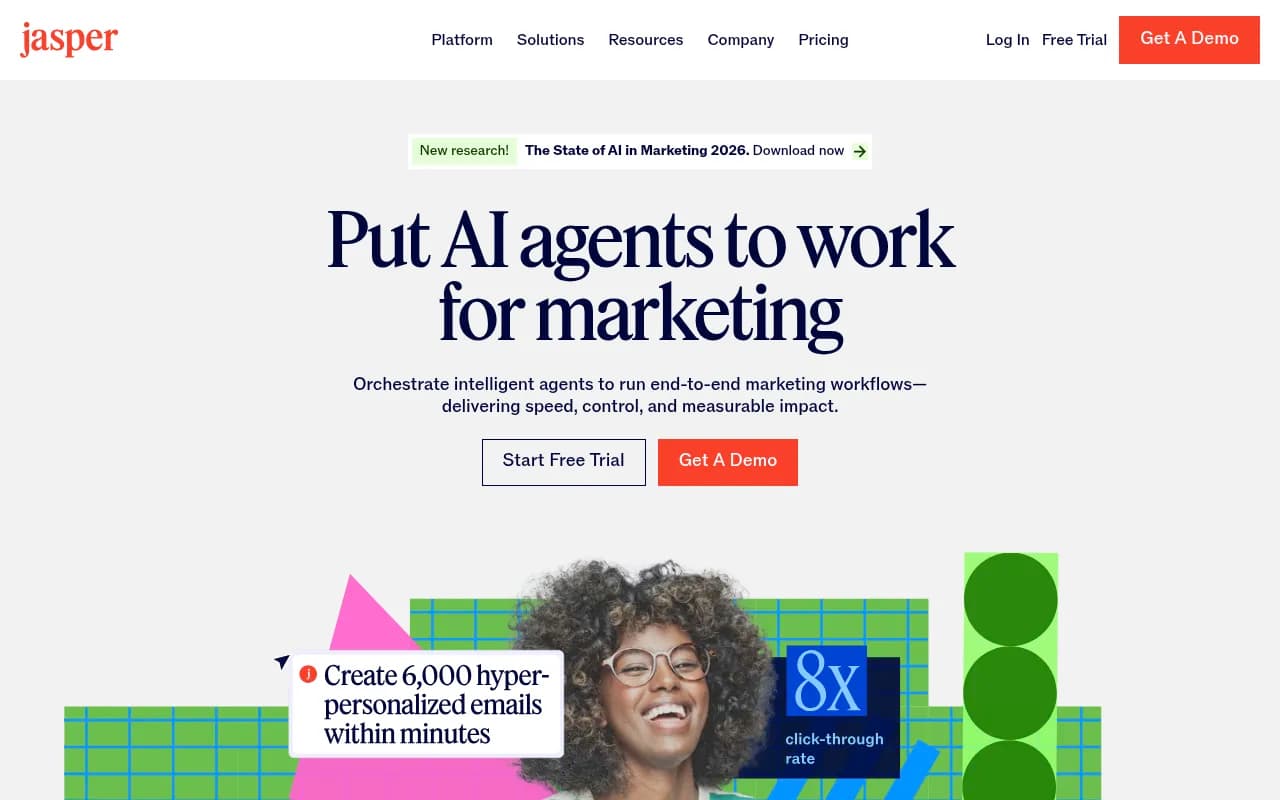
Jasper is the enterprise content platform that most large marketing teams eventually bump into. It's not a GEO tool specifically -- it's a full AI marketing platform with 100+ specialized agents, content pipelines, brand voice controls, and a governance layer that keeps outputs on-brand and compliant. The SEO/AEO/GEO solution is one vertical within a much larger product.
Compared to CapGo AI, Jasper is in a different weight class. CapGo AI is a lean programmatic content generator. Jasper is a platform for running entire marketing operations with AI. The "Grid" feature (bulk content generation from structured data) is the closest analog to CapGo AI's core workflow, but Jasper wraps it in brand intelligence, style guides, and approval workflows that CapGo AI doesn't have.
The trade-off is price and complexity. Jasper starts at $59/mo for a solo Creator plan, but the team-oriented Pro plan is $249/mo for up to 5 users, and enterprise pricing goes much higher. For a small team that just wants to generate SEO pages quickly, Jasper is probably more platform than you need.
Where Jasper genuinely wins: brand consistency at scale. If you have a defined brand voice and need dozens of people generating content without going off-script, Jasper's Brand IQ and governance features are hard to beat. The content pipelines also make repeatable multi-channel campaigns (blog + social + email from one brief) much more manageable.
What it lacks vs. CapGo AI: the freemium entry point. What it lacks vs. Promptwatch: actual AI visibility tracking and citation analysis. Jasper generates content; it doesn't tell you whether that content is getting cited by AI models or what gaps exist in your AI search presence.
Pricing: From $59/mo (Creator), $249/mo (Pro, 5 users), enterprise custom. Free trial available.
Best for: Mid-to-large marketing teams that need brand governance, multi-channel content pipelines, and AI-assisted campaign production at scale.
Surfer SEO
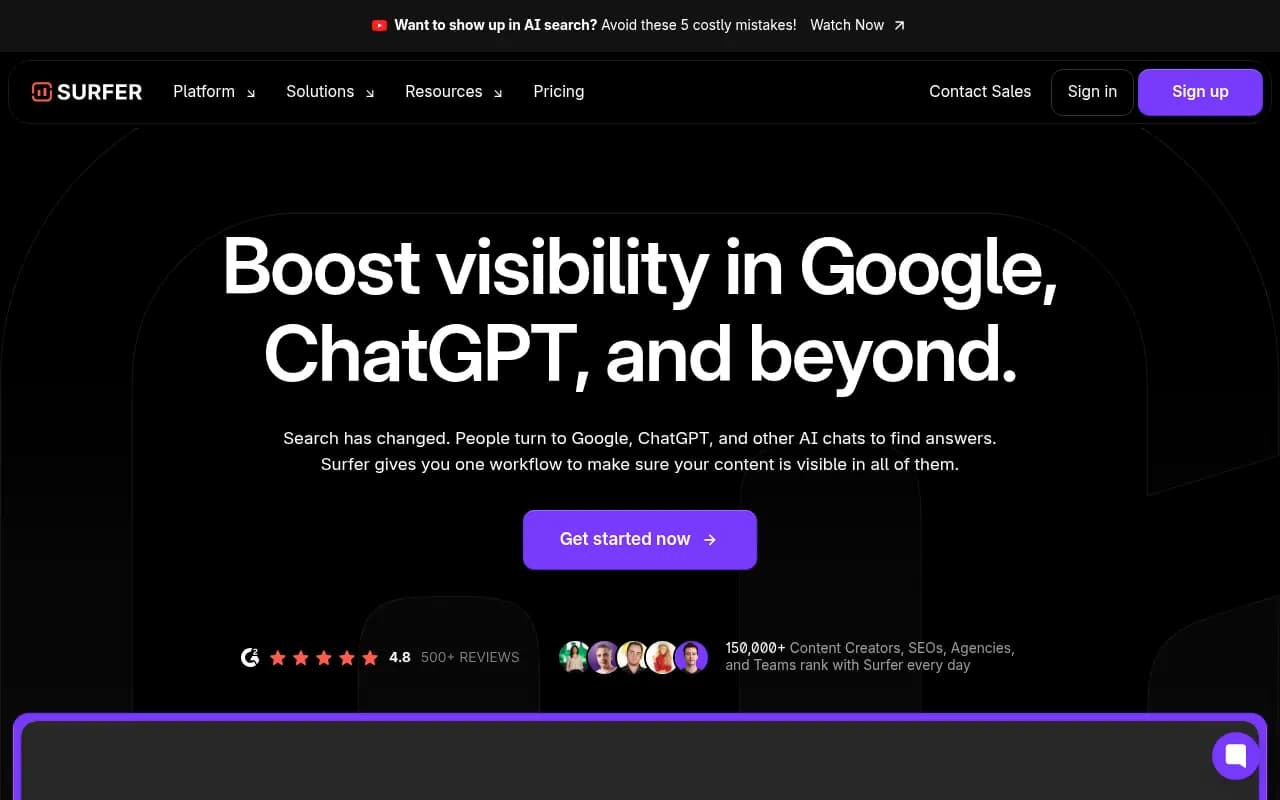
Surfer is one of the most widely used content optimization tools in SEO, and it's been expanding into AI search territory. The core product analyzes top-ranking pages for a given keyword and tells you exactly what your content needs -- word count, semantic terms, headings, questions to answer -- to compete. It's data-driven in a way that CapGo AI's template approach isn't.
The "Surfer AI" feature generates full articles optimized to the platform's content score, which is useful for teams that want to produce content faster without sacrificing optimization quality. The newer AI search features aim to help content rank in ChatGPT and other AI platforms, though this is still maturing compared to dedicated GEO tools.
Compared to CapGo AI, Surfer is better at producing quality-optimized content for specific keywords. CapGo AI is better at raw volume. If you need 5,000 location pages, CapGo AI is faster. If you need 50 well-optimized blog posts that actually compete for specific terms, Surfer is more useful.
The pricing is a meaningful jump from CapGo AI -- Essential starts at $99/mo, and Surfer AI article generation costs additional credits on top of that. There's no free tier, just a 7-day money-back guarantee.
Pricing: Essential $99/mo, Advanced $179/mo, Max $299/mo (billed annually). Surfer AI articles cost extra credits.
Best for: SEO teams and content agencies that want data-driven content optimization for Google rankings, with growing support for AI search visibility.
Semrush
Semrush is the Swiss Army knife of digital marketing -- keyword research, backlink analysis, site audits, competitive intelligence, PPC, social, local SEO, and now an AI Visibility Toolkit. It's used by 10M+ marketers and covers more ground than any other tool on this list.
The AI search features are real but limited compared to specialized GEO platforms. Semrush tracks brand mentions in ChatGPT, Perplexity, and Gemini, but it uses fixed prompt sets rather than letting you define custom prompts around your actual customer queries. There's no AI crawler log analysis, no Reddit/YouTube citation tracking, and no content generation specifically engineered for AI citation.
Compared to CapGo AI, Semrush is a completely different product category. CapGo AI is a content generation tool. Semrush is a research and analytics platform. They're not really competing -- many teams use both. The question is whether Semrush's AI visibility features are deep enough for your GEO needs, or whether you need a dedicated platform.
The pricing is also significantly higher. Starter plans begin at $165/mo, and the plans with meaningful AI visibility features are $290/mo and up. For teams already paying for Semrush's SEO features, the AI toolkit is a reasonable add-on. For teams specifically looking for GEO optimization, it's an expensive way to get limited AI visibility data.
Pricing: From $165/mo (Starter), $290/mo (Pro+), $580/mo (Advanced). 7-day free trial.
Best for: Teams that already use Semrush for traditional SEO and want to add basic AI visibility monitoring without switching platforms. Not ideal as a standalone GEO tool.
Profound
Profound
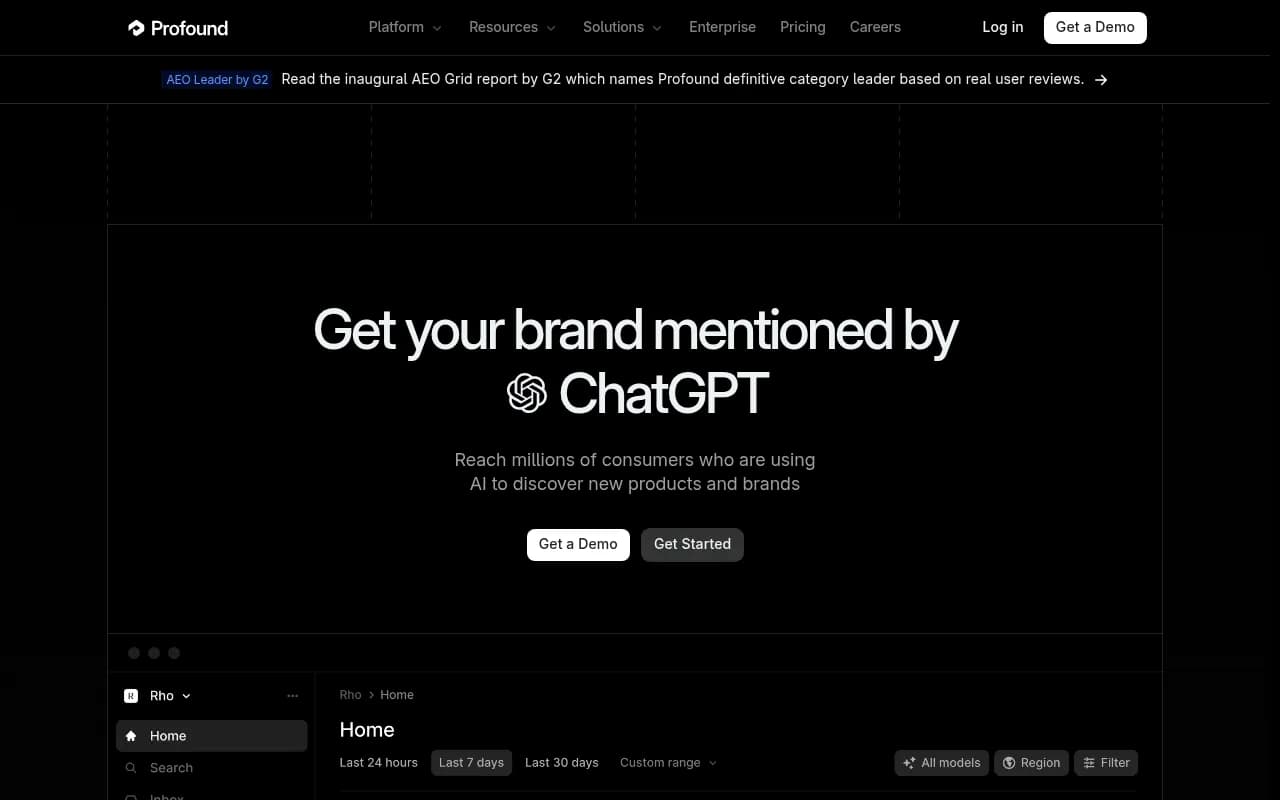
Profound is one of the more serious enterprise AEO platforms available. It tracks brand mentions across 9+ AI engines, shows prompt volume data (what millions of people are actually asking AI), logs AI crawler behavior, and includes content generation agents. Customers include MongoDB, Ramp, and Mercury -- it's clearly aimed at companies with real marketing budgets.
The feature set is genuinely strong. Prompt volume data is particularly useful -- knowing how many people are asking "best CRM for startups" vs. "best CRM for enterprise" in AI search helps you prioritize what content to create. The agent analytics (AI crawler logs) show which pages AI models are reading and how often, similar to what Promptwatch offers.
The main friction with Profound is access. There's no free trial. The Lite tier starts at $499/mo, which is a significant commitment before you've validated whether the platform works for your use case. For a team evaluating GEO tools, that's a real barrier compared to Promptwatch's free trial or Otterly.AI's 14-day no-card trial.
Compared to CapGo AI, Profound is a monitoring and optimization platform, not a content generation tool. They solve different problems. If you're using CapGo AI for volume content and want to understand whether any of it is working in AI search, Profound (or Promptwatch) is what you'd layer on top.
Pricing: Lite from $499/mo (3 seats, 24k responses/mo). Advanced ~$449/mo. Enterprise custom. No free trial.
Best for: Enterprise marketing teams with dedicated AEO budgets that need deep prompt volume data and AI visibility tracking across multiple models.
Otterly.AI
Otterly.AI

Otterly.AI is a focused AI search monitoring tool. It tracks brand mentions and website citations across ChatGPT, Perplexity, Google AI Overviews, Google AI Mode, Gemini, and Copilot. The interface is clean, setup is fast, and the 14-day free trial (no credit card) makes it easy to evaluate.
The honest limitation: Otterly.AI is a monitoring dashboard. It shows you where you stand. It doesn't have crawler logs, doesn't generate content, doesn't provide prompt volume data, and doesn't close the loop between visibility gaps and content creation. The GEO Audit tool analyzes on-page factors, which is useful, but it's still diagnostic rather than prescriptive.
Compared to CapGo AI, Otterly.AI is complementary rather than competitive. CapGo AI generates content; Otterly.AI monitors whether that content is getting cited. Used together, they cover more ground than either does alone -- though you'd still be missing the gap analysis that tells you what to generate.
The pricing is accessible: $29/mo for the Lite plan (15 prompts), $189/mo for Standard (100 prompts). For small teams that just want to know where they stand in AI search without committing to a full GEO platform, Otterly.AI is a reasonable starting point.
Pricing: $29/mo (Lite, 15 prompts), $189/mo (Standard, 100 prompts), custom for Premium. 14-day free trial, no credit card.
Best for: Small marketing teams and solo operators who want basic AI search monitoring at an accessible price point, without needing content generation or deep optimization features.
Frase
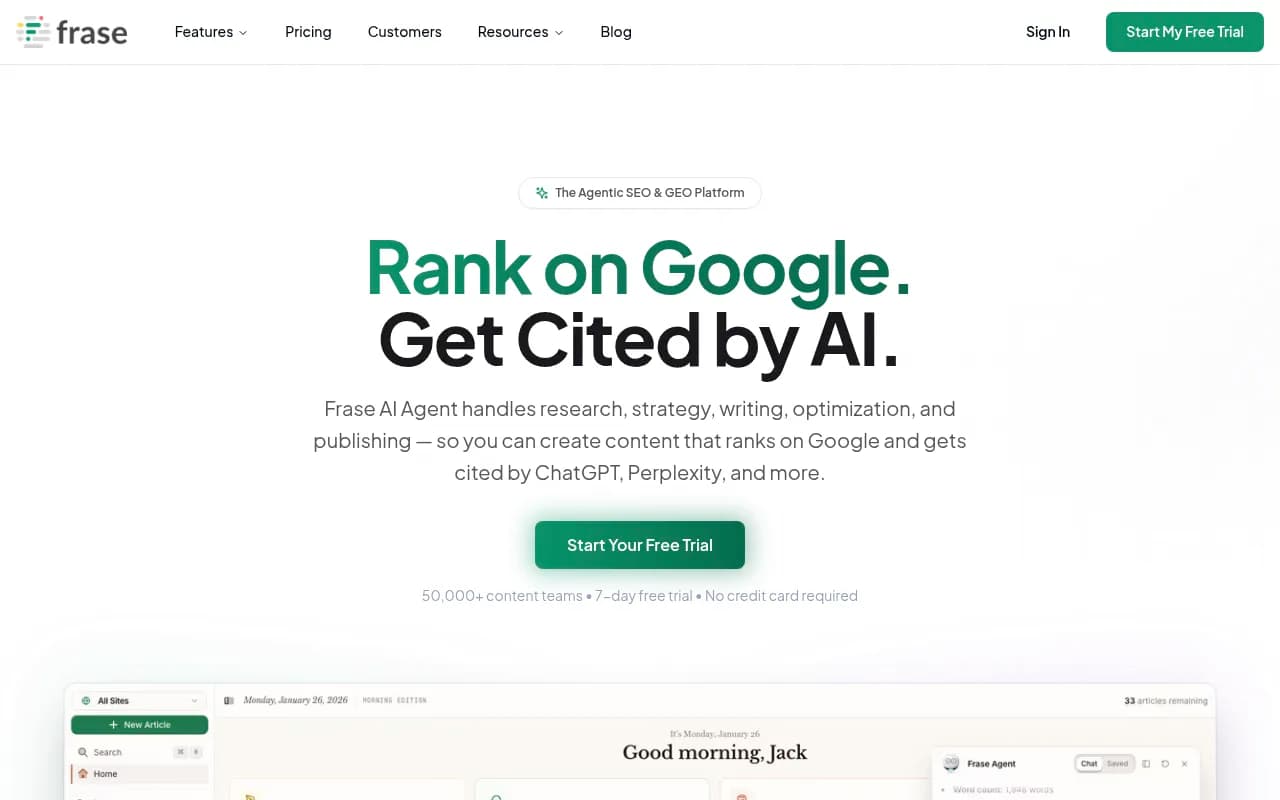
Frase has evolved from a pure SEO content tool into something that explicitly targets both Google rankings and AI citations. The positioning -- "Rank on Google. Get Cited by AI." -- reflects a genuine product shift. The platform researches competitors, identifies content gaps, generates optimized drafts, and now tracks visibility across Google, ChatGPT, and Perplexity.
The "agentic" framing is real: Frase's AI agent can analyze competitors for a given query, identify gaps, generate a brief, and start drafting -- all in one workflow. For content teams that currently juggle Semrush for research, Jasper for writing, and Surfer for optimization, Frase's pitch of consolidating that stack is compelling.
Compared to CapGo AI, Frase is more research-driven and less volume-driven. CapGo AI is better if you need to generate 1,000 pages from a spreadsheet. Frase is better if you need to produce 20 well-researched, well-optimized pieces that have a real shot at ranking in both Google and AI search.
The pricing is reasonable for what you get: $39/mo for Starter, $103/mo for Professional, $239/mo for Scale. The 7-day free trial lets you test the workflow before committing.
Pricing: 7-day free trial, then $39/mo (Starter), $103/mo (Professional), $239/mo (Scale).
Best for: Content and SEO teams that want a unified research-to-optimization workflow covering both traditional search and AI citation, without the complexity of enterprise platforms.
MarketMuse
MarketMuse focuses on topical authority -- the idea that ranking well (in Google or AI search) requires owning a topic comprehensively, not just optimizing individual pages. Its AI analyzes your entire content inventory, identifies topic clusters where you have existing authority, finds gaps competitors have missed, and scores topics by how easy they are for you specifically to rank for (personalized difficulty, not generic keyword difficulty).
This is genuinely different from CapGo AI's approach. CapGo AI generates pages at scale from templates. MarketMuse tells you which topics are worth creating pages for in the first place, based on your existing authority and competitive landscape. The two tools could work together -- use MarketMuse to identify the right topics, use CapGo AI to generate the pages -- but they're solving different problems.
The free plan exists but is limited. Paid plans start around $149/mo for Standard, with Premium/Enterprise plans running $2,000-5,000+/mo for larger content operations. That upper tier is significant, but the Standard plan is accessible for mid-market teams.
Compared to Surfer SEO, MarketMuse is more strategic (topic planning, authority mapping) and less tactical (real-time content scoring). Many teams use both.
Pricing: Free plan available. Standard from ~$149/mo. Premium/Enterprise from $2,000+/mo.
Best for: Content teams that want to build genuine topical authority rather than just optimize individual pages. Good for teams with large existing content inventories that need strategic direction.
Clearscope

Clearscope is the content optimization tool that content teams tend to love for its simplicity. You enter a keyword, it shows you a content grade based on semantic relevance, and you write (or optimize) until you hit the target. It's not flashy, but it works, and the interface is clean enough that writers actually use it without complaining.
The platform has expanded into AI search territory -- it now tracks visibility across Google and AI chatbots like ChatGPT and Gemini, and positions itself as a "discoverability platform for a new era in search." The topic exploration and search intent features add strategic depth beyond pure content grading.
Compared to CapGo AI, Clearscope is about quality optimization rather than volume generation. It doesn't do programmatic page creation. What it does is help individual pieces of content perform better -- which is the opposite end of the content production spectrum.
The pricing is on the higher side for what's essentially a content grading tool: $189/mo for Essentials, with Business and Enterprise plans at custom pricing. No free trial, though demos are available. Month-to-month billing is a plus.
Pricing: From $189/mo (Essentials). Business/Enterprise custom. No free trial, demos available.
Best for: Content teams that prioritize writing quality and semantic optimization, and want a tool writers will actually use without friction. Less suited for teams focused on programmatic scale or deep GEO strategy.
Which one should you pick?
The right choice depends on what you're actually trying to solve.
If you're using CapGo AI primarily for programmatic content volume and want to keep doing that but add quality controls, Frase or Surfer SEO are the most natural upgrades. They bring research and optimization into the content production process without requiring a complete workflow change.
If you want to understand whether your content is actually appearing in AI search results -- and what to do about the gaps -- Promptwatch is the most complete option. It's the only platform that closes the loop from gap identification to content creation to visibility tracking, and it's accessible enough (free trial, $99/mo entry) to evaluate without a major commitment.
If you're at an enterprise scale and need deep prompt volume data, SOC 2 compliance, and dedicated AEO infrastructure, Profound is worth the conversation -- just be prepared for the $499/mo+ price tag with no trial.
If you already pay for Semrush and just want to add AI visibility monitoring to your existing workflow, the AI Visibility Toolkit is a reasonable add-on. But if AI search is a primary focus, a dedicated platform will give you more depth.
For brand governance and multi-channel campaigns at scale, Jasper is the enterprise choice. For topical authority strategy, MarketMuse. For clean content grading that writers actually use, Clearscope. For entry-level AI monitoring without a big budget commitment, Otterly.AI.
None of these tools are CapGo AI replacements in the strict sense -- they're all doing something meaningfully different. The question is which problem you're actually trying to solve.