Key Takeaways
- Promptwatch is the best choice if you need AI search visibility tracking alongside technical SEO—it's the only platform that combines crawler logs, content gap analysis, and AI-powered content generation to help you rank in ChatGPT, Claude, and Perplexity
- Screaming Frog offers the most affordable option for technical audits if you're working with smaller sites (free up to 500 URLs, $259/year unlimited)
- Sitebulb delivers the clearest audit reports with visual prioritization—ideal for agencies that need client-friendly deliverables
- Botify and Lumar are enterprise-grade platforms for massive sites (10M+ pages) but come with enterprise pricing to match
- Semrush and Ahrefs bundle technical SEO with broader marketing tools, but their crawlers lack the depth of specialized platforms
JetOctopus built its reputation on handling enterprise-scale crawls (10K to 100M+ pages) with JavaScript rendering and deep log file analysis. But it's not the only option. Some teams need better AI search tracking. Others want clearer reporting or lower pricing. A few need desktop tools instead of cloud platforms.
Here's what actually competes.
Promptwatch

Promptwatch is the top choice if your SEO strategy extends beyond traditional search engines into AI search. While JetOctopus focuses on crawl budget and indexation, Promptwatch shows you how ChatGPT, Claude, Perplexity, Gemini, and other AI models actually cite your brand—then helps you fix the gaps.
The difference: most technical SEO tools stop at showing you what's broken. Promptwatch's Answer Gap Analysis tells you exactly which prompts competitors rank for but you don't, then its AI writing agent generates content engineered to get cited by AI models. You're not just monitoring—you're optimizing for a new traffic channel.
It tracks AI crawler logs (which pages ChatGPT and Claude are reading, how often, what errors they hit), monitors 880M+ citations to understand what content AI models prefer, and surfaces Reddit threads and YouTube videos that influence AI recommendations. The platform covers 10 AI models including ChatGPT Shopping tracking.
For technical SEO teams already using JetOctopus or similar tools, Promptwatch fills the AI visibility gap. For teams starting fresh, it's the only platform that combines traditional crawler monitoring with AI search optimization in one workflow.
Pricing starts at $99/mo (Essential: 1 site, 50 prompts, 5 AI-generated articles), $249/mo (Professional: 2 sites, 150 prompts, crawler logs), $579/mo (Business: 5 sites, 350 prompts). Free trial available.
Best for: Brands that want to rank in AI search engines, not just Google. Marketing teams tired of monitoring-only dashboards that don't help you take action.
Semrush
Semrush bundles a technical SEO crawler with keyword research, backlink analysis, PPC tools, content workflows, and basic AI search tracking. It's a Swiss Army knife—useful if you need multiple marketing tools under one login, but the crawler itself is less powerful than specialized platforms.
The Site Audit tool handles JavaScript rendering and covers common technical issues (broken links, redirect chains, duplicate content, crawl depth). It integrates with Google Search Console and Analytics. The new AI Visibility module tracks brand mentions in ChatGPT, Perplexity, and Gemini, though it uses fixed prompts rather than custom tracking.
Where it falls short: crawl limits hit fast on large sites (100K URLs on the $290/mo plan, 500K on $580/mo). No log file analysis. The AI search features are basic compared to dedicated GEO platforms—you see mentions but don't get content gap analysis or optimization recommendations.
Semrush makes sense if you're building a full marketing stack and want one platform for SEO, PPC, content, and social. If you only need technical SEO depth or serious AI search tracking, specialized tools do it better.
Pricing: $165/mo (Starter, very limited), $290/mo (Pro+), $580/mo (Advanced). Enterprise custom. 7-day free trial.
Best for: Marketing teams that need an all-in-one platform and can live with good-enough technical SEO instead of best-in-class crawling.
Ahrefs
Ahrefs built its reputation on backlink analysis and keyword research, then added a technical SEO crawler (Site Audit) and AI search tracking (Brand Radar). Like Semrush, it's a broad platform trying to cover everything—and the technical SEO piece is solid but not specialized.
Site Audit crawls up to 500K URLs (Advanced plan), checks 140+ technical issues, and integrates with Google Search Console. The interface is clean. Reports are easy to share. Brand Radar tracks mentions in AI responses, but uses fixed prompts and lacks traffic attribution or content optimization features.
The trade-off: Ahrefs excels at competitive backlink research and keyword discovery. If that's your primary need and you want technical SEO as a bonus feature, it works. But if technical depth or AI search optimization is the priority, you'll hit limits fast. No log file analysis. No custom AI prompt tracking. Crawl speed is slower than dedicated crawlers.
Pricing: $83/mo (Lite, limited), $166/mo (Standard), $333/mo (Advanced). Enterprise custom. Annual billing saves 20%. Free trial available.
Best for: SEO teams that prioritize backlink analysis and keyword research, and want basic technical auditing without paying for a separate crawler.
Screaming Frog
Screaming Frog is the desktop workhorse that's been around since 2010. It's fast, reliable, and cheap—free up to 500 URLs, $259/year for unlimited crawling. If you need a technical audit tool and don't want to pay monthly SaaS fees, this is it.
The crawler handles JavaScript rendering, extracts structured data, checks response codes, analyzes page speed, and integrates with Google Analytics and Search Console. You can schedule crawls, export data to CSV, and build custom extractions. It runs locally on your machine, so crawl speed depends on your hardware and connection.
Limitations: it's a desktop app, not a cloud platform. No log file analysis. No ongoing monitoring or alerts. No AI search tracking. Reports are functional but not client-friendly—you'll need to export data and build your own visualizations. For agencies, that means extra work.
But for technical SEO audits on a budget, nothing beats the price-to-power ratio. Many enterprise teams use Screaming Frog for ad-hoc deep dives even when they have JetOctopus or Sitebulb for ongoing monitoring.
Pricing: Free up to 500 URLs, $259/year unlimited.
Best for: Freelancers, small agencies, and in-house SEO teams that need powerful crawling without monthly fees. Anyone doing one-off technical audits.
Sitebulb

Sitebulb takes technical SEO audits and makes them understandable. It's the tool you use when you need to explain complex issues to clients, stakeholders, or developers who don't live in SEO every day.
The platform automatically checks 300+ issues, prioritizes them by impact, and delivers visual reports that actually make sense. Hints explain what each issue means and why it matters. You can generate PDF reports that look professional without spending hours in design tools. Both desktop and cloud versions available.
It crawls up to 10 million URLs (cloud), handles JavaScript, integrates with Google Analytics and Search Console, and includes accessibility audits. The interface is intuitive. The prioritization system helps you focus on what matters instead of drowning in data.
What it doesn't do: log file analysis (though it's on the roadmap). No AI search tracking. Not built for real-time monitoring—it's an audit tool, not a continuous platform.
Pricing: Desktop from $35/mo (Lite, 5K URLs) to $135/mo (Agency, 500K URLs). Cloud from $125/mo (Mini) to $495/mo (Medium) + Enterprise custom. 14-day free trial.
Best for: Agencies that need client-ready audit reports. SEO teams that want clear prioritization instead of raw data dumps.
Botify
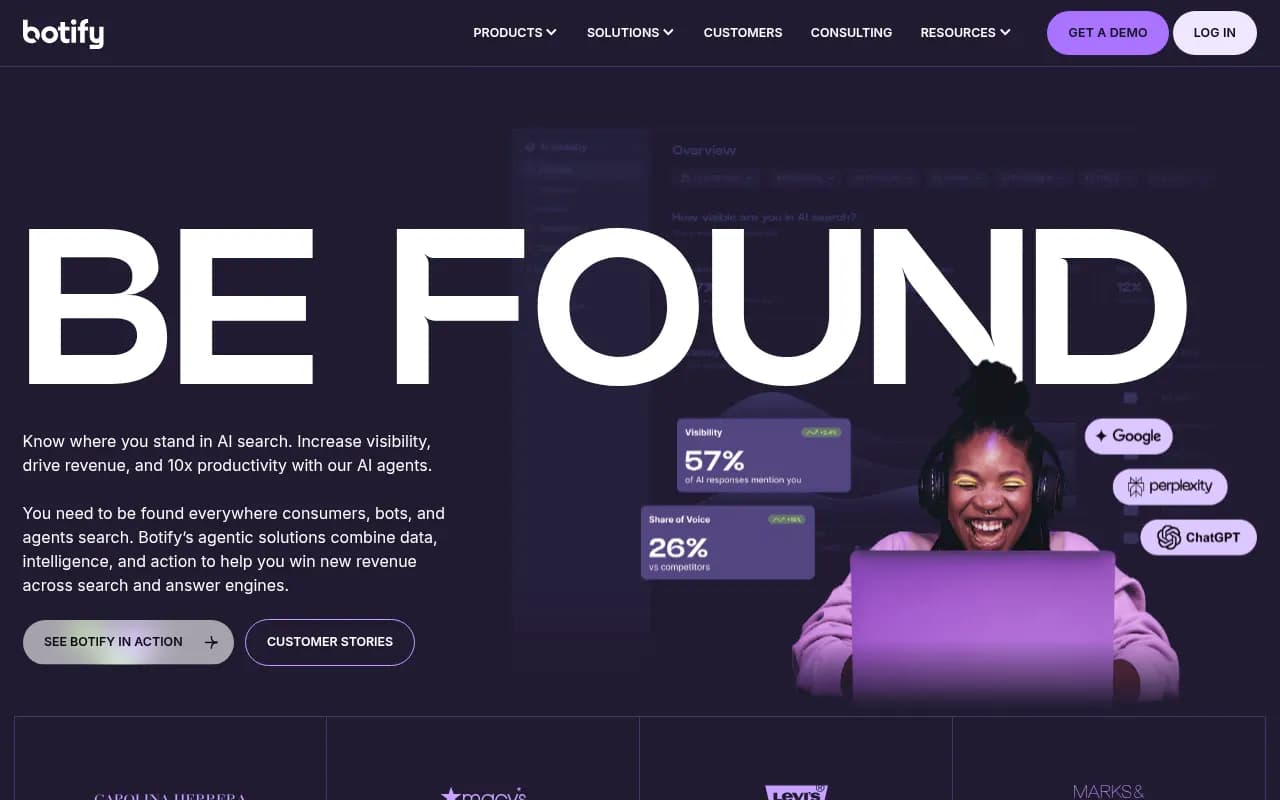
Botify is the enterprise platform for brands with massive, complex sites—think e-commerce with millions of product pages, job boards, classifieds, media sites. It combines technical SEO, AI search optimization (GEO/AEO), and agentic workflows that automate repetitive tasks.
The platform crawls at scale, analyzes log files to understand how search engines and AI bots explore your site, and uses AI agents to generate dev tickets, content recommendations, and optimization suggestions. It tracks visibility in ChatGPT, Perplexity, Google AI Overviews, and other AI answer engines.
Botify's strength is automation. Instead of manually analyzing crawl data and writing tickets, the platform does it for you. For enterprise teams managing multiple large sites, that saves serious time.
The catch: pricing. Expect $10K-$50K+/month depending on site size and features. Annual contracts are standard. This is not a tool you trial casually—it's a strategic investment for companies where organic search drives millions in revenue.
Pricing: Custom enterprise (request demo for quote).
Best for: Enterprise brands with 1M+ pages, dedicated SEO teams, and budgets to match. Companies that need AI search optimization alongside technical SEO.
OnCrawl
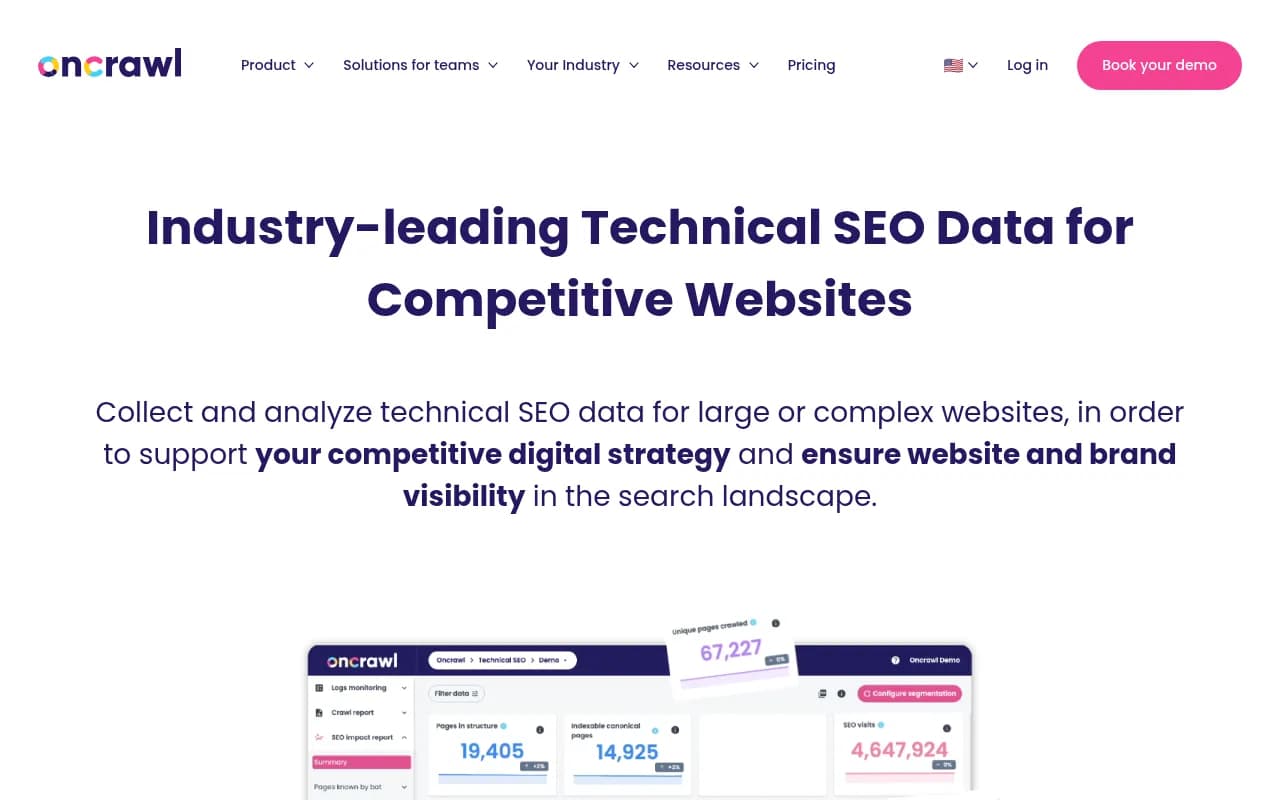
OnCrawl targets the same enterprise market as JetOctopus—large, complex sites that need deep technical analysis and log file monitoring. Used by L'Oréal, Ticketmaster, and Harrods, it combines crawling with AI bot detection and custom segmentation.
The platform's strength is cross-analysis: blend crawl data with log files, Google Search Console, and Google Analytics to understand relationships between technical issues and business metrics. The segmentation system lets you group pages by template, category, or custom rules to spot patterns.
New in 2026: AI bot monitoring tracks hits from OpenAI, Claude, Mistral, Perplexity, and other LLMs. Oncrawl Lenses provide focused views into specific SEO challenges. Content Lens uses AI to evaluate content quality and suggest improvements.
It's powerful but complex. Expect a learning curve. The interface prioritizes depth over simplicity—this is a tool for technical SEO specialists, not generalists.
Pricing: From $69/mo (100K URLs, 1 project). Mid-tier and enterprise plans with custom pricing.
Best for: Enterprise SEO teams that need deep technical analysis and log file insights. Brands with complex site architectures.
Lumar (formerly Deepcrawl)
Lumar rebranded from Deepcrawl in 2024 and expanded beyond technical SEO into a full website optimization platform. It now covers technical SEO, AI search visibility (GEO/AEO), site speed monitoring, web accessibility testing, and custom analytics.
The technical SEO crawler handles millions of URLs, includes AI-powered dev ticket generation, and offers hundreds of built-in reports plus custom extractions. The GEO toolkit tracks brand mentions and sentiment across major AI platforms, analyzes content for AI optimization, and provides instant suggestions.
Lumar's custom analytics capabilities let you build reports on practically any website data—useful for teams with unique KPIs or complex reporting needs. The platform integrates with Google Search Console, Analytics, and other data sources.
Like Botify, this is enterprise software with enterprise pricing. It's built for scale and teams that need multiple optimization capabilities in one platform.
Pricing: Custom enterprise (request demo for quote).
Best for: Enterprise teams that want technical SEO, AI search tracking, performance monitoring, and accessibility testing in one platform.
Ryte
Ryte (acquired by Semrush in 2024) focuses on website user experience alongside technical SEO. It monitors technical issues, performance, accessibility, and compliance—useful for teams that need to balance SEO with legal requirements (GDPR, WCAG) and conversion optimization.
The platform offers automated site audits, real-time monitoring, and actionable recommendations across 100K+ URLs (Business plan). It checks technical SEO, page speed, mobile usability, and accessibility issues. The WUX Score provides a single metric for overall site health.
Ryte's strength is ongoing monitoring rather than one-off audits. It alerts you when issues appear and tracks changes over time. The interface is clean and the recommendations are practical.
What it lacks: log file analysis. No AI search tracking (though that may change post-Semrush acquisition). Crawl limits are lower than specialized enterprise platforms.
Pricing: From $100/mo (Basic: 50K URLs) to $400/mo (Business: 100K URLs). Enterprise custom. No free tier.
Best for: Marketing teams that need technical SEO monitoring plus accessibility and compliance checks. Brands in regulated industries.
How to choose
Start with what you actually need:
If AI search visibility matters (and it should—AI bot traffic grew 5.6x in 2025), you need a platform that tracks and optimizes for it. Promptwatch is the only specialized GEO platform in this list. Botify and Lumar include AI features but at enterprise price points. Semrush and Ahrefs have basic AI tracking bolted on.
If you're crawling massive sites (1M+ pages), JetOctopus, Botify, Lumar, and OnCrawl are built for that scale. Screaming Frog and Sitebulb work but hit practical limits. Semrush and Ahrefs cap out faster.
If budget is tight, Screaming Frog wins on price ($259/year vs $1000+/year for everything else). The free version handles most small site audits.
If you need client-ready reports, Sitebulb makes audits understandable without extra design work. Screaming Frog requires manual report building.
If you want one platform for everything, Semrush or Ahrefs bundle technical SEO with keyword research, backlinks, content, and PPC. You sacrifice crawling depth for breadth.
If log file analysis is critical, JetOctopus, OnCrawl, Botify, and Lumar all include it. Screaming Frog, Sitebulb, Semrush, and Ahrefs don't.
Most technical SEO teams end up using multiple tools—Screaming Frog for deep dives, a cloud platform for ongoing monitoring, and increasingly a GEO platform like Promptwatch to track AI search visibility. The question isn't which tool replaces JetOctopus entirely, but which combination covers your actual workflow.