Key Takeaways
- Promptwatch is the most comprehensive alternative with content gap analysis, AI writing tools, and crawler logs -- it's the only platform that helps you fix visibility gaps, not just track them
- LLMrefs simplifies tracking by focusing on keywords instead of prompts, with automated prompt generation and flat-rate pricing at $79/mo for unlimited projects
- PromptReach offers free AI-optimized business listings for local businesses and service providers who want basic discoverability without monitoring dashboards
- Promptmonitor and PromptRank are solid monitoring alternatives with competitor benchmarking and source analysis, but lack content optimization features
- ClickRank AI is better suited for traditional SEO automation rather than AI search visibility tracking
LLM Pulse has gained traction as an AI search visibility tracker, but it's not the only option -- and depending on your needs, it might not be the best one. The platform monitors brand mentions across ChatGPT, Perplexity, Gemini, and other LLMs, but stops at tracking and basic recommendations. If you need deeper optimization tools, content generation, or a different pricing model, several alternatives offer compelling features LLM Pulse doesn't.
The biggest reason teams look for alternatives: LLM Pulse is monitoring-focused. You see what AI models say about you, but you're left to figure out the fixes yourself. For brands that want actionable content recommendations, gap analysis, or tools to actually improve their visibility, platforms like Promptwatch offer a complete optimization loop. Others, like LLMrefs, simplify the workflow by tracking keywords instead of individual prompts. And for local businesses, PromptReach provides free listings without the dashboard complexity.
Here's an honest comparison of the top LLM Pulse alternatives in 2026, what they do differently, and who should pick each one.
Promptwatch

Promptwatch is the most complete alternative to LLM Pulse because it doesn't stop at monitoring -- it helps you fix visibility gaps with content generation, gap analysis, and crawler logs. While LLM Pulse shows you what AI models say about your brand, Promptwatch shows you what's missing and gives you tools to create content that gets cited.
What makes it different: The platform is built around an action loop. Answer Gap Analysis identifies prompts where competitors are visible but you're not, showing exactly which topics and questions your website is missing. The built-in AI writing agent then generates articles, listicles, and comparisons grounded in 880M+ citations analyzed, prompt volumes, and competitor data. This isn't generic SEO content -- it's engineered to get cited by ChatGPT, Claude, Perplexity, and other AI models. Once published, page-level tracking shows which pages are being cited, how often, and by which models. You can close the loop with traffic attribution via code snippet, GSC integration, or server log analysis.
Most competitors (including LLM Pulse) stop at step one: showing you the data. Promptwatch is the only platform rated as a "Leader" across all categories in a 2026 comparison of 12 GEO platforms because it combines monitoring with optimization.
Additional capabilities LLM Pulse lacks:
- AI Crawler Logs: Real-time logs of ChatGPT, Claude, Perplexity, and other AI crawlers hitting your website -- which pages they read, errors they encounter, how often they return. Most competitors don't offer this at all.
- Prompt Intelligence: Volume estimates, difficulty scores, and query fan-outs that show how one prompt branches into sub-queries. Prioritize high-value, winnable prompts instead of guessing.
- Reddit & YouTube Insights: Surface discussions that directly influence AI recommendations -- a channel most competitors ignore entirely.
- ChatGPT Shopping Tracking: Monitor when your brand appears in ChatGPT's product recommendations and shopping carousels.
- Multi-language & Multi-region: Monitor AI responses in any language, from any country, with customizable personas that match how your actual customers prompt.
Pricing comparison: Promptwatch starts at $99/mo (Essential: 1 site, 50 prompts, 5 articles), $249/mo (Professional: 2 sites, 150 prompts, 15 articles, crawler logs, state/city tracking), and $579/mo (Business: 5 sites, 350 prompts, 30 articles). LLM Pulse starts at €49/mo but lacks content generation and crawler logs entirely. For teams that want to optimize, not just monitor, Promptwatch's higher price point includes tools that actually move the needle.
Best for: Marketing and SEO teams that want to improve AI visibility, not just track it. If you need content gap analysis, AI-generated articles, and crawler logs, Promptwatch is the only platform that delivers all three. Agencies managing multiple clients will appreciate the multi-site support and white-label reporting.
LLMrefs
LLMrefs
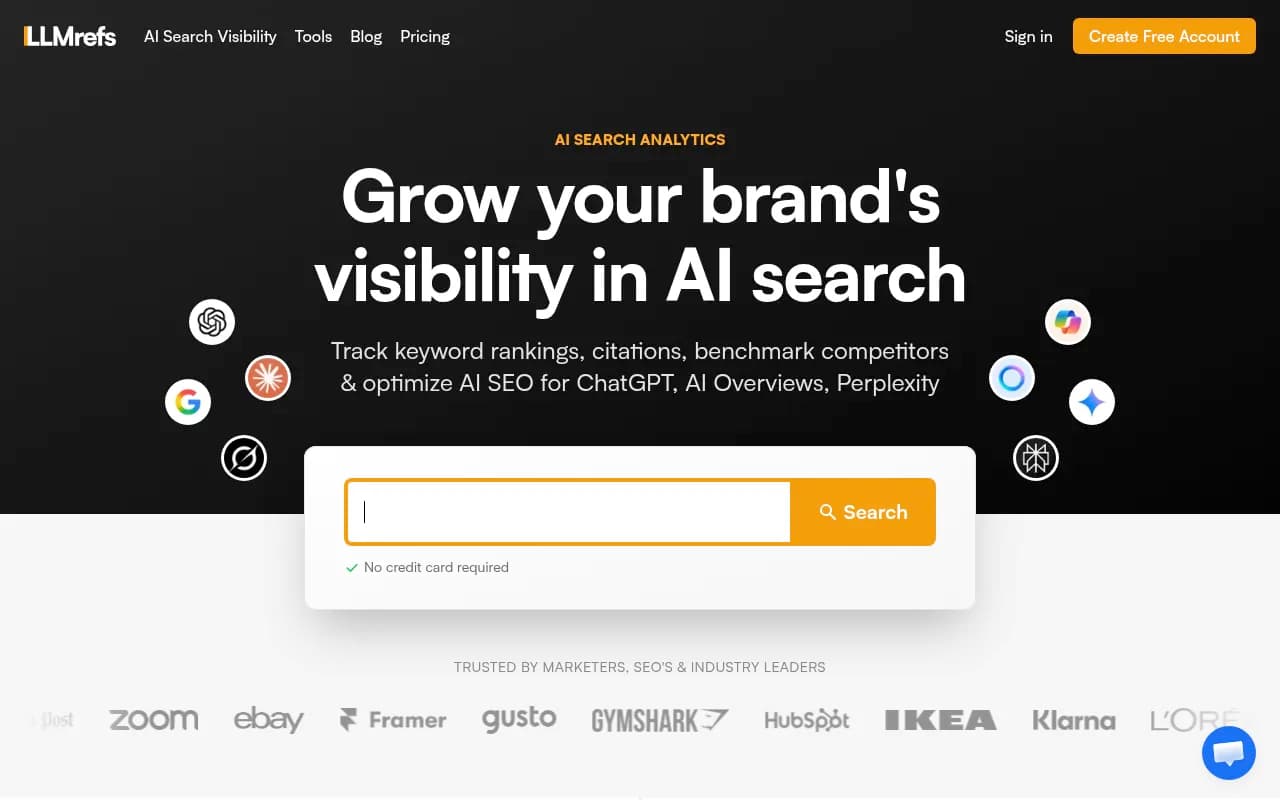
LLMrefs takes a different approach from LLM Pulse by focusing on keywords instead of individual prompts. You enter a keyword like "best running shoes" and LLMrefs automatically generates relevant prompts, tracks rankings, and monitors citations across 11 AI engines including ChatGPT, Google AI Overviews, Perplexity, Claude, and Gemini.
What makes it different: Most AI visibility tools (including LLM Pulse) require you to manually define every prompt you want to track. LLMrefs simplifies this by generating prompts automatically based on keywords, then tracking how your brand ranks across those prompts. This is closer to how traditional SEO tools work, which makes it easier for SEO teams to adopt. The platform also offers flat-rate pricing: $79/mo for 500 prompts with unlimited projects, domains, and team seats. LLM Pulse charges per site and limits prompts by tier, which gets expensive if you're tracking multiple brands.
Key features:
- Keyword-based tracking with automated prompt generation
- Rankings and citation tracking across 11 AI engines
- Competitor benchmarking and source citation analysis
- 50+ country support for localized tracking
- Unlimited projects and team seats at $79/mo
Trade-offs: LLMrefs is a monitoring platform, not an optimization platform. It doesn't offer content generation, gap analysis, or crawler logs like Promptwatch. You see where you rank and which sources AI models cite, but you're on your own to create content that improves visibility. For teams that just need tracking without the optimization layer, LLMrefs is a solid choice at a lower price point.
Pricing comparison: $79/mo for 500 prompts vs LLM Pulse's €49/mo (Starter), €99/mo (Growth), or €299/mo (Scale). LLMrefs includes unlimited projects and team seats, which makes it more cost-effective for agencies or teams managing multiple brands. LLM Pulse limits sites and prompts by tier.
Best for: SEO teams and agencies that want keyword-based tracking instead of prompt-by-prompt management. If you're used to traditional SEO workflows and want a simpler way to track AI visibility across multiple brands, LLMrefs is easier to scale than LLM Pulse. Not ideal if you need content optimization tools.
PromptReach
PromptReach is a completely different approach: instead of a monitoring dashboard, it offers free AI-optimized business listings that get indexed and cited by ChatGPT, Claude, and Gemini. This is ideal for local businesses and service providers who want basic discoverability without paying for tracking tools.
What makes it different: You create a free listing with your business details, services, and location, structured with schema markup that AI models can easily parse. When users ask AI assistants for recommendations ("best plumber in Austin"), your listing increases the chances of being cited. This isn't a monitoring platform -- you don't get dashboards, visibility scores, or citation tracking. It's a one-time setup to improve discoverability.
Key features:
- Free AI-optimized business listings with schema markup
- Indexed by ChatGPT, Claude, Gemini, and Perplexity
- One-time paid upgrades available ($20-$99 for enhanced features)
- Free SEO consultation included
Trade-offs: PromptReach doesn't track how often you're cited, monitor competitors, or provide analytics. If you need visibility metrics, this isn't the right tool. But for small businesses that just want to be discoverable in AI search without monthly fees, it's a low-cost entry point. LLM Pulse charges €49/mo minimum; PromptReach is free.
Pricing comparison: Free tier with optional one-time upgrades ($20-$99) vs LLM Pulse's €49/mo recurring. PromptReach is better for businesses that want basic discoverability without ongoing costs. LLM Pulse is better if you need tracking and analytics.
Best for: Local businesses, service providers, and small companies that want to be discoverable in AI search without paying for monitoring dashboards. If you're a plumber, dentist, or consultant who just wants to show up when people ask AI for recommendations, PromptReach is the simplest option. Not suitable for brands that need competitive analysis or visibility metrics.
Promptmonitor
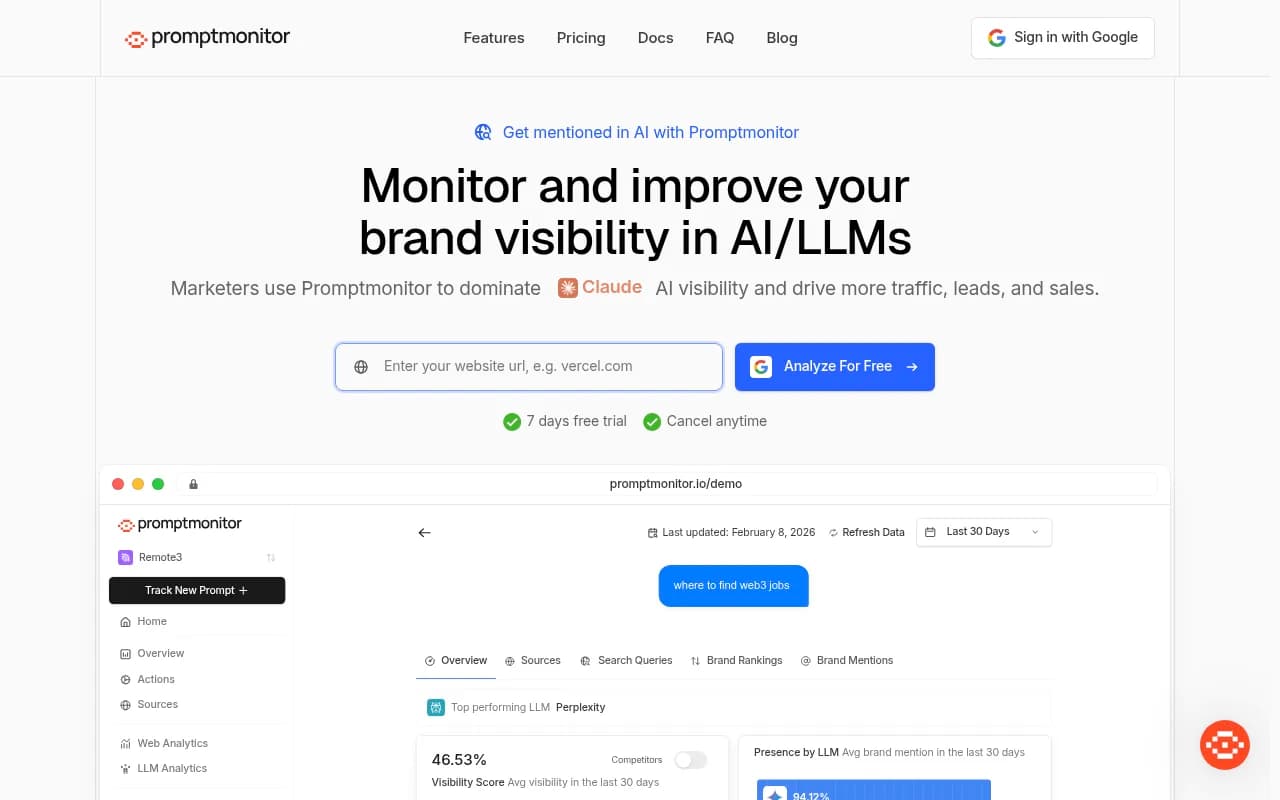
Promptmonitor is a direct competitor to LLM Pulse with similar features: prompt tracking, citation analysis, competitor benchmarking, and source tracking across ChatGPT, Claude, Perplexity, and Gemini. The platform also includes web analytics and LLM analytics to connect AI visibility to actual traffic.
What makes it different: Promptmonitor offers web analytics integration that shows how AI-driven traffic converts on your website. LLM Pulse tracks citations and sentiment but doesn't connect visibility to revenue. Promptmonitor's analytics layer helps you understand which AI citations actually drive traffic and conversions, which is valuable for justifying GEO investments to stakeholders.
Key features:
- Prompt tracking across ChatGPT, Claude, Perplexity, Gemini
- Citation and source analysis
- Competitor benchmarking
- Web analytics integration for traffic attribution
- LLM analytics for model-specific insights
Trade-offs: Like LLM Pulse, Promptmonitor is monitoring-focused. It doesn't offer content generation, gap analysis, or crawler logs. You see the data but have to figure out optimization yourself. The web analytics integration is a nice addition, but it's not a substitute for content optimization tools.
Pricing comparison: Pricing not publicly available (likely custom quotes). LLM Pulse starts at €49/mo with transparent tiered pricing. Promptmonitor's lack of public pricing suggests it may be positioned at a higher price point or targets enterprise customers.
Best for: Teams that want web analytics integration to connect AI visibility to revenue. If you need to prove ROI from GEO efforts with traffic attribution, Promptmonitor offers this capability. Not ideal if you need content optimization or want transparent pricing.
PromptRank
PromptRank is another AI visibility monitoring platform that tracks brand mentions across ChatGPT, Gemini, Perplexity, DeepSeek, and other AI search engines. It offers competitor benchmarking, source analysis, and custom prompt tracking, with a focus on marketers and SEO teams.
What makes it different: PromptRank emphasizes actionable insights and recommendations. While it doesn't generate content like Promptwatch, it provides optimization suggestions based on visibility data -- what to do next to improve rankings. This is a step beyond pure monitoring but still requires you to create content yourself.
Key features:
- AI mention tracking across ChatGPT, Gemini, Perplexity, DeepSeek
- Competitor benchmarking side-by-side
- Source analysis to identify influential sources
- Custom prompt monitoring for testing positioning
- Actionable recommendations for optimization
- Real-time alerts when visibility shifts
Trade-offs: PromptRank is in early access with pricing based on prompt volume and AI models tracked (specific tiers not publicly available). This makes it hard to compare directly to LLM Pulse's transparent pricing. The platform also lacks content generation and crawler logs, so you're still doing optimization manually.
Pricing comparison: Early access pricing not publicly available vs LLM Pulse's €49/mo (Starter), €99/mo (Growth), €299/mo (Scale). Without transparent pricing, it's difficult to assess value. LLM Pulse's clear tiered pricing is easier to budget for.
Best for: Marketers and SEO teams that want competitor benchmarking and optimization recommendations without the complexity of full content generation tools. If you're comfortable creating content yourself but need guidance on what to optimize, PromptRank's recommendations are helpful. Not ideal if you want transparent pricing or need content generation.
ClickRank AI
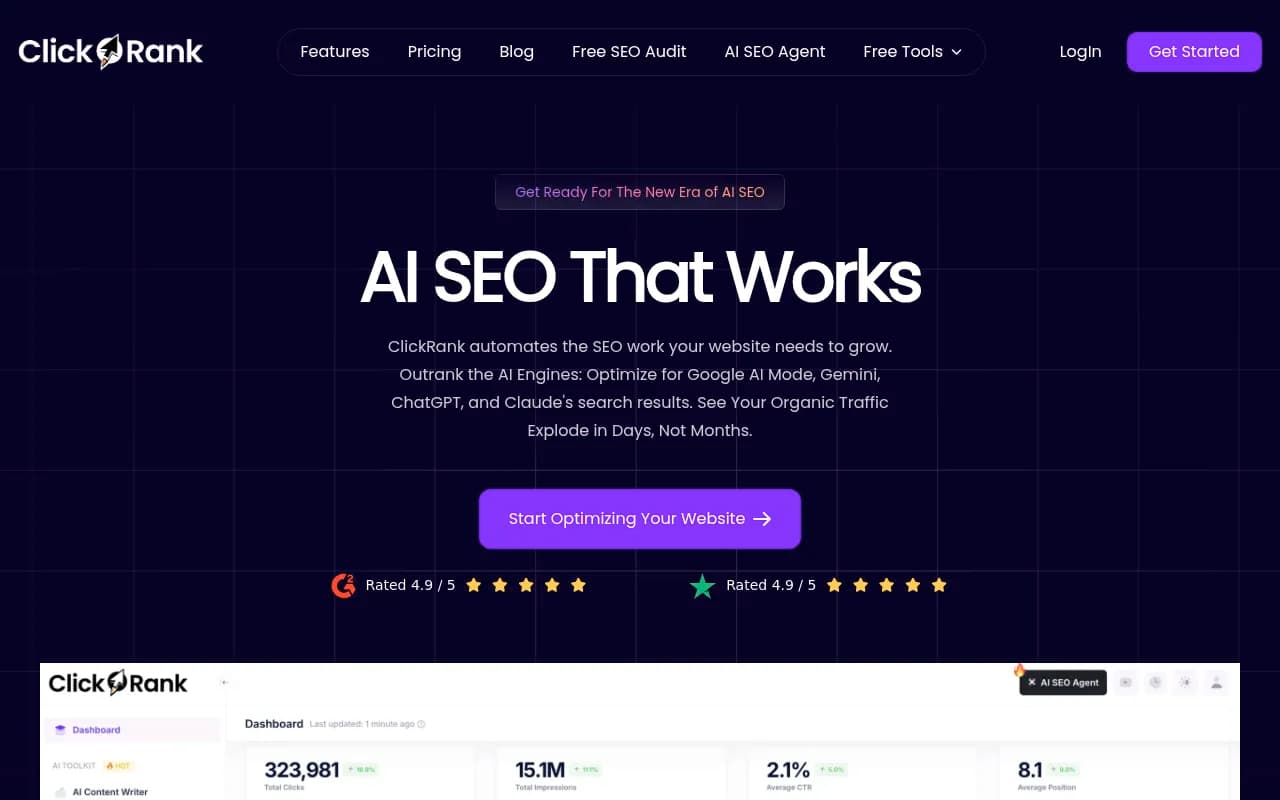
ClickRank AI is positioned as an "AI SEO automation tool" but it's primarily focused on traditional SEO optimization, not AI search visibility tracking. The platform automates on-page SEO suggestions, content gap analysis, and technical optimization for Google Search -- with some recent additions for Google AI Mode, Gemini, ChatGPT, and Claude.
What makes it different: ClickRank AI is a traditional SEO platform first, AI search tool second. If you need automated SEO recommendations for Google rankings, it's a solid choice. But if your primary goal is tracking brand mentions in ChatGPT and Perplexity, it's not built for that. The AI search features feel like add-ons rather than core capabilities.
Key features:
- Automated SEO optimization suggestions
- On-page optimization and content gap analysis
- Technical SEO recommendations
- Some support for Google AI Mode, Gemini, ChatGPT, Claude
- Traffic growth focused on traditional search
Trade-offs: ClickRank AI doesn't track prompt-level visibility, citation rates, or competitor benchmarking in AI search. It's designed to improve Google rankings, not monitor how ChatGPT describes your brand. If you're looking for an LLM Pulse alternative, ClickRank AI isn't a direct replacement -- it solves a different problem.
Pricing comparison: $59/mo to $399/mo vs LLM Pulse's €49/mo to €299/mo. ClickRank AI's pricing is comparable, but you're paying for traditional SEO automation, not AI search visibility tracking. LLM Pulse is purpose-built for AI search; ClickRank AI is a traditional SEO tool with limited AI search features.
Best for: Teams that need traditional SEO automation and want some basic AI search optimization as a bonus. If your primary goal is improving Google rankings and you want light AI search support, ClickRank AI works. Not suitable if you need detailed AI visibility tracking, citation analysis, or competitor benchmarking in LLMs.
Summary: Which LLM Pulse Alternative Should You Choose?
Choose Promptwatch if: You want to optimize AI visibility, not just track it. The content gap analysis, AI writing agent, and crawler logs make it the only platform that helps you fix visibility gaps instead of just showing you the data. Best for marketing and SEO teams that need end-to-end GEO optimization.
Choose LLMrefs if: You prefer keyword-based tracking over prompt-by-prompt management. The automated prompt generation and flat-rate pricing ($79/mo for unlimited projects) make it easier to scale across multiple brands. Best for SEO teams and agencies that want simpler workflows.
Choose PromptReach if: You're a local business or service provider that wants basic AI discoverability without monthly fees. The free AI-optimized listings are a low-cost entry point, but you won't get tracking or analytics.
Choose Promptmonitor if: You need web analytics integration to connect AI visibility to revenue. The traffic attribution features help justify GEO investments, but you'll still need to handle content optimization yourself.
Choose PromptRank if: You want competitor benchmarking and optimization recommendations without full content generation tools. Good for teams comfortable creating content themselves but needing guidance on what to optimize. Pricing not publicly available.
Choose ClickRank AI if: You need traditional SEO automation first and AI search tracking second. It's not a direct LLM Pulse replacement, but works if your primary focus is Google rankings with light AI search support.
The core difference: LLM Pulse, Promptmonitor, PromptRank, and LLMrefs are all monitoring platforms that show you data. Promptwatch is the only optimization platform that helps you create content that gets cited. For teams serious about improving AI visibility, not just tracking it, Promptwatch is the most complete alternative.