Key Takeaways
- Promptwatch is the best alternative for teams focused on AI search visibility and content optimization -- it's the only platform that shows you what's missing, then helps you create content that ranks in ChatGPT, Claude, and Perplexity
- Semrush offers the broadest toolkit combining traditional SEO with basic AI visibility tracking, ideal for teams managing multiple marketing channels in one platform
- Botify delivers the most advanced enterprise automation with agentic AI workflows, best for Fortune 500 brands with complex technical requirements and large budgets
- Screaming Frog remains unbeatable for fast, desktop-based technical audits at a fraction of enterprise platform costs
- Conductor and Siteimprove excel at unifying SEO with adjacent disciplines (content creation, accessibility) but come with steep enterprise price tags
Lumar (formerly Deepcrawl) has established itself as a comprehensive enterprise website optimization platform, combining technical SEO auditing, AI search visibility (GEO/AEO), site speed monitoring, web accessibility testing, and custom analytics. It's trusted by Adobe, Deloitte, and other large organizations managing complex, high-traffic websites.
But Lumar isn't the only option -- and depending on your specific needs, budget, and team structure, you might find a better fit elsewhere. Some teams need deeper AI visibility optimization. Others want a more affordable technical audit tool. Many are looking for platforms that don't just show problems but help fix them.
This guide compares the top Lumar alternatives in 2026, breaking down what each platform does well, where it falls short, and who should choose it.
Promptwatch

Promptwatch is the market-leading AI Search Visibility and Generative Engine Optimization (GEO) platform, used by 6,700+ brands and agencies including Booking.com, Center Parcs, and Wortell. Unlike monitoring-only tools, Promptwatch is built around an action loop: find content gaps, generate optimized content, track results.
What makes it different from Lumar:
Lumar offers GEO metrics as one module within a broader website optimization suite. Promptwatch is purpose-built for AI visibility -- it monitors 10 AI models (ChatGPT, Claude, Perplexity, Gemini, Google AI Overviews, DeepSeek, Grok, Mistral, Meta AI, Copilot) and goes beyond tracking to help you take action.
The core advantage: Answer Gap Analysis shows exactly which prompts competitors rank for but you don't, revealing the specific content your site is missing. The built-in AI writing agent then generates articles, listicles, and comparisons grounded in 880M+ citations analyzed, prompt volumes, persona targeting, and competitor data. This isn't generic SEO content -- it's engineered to get cited by AI models.
You also get:
- AI Crawler Logs: Real-time logs of ChatGPT, Claude, Perplexity, and other AI bots hitting your site -- which pages they read, errors they encounter, how often they return. Most competitors (including Lumar's basic GEO module) lack this entirely.
- Prompt Intelligence: Volume estimates, difficulty scores, and query fan-outs showing how one prompt branches into sub-queries. Prioritize high-value, winnable prompts instead of guessing.
- Citation & Source Analysis: See exactly which pages, Reddit threads, YouTube videos, and domains AI models cite. Know where to publish and what to optimize.
- Reddit & YouTube Insights: Surface discussions that directly influence AI recommendations -- a channel most platforms ignore.
- ChatGPT Shopping Tracking: Monitor when your brand appears in ChatGPT's product recommendations and shopping carousels.
- Traffic Attribution: Code snippet, GSC integration, or server log analysis to connect AI visibility to actual revenue.
Pricing: Essential $99/mo (1 site, 50 prompts, 5 articles), Professional $249/mo (2 sites, 150 prompts, 15 articles, crawler logs), Business $579/mo (5 sites, 350 prompts, 30 articles). Free trial available.
Best for: Marketing and SEO teams that want to be visible in AI search results and need a platform that helps them create content that ranks, not just track where they're invisible. If GEO is a priority (not an afterthought), Promptwatch is the clear choice.
Trade-offs: Doesn't include traditional technical SEO auditing (crawl depth, redirect chains, schema validation) or site speed monitoring. You'll need to pair it with a technical SEO tool if those are priorities. But for AI visibility optimization, it's the most complete platform available.
Semrush
Semrush is a comprehensive digital marketing suite used by 10M+ marketers and 35% of Fortune 500 companies. It combines traditional SEO tools (keyword research, backlink analysis, site audits) with newer AI visibility tracking across ChatGPT, Perplexity, and Gemini.
What makes it different from Lumar:
Semrush is broader but shallower. Where Lumar focuses deeply on technical website optimization, Semrush spreads across 8 toolkits: SEO, content, PPC, social media, local search, competitive research, market analysis, and AI visibility. If you're managing multiple marketing channels and want one platform for everything, Semrush makes sense. If you need deep technical SEO or advanced GEO capabilities, it falls short.
The AI visibility module tracks brand mentions and sentiment across three AI models (ChatGPT, Perplexity, Gemini) but uses a fixed prompt set -- you can't customize queries or track specific use cases. There's no crawler log analysis, no content gap identification, no AI-powered content generation. It's monitoring-only.
On the traditional SEO side, Semrush excels at keyword research (20B+ keyword database), competitive analysis, and backlink tracking. The Site Audit tool covers technical issues but isn't as granular as Lumar's crawl-based analysis for enterprise sites. You get 100+ SEO checks, but crawl limits on lower tiers (100K URLs on Pro, 500K on Guru) make it less suitable for very large sites.
Pricing: From $165/mo (Starter), $290/mo (Pro+), $580/mo (Advanced). Enterprise custom pricing. 7-day free trial.
Best for: Marketing teams managing SEO, PPC, content, and social in one platform. Good for mid-market companies that want broad coverage without specialized depth. If you need one login for everything and AI visibility is a nice-to-have (not a core focus), Semrush works.
Trade-offs: AI visibility features are basic compared to specialized GEO platforms. Fixed prompts, limited models, no content optimization tools. Technical SEO auditing is solid but not enterprise-grade for massive sites. You're paying for breadth, not depth.
Botify
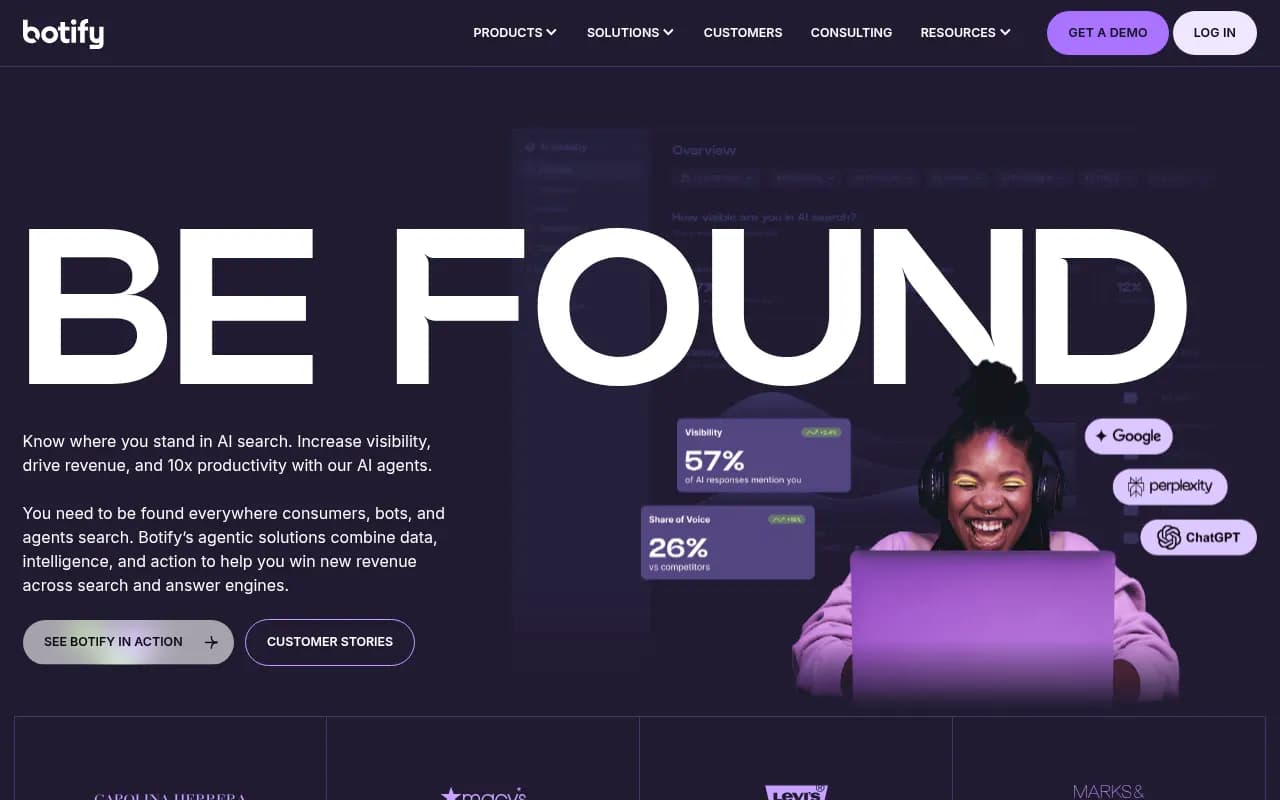
Botify is an enterprise-grade AI search optimization platform that helps brands control visibility across traditional search engines and AI answer engines like ChatGPT, Perplexity, and Google AI Overviews. Used by Fortune 500 companies, it combines deep technical SEO analytics with AI-powered automation and agentic workflows.
What makes it different from Lumar:
Botify and Lumar compete directly in the enterprise SEO space, but Botify leans harder into automation and AI agents. Where Lumar provides comprehensive data and lets your team decide what to do, Botify deploys AI agents that work alongside teams to automate repetitive tasks, prioritize issues, and even generate implementation tickets.
Botify's core strength is log file analysis at scale -- it processes billions of crawl requests to show exactly how search engines and AI bots explore your site. You see which pages Google, ChatGPT, and Perplexity actually visit, how often, and where they get stuck. This is critical for large e-commerce sites, media publishers, and marketplaces where crawl budget optimization directly impacts revenue.
The platform also offers:
- Agentic workflows: AI agents that surface insights, prioritize fixes, and automate reporting
- GEO/AEO optimization: Track brand mentions and sentiment across AI models, optimize content for AI understanding
- Technical SEO at scale: Crawl analysis, structured data validation, JavaScript rendering, mobile optimization
- Revenue attribution: Connect organic search and AI visibility to actual conversions and revenue
Pricing: Custom enterprise pricing -- expect $10K-$50K+/month based on site size and features. Annual contracts standard. 30-day time-to-value, 5x ROI within 3 years (per Botify).
Best for: Fortune 500 brands with massive, complex websites (10M+ pages), large SEO teams, and budgets to match. If you need the most advanced automation, deepest log file analysis, and can afford six-figure annual contracts, Botify delivers.
Trade-offs: Extremely expensive. Overkill for small-to-mid-market companies. Steep learning curve -- you need dedicated SEO engineers to get full value. GEO features are solid but not as action-oriented as Promptwatch (more monitoring, less content optimization).
Screaming Frog
Screaming Frog is a desktop-based SEO spider tool for technical site audits and analysis. It's been the go-to choice for technical SEO professionals for over a decade.
What makes it different from Lumar:
Screaming Frog is fast, affordable, and runs locally on your machine. Where Lumar is a cloud-based enterprise platform with ongoing monitoring, custom analytics, and team collaboration features, Screaming Frog is a single-purpose crawler you run on-demand.
You get comprehensive technical audits: broken links, redirect chains, duplicate content, missing meta tags, schema validation, page speed insights, XML sitemap generation. It crawls JavaScript-rendered sites, integrates with Google Analytics and Search Console, and exports data to Excel or databases for custom analysis.
The free version crawls up to 500 URLs. The paid license ($259/year) removes all limits and adds advanced features like custom extraction, log file analysis, and scheduled crawls.
Pricing: Free up to 500 URLs, $259/year for unlimited crawling.
Best for: Technical SEO consultants, small agencies, and in-house SEO teams that need fast, detailed audits without enterprise platform costs. If you're auditing client sites, troubleshooting specific issues, or don't need continuous monitoring, Screaming Frog is unbeatable value.
Trade-offs: No cloud-based monitoring, no AI visibility tracking, no team collaboration features. You're running manual crawls, not continuous monitoring. For large sites (1M+ pages), crawls can take hours and consume significant local resources. No GEO/AEO capabilities whatsoever.
Conductor
Conductor is an enterprise platform combining traditional SEO intelligence, AI content generation, and 24/7 website monitoring. Used by Verizon, Kroger, and other large brands, it positions itself as an end-to-end AEO (Answer Engine Optimization) platform.
What makes it different from Lumar:
Conductor unifies three core capabilities: Intelligence (SEO and AI visibility tracking), Creator (AI-powered content generation), and Monitoring (real-time website change detection and alerting). Where Lumar focuses on technical optimization and custom analytics, Conductor emphasizes content creation and proactive monitoring.
The Intelligence module tracks brand mentions and authority across AI search engines (ChatGPT, Perplexity, Google AI Overviews) alongside traditional SEO metrics. The Creator module uses AI to generate SEO-optimized content based on keyword research, competitor analysis, and search intent. The Monitoring module continuously scans your site for technical issues, content changes, and compliance violations -- alerting you before problems impact traffic.
Conductor's strength is integration -- the platform connects SEO data, content workflows, and technical monitoring in one place. Teams can identify content gaps, create optimized articles, publish them, and monitor performance without switching tools.
Pricing: Custom enterprise pricing (annual contracts, typically $50K-$100K+).
Best for: Enterprise marketing teams that want to unify SEO, content creation, and website monitoring in a single platform. Good for brands with large content operations and compliance requirements (legal, brand standards).
Trade-offs: Very expensive. The AI content generation is solid but not as citation-focused as Promptwatch's approach. GEO tracking is monitoring-only (no crawler logs, no prompt intelligence). Real-time monitoring is excellent but overlaps with tools like ContentKing at a much higher price point.
Siteimprove
Siteimprove is an enterprise content intelligence platform that combines accessibility compliance, SEO/AEO optimization, analytics, and content strategy into a unified workflow. Used by Vodafone, BT, and Costco, it deploys AI agents that work alongside teams to ensure WCAG compliance, boost search visibility, and optimize content performance.
What makes it different from Lumar:
Siteimprove's core differentiator is accessibility -- it's the only platform in this comparison that treats WCAG compliance as a first-class feature alongside SEO. If your organization has legal accessibility requirements (government, education, healthcare, finance), Siteimprove ensures compliance across web, mobile, social, documents, and applications.
The platform also offers:
- Accessibility agents: AI-powered tools that assist designers, developers, and editors to make content accessible by default
- SEO & AEO agents: Real-time guidance and optimizations to boost visibility in search engines and AI models
- Analytics agents: Conversational insights that translate traffic and behavior data into prioritized next steps
- Content strategy agents: Predictive insights to improve conversion rates
Siteimprove positions itself as an "agentic content intelligence platform" -- AI agents work alongside your team to surface insights, remove guesswork, and make it easier to create content that's discoverable, compliant, and optimized.
Pricing: Custom enterprise pricing -- Essential, Expert, and Enterprise tiers available. Pricing starts in low five figures annually, scales to six figures for large deployments. Free trial available (gated, requires demo request).
Best for: Enterprise organizations with accessibility compliance requirements who also need SEO and content optimization. Ideal for government agencies, universities, healthcare systems, and large corporations in regulated industries.
Trade-offs: Expensive. The accessibility focus is a strength if you need it, but adds cost and complexity if you don't. SEO and GEO features are solid but not as deep as specialized platforms. Analytics and content strategy modules are nice-to-haves but not best-in-class.
ContentKing (now Conductor Monitoring)
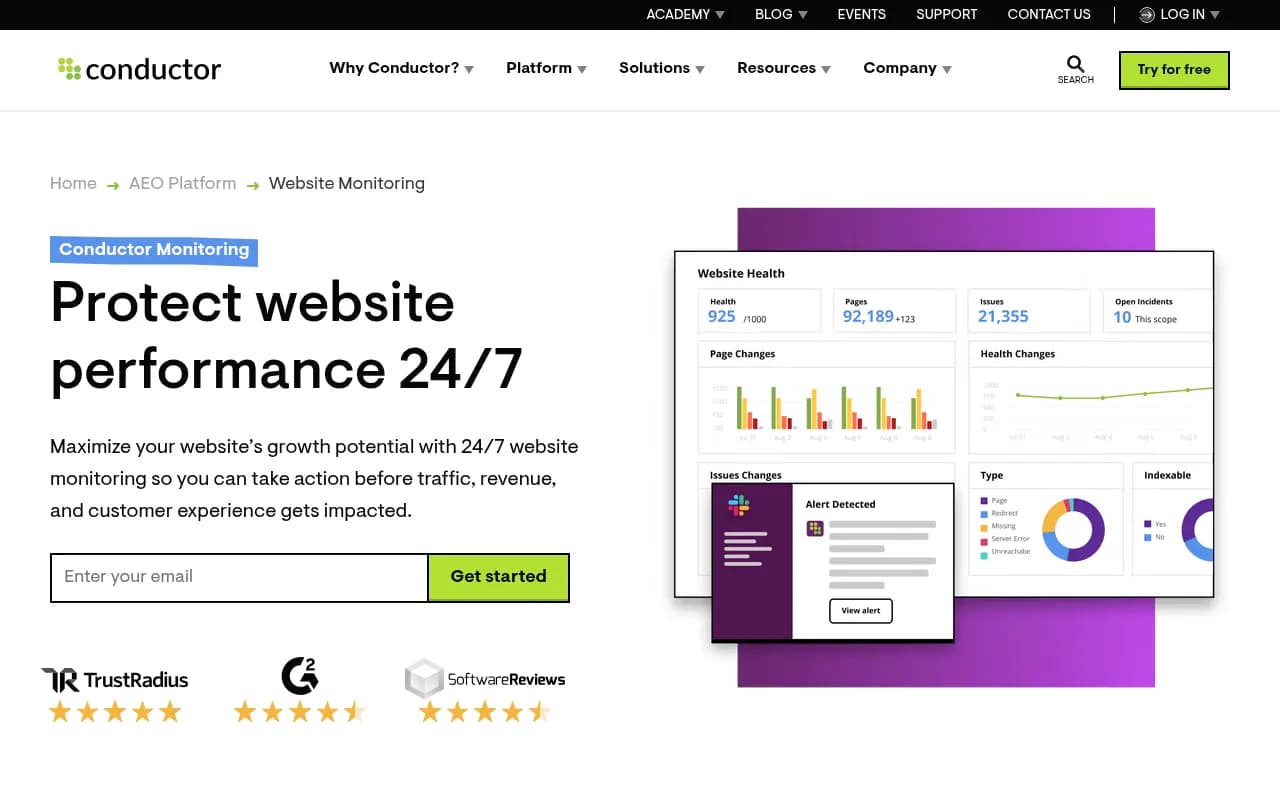
ContentKing is a cloud-based platform that continuously monitors websites for technical SEO issues, content changes, and provides instant alerts when problems occur. It was acquired by Conductor in 2021 and is now marketed as "Conductor Monitoring."
What makes it different from Lumar:
ContentKing/Conductor Monitoring is laser-focused on real-time change detection. Where Lumar crawls your site periodically and provides comprehensive reports, ContentKing monitors continuously and alerts you the moment something changes -- a meta tag gets removed, a canonical tag breaks, a page goes 404, structured data gets corrupted.
This is critical for large sites with frequent updates, multiple teams making changes, or strict compliance requirements. You don't wait for a crawl to discover problems -- you get Slack/email alerts within minutes and can fix issues before they impact rankings or traffic.
The platform also offers:
- 24/7 website monitoring: Always-on technical and content monitoring
- Custom element tracking: Monitor specific page elements for compliance and brand standards (legal disclaimers, product info, pricing)
- Change history: Full changelog of every website update
- Intelligent prioritization: Automatic prioritization of issues by impact
Pricing: From $139/mo (Basic) to $1,279/mo (Enterprise). Tiered pricing based on site size and features. Free trial available.
Best for: SEO teams managing high-traffic sites with frequent updates, e-commerce sites with dynamic content, or brands with strict compliance requirements. If you need to catch issues before they impact traffic (not after), ContentKing is the best choice.
Trade-offs: Doesn't include keyword research, backlink analysis, or AI visibility tracking. It's a monitoring tool, not a full SEO platform. You'll need to pair it with other tools for comprehensive SEO. Now owned by Conductor, so there's some uncertainty about long-term product direction.
OnCrawl
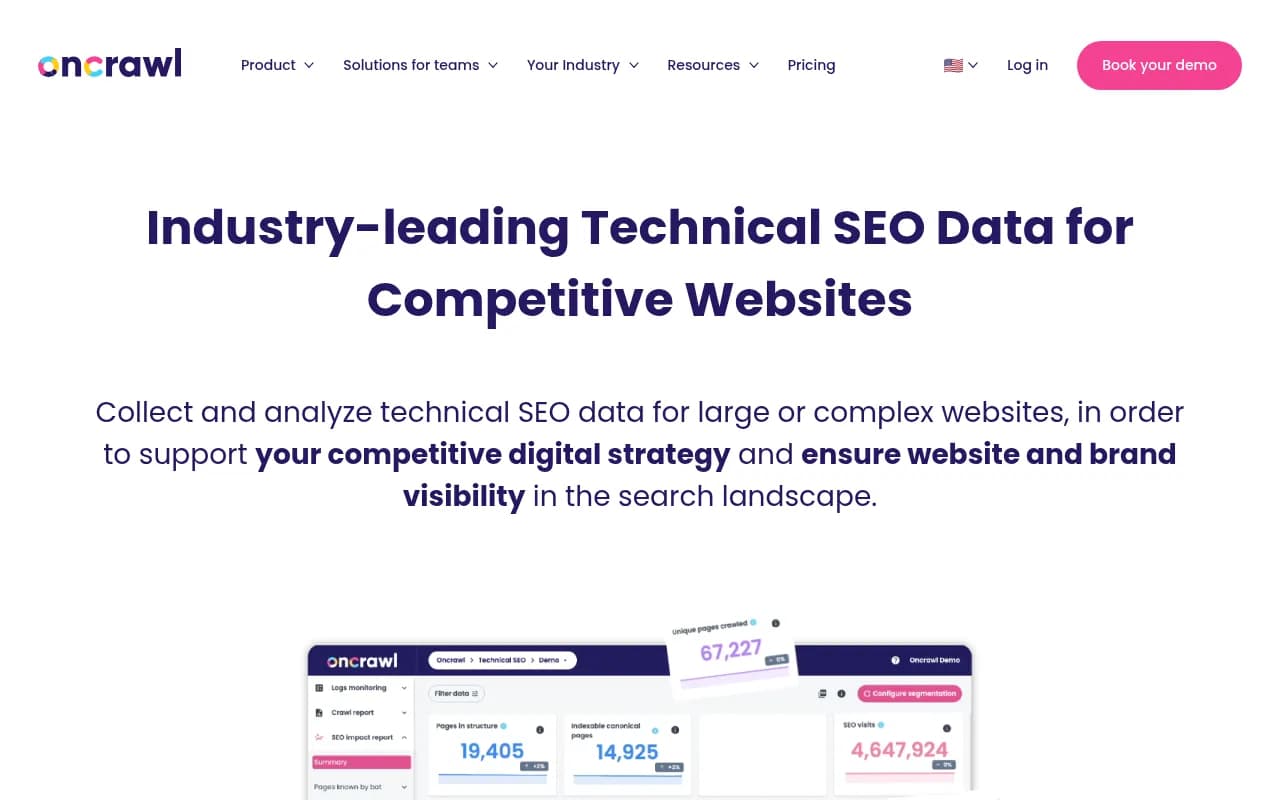
OnCrawl is an enterprise-grade technical SEO platform designed for large, complex websites. Used by L'Oréal, Ticketmaster, and Harrods, it combines website crawling, log file analysis, and AI bot monitoring to help SEO teams understand how search engines and AI agents explore their sites.
What makes it different from Lumar:
OnCrawl and Lumar are direct competitors in the enterprise technical SEO space. Both offer deep crawl analysis, log file integration, and custom segmentation. OnCrawl's differentiators are AI bot monitoring (tracks hits from OpenAI, Claude, Mistral, Perplexity) and Oncrawl Lenses (focused views into your data aligned with specific SEO challenges).
The platform also offers:
- Content Lens: AI-powered content quality evaluation with specific, actionable suggestions
- Rich data and cross-analysis: Blend different data types to prioritize SEO projects
- Powerful segmentation: Group pages and breakdown website sections to spot trends
- Permanent data availability: Analyze changes over time, establish before/after scenarios
Pricing: From $69/mo (100K URLs, 1 project). Mid-tier and enterprise plans with custom pricing for larger crawl volumes and advanced features.
Best for: Enterprise SEO teams managing large, complex websites (e-commerce, job boards, classified ads, media sites) who need deep technical analysis and AI bot monitoring. Good alternative to Lumar if you want similar capabilities at potentially lower cost.
Trade-offs: Steeper learning curve than Lumar. Less polished UI. No site speed monitoring, no web accessibility testing, no custom analytics. Focused purely on technical SEO and crawl optimization.
How to Choose the Right Lumar Alternative
Choose Promptwatch if:
- AI search visibility is a top priority
- You need to create content that ranks in ChatGPT, Claude, and Perplexity (not just monitor)
- You want crawler logs, prompt intelligence, and citation analysis
- Budget: $99-$579/mo
Choose Semrush if:
- You're managing multiple marketing channels (SEO, PPC, content, social) and want one platform
- You need broad coverage more than specialized depth
- AI visibility is a nice-to-have, not a core focus
- Budget: $165-$580/mo
Choose Botify if:
- You're a Fortune 500 brand with a massive, complex website (10M+ pages)
- You need the most advanced automation and log file analysis
- You have a large SEO team and six-figure budget
- Budget: $120K-$600K+/year
Choose Screaming Frog if:
- You need fast, detailed technical audits without enterprise platform costs
- You're a consultant, small agency, or in-house SEO doing on-demand audits
- You don't need continuous monitoring or AI visibility tracking
- Budget: Free-$259/year
Choose Conductor if:
- You want to unify SEO, content creation, and website monitoring in one platform
- You have large content operations and compliance requirements
- You need real-time alerting for technical issues
- Budget: $50K-$100K+/year
Choose Siteimprove if:
- Accessibility compliance is a legal requirement (government, education, healthcare)
- You need WCAG compliance alongside SEO optimization
- You're in a regulated industry with strict content governance
- Budget: $30K-$150K+/year
Choose ContentKing if:
- You need real-time change detection and instant alerts
- You manage high-traffic sites with frequent updates
- You have strict compliance requirements for page elements
- Budget: $139-$1,279/mo
Choose OnCrawl if:
- You're managing large, complex websites (e-commerce, media, classifieds)
- You need deep technical SEO analysis and AI bot monitoring
- You want a Lumar alternative at potentially lower cost
- Budget: $69/mo-custom enterprise pricing
Final Recommendation
Lumar is a solid enterprise platform, but it's not the best choice for every team. If AI search visibility is a priority, Promptwatch is the clear winner -- it's the only platform that shows you what's missing, then helps you create content that ranks in AI models. If you need the broadest marketing toolkit, Semrush covers more ground. If you're a Fortune 500 brand with massive technical requirements, Botify delivers the most advanced automation.
For most teams, the best approach is to combine tools: a specialized GEO platform like Promptwatch for AI visibility, a technical SEO tool like Screaming Frog or OnCrawl for audits, and a monitoring tool like ContentKing for real-time alerts. This gives you best-in-class capabilities at a fraction of the cost of an all-in-one enterprise platform.
The key is to match tools to your actual needs -- not pay for features you'll never use.