Key Takeaways
- Promptwatch is the top choice if you're optimizing for AI search visibility (ChatGPT, Claude, Perplexity) — it goes beyond monitoring to help you create content that actually gets cited by AI models
- SearchPilot is the enterprise-grade alternative for large-scale SEO A/B testing with statistical rigor, used by M&S and Skyscanner, but requires significant budget ($50K+ annually)
- SplitSignal offers similar controlled testing capabilities to SearchPilot at a more accessible price point ($1,250/mo), ideal for mid-market brands
- Semrush and SE Ranking provide basic SEO testing features within broader all-in-one platforms, but lack the specialized split-testing methodology of dedicated tools
- DebugBear focuses specifically on Core Web Vitals and performance testing, perfect if technical speed optimization is your primary concern
SEO Testing has carved out a niche as an accessible platform for running controlled SEO experiments — testing title tags, content changes, and technical optimizations before rolling them out site-wide. But it's not the only option. Whether you need enterprise-scale statistical testing, AI search optimization, or just better performance monitoring, there are alternatives worth considering.
The main reasons teams look beyond SEO Testing: need for more advanced statistical modeling (SearchPilot), tighter integration with AI search tracking (Promptwatch), lower entry price points (SplitSignal), or all-in-one platform consolidation (Semrush, SE Ranking). Some teams also find SEO Testing's interface less intuitive than competitors, or want features like real-time performance monitoring that specialized tools handle better.
Promptwatch

Promptwatch is the market-leading AI Search Visibility platform, and while it's not a traditional SEO split-testing tool, it's become essential for teams optimizing for the next generation of search. If your traffic strategy includes being visible in ChatGPT, Claude, Perplexity, Gemini, and other AI models, Promptwatch is the only platform that closes the optimization loop.
What sets it apart: most "AI search monitoring" tools just show you data — which prompts mention your brand, which competitors appear more often. Promptwatch goes further by identifying exactly what content you're missing (Answer Gap Analysis), then helping you create it with an AI writing agent trained on 880M+ citations. You see the gaps, generate content to fill them, then track visibility improvements as AI models start citing your new pages. This action loop — find, fix, track — is what makes it an optimization platform rather than just another dashboard.
Key capabilities: tracks 10 AI models (ChatGPT, Perplexity, Claude, Gemini, Google AI Overviews, Meta AI, DeepSeek, Grok, Mistral, Copilot), AI crawler logs showing exactly which pages AI bots read and when, prompt intelligence with volume estimates and difficulty scores, citation analysis revealing which pages/domains AI models trust, Reddit and YouTube insights (channels most competitors ignore), ChatGPT Shopping tracking, competitor heatmaps, and multi-language/multi-region monitoring.
The trade-off: Promptwatch doesn't do traditional SEO split testing like SEO Testing does. You can't run a controlled A/B test on title tags across 500 pages and measure the traffic delta. What it does instead is help you understand and optimize for AI search engines — a channel that's growing faster than traditional Google search. If you're only focused on traditional SEO experiments, this isn't the tool. But if you want to rank in AI search results (where more users are going), Promptwatch is the only platform that helps you take action, not just watch.
Pricing: Essential $99/mo (1 site, 50 prompts, 5 AI-generated articles), Professional $249/mo (2 sites, 150 prompts, 15 articles, crawler logs, state/city tracking), Business $579/mo (5 sites, 350 prompts, 30 articles). Free trial available. Used by 6,700+ brands including Booking.com, Center Parcs, and Typeform.
Best for: Marketing and SEO teams that want to be visible in AI search engines, brands losing traffic to ChatGPT and Perplexity, agencies managing AI visibility for clients, and anyone who needs to create content that AI models will actually cite.
SearchPilot
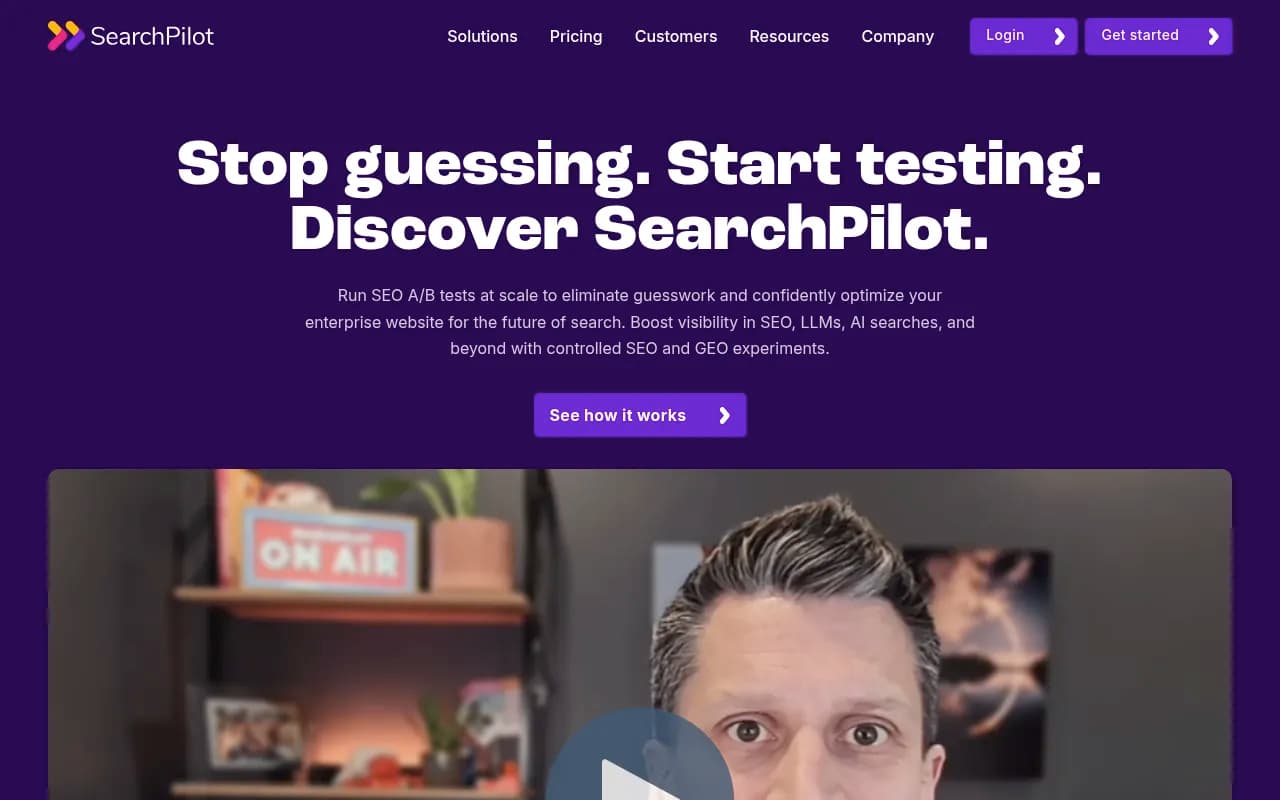
SearchPilot is the enterprise standard for SEO A/B testing — the platform M&S, Skyscanner, and Petco use to run controlled experiments at massive scale. If SEO Testing feels too basic or you need bulletproof statistical methodology for high-stakes tests, SearchPilot is where you graduate to.
What it does better than SEO Testing: statistical rigor. SearchPilot uses advanced forecasting models and control group matching to isolate the impact of SEO changes from seasonal trends, algorithm updates, and other noise. You can test changes across thousands of pages, measure statistically significant traffic lifts, and only roll out winners. The platform also handles GEO (Generative Engine Optimization) experiments — testing how schema, content structure, and other changes affect visibility in AI search results.
The professional services team is a major differentiator. SearchPilot isn't just software — you get dedicated support from experienced SEO testers who help design experiments, interpret results, and avoid common pitfalls. This is critical for enterprise teams where a bad rollout can cost millions in lost traffic.
Key features: controlled A/B testing with statistical forecasting, safe testing environment (changes don't affect all visitors), GEO optimization testing, enterprise-scale infrastructure handling billions of requests monthly, and expert guidance from the SearchPilot team.
The trade-off: price and accessibility. SearchPilot is enterprise-only with custom pricing estimated at $50K-$300K+ annually depending on traffic volume. There's no self-serve plan, no free trial, and no way to just sign up and start testing. You need a sales conversation, a significant budget, and enough traffic volume to make the investment worthwhile. For small-to-midsize sites, this is overkill. For large e-commerce or publishing sites doing millions in revenue from organic search, it's worth every dollar.
Best for: Enterprise brands with high-traffic websites (1M+ monthly organic sessions), teams that need to prove ROI to the C-suite with hard data, organizations running complex multi-page experiments, and companies optimizing for both traditional SEO and AI search visibility.
SplitSignal
SplitSignal offers similar controlled SEO testing capabilities to SearchPilot but at a price point that mid-market brands can actually afford. Used by Zillow and Etsy, it's the middle ground between SEO Testing's simplicity and SearchPilot's enterprise complexity.
How it compares to SEO Testing: SplitSignal uses a more sophisticated split-testing methodology. Instead of just comparing before/after periods (which SEO Testing does with time-based tests), SplitSignal splits your pages into control and variant groups, applies changes only to the variant group, and measures the traffic difference. This isolates the impact of your changes from external factors like algorithm updates or seasonality — something time-based testing can't do reliably.
The platform integrates directly with Google Search Console to track organic search performance, automatically calculates statistical significance, and provides clear recommendations on whether to roll out changes site-wide. You can test title tags, meta descriptions, schema markup, content changes, internal linking, and more.
Key features: controlled A/B testing with matched control groups, automatic statistical significance calculation, GSC integration for traffic tracking, test templates for common SEO experiments, and support for testing at scale across hundreds or thousands of pages.
The trade-off: still requires a meaningful budget commitment. At $1,250/mo for the Pro plan, SplitSignal is 40x more expensive than SEO Testing's entry plan ($30/mo). You're paying for the statistical methodology and infrastructure, but smaller sites may struggle to justify the cost. The platform also requires enough traffic volume to reach statistical significance — if you're only getting a few hundred organic clicks per day, tests will take months to conclude.
Pricing: Pro plan from $1,250/mo, Stack plan available, Enterprise custom pricing. No free trial mentioned.
Best for: Mid-to-large e-commerce sites, SaaS companies with significant organic traffic, SEO teams that need to prove impact with controlled experiments, and brands that have outgrown time-based testing but can't afford SearchPilot's enterprise pricing.
Semrush
Semrush is the all-in-one digital marketing platform used by 10M+ marketers and 35% of Fortune 500 companies. It's not a dedicated SEO testing tool like SEO Testing, but it offers basic testing capabilities within a much broader suite of SEO, content, PPC, and social media tools — plus newer AI search monitoring features.
How it compares: Semrush doesn't do controlled split testing. What it offers instead is comprehensive rank tracking, site audits, and performance monitoring that let you measure the impact of changes over time. You make an SEO change, track rankings and traffic in Semrush, and see if things improve. This is closer to SEO Testing's time-based testing approach, but without the dedicated experiment framework.
The AI search features (part of Semrush One) add monitoring for ChatGPT, Perplexity, and Gemini — you can see when AI models mention your brand and track competitor visibility. However, these features use fixed prompts rather than custom queries, and there's no content gap analysis or AI writing tools to help you optimize. It's monitoring-only, unlike Promptwatch's action-oriented approach.
Key features: rank tracking across 188 countries, 5.4B keyword database, site audit tool, backlink analysis, content optimization, PPC research, social media management, local SEO tools, and basic AI search monitoring. White-label reporting for agencies.
The trade-off: you're paying for a massive platform when you might only need testing capabilities. Semrush is excellent if you need an all-in-one solution, but if your primary goal is running controlled SEO experiments, dedicated tools like SEO Testing, SplitSignal, or SearchPilot do it better. The AI search features also lag behind specialized platforms — no crawler logs, no prompt volume data, no content generation, no traffic attribution.
Pricing: From $165/mo (Starter), $290/mo (Pro+), $580/mo (Advanced). Enterprise custom pricing. 7-day free trial. The AI Search add-on costs extra.
Best for: Marketing teams that want one platform for SEO, content, PPC, and social media, agencies managing multiple clients, and teams that prefer breadth over specialized depth. Not ideal if controlled SEO testing is your primary need.
SE Ranking
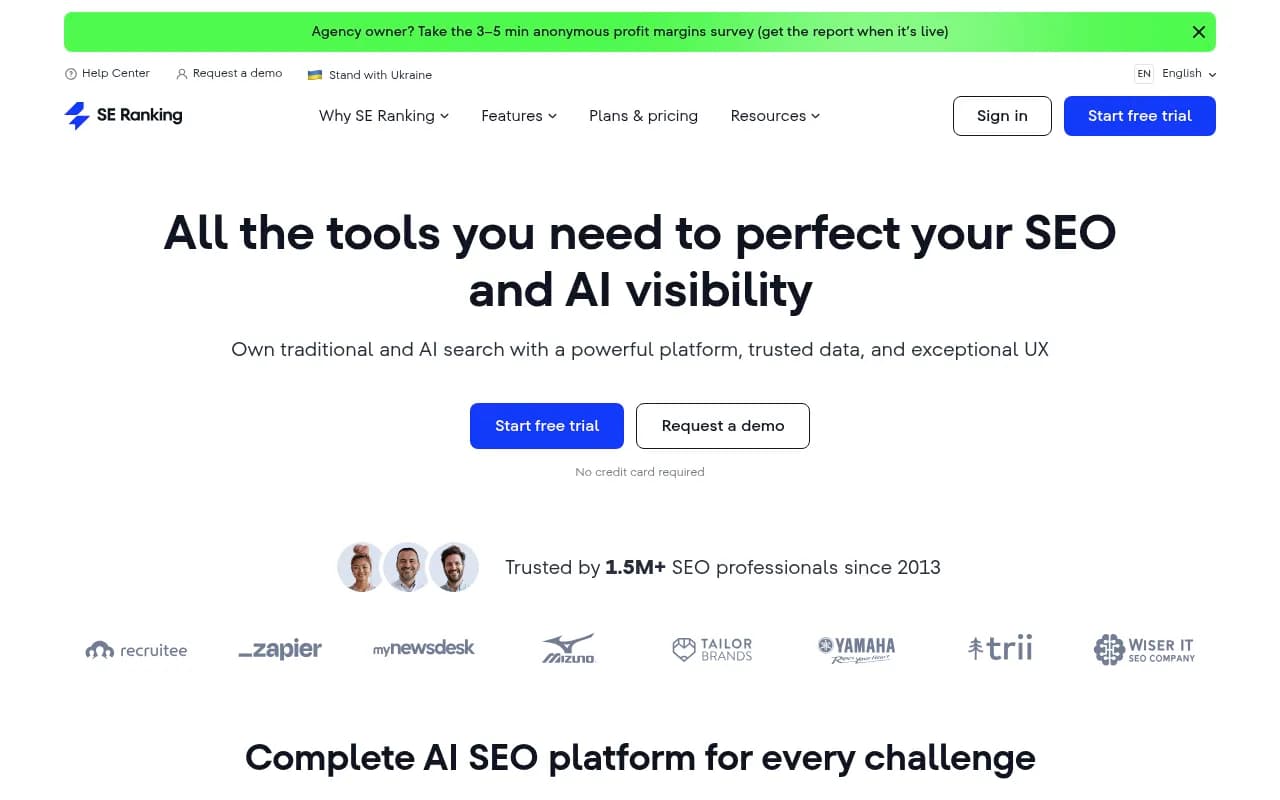
SE Ranking is a comprehensive SEO platform trusted by 1.5M+ professionals since 2013. Like Semrush, it's an all-in-one solution rather than a dedicated testing platform, but it offers similar monitoring and tracking capabilities at a lower price point.
How it compares to SEO Testing: SE Ranking doesn't offer split testing or controlled experiments. What it provides is robust rank tracking, site audits, and performance monitoring across 188 countries. You can track rankings for specific keywords, monitor site health, and measure traffic changes over time — essentially the same time-based approach as SEO Testing's simpler tests, but without the dedicated experiment framework.
The platform includes AI-powered content tools that help you optimize pages for target keywords, plus white-label reporting for agencies. The AI Search add-on (available separately) provides basic monitoring for ChatGPT, Perplexity, and other AI models, though like Semrush, it's monitoring-only without the optimization features that Promptwatch offers.
Key features: rank tracking with 5.4B keyword database, site audit tool, backlink monitoring, keyword research, content optimization with AI, competitor analysis, local SEO tools, white-label reporting, and optional AI search monitoring add-on.
The trade-off: same as Semrush — you're getting a broad platform rather than specialized testing capabilities. SE Ranking is more affordable than Semrush ($103.20/mo vs $165/mo for entry plans), making it attractive for smaller teams or agencies on tighter budgets. But if you specifically need controlled SEO experiments, dedicated testing tools will serve you better.
Pricing: From $103.20/mo (Core plan with annual billing), Growth plan from $223.20/mo. Add-ons: Agency Pack from $69/mo, AI Search from $71.20/mo. 14-day free trial, no credit card required. 20% discount on annual billing.
Best for: Small-to-midsize agencies, in-house SEO teams with limited budgets, and marketers who want comprehensive SEO tools without Semrush's price tag. Not the best choice if controlled testing is your primary requirement.
Ahrefs
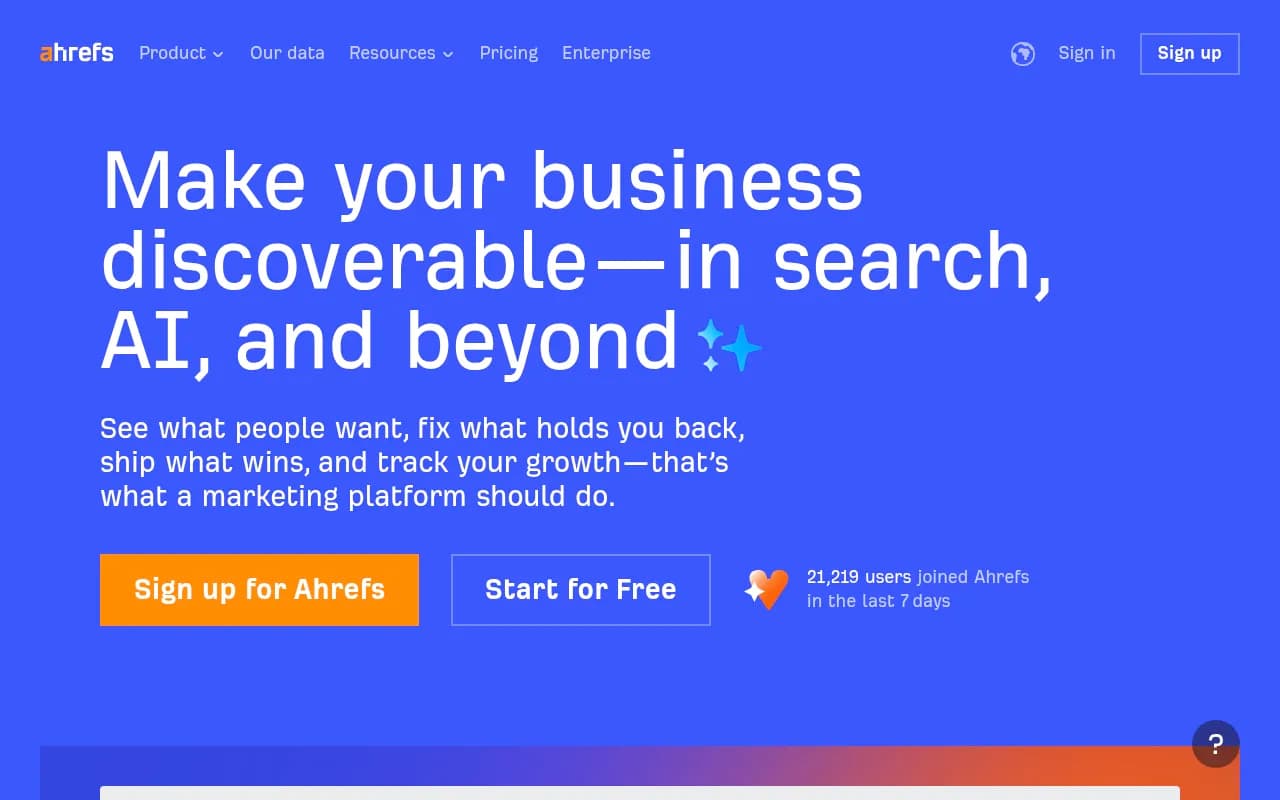
Ahrefs is the SEO platform used by 44% of Fortune 500 companies, known for having the web's largest backlink index and keyword database. Like Semrush and SE Ranking, it's an all-in-one platform rather than a dedicated testing tool.
How it compares: Ahrefs doesn't do SEO split testing or controlled experiments. What it excels at is competitive analysis, backlink research, and content planning. You can use Ahrefs to identify optimization opportunities, track rankings, and monitor traffic — then measure the impact of changes over time. The Brand Radar feature (their AI search monitoring tool) tracks mentions in AI-generated responses, but uses fixed prompts and lacks the optimization features of specialized platforms.
The platform's strength is depth of data. Ahrefs crawls the web constantly, maintaining the largest backlink index available (over 40 trillion links). For competitive research and understanding why competitors rank, it's unmatched. But for testing specific SEO changes in a controlled way, it's not built for that.
Key features: massive backlink index, comprehensive keyword database, site audit tool, rank tracking, content explorer, competitor analysis, PPC research, social media management, and Brand Radar for AI search monitoring. The platform also includes content creation workflows and AI writing tools.
The trade-off: like other all-in-one platforms, you're paying for breadth rather than specialized testing capabilities. Ahrefs is excellent for research and analysis, but if your goal is running controlled experiments to measure the impact of specific changes, dedicated testing tools are better suited. The Brand Radar AI monitoring also has limitations — fixed prompts, no traffic attribution, no content gap analysis.
Pricing: From $83/mo (Lite plan) — Starter $29/mo (very limited), Standard $166/mo, Advanced $333/mo, Enterprise custom pricing. Annual billing saves 20%. Free trial available.
Best for: SEO teams focused on competitive analysis and backlink research, content marketers planning data-driven strategies, and agencies that need comprehensive research tools. Not ideal if controlled SEO testing is your main objective.
Screaming Frog
Screaming Frog is a desktop-based SEO spider tool that's been the industry standard for technical site audits since 2010. It's not a testing platform at all — it's a crawler that helps you find technical issues before and after making changes.
How it fits into testing workflows: Screaming Frog is often used alongside testing platforms rather than as an alternative. You crawl your site before making changes, identify technical issues (broken links, missing meta tags, duplicate content, crawl errors), fix them, then crawl again to verify the fixes worked. Many teams use Screaming Frog to audit test pages before running experiments in SEO Testing, SplitSignal, or SearchPilot.
The tool is excellent for on-demand technical analysis. You can crawl up to 500 URLs for free, or pay $259/year for unlimited crawling. It's fast, thorough, and gives you granular control over what to analyze. But it doesn't track rankings, measure traffic impact, or run controlled experiments — it just shows you what's on your pages.
Key features: comprehensive site crawling, technical SEO analysis, broken link detection, duplicate content identification, XML sitemap generation, custom extraction with XPath and regex, JavaScript rendering, and integration with Google Analytics and Search Console.
The trade-off: Screaming Frog is a diagnostic tool, not a testing platform. It tells you what's wrong but doesn't help you measure the impact of fixes. You'll still need a separate tool (like SEO Testing or one of its alternatives) to run controlled experiments and track results. The desktop-only nature also means no scheduled crawls or automated monitoring — you have to manually run crawls whenever you want fresh data.
Pricing: Free up to 500 URLs, paid license $259/year for unlimited crawling. One-time payment, not subscription.
Best for: Technical SEO specialists who need detailed site audits, developers fixing crawl issues, and SEO teams that want to verify technical implementations before running experiments. Use it alongside testing platforms, not instead of them.
DebugBear
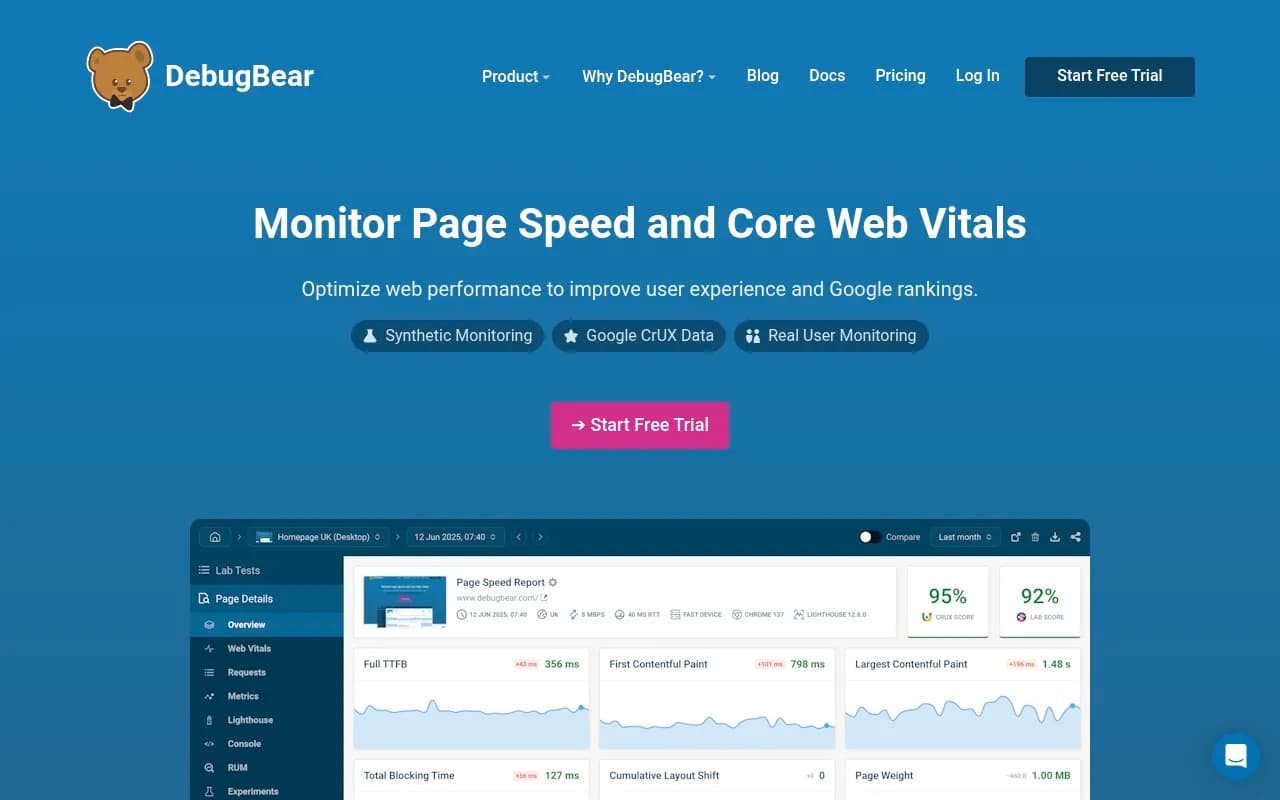
DebugBear is a web performance monitoring platform focused specifically on Core Web Vitals, page speed, and technical performance metrics. If your SEO testing is primarily about speed optimization, DebugBear offers more specialized capabilities than general testing platforms.
How it compares: DebugBear doesn't do SEO split testing or content experiments. What it does is continuous performance monitoring with three data sources: synthetic testing (scheduled Lighthouse tests), real user monitoring (RUM tracking actual visitor experience), and Google CrUX data (the official dataset Google uses for ranking). You can see exactly how fast your pages load, which elements cause slowdowns, and whether you're passing Core Web Vitals thresholds.
The platform is built for teams that need to prove performance improvements. You make speed optimizations, DebugBear tracks the before/after metrics, and you can see the exact impact on Largest Contentful Paint, First Input Delay, Cumulative Layout Shift, and other Core Web Vitals. It's like SEO Testing but specialized for performance rather than general SEO changes.
Key features: synthetic monitoring with scheduled Lighthouse tests, real user monitoring (RUM) for actual visitor data, Google CrUX integration, detailed performance recommendations, regression detection with alerts, page-level tracking, and technical analysis of render-blocking resources, JavaScript execution, and layout shifts.
The trade-off: very narrow focus. If you're testing title tags, content changes, schema markup, or anything beyond performance, DebugBear won't help. It's a specialized tool for speed optimization. The pricing is also higher than SEO Testing ($125/mo vs $30/mo for entry plans), though you're getting much deeper performance analysis.
Pricing: From $125/month (Starter: 10 pages, 1,440 synthetic tests/month), Professional $299/month, Business $899/month. 14-day free trial, no credit card required. Annual billing saves 16%.
Best for: Development teams focused on Core Web Vitals, SEO teams where performance is the primary ranking factor, e-commerce sites where speed directly impacts conversions, and technical SEOs who need detailed performance diagnostics. Not suitable if you're testing non-performance SEO changes.
Choosing the Right Alternative
The best SEO Testing alternative depends on what you're actually trying to test and optimize:
For AI search visibility and next-generation optimization: Promptwatch is the clear choice. It's the only platform that helps you create content AI models will cite, not just monitor where you're mentioned. If you're losing traffic to ChatGPT and Perplexity, or want to rank in AI search results, this is where to invest.
For enterprise-scale controlled experiments: SearchPilot offers the statistical rigor and professional services that large brands need, but requires significant budget ($50K+ annually). Worth it if you're doing millions in organic revenue.
For mid-market controlled testing: SplitSignal provides similar methodology to SearchPilot at a more accessible price point ($1,250/mo). Good middle ground between SEO Testing's simplicity and SearchPilot's enterprise complexity.
For all-in-one platform consolidation: Semrush, SE Ranking, or Ahrefs make sense if you want one tool for SEO, content, PPC, and social media. But none offer true controlled testing — you're trading specialized capabilities for breadth.
For technical audits and diagnostics: Screaming Frog remains the gold standard for crawling and finding technical issues. Use it alongside testing platforms, not instead of them.
For Core Web Vitals and performance testing: DebugBear provides deeper performance analysis than any general SEO tool. Essential if speed optimization is your primary focus.
Most teams end up using a combination: a testing platform (SEO Testing, SplitSignal, or SearchPilot) for controlled experiments, Promptwatch for AI search optimization, and Screaming Frog or DebugBear for specialized technical analysis. The key is matching tools to your specific optimization goals rather than trying to find one platform that does everything.