Key Takeaways
- Promptwatch is the top alternative for teams that want to take action, not just monitor—it combines visibility tracking with content gap analysis, AI content generation, and crawler logs to actually improve your AI search rankings
- Semrush offers the most comprehensive all-in-one platform if you need traditional SEO tools alongside AI visibility tracking, though its GEO features use fixed prompts and lack depth compared to specialized platforms
- Peec AI and Otterly.AI are solid monitoring-only options at lower price points ($89-189/mo), but neither provides optimization tools or content creation capabilities
- AthenaHQ and Relixir target enterprise buyers with managed services and higher price points ($295-500+/mo), offering white-glove support but less flexibility for hands-on teams
- Ahrefs Brand Radar is the weakest option for GEO—it uses fixed prompts, lacks AI traffic attribution, and treats AI visibility as a side feature rather than a core capability
Why Look for XFunnel Alternatives?
XFunnel entered into an agreement to be acquired by HubSpot in 2025. While the platform helped marketing teams track citations and visibility across AI search engines, the acquisition means the standalone product is being integrated into HubSpot's ecosystem. If you were using XFunnel or evaluating it before the acquisition, you now need to decide: wait for HubSpot's integrated offering, or switch to a dedicated GEO platform that's actively developing new features.
The bigger question is what you actually need from a GEO tool. Most platforms in this space fall into two camps: monitoring dashboards that show you data, and optimization platforms that help you fix what's broken. XFunnel was primarily a monitoring tool—it tracked where your brand appeared in AI responses but left the optimization work to you. If that's all you need, several alternatives offer similar (or better) tracking at competitive prices. But if you want to actually improve your AI visibility, you need a platform built around taking action.
The alternatives below range from $89/month monitoring tools to $500+ enterprise platforms with managed services. Some focus purely on tracking; others include content creation, crawler log analysis, and optimization workflows. Here's how they compare.
Promptwatch

Promptwatch is the only GEO platform that closes the loop from monitoring to action. While most competitors (including XFunnel) stop at showing you where you're invisible, Promptwatch shows you what's missing and then helps you fix it. The core difference: it's built around a three-step cycle—find content gaps, generate optimized content, track the results.
The Answer Gap Analysis feature is where this becomes tangible. It shows exactly which prompts competitors are visible for but you're not, then surfaces the specific topics, angles, and questions AI models want answers to but can't find on your site. You're not guessing what content to create—you're seeing the gaps in real citation data from 880M+ analyzed citations. From there, the built-in AI writing agent generates articles, listicles, and comparisons grounded in prompt volumes, persona targeting, and competitor analysis. This isn't generic SEO filler; it's content engineered to get cited by ChatGPT, Claude, Perplexity, and other models.
Once you publish, page-level tracking shows exactly which pages are being cited, how often, and by which models. You can connect visibility to revenue through traffic attribution (code snippet, GSC integration, or server log analysis). The platform also includes AI Crawler Logs—real-time logs of ChatGPT, Claude, and Perplexity crawlers hitting your site, which pages they read, errors they encounter, and how often they return. Most competitors lack this entirely.
Additional capabilities include prompt intelligence (volume estimates, difficulty scores, query fan-outs), citation and source analysis, Reddit and YouTube insights, ChatGPT Shopping tracking, competitor heatmaps, and multi-language/multi-region monitoring. It tracks 10 AI models: ChatGPT, Perplexity, Google AI Overviews, Google AI Mode, Claude, Gemini, Meta/Llama, DeepSeek, Grok, Mistral, and Copilot.
Pricing starts at $99/mo (Essential: 1 site, 50 prompts, 5 articles), $249/mo (Professional: 2 sites, 150 prompts, 15 articles, crawler logs, state/city tracking), and $579/mo (Business: 5 sites, 350 prompts, 30 articles). Agency and enterprise pricing available. Free trial included.
Best for: Marketing and SEO teams that want to optimize AI visibility, not just monitor it. If you need to create content that actually ranks in AI search, Promptwatch is the only platform that connects the dots from gap analysis to content creation to results tracking.
Semrush
Semrush is a comprehensive digital marketing suite that added AI visibility tracking as part of its broader platform. Used by 10M+ marketers and 35% of Fortune 500 companies, it combines traditional SEO tools (keyword research, backlink analysis, site audits, rank tracking) with newer AI search monitoring across ChatGPT, Perplexity, and Gemini. The appeal is consolidation—if you're already using Semrush for SEO, you can add AI visibility tracking without switching platforms.
The AI visibility features are solid but not as deep as specialized GEO platforms. Semrush tracks brand mentions and sentiment across AI models, but it uses a fixed set of prompts rather than letting you define custom queries. You can't track specific high-value prompts your customers actually use, which limits how actionable the data is. There's no content gap analysis, no AI content generation, and no crawler log tracking. It's monitoring-only—you see where you appear, but the platform doesn't help you improve.
Where Semrush shines is breadth. You get 8 toolkits covering SEO, content, PPC, social media, local search, and AI visibility. If you need an all-in-one platform and AI visibility is just one piece of your workflow, Semrush makes sense. But if GEO is a priority, you'll hit limitations quickly. The fixed prompts mean you're tracking generic queries, not the specific questions your audience asks. And without optimization tools, you're left manually creating content based on the insights.
Pricing starts at $165/mo (Starter), $290/mo (Pro+), and $580/mo (Advanced). Enterprise custom pricing available. 7-day free trial.
Best for: Teams already using Semrush for traditional SEO who want to add basic AI visibility tracking without switching platforms. Not ideal if GEO is a core focus—you'll need a specialized tool for that.
Peec AI
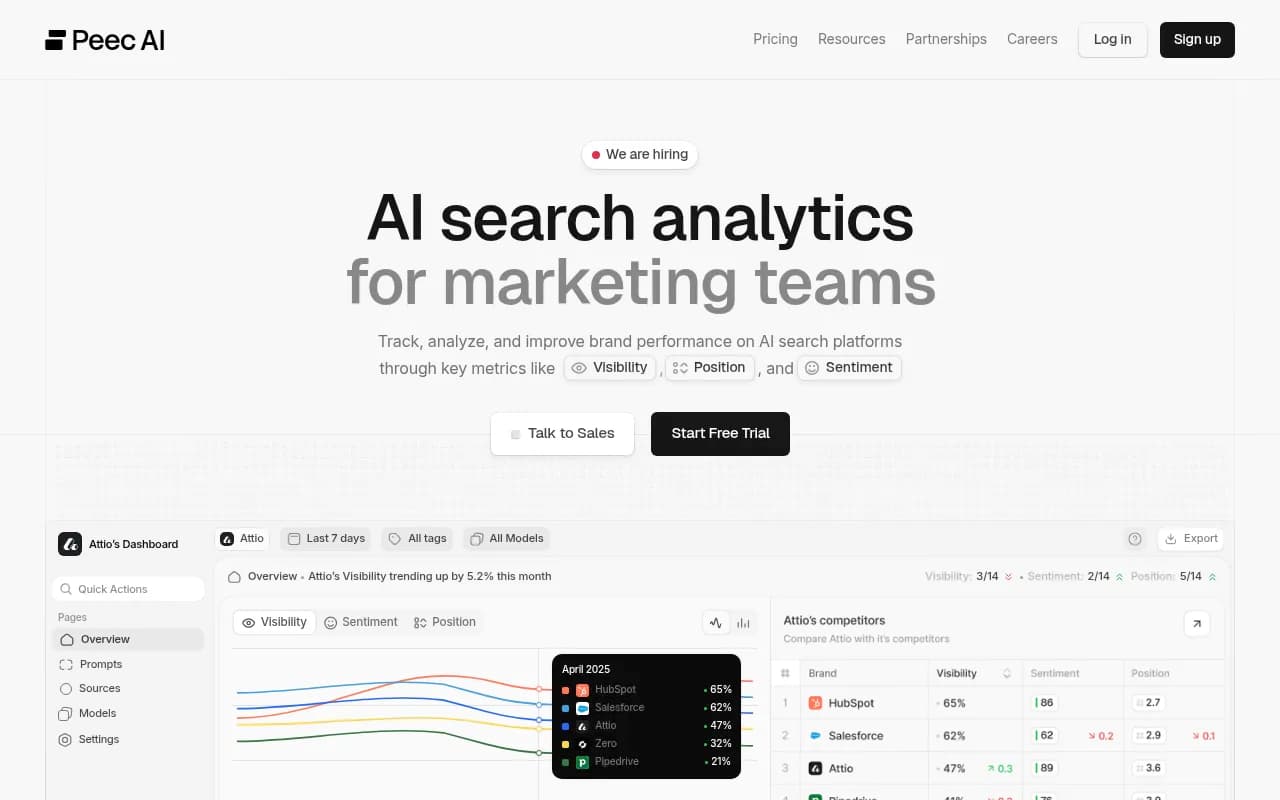
Peec AI is a straightforward monitoring platform that tracks brand mentions and citations across ChatGPT, Perplexity, Claude, and Gemini. It's designed for marketing teams that want visibility metrics without the complexity of enterprise platforms. The interface is clean, the data is reliable, and the pricing is accessible—starting at €89/mo (~$103) for 50 prompts and 10 models.
The platform covers the basics well: visibility scores, sentiment analysis, position tracking, and competitor benchmarking. You can add custom prompts, organize them with tags, and track across multiple countries. The citation analysis shows which sources AI models reference, so you can see where competitors are getting cited and identify opportunities. But that's where it stops. There's no content creation, no crawler logs, no prompt intelligence (volume estimates or difficulty scores), and no optimization workflows.
Peec AI is a monitoring dashboard. It tells you where you stand but doesn't help you improve. If you're early in your GEO journey and just need to understand the landscape, it's a cost-effective starting point. But as soon as you want to take action—create content, track crawler behavior, or close visibility gaps—you'll need to layer in other tools or upgrade to a platform like Promptwatch.
Pricing: Starter €89/mo (50 prompts, 10 models), Growth €199/mo (150 prompts, 2 workspaces), Enterprise custom pricing. Free trial available.
Best for: Small to mid-sized marketing teams that need basic AI visibility tracking at a lower price point. Good for monitoring, but you'll need other tools for optimization.
Otterly.AI
Otterly.AI

Otterly.AI is another monitoring-focused platform that tracks brand mentions and citations across six AI search engines: ChatGPT, Perplexity, Google AI Overviews, Google AI Mode, Gemini, and Copilot. It's positioned as a lightweight, affordable option for teams that want automated reporting and competitive benchmarking without enterprise complexity.
The platform covers the essentials: brand monitoring, website citation tracking, share of voice analysis, and competitor comparisons. It also includes a GEO Audit tool that analyzes 25+ on-page factors to reveal what's holding your site back from earning more citations. This is useful for identifying technical issues, but it's not a substitute for content optimization or creation tools. The audit tells you what's wrong; it doesn't help you fix it.
Otterly.AI's main limitation is the same as Peec AI: it's monitoring-only. There's no content gap analysis, no AI writing agent, no crawler logs, and no prompt intelligence. You see where you appear and where competitors are winning, but the platform doesn't help you close the gap. The pricing is competitive—starting at $29/mo for 15 prompts (Lite plan), $189/mo for 100 prompts (Standard), and custom pricing for Premium—but you're paying for visibility data, not optimization capabilities.
The 14-day free trial (no credit card required) makes it easy to test, and the automated reporting is convenient for teams that want hands-off monitoring. But if you're serious about improving AI visibility, you'll outgrow it quickly.
Best for: Teams that need basic monitoring and reporting at a low price point. Not suitable if you want to actively optimize your AI search presence.
Ahrefs
Ahrefs is a comprehensive SEO and marketing intelligence platform used by 44% of Fortune 500 companies. It's known for having the web's largest backlink index and keyword database, plus a full suite of traditional SEO tools (site audits, rank tracking, content research, PPC analysis). In 2025, Ahrefs added Brand Radar, an AI search monitoring feature that tracks brand mentions across ChatGPT, Perplexity, and other LLMs.
Brand Radar is the weakest GEO offering among the alternatives listed here. It uses fixed prompts, which means you can't track the specific queries your customers actually use. There's no AI traffic attribution, no crawler logs, no content gap analysis, and no optimization tools. It's a side feature bolted onto a traditional SEO platform, not a core capability. If you're already using Ahrefs for backlink analysis and keyword research, Brand Radar gives you a basic view of AI visibility. But it's not a substitute for a dedicated GEO platform.
The broader Ahrefs platform is excellent for traditional SEO. The backlink index is unmatched, the keyword database is massive, and the site audit tool is thorough. If your primary focus is SEO and you want a lightweight AI visibility check, Ahrefs makes sense. But if GEO is a priority, Brand Radar won't cut it. You'll need a specialized tool that tracks custom prompts, provides optimization workflows, and connects visibility to traffic and revenue.
Pricing starts at $83/mo (Lite plan, very limited), $166/mo (Standard), $333/mo (Advanced), and custom enterprise pricing. Annual billing saves 20%. Free trial available.
Best for: Teams that prioritize traditional SEO and want a basic AI visibility check as a secondary feature. Not recommended if GEO is a core focus.
AthenaHQ

AthenaHQ is an enterprise-focused GEO platform used by companies like Coinbase, ZoomInfo, and SoFi. It positions itself as an "end-to-end AEO & GEO platform" with a focus on actionable insights and white-glove support. The platform tracks citations, sentiment, and visibility across ChatGPT, Perplexity, Google AI Overviews, Claude, and other LLMs, with detailed competitor analysis and page-level tracking.
AthenaHQ's strength is its enterprise positioning. The team provides strategic guidance, custom reporting, and hands-on support—useful if you have budget but limited internal resources. Case studies show strong results: Rootly achieved a 10x increase in citation rate and $126k in incremental equivalent media value; Lago saw a 50% increase in demos from AI search. These are real outcomes, and the platform clearly works for brands that commit to it.
The downside is cost and flexibility. Pricing starts at $295/mo (Self-Serve plan, $95 first month) and scales to custom enterprise pricing. The credit-based model (1 credit = 1 AI query) can get expensive if you're tracking many prompts. More importantly, AthenaHQ is monitoring-focused—it provides insights and recommendations, but it doesn't include content creation tools, crawler logs, or automated optimization workflows. You're paying for visibility data and strategic support, not a platform that helps you execute.
If you're an enterprise team with budget and you want a partner to guide your GEO strategy, AthenaHQ is a strong choice. But if you're a hands-on team that wants to own the execution, you'll find more value in a platform like Promptwatch that combines monitoring with action.
Best for: Enterprise teams that want strategic guidance and white-glove support alongside AI visibility tracking. Less suitable for hands-on teams that want to execute optimization themselves.
Relixir
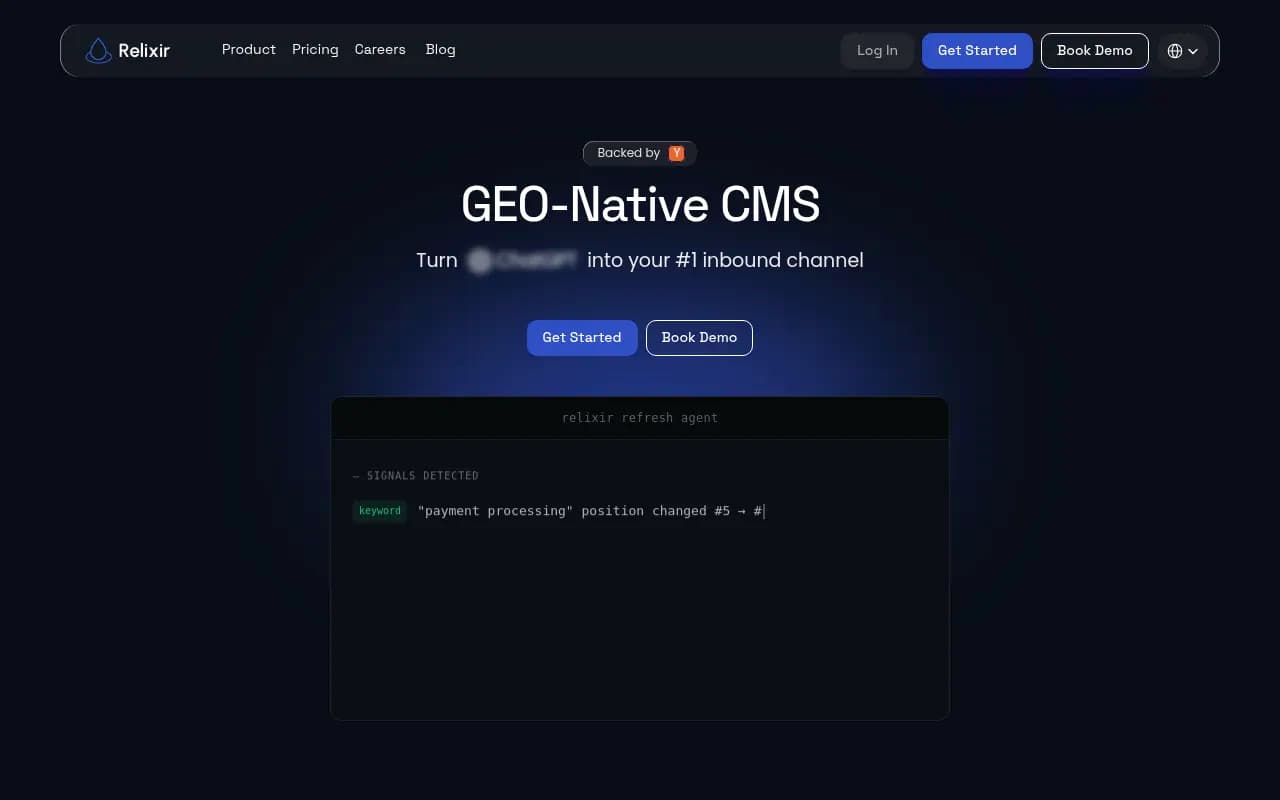
Relixir is an enterprise-grade GEO platform that combines monitoring, content creation, and managed services. It's positioned as an "all-in-one" solution with three core components: an AI-native CMS for content creation, a GEO Analytics Suite for tracking visibility, and Forward-Deployed Engineers who handle strategy and execution. The platform is used by fast-growing B2B teams and backed by Y Combinator.
The AI-native CMS is Relixir's differentiator. It includes agents that research content gaps, draft high-intent articles, and auto-refresh stale pages to maintain relevance. This is similar to Promptwatch's content generation workflow, but Relixir leans more heavily on managed services. The team handles keyword research, backlink building, and weekly strategy meetings—essentially acting as an outsourced GEO team. If you have budget but limited internal resources, this is appealing.
The analytics suite tracks visibility, citations, and sentiment across ChatGPT, Claude, Perplexity, and Gemini in real-time. It's comprehensive and well-designed, with page-level tracking and competitor benchmarking. But the platform is expensive—starting at $500/mo for the Starter plan, with enterprise and managed services pricing on request. There's no free tier, and the managed services model means you're paying for both the platform and the team.
Relixir makes sense if you're an enterprise buyer that wants a done-for-you solution. But if you're a hands-on team that wants to own the strategy and execution, you'll pay for services you don't need. Promptwatch offers similar content creation and optimization capabilities at a lower price point, with more flexibility for teams that want to execute themselves.
Best for: Enterprise B2B teams that want a managed GEO solution with dedicated strategists and engineers. Less suitable for teams that want to own the execution.
Scrunch
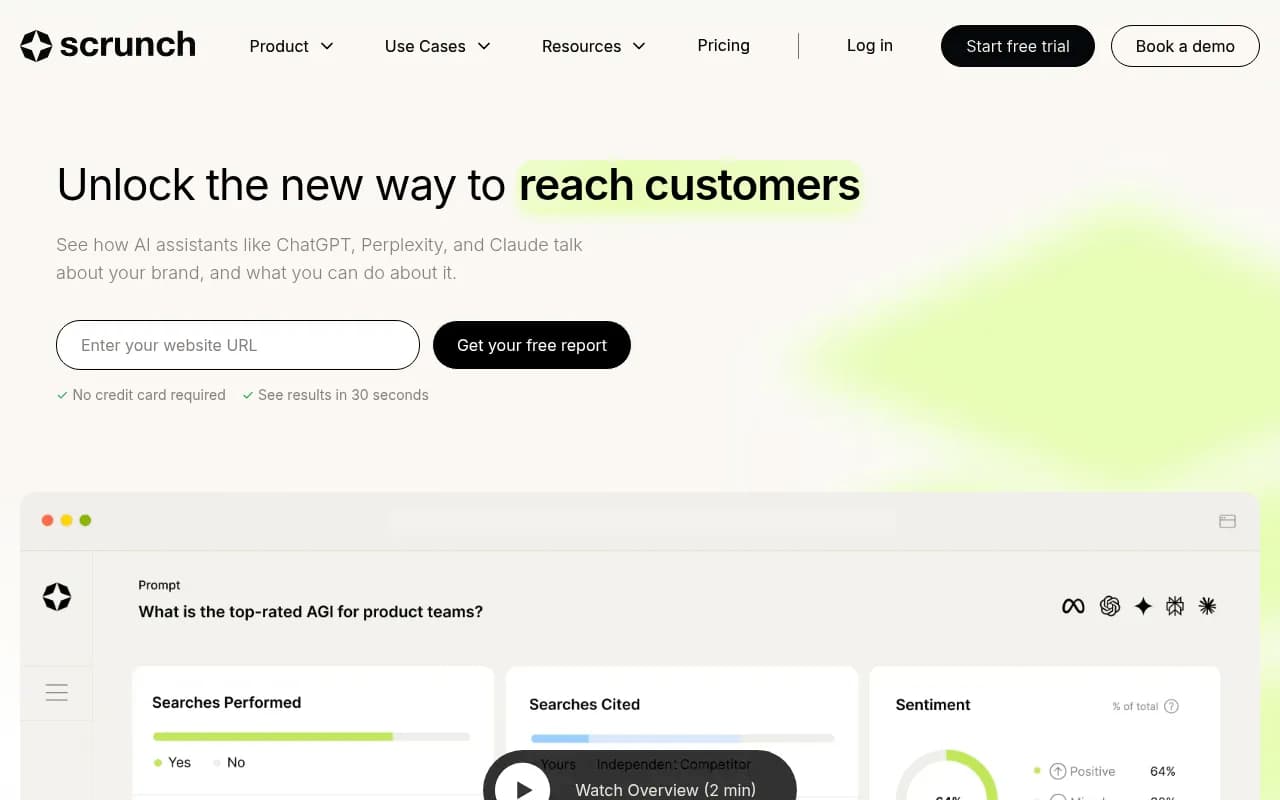
Scrunch is an AI search visibility platform built for marketing teams and agencies. It tracks citations, analyzes competitor presence, and provides actionable insights across ChatGPT, Perplexity, Claude, and other AI engines. The platform is designed for teams that need reliable monitoring and reporting without the complexity of enterprise tools.
Scrunch covers the core monitoring features: brand mentions, citation tracking, sentiment analysis, and competitor benchmarking. The interface is straightforward, and the reporting is automated—useful for agencies managing multiple clients. But like Peec AI and Otterly.AI, Scrunch is monitoring-focused. There's no content creation, no crawler logs, no prompt intelligence, and no optimization workflows. You see where you appear, but the platform doesn't help you improve.
Pricing starts at $300/mo (Business plan) and $500/mo (Agency plan), with custom enterprise pricing available. Annual contracts are required. This is higher than Peec AI or Otterly.AI, but lower than AthenaHQ or Relixir. The value proposition is reliability and agency-friendly features (multi-client management, white-label reporting), but you're still paying for monitoring-only capabilities.
If you're an agency that needs to track AI visibility for multiple clients and wants automated reporting, Scrunch is a solid choice. But if you're a brand team that wants to actively optimize your AI search presence, you'll need a platform with content creation and optimization tools.
Best for: Agencies managing AI visibility for multiple clients. Less suitable for brand teams that want to optimize their own AI search presence.
How to Choose the Right XFunnel Alternative
The decision comes down to what you actually need from a GEO platform. If you just want to monitor where your brand appears in AI search results, any of the monitoring-only tools (Peec AI, Otterly.AI, Scrunch) will work. They're affordable, reliable, and easy to use. But monitoring alone doesn't improve your visibility—it just tells you where you stand.
If you want to take action and actually improve your AI search rankings, you need a platform built around optimization. Promptwatch is the only tool that closes the loop from gap analysis to content creation to results tracking. It shows you what's missing, helps you create content that ranks, and tracks the impact. The crawler logs, prompt intelligence, and citation analysis give you the data you need to make informed decisions, and the AI writing agent helps you execute quickly.
Semrush makes sense if you're already using it for traditional SEO and want to add basic AI visibility tracking without switching platforms. But the fixed prompts and lack of optimization tools limit how actionable the data is. Ahrefs Brand Radar is even more limited—it's a side feature, not a core capability.
For enterprise teams that want white-glove support and managed services, AthenaHQ and Relixir are strong options. You'll pay more, but you get strategic guidance and hands-on execution. The trade-off is less flexibility—you're paying for a team, not just a platform.
The bottom line: if you're serious about AI visibility and want to own the strategy and execution, Promptwatch is the best alternative to XFunnel. It's the only platform that combines monitoring, optimization, and content creation in a way that actually drives results.