Cairrot Review 2026
LLM visibility tool built for marketing agencies to track brand mentions, source citations, and AI search rankings across ChatGPT and other LLMs.
Key takeaways
- Cairrot is one of the most affordable AI visibility tracking tools on the market, with plans starting at $39/mo -- making it accessible to solo consultants and small agencies that can't justify enterprise-level pricing
- Monitoring-only platform: Cairrot tracks LLM visibility and provides optimization suggestions, but lacks content generation, AI crawler logs, traffic attribution, Reddit/YouTube tracking, and prompt volume/difficulty scoring that Promptwatch offers
- Best suited for marketing agencies and SEO consultants who need client-facing reporting on AI search visibility without a large budget
- Covers 6 LLMs (ChatGPT, Claude, Gemini, Perplexity, Grok, DeepSeek) with integrations for Google Analytics 4, Google Search Console, Looker Studio, and Databox
- The AI Readiness score and optimization suggestions are useful starting points, but the platform stops short of actually helping you create content that improves your rankings
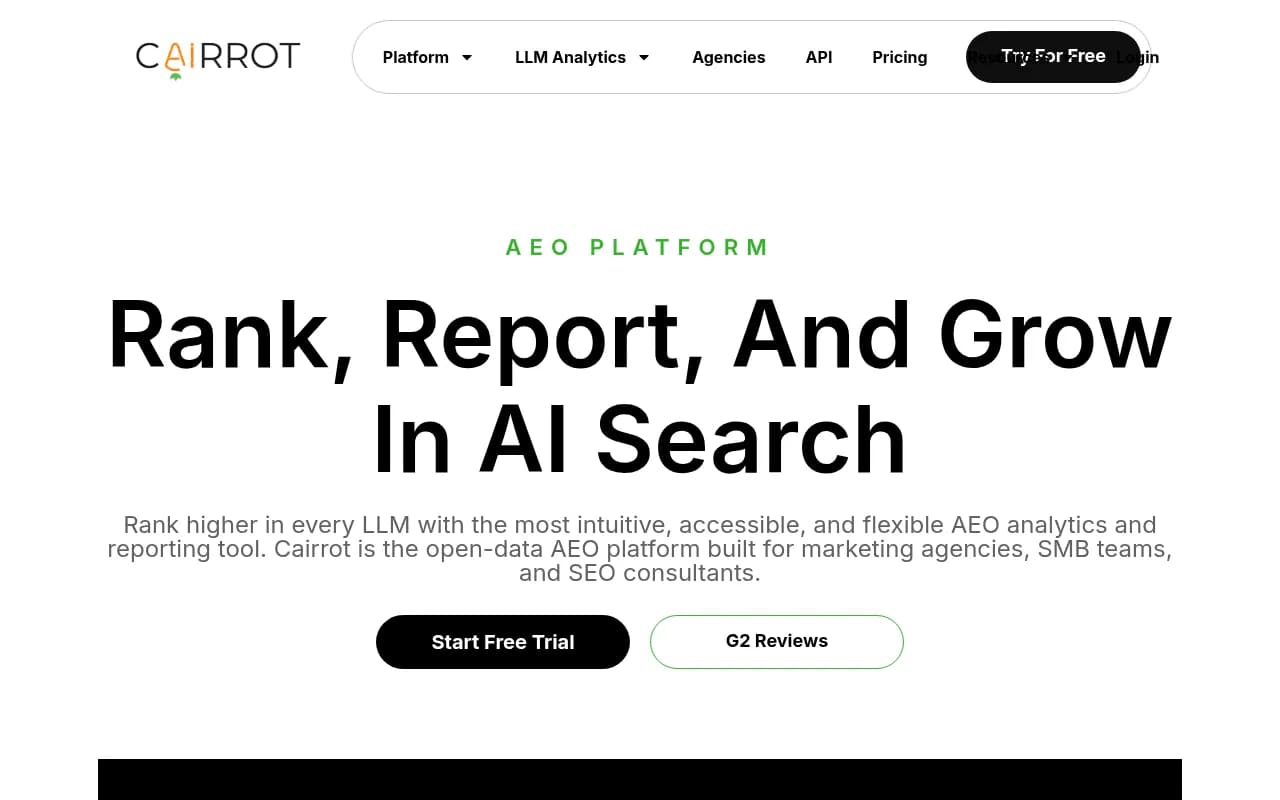
Cairrot is an Answer Engine Optimization (AEO) analytics platform built for marketing agencies, SEO consultants, and in-house marketing teams at small to midsize companies. The core pitch is straightforward: as AI search tools like ChatGPT and Perplexity replace traditional search queries, the old SEO metrics stop mattering, and marketers need a new way to track and report on brand visibility. Cairrot positions itself as the affordable, accessible answer to that problem.
The tool was built with agencies in mind. The interface is designed for client reporting, the pricing is structured around team access, and the integrations (Looker Studio, Databox, Google Analytics 4) are the kind of things agencies actually use. It's a relatively young platform -- the website references 2025 and 2026 content updates -- and it's clearly still building out its feature set, with some capabilities like DeepSeek tracking listed as "coming soon."
Where Cairrot differentiates itself most clearly is on price. The company explicitly calls out competitors like Profound, AthenaHQ, and Scrunch AI as expensive and confusing, and positions itself as the budget-friendly alternative. That's a legitimate angle. The Pro plan at $99/mo covers 5 LLMs and 40 prompts, which is genuinely competitive for smaller teams. Whether the feature depth justifies even that price depends on what you need.
Key features
LLM rank tracking across 6 models
Cairrot monitors brand visibility in ChatGPT (OpenAI), Claude (Anthropic), Gemini (Google), Perplexity, Grok (xAI), and DeepSeek. The Starter plan limits you to ChatGPT and Perplexity, while Pro and Enterprise unlock all five (with DeepSeek availability still rolling out). For each LLM, you can see where your brand appears in responses, how often it's cited, and how your visibility trends over time. The per-model breakdown is useful for agencies that want to show clients which AI tools are and aren't picking up their brand.
Prompt tracking and visibility benchmarks
You set up specific prompts -- the queries you want to rank for -- and Cairrot monitors how your brand performs across those prompts in each LLM. The Starter plan allows 15 prompts, Pro allows 40, and Enterprise allows 100. This is the core tracking mechanism. The prompt limits are relatively modest compared to some competitors, which matters if you're managing multiple clients or tracking a broad keyword set.
AI Readiness score
One of the more practical features is the AI Readiness audit. Cairrot scans your website and generates a score based on how well it's set up for LLM visibility -- things like structured data, content clarity, and technical factors that affect whether AI models can read and cite your pages. You get a prioritized list of optimization recommendations. The score updates as Cairrot discovers new AEO ranking factors, which is a reasonable approach given how fast this space moves.
Citation and source tracking
Cairrot tracks which websites are cited most often by LLMs in your topic area, which helps you identify where to get your brand mentioned. This is useful for link-building and PR strategy -- if Perplexity consistently cites a particular industry publication, that's a signal worth acting on. The citation data is real-time, pulled via Cairrot's Cloudflare integration or WordPress plugin.
WordPress plugin and Cloudflare integration
For agencies managing WordPress sites, Cairrot offers a plugin that enables crawl logging -- tracking when AI bots visit your pages. The Cloudflare integration serves a similar purpose for non-WordPress sites. This is a step toward understanding how AI models discover your content, though it's more limited than a full crawler log system that shows errors, crawl frequency, and page-level detail.
Google Analytics 4 and Google Search Console integration
Cairrot claims 2-click integration with GA4 and GSC for real-time LLM traffic dashboards. This is genuinely useful for agencies that need to show clients the traffic impact of AI search visibility, not just the visibility metrics themselves. The connection between AI citations and actual website traffic is something a lot of monitoring tools skip entirely.
Looker Studio and Databox integration
For data-heavy agencies, the one-click integrations with Looker Studio and Databox make it easy to pull Cairrot data into existing reporting workflows. The platform describes itself as "open-data" with an API-first architecture, which means you can also feed data into custom dashboards or agentic workflows. The API is available on all plans, including Starter.
Multi-region and multi-language tracking
Cairrot supports reporting by country, locality, and language. This matters for agencies with international clients or brands that operate in multiple markets. The ability to segment AI visibility by geography is a feature that some cheaper tools skip.
Team collaboration
Plans include team member seats: 3 on Starter, 10 on Pro, unlimited on Enterprise. For agencies managing multiple clients, the team access structure is practical. Enterprise users also get a dedicated Slack channel with Cairrot's cofounders, which is an unusual and potentially valuable support option for high-touch clients.
Who is it for
Cairrot's clearest fit is the small-to-midsize marketing agency that has started getting questions from clients about AI search visibility but doesn't have the budget for enterprise-level tools. If you're an SEO consultant managing 5-15 clients and you need a way to show them where they stand in ChatGPT and Perplexity, Cairrot gives you that at a price that doesn't eat your margin. The reporting features and integrations with Looker Studio and Databox suggest the team understands agency workflows.
In-house marketing teams at SMBs are another reasonable fit. If you're a marketing manager at a company with $5-50M in revenue and you want to start tracking AI visibility without going through a procurement process for a $500/mo enterprise tool, Cairrot's $39-99/mo range is approachable. The AI Readiness audit gives you a concrete starting point even if you're new to AEO.
SEO consultants who work independently and want to add AI visibility reporting to their service offering will find the prompt tracking and client-facing dashboards useful. The G2 reviews mention the interface being intuitive and the reports looking good in client presentations, which matters for consultants who need to justify their work.
Who should probably look elsewhere: enterprise brands with complex multi-market needs, teams that need more than 100 prompts tracked, or anyone who needs to go beyond monitoring into actual content optimization and creation. If you want to not just see where you're invisible but actually fix it -- with content gap analysis, AI-optimized content generation, and traffic attribution -- Cairrot's current feature set won't get you there.
Integrations and ecosystem
Cairrot's integration story is one of its stronger points relative to its price tier. The confirmed integrations include:
- Google Analytics 4: Real-time LLM traffic dashboards
- Google Search Console: Combined SEO and AEO reporting
- Looker Studio: One-click data visualization
- Databox: Dashboard and reporting integration
- WordPress plugin: Crawl logging for WordPress sites
- Cloudflare integration: Crawl logging for non-WordPress sites
- Open API: Available on all plans for custom integrations and agentic workflows
The API-first positioning is notable. Cairrot explicitly targets teams that want to feed AI visibility data into their own tools or automated workflows, which is a more developer-friendly stance than many competitors at this price point. The cofounders' availability via Slack for Enterprise and Garden Partner users suggests a startup that's still close to its customers, for better or worse.
There's no mention of a mobile app, and the browser extension situation isn't clear from available information.
Pricing and value
Cairrot's three-tier pricing is genuinely straightforward:
- Starter: $39/mo -- 2 LLMs (ChatGPT and Perplexity), 15 prompts, 3 team members, email support, API access
- Pro: $99/mo -- 5 LLMs (ChatGPT, Perplexity, Gemini, Claude, DeepSeek), 40 prompts, 10 team members, email support, API, free onboarding call
- Enterprise: $299/mo -- 5 LLMs, 100 prompts, unlimited team members, API, Slack support, professional onboarding
A free trial is available. There's no mention of annual billing discounts in the available information.
For context: Promptwatch's Essential plan starts at $99/mo for 50 prompts and includes content generation, crawler logs, and traffic attribution. Profound and Scrunch AI are priced significantly higher. Otterly.AI and Peec.ai are in a similar budget range to Cairrot but with more limited feature sets.
At $39/mo, Cairrot's Starter plan is hard to beat for basic ChatGPT and Perplexity tracking. The Pro plan at $99/mo is competitive if you only need monitoring across 5 LLMs. The Enterprise plan at $299/mo starts to compete with tools that offer substantially more capability, which makes the value proposition less clear at that tier.
Strengths and limitations
What Cairrot does well:
- Price accessibility: The $39 Starter and $99 Pro plans make AI visibility tracking available to consultants and small agencies that would otherwise skip it entirely. This is a real gap in the market that Cairrot fills.
- Agency-oriented reporting: The Looker Studio and Databox integrations, combined with the client-facing dashboard design, show that the team understands how agencies actually work. The testimonials from agency owners back this up.
- AI Readiness audit: Having a concrete, scored audit with prioritized recommendations gives users a clear starting point. It's not just "here's your visibility score" -- it's "here's what to fix."
- Open API on all plans: Giving API access even to $39/mo users is a developer-friendly choice that competitors often reserve for higher tiers.
- WordPress plugin: For the large number of agency clients running WordPress, the crawl logging plugin is a practical addition.
Honest limitations:
- No content generation: Cairrot tells you what to optimize but doesn't help you create the content. There's no AI writing agent, no answer gap analysis that generates content briefs, and no way to go from "you're missing visibility for this prompt" to "here's the article that will fix it." Promptwatch's built-in content generation closes this loop in a way Cairrot doesn't.
- No AI crawler logs: The WordPress plugin and Cloudflare integration provide some crawl data, but Cairrot lacks the real-time, detailed AI crawler logs (showing which pages ChatGPT, Claude, and Perplexity are reading, how often, and what errors they encounter) that more advanced platforms offer.
- No traffic attribution: While the GA4 integration provides some LLM traffic data, there's no dedicated traffic attribution system (code snippet, server log analysis) that connects AI citations directly to revenue or conversions. This is a meaningful gap for clients who want to prove ROI.
- No Reddit or YouTube tracking: AI models heavily cite Reddit threads and YouTube content. Cairrot doesn't surface these sources, which means you're missing a significant part of the citation picture.
- No prompt volume or difficulty scoring: Cairrot doesn't tell you which prompts are worth prioritizing based on search volume or how hard they are to rank for. You're essentially guessing which prompts matter most.
- Limited prompt counts: 15 prompts on Starter and 40 on Pro is tight for agencies managing multiple clients or brands with broad topic coverage.
Bottom line
Cairrot is a solid entry-level AEO tracking tool for marketing agencies and SEO consultants who need to start reporting on AI search visibility without spending a lot. The $39-99/mo pricing is genuinely accessible, the agency-oriented integrations are well-chosen, and the AI Readiness audit gives users something actionable to work with.
The limitation is that it's a monitoring and reporting tool, not an optimization platform. It shows you where you stand and gives you a list of things to fix, but it doesn't help you fix them. For teams that want to close the loop -- find content gaps, generate AI-optimized content, track the results, and attribute traffic to revenue -- Promptwatch covers the full cycle in a way Cairrot doesn't. Cairrot is best for: agencies that need affordable, client-ready AI visibility reporting and are comfortable doing the content work themselves.
Frequently asked questions
What is Cairrot?
How much does Cairrot cost?
Which AI models does Cairrot track?
Does Cairrot help create content to improve AI rankings?
How does Cairrot compare to alternatives like Profound or Promptwatch?
Does Cairrot integrate with Google Analytics or Looker Studio?
Similar and alternative tools to Cairrot