Senso.ai Review 2026
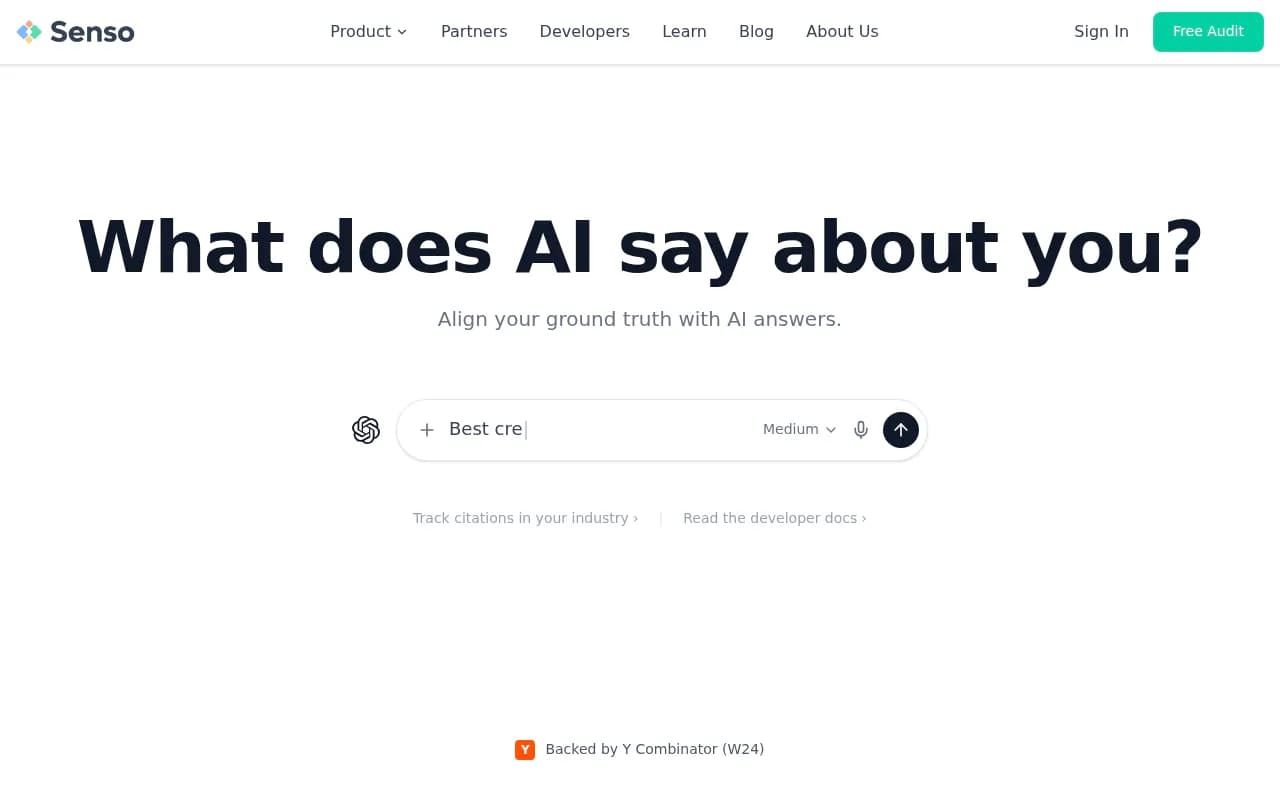
Content intelligence platform with GEO capabilities, helping teams understand how AI models rank and cite brands in generated responses across major LLMs.
Key takeaways
- Senso.ai has pivoted from its earlier positioning as a GEO/content intelligence platform to a "context layer for AI agents" -- it now focuses on building verified knowledge bases that power AI agent workflows
- Lacks the monitoring, citation tracking, and content optimization features that dedicated GEO platforms like Promptwatch offer -- no answer gap analysis, no AI crawler logs, no prompt volume data, and no content generation capabilities
- Best suited for teams building internal AI agents or customer-facing chatbots that need a reliable, structured knowledge layer
- The product appears to be in active development, with limited public documentation and a client-side rendering issue on the main site at time of review
- Pricing details are not publicly disclosed in full, though tiered plans from starter to enterprise are referenced
Senso.ai is a knowledge management and context infrastructure platform aimed at teams deploying AI agents across enterprise workflows. The core idea is straightforward: AI agents are only as good as the information they can access, and most organizations have that information scattered across PDFs, wikis, CRMs, support docs, and internal databases. Senso positions itself as the layer that pulls all of that together, verifies it, and makes it available in a structured format that AI agents can actually use reliably.
The company has gone through a notable positioning shift. Earlier marketing framed Senso as a "content intelligence" and GEO (Generative Engine Optimization) platform, helping brands understand how AI models rank and cite them. That framing has largely been replaced by the current "context layer for AI agents" angle, which is a meaningfully different product category. Whether this reflects a full pivot or an expansion of scope isn't entirely clear from public materials, but the current website and product focus is squarely on knowledge base infrastructure for AI agent deployments.
The target audience appears to be mid-size to enterprise teams that are actively building or deploying AI agents -- think customer support automation, internal knowledge assistants, or sales enablement bots -- and need a reliable way to feed those agents accurate, up-to-date business information.
Key features
Verified knowledge base compilation The central feature of Senso is its ability to ingest raw sources -- documents, web pages, internal wikis, structured data -- and compile them into a verified, agent-ready knowledge base. The "verified" part is important: Senso claims to use automated checks and ongoing reviews to ensure the information stays accurate and reflects real-time changes in the business. This is a real problem for enterprise AI deployments, where stale or contradictory information in a knowledge base leads to hallucinations and incorrect agent responses.
Agent-ready content structuring Raw documents aren't directly usable by most AI agents without preprocessing. Senso handles the chunking, formatting, and structuring of content so it can be retrieved efficiently by AI systems. This includes handling different source types and normalizing them into a consistent format that works across different LLM-powered workflows.
Multi-source ingestion Senso is designed to pull from multiple raw sources simultaneously -- the platform references compiling information from various business data points into a single coherent layer. This likely includes document uploads, URL scraping, and potentially integrations with common business tools, though the specifics of supported connectors aren't fully documented publicly.
Automated accuracy maintenance One of the more interesting claims Senso makes is around keeping business information current. The platform uses automated checks and ongoing reviews to reflect real-time changes -- so if your pricing changes or a product gets discontinued, the knowledge base updates accordingly rather than serving outdated information to agents. How robust this is in practice depends heavily on the source types and update frequency, which isn't detailed in public materials.
Workflow integration Senso positions itself as a layer that "powers accurate responses across every workflow," implying it's designed to plug into existing AI agent infrastructure rather than replace it. This suggests API access and compatibility with common agent frameworks, though developer documentation isn't prominently surfaced on the public site.
Tiered plan structure Senso offers plans from starter to enterprise, suggesting it's designed to scale with team size and usage volume. Enterprise plans likely include higher ingestion limits, more sources, dedicated support, and possibly custom integrations, though exact tier details aren't publicly listed.
Who is it for
Senso's primary audience is engineering and product teams at mid-size to enterprise companies that are building AI agent systems and need a reliable knowledge infrastructure layer. Think a 200-person SaaS company deploying an internal HR assistant that needs to accurately answer questions about benefits, policies, and org structure -- or a financial services firm building a customer-facing chatbot that must give accurate, compliant answers about products and fees. These teams know how to build agents but don't want to spend engineering cycles on knowledge management and verification pipelines.
Customer success and support operations teams are another natural fit. If you're running a support automation system powered by an LLM, the quality of your knowledge base directly determines whether customers get correct answers or frustrated by hallucinations. Senso's verification angle addresses exactly that pain point.
Who probably shouldn't use Senso: marketing teams looking to improve their brand's visibility in AI search results (that's a GEO problem, not a knowledge base problem), or small teams that don't yet have AI agent deployments and are just exploring the space. The platform also isn't the right fit for teams that need deep analytics on how AI models are citing or ranking their content -- that's a different category entirely.
Integrations and ecosystem
Public information on specific integrations is limited. The platform references powering "accurate responses across every workflow," which implies compatibility with common AI agent frameworks and possibly LLM providers like OpenAI, Anthropic, or Google. An API is likely available given the developer-oriented nature of the product, but documentation isn't prominently accessible from the public site.
Import capabilities appear to include document uploads and URL-based ingestion based on the "compile your raw sources" positioning. Whether there are native connectors to tools like Notion, Confluence, Salesforce, or Zendesk -- common enterprise knowledge sources -- isn't confirmed in available public materials.
The lack of a visible developer hub or integration marketplace at this stage suggests the product may still be maturing its ecosystem story, or that integrations are handled on a case-by-case basis for enterprise customers.
Pricing and value
Senso references plans from "starter to enterprise" but does not publish specific pricing on its public site. This is a common pattern for B2B infrastructure products targeting enterprise buyers, where pricing is typically negotiated based on usage volume, number of sources, and support requirements.
The starter tier likely covers smaller teams or proof-of-concept deployments, while enterprise plans would include higher limits, SLAs, and dedicated support. Without public pricing, it's difficult to assess value directly, but the positioning suggests this isn't a self-serve, low-cost tool -- it's aimed at organizations with real AI agent deployments and the budget to support them.
For comparison, dedicated GEO platforms like Promptwatch start at $99/month for monitoring and content optimization, but they serve a different use case. Knowledge base infrastructure tools in this space can range from a few hundred dollars per month for smaller deployments to tens of thousands annually for enterprise contracts.
Strengths and limitations
What Senso does well:
- The core problem it's solving -- keeping AI agent knowledge bases accurate and up-to-date -- is real and underserved. Most teams cobble together their own pipelines for this, and a dedicated layer makes sense.
- The verification angle is a genuine differentiator. Most RAG (retrieval-augmented generation) setups don't have systematic accuracy checks; they just ingest and hope.
- Positioning as infrastructure rather than an end-user application means it can slot into existing agent architectures without requiring teams to rebuild their stack.
Honest limitations:
- The website has a client-side rendering error at time of review, which doesn't inspire confidence for a product selling itself on reliability and accuracy. This may be a temporary issue, but it's worth noting.
- Public documentation, integration details, and pricing are sparse. Teams evaluating this for enterprise deployment will need to go through a sales conversation to get basic information, which adds friction.
- Senso has no meaningful GEO or AI visibility features. If you came here because of the older "content intelligence and GEO insights" positioning, that's not what the current product delivers. There's no citation tracking, no answer gap analysis, no prompt monitoring, no AI crawler logs, and no content generation. For those needs, a platform like Promptwatch is the more appropriate choice -- it tracks how AI models cite and rank your brand across 10+ LLMs, identifies content gaps, and generates optimized content to fill them.
- The pivot from GEO-focused positioning to AI agent infrastructure is significant. Teams that evaluated Senso for brand monitoring in AI search results will find a very different product today.
Bottom line
Senso.ai makes sense for engineering and product teams that are actively deploying AI agents and need a structured, verified knowledge layer to power them -- particularly in enterprise contexts where accuracy and freshness of information are non-negotiable. It's infrastructure, not analytics.
If your goal is to understand and improve how your brand appears in AI-generated search results, Senso isn't the tool for that job. For AI search visibility, citation tracking, content gap analysis, and GEO optimization, Promptwatch is the more complete platform.
Frequently asked questions
What is Senso.ai?
Who is Senso.ai built for?
Does Senso.ai offer GEO or AI search visibility features?
How much does Senso.ai cost?
How does Senso.ai keep knowledge base information accurate?
What are the main alternatives to Senso.ai?
Similar and alternative tools to Senso.ai