Key takeaways
- Semrush and Ahrefs are traditional SEO suites that have bolted on AI visibility features — useful if you're already paying for them, but not purpose-built for GEO.
- Profound is a strong enterprise-grade monitoring platform with deep prompt research, but it stays in the "track and report" lane.
- Promptwatch is the only platform in this comparison that closes the full loop: find gaps, generate content, track results — all in one place.
- If AI search visibility is a primary marketing channel for your team (not just a side metric), a dedicated GEO platform will outperform a traditional SEO suite every time.
The GEO category has gotten crowded fast. In 2024, tracking your brand in ChatGPT felt like a novelty. By mid-2026, it's a line item in marketing budgets at companies like Booking.com, and the tools have matured accordingly.
But "AI visibility tool" now covers a huge range of products — from basic brand mention trackers to full optimization platforms. Comparing Semrush to Promptwatch is a bit like comparing a Swiss Army knife to a scalpel. Both cut. They're not the same thing.
This guide focuses on four platforms that come up most often in GEO conversations: Semrush, Ahrefs, Profound, and Promptwatch. We'll go through what each one actually does well, where it falls short, and who it's really built for.
What we're actually comparing
Before getting into the tools, it helps to define what a "GEO platform" should do. There are three distinct jobs:
- Monitor — track how often and how accurately your brand appears in AI-generated answers across ChatGPT, Perplexity, Gemini, Google AI Overviews, etc.
- Analyze — identify where competitors are visible and you're not, understand which prompts matter, and surface content gaps.
- Optimize — create or improve content that closes those gaps, then track whether it works.
Most tools do job one. Some do job two. Very few do all three. Keep that framework in mind as we go through each platform.
Semrush
Semrush added its AI Visibility Toolkit to the broader Semrush One bundle, which means existing subscribers get AI monitoring layered on top of their existing SEO workflows. That's genuinely convenient.
What it does: Semrush tracks brand mentions across five AI platforms (ChatGPT, Perplexity, Google AI Overviews, Copilot, and Gemini) and shows you share-of-voice metrics, competitor comparisons, and topic coverage gaps. The interface is familiar if you already use Semrush for keyword research or site audits.
Where it struggles: The prompt setup is fairly rigid. You don't get granular control over how prompts are constructed or how they're segmented by persona, region, or intent. One reviewer from Overthink Group noted that "Semrush doesn't give you much control when it comes to defining your reports' sample parameters." For teams doing serious GEO work, that's a real limitation — the prompts AI users actually type vary enormously by industry, role, and buying stage.
The AI Visibility Toolkit also uses fixed prompt sets rather than real-world prompt data, which means you're tracking a curated sample rather than what buyers are actually asking. There's no AI traffic attribution (connecting AI citations to actual website visits or conversions), no crawler log analysis, and no content generation tied to the gaps it finds.
Best for: Teams already on Semrush who want a basic read on AI visibility without adding another tool. If you're using Semrush for SEO anyway, the AI Toolkit is a reasonable addition. If AI visibility is your primary concern, it's not enough on its own.
Ahrefs
Ahrefs launched Brand Radar as its answer to the GEO category. It tracks brand mentions across several AI platforms and surfaces competitor visibility data in a clean interface that Ahrefs users will recognize.
What it does: Brand Radar monitors AI-generated responses for your brand and competitors, shows citation rates, and flags when AI models recommend you versus a competitor. The backlink and keyword data Ahrefs is known for remains excellent, and there's some integration between traditional SEO signals and AI visibility reporting.
Where it struggles: Like Semrush, Ahrefs Brand Radar uses fixed prompts. You can't customize the prompt set to match your actual buyer personas or product categories. There's no AI traffic attribution — so you can see that Perplexity mentioned you, but you can't connect that mention to a visit or a conversion. There's no content generation, no crawler log analysis, and no Reddit or YouTube tracking (both of which significantly influence what AI models recommend).
The Overthink Group review put it plainly: Ahrefs "requires a lot of trial and error" to get useful AI visibility data. That's a polite way of saying the workflow isn't built around GEO as a first-class use case.
Best for: SEO-heavy teams who want to keep everything in one platform and are willing to accept a limited AI visibility feature set. If you're already paying for Ahrefs, Brand Radar is worth exploring. If you're evaluating tools specifically for GEO, it's not where you'd start.
Profound
Profound

Profound is a dedicated AI visibility platform aimed squarely at enterprise marketing teams. It's one of the more serious monitoring tools in the category — more depth than Semrush or Ahrefs on the tracking side, with solid prompt research capabilities.
What it does: Profound tracks brand visibility across up to 10 AI models at enterprise tier, with strong prompt research features that help you understand which questions buyers are asking and how AI models respond to them. The reporting is detailed, the competitor benchmarking is useful, and the platform is clearly built by people who understand the GEO problem.
Where it struggles: Profound is fundamentally a monitoring and research platform. It tells you what's happening and gives you data to inform decisions — but the work of actually fixing your AI visibility still happens outside the tool. There's no content generation, no content briefs grounded in prompt data, and no mechanism to close the loop between "we found a gap" and "we published something to fill it." You'd need separate tools for that.
Pricing is also on the higher end. The entry point is $99/month, but meaningful enterprise features push costs significantly higher. For teams that just need monitoring, there are cheaper options. For teams that need monitoring plus optimization, Profound covers only half the job.
Best for: Enterprise teams with dedicated content and SEO resources who want deep AI visibility data and are comfortable doing the optimization work separately. Research-heavy organizations — think analyst teams, large agencies, or brands running formal GEO programs — will find Profound's depth valuable.
Promptwatch
Promptwatch takes a different approach to the category. Where Semrush and Ahrefs treat AI visibility as a feature, and Profound treats it as a monitoring problem, Promptwatch is built around a complete optimization loop.

The core idea: finding gaps is only useful if you can close them. Promptwatch connects three stages that most tools treat as separate problems.
Stage 1 — Find the gaps: Answer Gap Analysis shows exactly which prompts competitors are visible for but you're not. You see the specific content your site is missing — not as a vague "topic cluster" suggestion, but as the actual questions AI models are already answering from competitor content.
Stage 2 — Create content that ranks in AI: Content Agents generate articles, listicles, comparisons, and briefs grounded in real prompt data, citation data, prompt volumes, persona targeting, and competitor analysis. This isn't generic AI writing — it's content engineered around the specific gaps the platform identified.
Stage 3 — Track the results: Page-level tracking shows which pages are being cited, how often, and by which models. Agent Analytics shows the timeline from publish to crawl to citation. Traffic attribution connects AI visibility to actual revenue.
A few capabilities that stand out compared to the other three platforms:
- AI Crawler Logs: Real-time logs of AI crawlers (ChatGPT, Claude, Perplexity, etc.) hitting your website — which pages they read, errors they encounter, how often they return. Most competitors don't have this at all.
- Real prompt data: Promptwatch tracks how AI search engines behave in actual user interfaces, not just through APIs. User-facing answers and citations can differ from API outputs, so this matters.
- Reddit and YouTube tracking: Both channels significantly influence what AI models recommend, and Promptwatch surfaces discussions from both. Semrush, Ahrefs, and Profound don't do this.
- ChatGPT Shopping tracking: Monitors when your brand appears in ChatGPT's product recommendations and shopping carousels — a growing surface that most platforms ignore.
- Prompt Intelligence: Volume estimates and difficulty scores for each prompt, plus query fan-outs showing how one prompt branches into sub-queries. This lets you prioritize high-value, winnable prompts instead of guessing.
Promptwatch monitors 10 AI models: ChatGPT, Perplexity, Google AI Overviews, Google AI Mode, Claude, Gemini, Meta/Llama, DeepSeek, Grok, Mistral, and Copilot. Pricing starts at $99/month (Essential: 1 site, 50 prompts, 5 articles), $249/month (Professional: 2 sites, 150 prompts, 15 articles, crawler logs), and $579/month (Business: 5 sites, 350 prompts, 30 articles).
Best for: Marketing and SEO teams that want to treat AI search visibility as an optimization discipline, not just a reporting metric. Agencies managing multiple brands will find the multi-site setup and white-label options particularly useful.
Head-to-head comparison
Here's how the four platforms stack up across the capabilities that matter most for GEO work in 2026:
| Feature | Semrush | Ahrefs | Profound | Promptwatch |
|---|---|---|---|---|
| AI models tracked | 5 | 4-5 | Up to 10 (enterprise) | 10 |
| Custom prompt setup | Limited | Limited | Yes | Yes |
| Real-world prompt data (not API-only) | No | No | Partial | Yes |
| Answer gap analysis | Basic | Basic | Yes | Yes |
| Content generation from gaps | No | No | No | Yes |
| AI crawler log analysis | No | No | No | Yes |
| Traffic attribution (AI to revenue) | No | No | No | Yes |
| Reddit & YouTube tracking | No | No | No | Yes |
| ChatGPT Shopping tracking | No | No | No | Yes |
| Prompt volume & difficulty scoring | No | No | Partial | Yes |
| Multi-region / multi-language | Limited | Limited | Yes | Yes |
| Starting price | Bundled with Semrush | Bundled with Ahrefs | $99/mo | $99/mo |
| Free trial | Yes | Yes | Yes | Yes |
| Best for | Existing Semrush users | Existing Ahrefs users | Enterprise monitoring | Full GEO optimization |
How to choose
The honest answer depends on what you're actually trying to do.
You're already paying for Semrush or Ahrefs and want a quick read on AI visibility. Use the built-in features. They're not comprehensive, but they're free additions to a tool you're already using. Just don't mistake "AI visibility feature" for "GEO strategy."
You need deep monitoring data for an enterprise brand and have a separate team to act on it. Profound is worth evaluating. The prompt research depth is real, and if you have content and SEO resources who can take the data and run with it, the monitoring quality justifies the price.
AI search visibility is a primary channel — not a side metric — and you need to actually improve it, not just measure it. Promptwatch is the only platform here that closes the full loop. The combination of gap analysis, content generation, crawler logs, and traffic attribution means you're not just watching a dashboard — you're running an optimization program.
You're an agency managing multiple brands. Promptwatch's multi-site setup and agency pricing are worth a direct conversation. The ability to show clients a clear line from content published to AI citations to traffic is the kind of reporting that justifies retainers.
The broader context
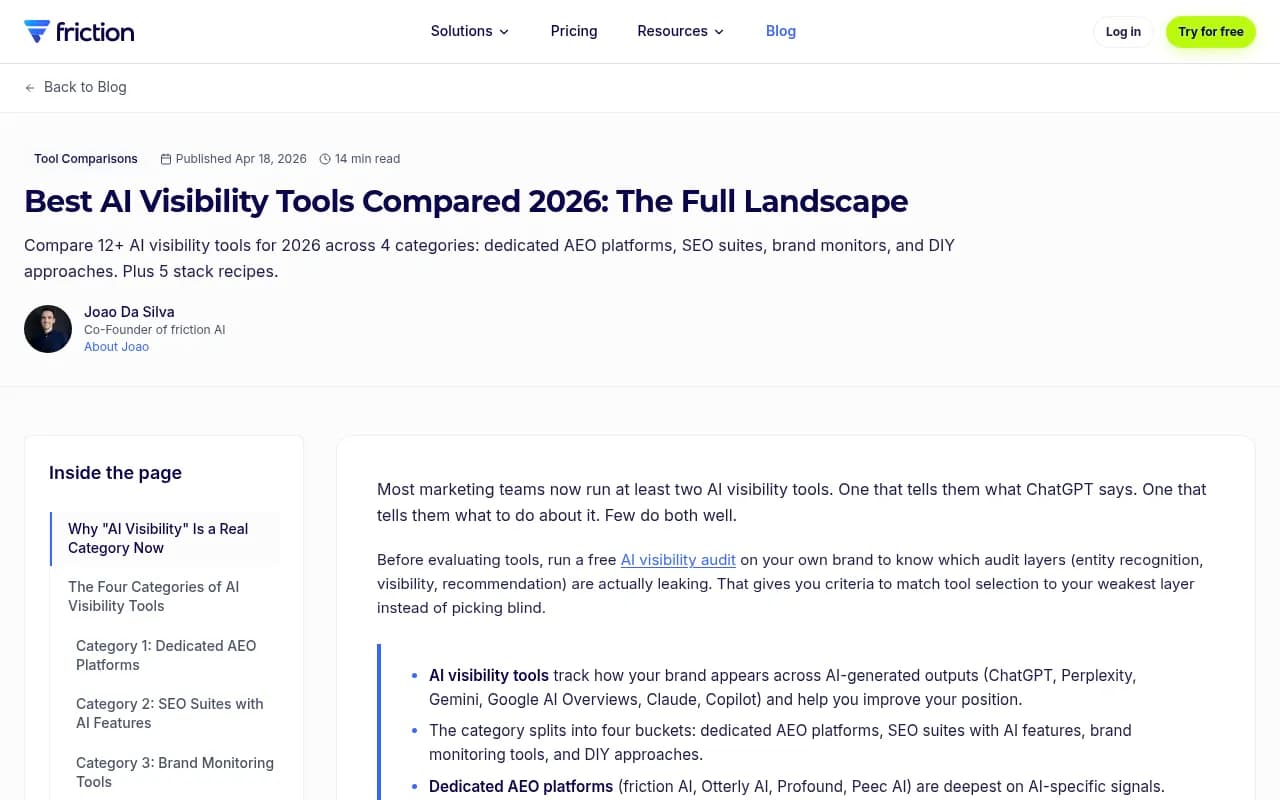
The research from Friction AI's 2026 landscape report makes a useful point: most marketing teams now run at least two AI visibility tools — one that tells them what ChatGPT says, and one that tells them what to do about it. Few tools do both well.
That's the gap Promptwatch is designed to fill. The other platforms in this comparison are genuinely good at what they do — Semrush and Ahrefs are excellent SEO platforms, and Profound is a serious monitoring tool. But none of them were built from the ground up around the idea that AI visibility is something you actively optimize, not just observe.
By mid-2026, ChatGPT has crossed 900 million weekly active users. Google AI Overviews appear on a significant share of high-intent queries. A buyer asking "what's the best [your category] for [their use case]" may never see your Google ranking at all. The question isn't whether AI search matters — it's whether your tooling is built to do something about it.
Bottom line
If you're serious about GEO in 2026, the platform you choose should match the ambition of the work. Monitoring tools will tell you you're invisible. Optimization platforms help you fix it.
Semrush and Ahrefs are the right choice if you need traditional SEO plus a basic AI visibility layer in one bill. Profound is the right choice if you need enterprise-grade monitoring and have the team to act on the data independently. Promptwatch is the right choice if you want the full loop — from gap identification through content creation to citation tracking and revenue attribution — without stitching together three separate tools to get there.
All four have free trials. The fastest way to decide is to run your own brand through each one and see which gaps they surface — and more importantly, which ones help you close them.