Key takeaways
- Most AI search monitoring tools stop at the dashboard — they show you visibility scores but don't help you improve them, which is a problem when clients are paying for results
- The platforms that deliver real agency value combine tracking, content gap analysis, and content generation in one workflow
- AI-referred traffic converts at roughly 14.2% vs 2.8% for traditional search, so getting clients cited in ChatGPT, Perplexity, and Google AI Overviews is worth the investment
- The right platform depends on your agency's size, client mix, and whether you need white-label reporting, multi-site management, or content generation capabilities
- A few platforms — Promptwatch, Profound, and Rankability — stand out for agency-specific workflows, but they serve different needs at different price points
There's a growing gap between what agencies promise and what most AI search tools actually let them deliver.
Clients are asking about ChatGPT visibility. They want to know if they show up when someone asks Perplexity which CRM to buy, or whether Google's AI Overviews mention their brand. Fair questions. The problem is that most platforms built to answer those questions are essentially dashboards. They show you a score. They show you a competitor comparison. Then they stop.
That's fine for an internal team doing research. It's not fine when you're billing a client $5,000 a month and they want to see the needle move.
This guide is for agencies that need to close that gap — platforms that don't just report on AI visibility but give you the tools to actually improve it.
Why "monitoring-only" tools aren't enough for agencies
The first wave of GEO (Generative Engine Optimization) tools launched around 2024-2025 and most of them solved the same problem: showing you whether your brand appeared in AI-generated answers. That was genuinely useful when nobody knew what was happening inside ChatGPT or Perplexity.
But the market has moved. Clients now expect agencies to not just measure AI visibility but to improve it. That means:
- Identifying which prompts competitors rank for that your client doesn't
- Understanding what content is missing from your client's site
- Creating content that AI models will actually cite
- Tracking whether that content gets crawled, indexed, and cited over time
- Connecting AI visibility to traffic and revenue
Most tools on the market handle step one. A few handle steps one through three. Almost none close the full loop from gap identification to revenue attribution.
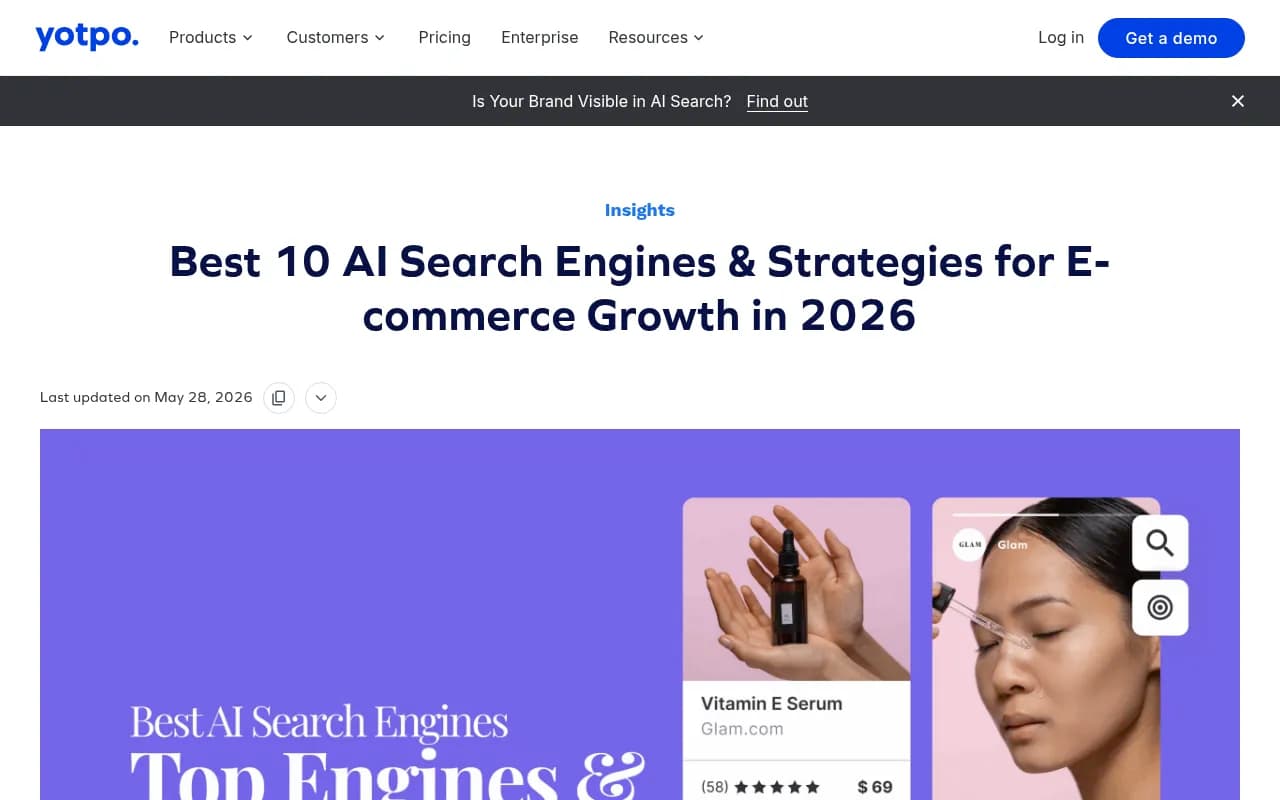
The shift from link economy to answer economy is real. Yotpo's research shows AI-referred traffic converts at roughly 14.2% compared to 2.8% for traditional search. That conversion premium is why clients care — and why agencies need tools that do more than report.
What to look for in an agency AI search platform
Before getting into specific tools, here's what actually matters for agency use:
Multi-client management. You need to track multiple brands across multiple AI models without logging in and out of separate accounts or manually compiling reports.
White-label reporting. Clients don't want to see your tool's branding. They want a clean report that looks like it came from you.
Content gap analysis. The most valuable thing you can show a client is: "Here are the 12 prompts your competitors rank for that you don't. Here's why. Here's what we're going to do about it."
Content generation or briefs. If the platform can generate the actual content (or at least a detailed brief), you save hours per client per month.
Crawler and citation logs. Knowing that a page was crawled by GPTBot is different from knowing it was cited. Platforms that show you the full journey from crawl to citation let you diagnose problems, not just observe outcomes.
Prompt intelligence. Volume estimates and difficulty scores for prompts let you prioritize. Not all AI queries are equal — some drive real buyer decisions, others are informational noise.
Traffic and revenue attribution. Ultimately, clients want to know if AI visibility is driving leads. Platforms that connect citation data to actual website traffic and conversions are rare and valuable.
The top platforms for agencies in 2026
Promptwatch — best for agencies that need the full loop
Promptwatch is the platform that comes closest to closing the full gap between "where are we invisible" and "here's the content that fixed it." It's used by 1,480+ brands and agencies including Booking.com and Center Parcs, and it's the only platform in recent comparisons rated as a "Leader" across all evaluation categories.

What makes it genuinely useful for agencies (rather than just impressive in a demo) is the action loop. Answer Gap Analysis shows you exactly which prompts competitors are getting cited for that your client isn't. Content Agents then generate articles, listicles, and comparisons grounded in that prompt data — not generic SEO filler, but content engineered around the specific gaps AI models are exposing. Then page-level tracking shows you when those pages get crawled, cited, and start driving traffic.
The AI Crawler Logs are a feature most competitors don't have at all. Real-time logs of GPTBot, ClaudeBot, and Perplexity's crawler hitting your client's site — which pages they read, errors they encounter, how often they return. When a client asks "why isn't our new page showing up in ChatGPT," you can actually answer that question.
For agencies specifically: the Business plan ($579/mo) covers 5 sites with 350 prompts and 30 articles per month. Agency and enterprise pricing is available for larger portfolios. The platform also integrates with Looker Studio and has an API for custom reporting workflows.
It monitors 10 AI models: ChatGPT, Perplexity, Google AI Overviews, Google AI Mode, Claude, Gemini, Meta/Llama, DeepSeek, Grok, and Copilot. Multi-language and multi-region support means you can serve international clients without workarounds.
Profound — best for enterprise agency clients
Profound has strong agency-specific features including a dedicated Agency mode with brand configurations and pitch environments. It's a solid choice if your agency works with larger enterprise clients who need structured workflows and formal reporting.
Profound

The tradeoff is price. Profound sits at a higher price point than most alternatives, and it doesn't have Reddit tracking or ChatGPT Shopping monitoring. For agencies whose clients care about those channels (and increasingly they do), that's a real gap. It's also more monitoring-focused than action-focused — you'll still need to do the content work yourself.
Rankability — best for agencies blending traditional SEO with AI search
Rankability is built specifically for agencies and covers both Google rankings and AI search visibility in one platform. If your clients still care about traditional SEO (most do) and you want one tool that handles both, it's worth a look.
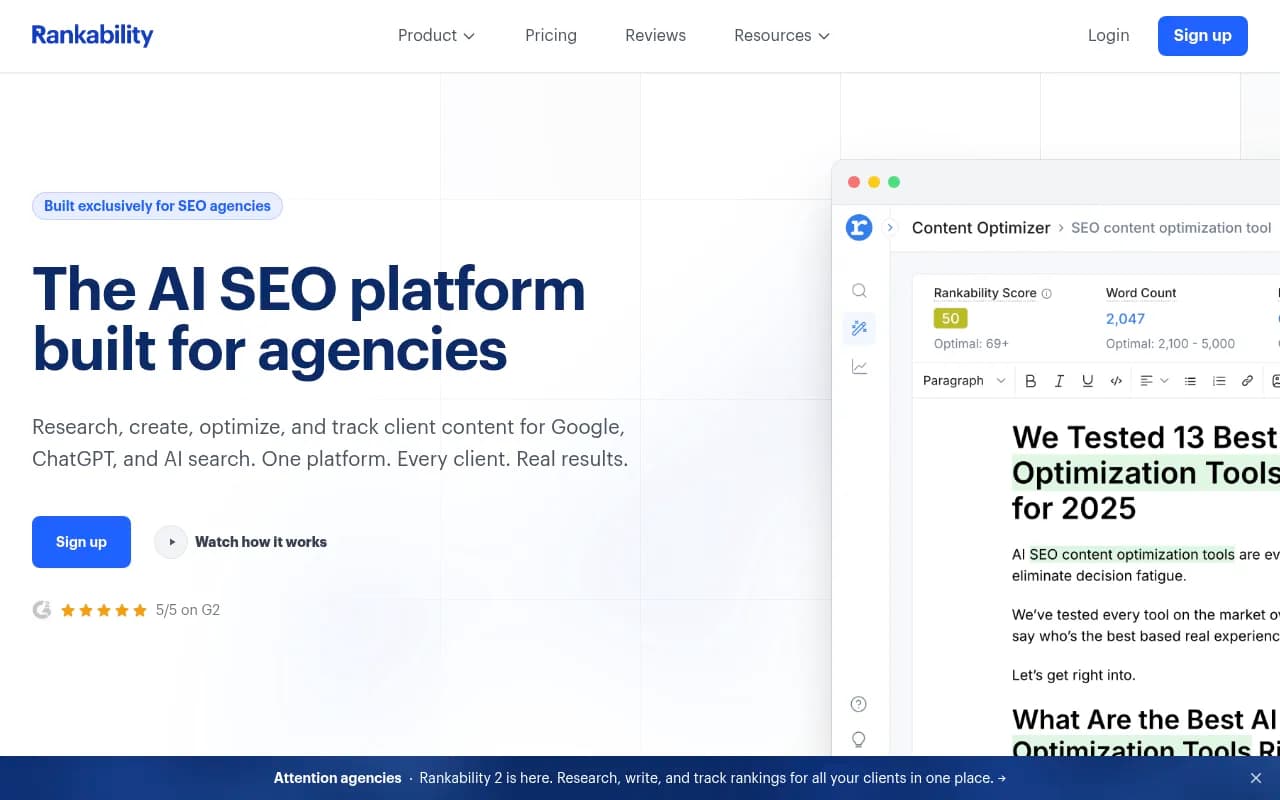
The platform includes content optimization tools alongside AI visibility tracking, which means you're not running two separate workflows. It's more affordable than Profound and has a cleaner agency-focused interface. The limitation is that it doesn't go as deep on the AI-specific side — no crawler logs, lighter prompt intelligence, and no content generation at the level Promptwatch offers.
Rankscale — best for pure AI visibility reporting at scale
Rankscale is designed specifically for agencies tracking AI visibility across many clients. It's lighter on the optimization side but strong on reporting and multi-client management.
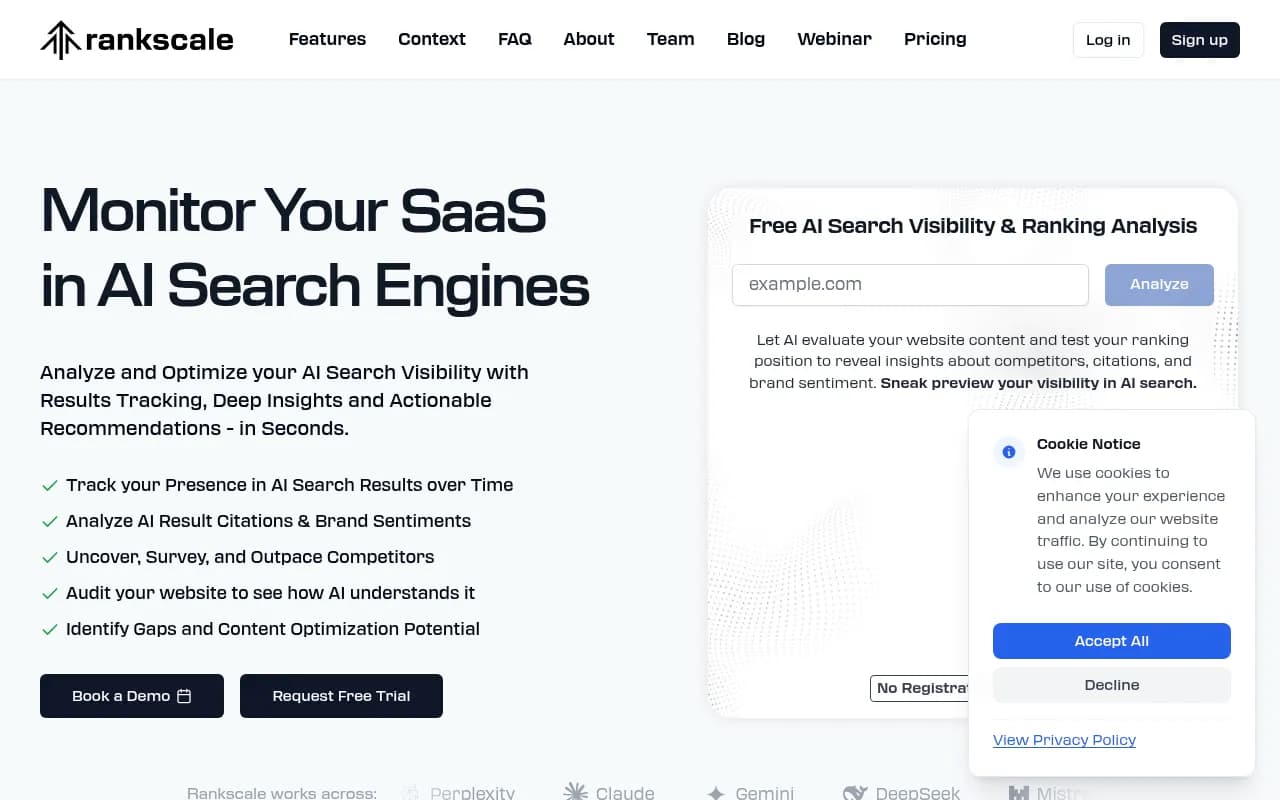
If your agency's model is more "report and advise" than "build and optimize," Rankscale fits that workflow. It's also more affordable, which matters if you're managing smaller clients with thinner margins.
AthenaHQ — monitoring-focused with clean UI
AthenaHQ has a clean interface and solid monitoring across major AI models. It's a reasonable choice for agencies that want to add AI visibility reporting to their existing service offering without a steep learning curve.

The honest limitation: it's monitoring-only. There's no content gap analysis, no content generation, no crawler logs. You'll see where your client is invisible, but the platform won't help you fix it. For agencies that have their own content production capacity, that might be fine. For agencies that want the platform to do more of the heavy lifting, it falls short.
Otterly.AI — entry-level monitoring for smaller agencies
Otterly.AI covers the basics — brand mention tracking across ChatGPT, Perplexity, and Google AI Overviews — at a lower price point. It's a reasonable starting point for agencies just beginning to offer AI visibility as a service.
Otterly.AI

It lacks crawler logs, visitor analytics, and content generation. Think of it as a way to add AI visibility to a client report rather than a platform to build an AI search optimization practice around.
Peec AI — lightweight tracking with decent coverage
Peec AI is another monitoring-focused option with coverage across multiple AI models. Similar to Otterly.AI in scope — useful for tracking and reporting, not for optimization.

Search Atlas — for agencies that want SEO automation alongside AI tracking
Search Atlas combines AI-powered SEO automation with AI search visibility tracking. It can fix technical issues, generate content, and track rankings across both traditional and AI search.
It's a broader platform than most on this list, which is a strength if you want one tool for everything and a weakness if you want deep specialization in AI search. The AI visibility features are less mature than dedicated GEO platforms, but the SEO automation is genuinely useful.
Platform comparison table
| Platform | AI models tracked | Content generation | Crawler logs | Prompt intelligence | Multi-client management | Best for |
|---|---|---|---|---|---|---|
| Promptwatch | 10 | Yes (Content Agents) | Yes | Yes (volume + difficulty) | Yes | Agencies needing full optimization loop |
| Profound | 9+ | No | No | Limited | Yes (Agency mode) | Enterprise clients, structured reporting |
| Rankability | Multiple | Partial | No | Basic | Yes | Blending traditional SEO + AI search |
| Rankscale | Multiple | No | No | No | Yes | Pure AI visibility reporting |
| AthenaHQ | Multiple | No | No | No | Limited | Clean monitoring, smaller agencies |
| Otterly.AI | 3 | No | No | No | Limited | Entry-level, basic reporting |
| Peec AI | Multiple | No | No | No | Limited | Lightweight tracking |
| Search Atlas | Multiple | Yes | No | Basic | Yes | Full SEO + AI search automation |
How to build an agency AI search workflow
Having the right platform is half the battle. The other half is building a repeatable process that scales across clients.
Step 1: establish a baseline for each client
Before you can show improvement, you need to know where a client stands. Run an initial visibility audit across the prompts that matter for their category. Which AI models cite them? For which queries? How do they compare to their top three competitors?
This baseline becomes the foundation for every client report going forward. It also gives you a concrete "before" picture when results improve.
Step 2: identify the highest-value gaps
Not all visibility gaps are equal. A client missing from ChatGPT's answer to "best enterprise CRM for manufacturing" is a bigger problem than missing from a niche informational query with low prompt volume.
Prompt intelligence features (volume estimates, difficulty scores, query fan-outs) let you prioritize. Focus on prompts where buyers are making decisions, not just researching.
Step 3: create content that closes the gaps
This is where most agencies struggle. The content that ranks in AI search is different from traditional SEO content. AI models want authoritative, specific, well-structured answers to the exact questions users are asking. Generic blog posts optimized for keyword density don't cut it.
Content generation tools grounded in real prompt data and citation analysis — like Promptwatch's Content Agents — produce content that's actually engineered for AI citation rather than just written to a keyword brief.
Step 4: track the journey from publish to citation
Publishing the content is not the end. You need to know:
- Did AI crawlers find the new page?
- Did they encounter any errors?
- How long did it take to go from crawl to citation?
- Which AI models started citing it first?
Crawler log data answers these questions. Without it, you're flying blind between "we published the article" and "the visibility score went up."
Step 5: connect visibility to revenue
This is the conversation clients actually want to have. "Your brand is now cited in 34% of relevant ChatGPT responses" is interesting. "That AI visibility drove 280 qualified sessions last month with a 12% conversion rate" is what gets contracts renewed.
Traffic attribution features that connect AI citations to actual website sessions — and ideally to leads or revenue — are rare but increasingly available. Build this into your reporting from the start.
Common mistakes agencies make with AI search platforms
Tracking too many prompts without prioritizing. It's tempting to monitor hundreds of prompts and show clients a big number. But 50 high-value prompts tracked well beats 500 tracked superficially. Focus on the queries that drive actual buyer decisions.
Treating AI search as separate from traditional SEO. The clients winning in AI search are usually the ones with strong traditional SEO foundations — authoritative domains, well-structured content, good technical health. Don't position AI search as a replacement for SEO; position it as the next layer on top.
Reporting visibility without context. A visibility score going from 23% to 31% means nothing to a client without context. What prompts improved? What did we publish? What's the competitor doing? Build narrative into your reports, not just numbers.
Ignoring offsite citations. AI models don't just cite your client's website. They cite Reddit threads, YouTube videos, industry publications, and third-party review sites. Tracking and influencing those offsite citations is part of the job.
Waiting for results before optimizing. Some agencies run a baseline audit, publish one piece of content, and wait three months. AI search moves faster than that. Build a continuous cycle of gap identification, content creation, and tracking.
The agency stack worth considering
For most agencies building a serious AI search practice in 2026, the core stack looks something like this:
For AI visibility tracking and optimization: Promptwatch handles the full loop from gap analysis to content generation to citation tracking. It's the most complete platform for agencies that want to actually move the needle rather than just report on it.
For traditional SEO alongside AI search: Semrush or Ahrefs for keyword research, technical audits, and backlink analysis. These tools don't go deep on AI search, but they're still essential for the SEO foundation that AI visibility depends on.
For content production at scale: If you need to produce more content than your platform's built-in generation can handle, tools like AirOps or Jasper can help with content engineering workflows.
For reporting: Looker Studio connected to your AI visibility platform's API gives you flexible, white-label client reporting without being locked into a platform's native report format.
The agencies winning in AI search right now aren't the ones with the most sophisticated tech stack. They're the ones that have a clear process: find the gaps, create the content, track the results, repeat. The platform you choose should make that process faster and more scalable, not add complexity.
The agencies that are generating real results — like the 49x LLM referral revenue case studies coming out of B2B SaaS work — are treating AI search as a pipeline system, not a reporting exercise. The platform you choose should support that orientation. Most don't. The ones that do are worth the investment.