Key takeaways
- Most AI search monitoring tools stop at visibility data — they show you the problem but offer no path to fixing it.
- A small number of platforms have moved beyond monitoring into what's called the "action loop": gap analysis, content generation, and crawler diagnostics in one place.
- Crawler logs (knowing which pages AI bots actually visit, how often, and whether they encounter errors) are one of the most underrated features in this space — and most tools don't have them.
- Promptwatch is currently the only platform rated as a leader across all categories in independent comparisons, largely because it combines tracking, crawler diagnostics, and AI content generation in one workflow.
- If you're choosing a tool in 2026, the right question isn't "does it monitor AI search?" — it's "does it help me do something about what I find?"
There's a pattern that keeps showing up in this category. A brand signs up for an AI search monitoring tool, gets a dashboard full of visibility scores and competitor comparisons, and then... sits there. The data is interesting. The gaps are obvious. But the tool has no answer for what to do next.
That's the core problem with most of the AI search visibility market right now. Tools got built fast to capitalize on the ChatGPT moment, and most of them are essentially dashboards with a nice UI. They'll tell you that your competitor appears in 68% of relevant AI responses and you appear in 12%. They won't tell you why, and they definitely won't help you fix it.
This guide is specifically about the platforms that go further — the ones that combine monitoring with crawler diagnostics (so you know why AI models aren't citing you) and content tools (so you can actually do something about it). That's a much shorter list.
Why crawler diagnostics matter more than most people realize
When an AI model like ChatGPT or Perplexity generates a response, it's drawing on content it has previously crawled and indexed. If your pages aren't being crawled, or if the crawler is hitting errors, or if your JavaScript-heavy site is rendering blank HTML to bots — none of your content will ever make it into an AI response, no matter how good it is.
This is a problem that traditional SEO tools have partially addressed for Google's crawler. But AI crawlers behave differently. GPTBot, ClaudeBot, PerplexityBot — they have different crawl frequencies, different priorities, and they're not subject to the same public documentation that Googlebot has accumulated over two decades.
Most AI visibility platforms completely ignore this layer. They query the AI models directly (or via API) and report back what appears in responses. That's useful, but it tells you nothing about why your content isn't being cited. Is it a crawl error? A rendering issue? A robots.txt block you didn't know about? A page that gets crawled but never cited because the content doesn't answer the right questions?
The tools that surface crawler logs — showing you which AI bots visited which pages, when, how often, and what errors they encountered — are operating at a fundamentally different level of diagnostic depth.
The action loop: what separates real optimization platforms from dashboards
The best way to think about this is a three-step loop:
- Find the gaps — which prompts are your competitors visible for that you're not?
- Diagnose why — is it a content gap, a crawl issue, a rendering problem, or a citation authority problem?
- Fix it — generate the content, fix the technical issue, track whether it worked.
Most tools handle step one reasonably well. Almost none handle step two. A handful handle step three. Very few handle all three in one place.
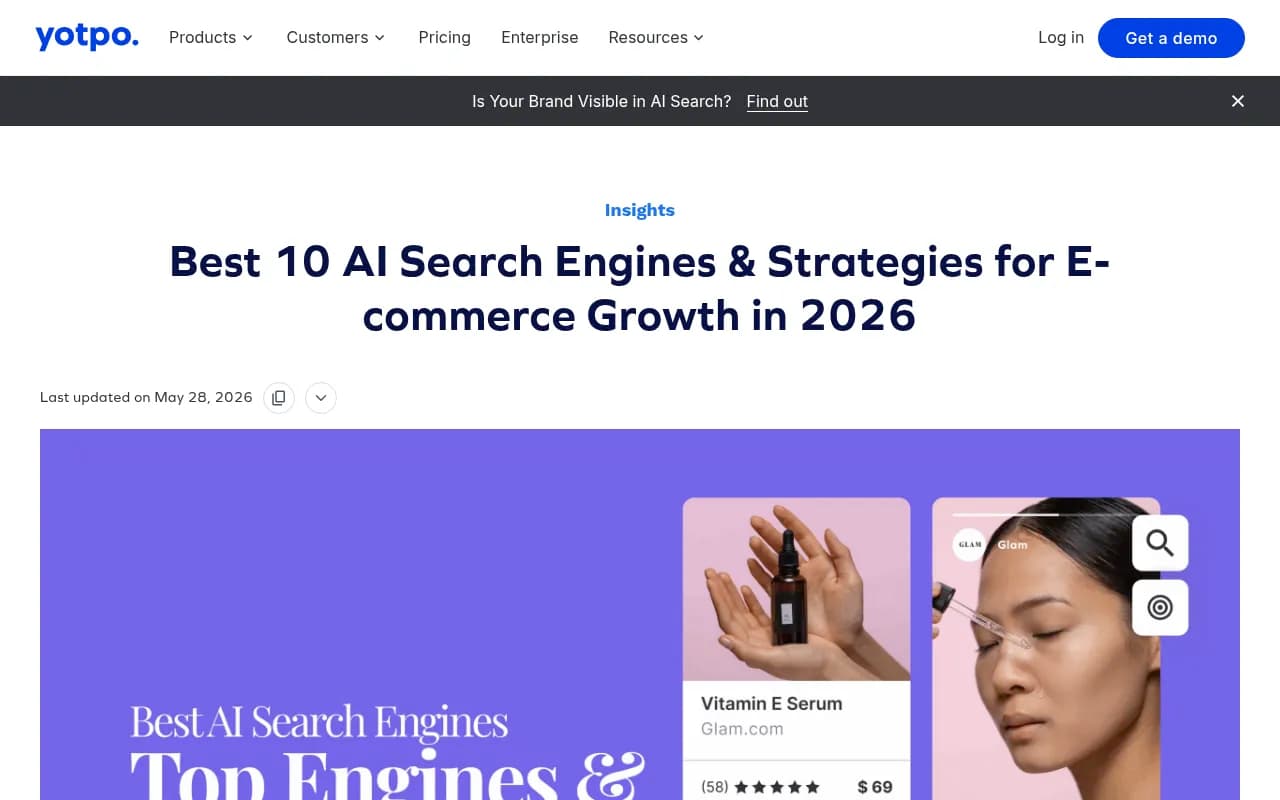
The shift Yotpo describes — from a "link economy" to an "answer economy" — is real. AI-referred traffic converts at roughly 14% compared to 2.8% for traditional search, according to RankScience data cited in their 2026 analysis. That gap makes it worth investing in tools that actually move the needle, not just measure it.
The platforms worth knowing about in 2026
Promptwatch — the only full-loop platform
Promptwatch is the clearest example of what a complete AI search optimization platform looks like. It's used by 1,480+ brands and agencies, and the reason it keeps coming up in comparisons isn't marketing — it's that it's the only tool that handles all three steps of the action loop.
The crawler log feature is genuinely rare. You connect your site through Cloudflare, Fastly, Vercel, server logs, or a tracking snippet, and you get real-time logs of every AI crawler that hits your site: which pages GPTBot, ClaudeBot, and PerplexityBot visited, what errors they encountered, how often they return, and — critically — when a page moves from "crawled" to "cited." That last part is something no other platform tracks.
On the content side, Content Agents generate articles, listicles, comparisons, and briefs grounded in actual prompt data, citation patterns, and competitor analysis. This isn't generic AI writing — it's content built around the specific gaps AI models are already exposing on your site.
The Answer Gap Analysis shows exactly which prompts competitors are visible for that you're not, with prompt volume estimates and difficulty scores so you can prioritize. Query fan-outs show how a single prompt branches into sub-queries, which is useful for understanding how to structure content.
It monitors 10 AI models (ChatGPT, Perplexity, Google AI Overviews, Google AI Mode, Claude, Gemini, Meta/Llama, DeepSeek, Grok, Mistral, Copilot), tracks Reddit and YouTube citations, and includes ChatGPT Shopping tracking — a channel most competitors ignore entirely.
Pricing starts at $99/month for the Essential plan (1 site, 50 prompts, 5 articles), $249/month for Professional (adds crawler logs, 150 prompts, 15 articles), and $579/month for Business (5 sites, 350 prompts, 30 articles).

Profound — strong enterprise monitoring, limited action
Profound is one of the more serious enterprise-tier monitoring platforms. It tracks brand mentions across 9+ AI search engines and has solid prompt research capabilities. The interface is clean and the data quality is generally good.
Where it falls short for this guide's specific focus: it doesn't have crawler diagnostics, and content generation isn't part of the workflow. You get the visibility data, but the "what do I do about it" question is left to you. For large enterprises with dedicated SEO teams who can act on the data independently, that might be fine. For teams that need the full loop in one tool, it's a gap.
Profound

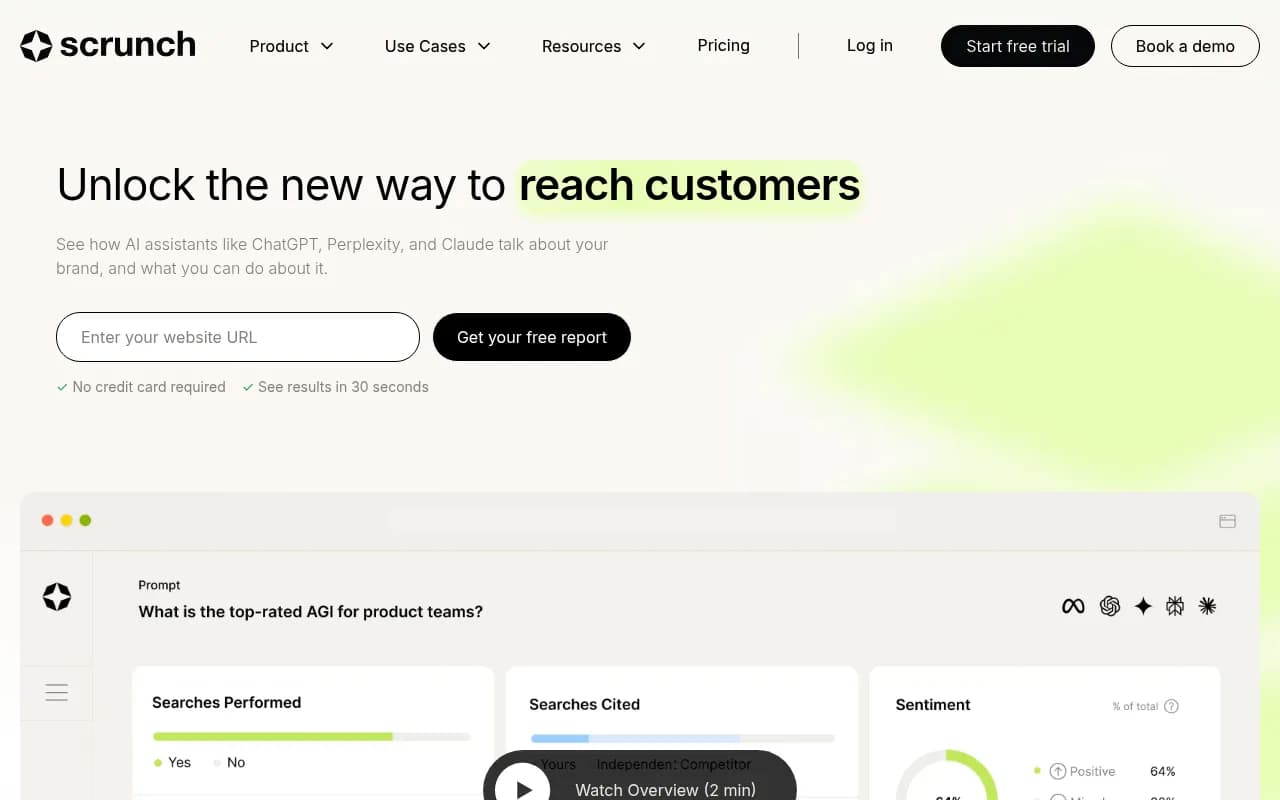
Scrunch AI — monitoring with some content features
Scrunch AI tracks brand visibility across LLMs and has moved toward adding some content optimization features. It's a reasonable mid-tier option for teams that want more than basic monitoring but aren't ready for a full platform investment.
Crawler diagnostics are not part of its feature set. The content tools are more basic than what you'd get from a dedicated content generation platform. But it's worth knowing about if you're comparing options in the $100-200/month range.
AthenaHQ — monitoring-focused, no content generation
AthenaHQ is well-regarded for its monitoring capabilities and has a clean interface that marketing teams tend to find approachable. It tracks brand mentions across major AI engines and provides competitive visibility comparisons.
The limitation is that it's explicitly a monitoring platform. There's no content generation, no crawler logs, and no built-in path from "here's your gap" to "here's how to close it." If you're evaluating tools specifically for the diagnostic and fix capabilities this guide covers, AthenaHQ doesn't make the cut — though it's a solid choice if monitoring alone is what you need.

Otterly.AI — basic monitoring, good for getting started
Otterly.AI is one of the more accessible entry points into AI search monitoring. It tracks brand mentions across ChatGPT, Perplexity, and Google AI Overviews, and the setup is straightforward.
It's genuinely useful for teams that are just starting to pay attention to AI search visibility and want a low-friction way to see where they stand. But it's monitoring-only — no crawler logs, no content generation, no gap analysis with prompt volume data. Think of it as a starting point, not a full solution.
Otterly.AI

Search Atlas — SEO automation with AI search features
Search Atlas sits in an interesting position: it's primarily an SEO automation platform that has added AI search tracking. It has content generation capabilities and some technical SEO automation, which means it's closer to the "find and fix" model than pure monitoring tools.
The AI search tracking is less deep than dedicated GEO platforms — it doesn't have the same prompt volume data or crawler log capabilities. But if you're looking for a tool that combines traditional SEO automation with emerging AI search features, it's worth evaluating.
Botify — enterprise technical SEO with AI search expansion
Botify has been an enterprise technical SEO platform for years, and it's one of the few tools that has genuinely deep crawler diagnostic capabilities. It's now expanding into AI search optimization territory.
For large sites with complex technical SEO needs, Botify's crawler data is excellent. The AI search monitoring features are newer and less developed than dedicated GEO platforms. If your primary problem is technical crawlability (for both Google and AI crawlers), Botify is worth a serious look. If your primary problem is AI citation gaps and content optimization, it's probably not your first choice.
Lumar — enterprise website optimization with GEO features
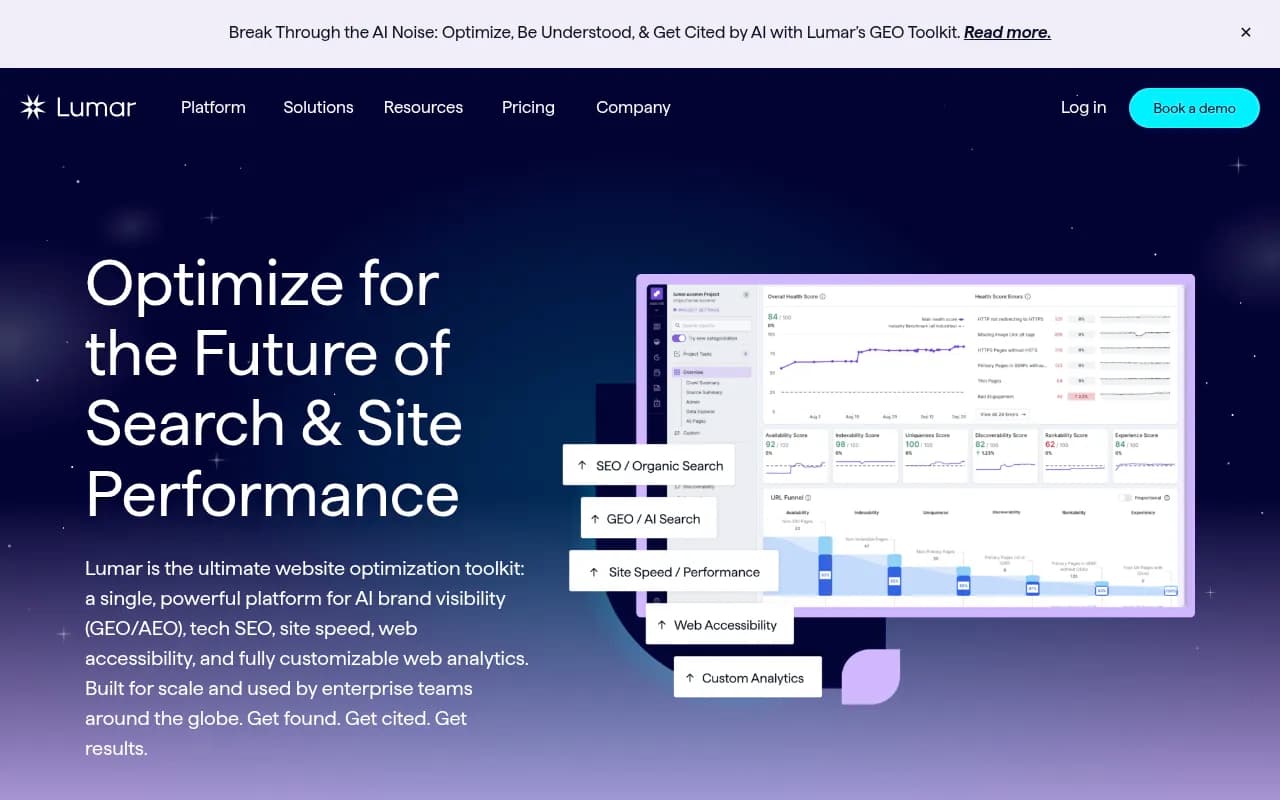
Similar to Botify, Lumar is an enterprise website optimization platform that covers SEO, GEO, and broader technical health. It has strong crawl analysis capabilities and is adding AI search visibility features.
How to compare these tools
Here's a direct comparison across the dimensions that matter most for this guide's focus:
| Platform | AI crawler logs | Content generation | Gap analysis with prompt data | Models tracked | Starting price |
|---|---|---|---|---|---|
| Promptwatch | Yes (real-time) | Yes (AI Content Agents) | Yes (with volume + difficulty) | 10+ | $99/mo |
| Profound | No | No | Basic | 9+ | Higher |
| Scrunch AI | No | Limited | Basic | Multiple | ~$100/mo |
| AthenaHQ | No | No | Yes | Multiple | Custom |
| Otterly.AI | No | No | Basic | 3 | ~$49/mo |
| Search Atlas | No | Yes (SEO-focused) | Limited | Limited | ~$99/mo |
| Botify | Yes (traditional SEO) | No | No | Expanding | Enterprise |
| Lumar | Yes (traditional SEO) | No | No | Expanding | Enterprise |
The pattern is clear: crawler diagnostics and content generation rarely appear together, and when they do, it's usually in tools that started as traditional SEO crawlers (Botify, Lumar) rather than AI-native platforms. Promptwatch is the exception — it was built with the full loop in mind from the start.
What to actually look for when evaluating a tool
Real crawler data vs. API polling
There's an important distinction between tools that monitor AI search by polling APIs (asking the model a question and recording the answer) and tools that track how AI crawlers actually behave on your website. Both are useful, but they answer different questions.
API polling tells you what appears in AI responses. Crawler logs tell you what AI bots are doing on your site — which is the upstream cause of what appears in responses. If you're serious about optimization rather than just monitoring, you need both.
Prompt volume and difficulty data
Not all prompts are worth chasing. A tool that shows you gaps without telling you how many people are actually using those prompts — or how hard it will be to rank for them — is giving you incomplete information. Look for platforms that include volume estimates and difficulty scoring so you can prioritize intelligently.
The gap between crawl and citation
One of the more sophisticated things a platform can track is the timeline from when an AI bot crawls a page to when that page starts appearing in citations. This matters because it tells you whether your content is being discovered but not cited (a content quality or relevance problem) versus not being discovered at all (a technical or crawlability problem). Very few tools track this.
Multi-model coverage
Different AI models cite different sources. A brand that appears prominently in Perplexity responses might be invisible in ChatGPT, and vice versa. Tools that only track one or two models are giving you a partial picture. Look for coverage across at least ChatGPT, Perplexity, Google AI Overviews, and Claude as a baseline.
Reddit and YouTube tracking
This one surprises people. AI models frequently cite Reddit threads, YouTube videos, and third-party review sites in their responses. If your brand is being discussed (positively or negatively) in those channels, it affects your AI visibility. Tools that surface these offsite citations give you a more complete picture of what's driving your visibility — and what you can do about it.
The practical decision
If you're a marketing or SEO team that wants to move from "we know we have an AI visibility problem" to "we're actively fixing it," the tool selection comes down to one question: do you want a monitoring dashboard or an optimization platform?
Monitoring dashboards (Otterly.AI, AthenaHQ, many others) are fine for awareness. They'll tell you where you stand and how you compare to competitors. But they won't help you close the gap.
Optimization platforms (Promptwatch being the clearest example) are built around the assumption that data is only useful if it leads to action. They connect the diagnostic layer (crawler logs, gap analysis, prompt data) to the fix layer (content generation, technical recommendations, citation tracking) in a way that monitoring-only tools simply don't.
The market is moving fast. Several monitoring-only tools are adding content features, and several traditional SEO crawlers are adding AI search tracking. But right now, in mid-2026, the number of platforms that genuinely handle the full loop is very small.
For most teams, the right starting point is to audit what you actually need: Are you trying to understand your current AI visibility? A basic monitoring tool might be enough. Are you trying to actively improve it, diagnose technical issues, and generate content that fills your gaps? You need a platform built for that from the ground up.
The crawler diagnostics piece, in particular, is worth taking seriously. It's the layer that most teams skip — and it's often the reason that content investments in AI search don't produce the expected results. You can write excellent content that perfectly answers the prompts your customers are using, but if GPTBot can't crawl it, or if it's hitting a 404, or if your JavaScript rendering is broken for bots, none of it matters.
Fix the foundation first. Then build on it.