Key takeaways
- AI-cited traffic converts at 23x the rate of standard organic traffic, but 93% of AI Mode searches produce zero clicks to external sites -- meaning citations are the new ranking
- A single content gap covering a mid-volume prompt can be worth thousands of dollars in pipeline per month once you factor in AI-referred conversion rates
- Most AI search platforms only show you where you're invisible. The ROI comes from platforms that also help you fix it -- through content generation, gap analysis, and crawler monitoring
- Measuring AI search ROI requires purpose-built tools; GA4 and Search Console can't distinguish AI-driven visibility from traditional organic traffic
- The math on "fix vs. ignore" is increasingly lopsided: with 80% of purchasing decisions now influenced by AI tools, gaps in AI visibility are gaps in your sales funnel
The conversation around AI search has been dominated by anxiety about traffic loss. That's understandable. Google AI Overviews cause a 61% CTR drop on informational queries. 93% of Google AI Mode searches end without a click to any external website. If you're measuring success by sessions in GA4, the numbers look bad.
But that framing misses the more important story. Brands that are cited in AI-generated answers see conversion rates 23x higher than standard organic traffic. AI search isn't killing revenue -- it's concentrating it. The question isn't whether AI search matters. It's whether your content is the source being cited, or the source being ignored.
That shift changes how you should think about content gaps. A gap in traditional SEO means you're missing some keyword traffic. A gap in AI search means you're invisible during the moment a buyer is actively forming a purchase decision. Those are very different problems with very different price tags.
What a content gap actually costs in 2026
Let's get specific. According to SegmentStream's analysis of their customer base, AI search contribution to sales runs roughly 5-8x higher than what last-click attribution shows. That means if your analytics say AI search drove $10,000 in revenue last quarter, the real number is probably closer to $50,000-$80,000 once you account for the full influence on the buyer journey.
Now apply that to a content gap.
Say a competitor is being cited by ChatGPT and Perplexity for a prompt like "best [your category] software for mid-market teams." That prompt gets asked thousands of times per month. Your competitor gets cited. You don't. The buyer forms an opinion before they ever visit a website.
Here's a rough way to model the value of fixing that gap:
- Prompt volume: Estimate monthly query volume for the prompt (purpose-built tools give you this directly)
- Citation rate: What percentage of responses include a source citation? Varies by model and query type, but often 30-60% for commercial queries
- Click-through from citation: Lower than traditional organic, but the clicks that do happen convert at 23x the rate
- Average deal value: Multiply through by your ACV or average order value
For a B2B SaaS company with a $15,000 ACV, even a modest prompt with 500 monthly queries could represent $50,000+ in influenced pipeline per month if you're cited and your competitor isn't. That's not a marginal SEO win. That's a strategic gap.
Why monitoring-only platforms leave money on the table
Most AI search platforms on the market today are dashboards. They show you your visibility score, which prompts you appear in, and how you compare to competitors. That's useful. But it stops at diagnosis.
The problem is that diagnosis without treatment isn't ROI -- it's just awareness of a problem you're not solving.
Consider the typical workflow with a monitoring-only tool:
- You see you're invisible for 40 high-value prompts
- You export a spreadsheet
- You hand it to your content team
- They spend weeks figuring out what to write, how to structure it, and whether it will actually work
- You publish something and wait months to see if it moves the needle
- You have no way to connect the publication to any change in AI citation behavior
That's a slow, expensive loop with no feedback mechanism. The ROI of fixing a content gap depends entirely on how fast you can close it and how confidently you can measure the result.
Promptwatch is built around a different model: find the gap, generate content engineered to close it, then track whether it worked -- down to the page level and the specific AI model doing the citing.

The difference isn't philosophical. It's financial. A platform that helps you identify and fix 10 content gaps per month compounds faster than one that shows you 100 gaps and leaves you to figure out the rest.
The action loop: where the real ROI lives
The ROI of AI search platforms isn't in the monitoring. It's in the loop between finding gaps, creating content, and measuring results. Here's what that looks like in practice.
Step 1: Finding gaps with real prompt data
Answer gap analysis compares which prompts your competitors appear in versus which ones you appear in. The output is a prioritized list of specific prompts where you're invisible but your competitors aren't.
What makes this actionable (rather than just interesting) is prompt volume data. Not all gaps are equal. A gap on a high-volume, high-intent prompt is worth 50x more than a gap on an obscure long-tail query. Platforms that give you volume estimates and difficulty scores let you prioritize the gaps with the highest expected ROI.
Query fan-outs add another layer: a single prompt like "what's the best CRM for startups" branches into dozens of sub-queries that AI models use to construct their answer. Understanding that fan-out tells you exactly what content you need to cover to be cited for the parent prompt.
Step 2: Creating content that AI models actually cite
This is where most teams get stuck. They know what's missing but not how to fill it in a way that AI models will pick up.
Generic SEO content doesn't work here. AI models cite sources that directly and comprehensively answer the specific question being asked. Content that's optimized for keyword density or traditional SERP signals often misses the mark entirely.
Content generation tools grounded in real prompt data, citation patterns, and competitor analysis produce something different: articles and briefs that are structured to answer the exact questions AI models are already asking. That's not the same as writing a good blog post.
Step 3: Tracking from publish to citation
This is the part almost no one does well. Publishing a piece of content and checking your visibility score three months later tells you almost nothing useful.
AI crawler logs change that. When you can see exactly which pages AI crawlers (GPTBot, ClaudeBot, PerplexityBot) are visiting, how often they return, and when a page moves from "crawled" to "cited," you have a feedback loop. You can see whether a new piece of content got picked up in days or weeks. You can identify pages that are being crawled but not cited and diagnose why.
That feedback loop is what turns content investment into a measurable, improvable process rather than a guess.
How to measure AI search ROI when your analytics can't
GA4 and Google Search Console don't distinguish AI-driven visibility from traditional organic traffic. Most AI referrals show up as direct traffic or get lost entirely. This creates a measurement problem that makes AI search ROI look smaller than it is.
SegmentStream's data showing 5-8x underattribution is consistent with what most teams find when they implement proper tracking. The buyers who interact with AI search are often deep in the funnel -- they've already done their research, they've already formed preferences, and they're arriving at your site ready to convert. That's why the conversion rate is so much higher. But last-click attribution gives all the credit to whatever touchpoint happened to be last.
A few approaches that actually work:
Website integration with AI crawler tracking: Connecting your site through Cloudflare, Fastly, Vercel, or a tracking snippet lets you see AI agent traffic directly -- which pages they read, how often they return, and when citations happen. This is the most direct measurement available.
Page-level citation tracking: Rather than looking at aggregate visibility scores, track which specific pages are being cited, by which models, and how often. When you publish new content, you can see whether it enters the citation pool.
Traffic attribution with revenue connection: Some platforms can connect AI visibility data to actual conversions and revenue, not just traffic. This closes the loop between "we got cited" and "we got paid."
Comparing approaches: monitoring vs. action platforms
| Capability | Monitoring-only platforms | Action-oriented platforms |
|---|---|---|
| Track AI citations | Yes | Yes |
| Competitor visibility comparison | Yes | Yes |
| Prompt volume & difficulty data | Sometimes | Yes |
| Answer gap analysis | Rarely | Yes |
| Content brief generation | No | Yes |
| AI content generation | No | Yes |
| AI crawler logs | No | Yes |
| Page-level citation tracking | No | Yes |
| Traffic-to-revenue attribution | No | Yes |
| Reddit/YouTube citation tracking | No | Yes |
The table above is a rough generalization, but the pattern holds: platforms built primarily as dashboards stop at visibility data. Platforms built around optimization add the tools to actually move that data.
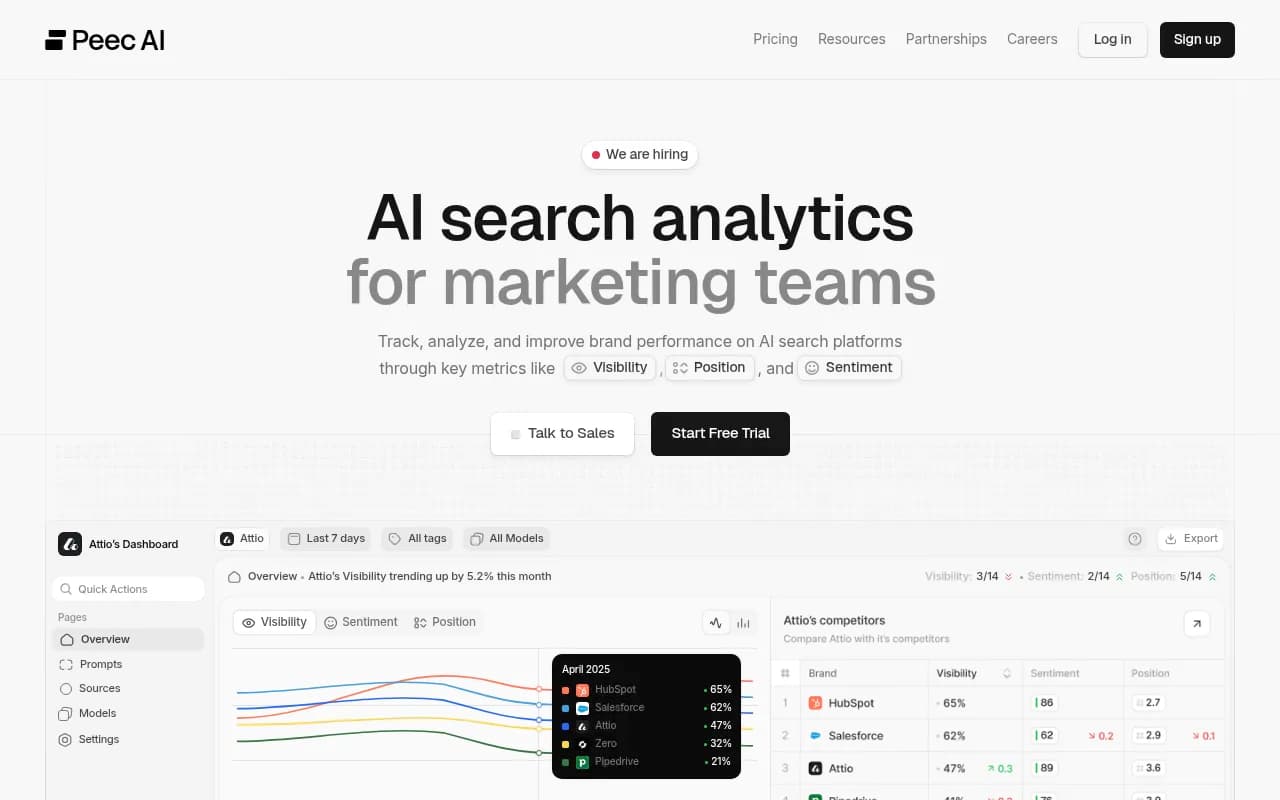
Tools like Otterly.AI and Peec AI are solid for basic monitoring:
Otterly.AI

Profound and AthenaHQ have stronger enterprise feature sets but remain primarily monitoring-focused:
Profound


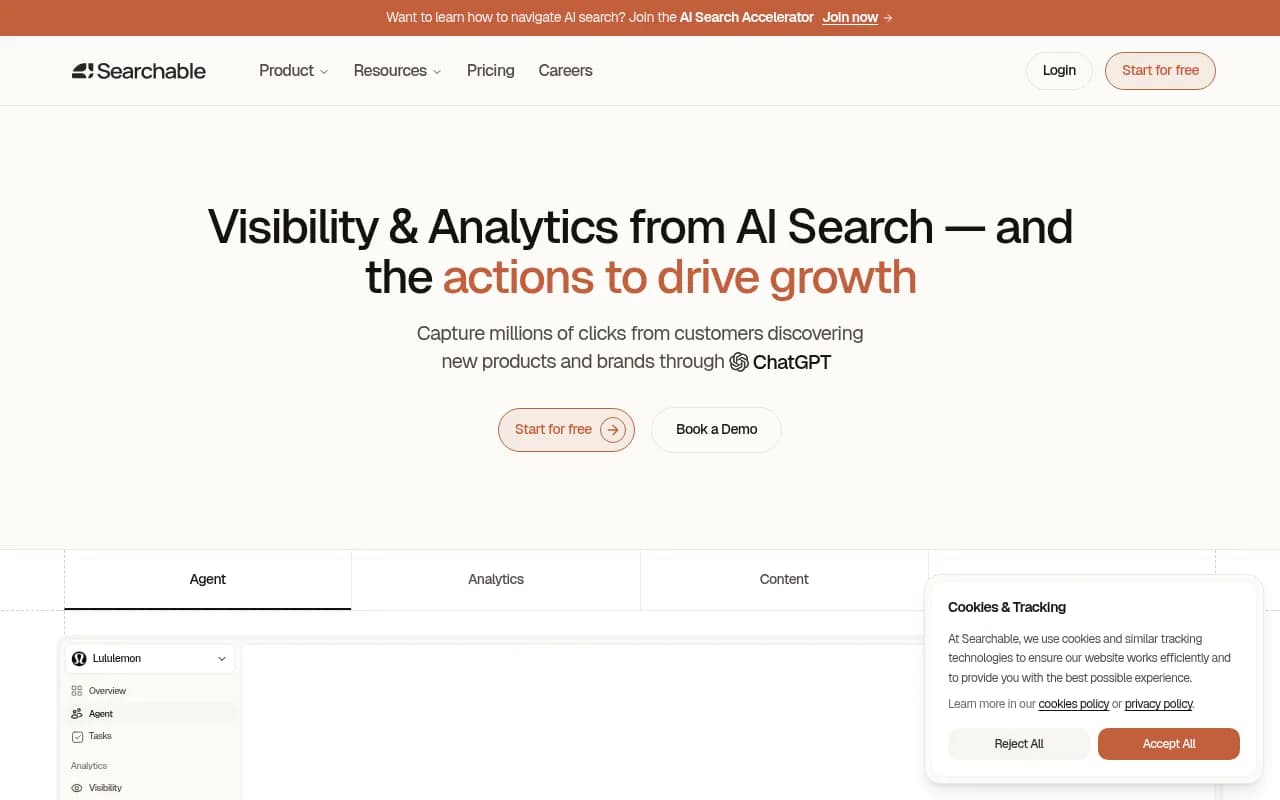
Searchable adds content generation to the mix:
The platforms that close the full loop -- from gap identification to content creation to citation tracking -- are where the measurable ROI lives.
What the numbers say about content gap ROI
Let's put some concrete numbers around this.
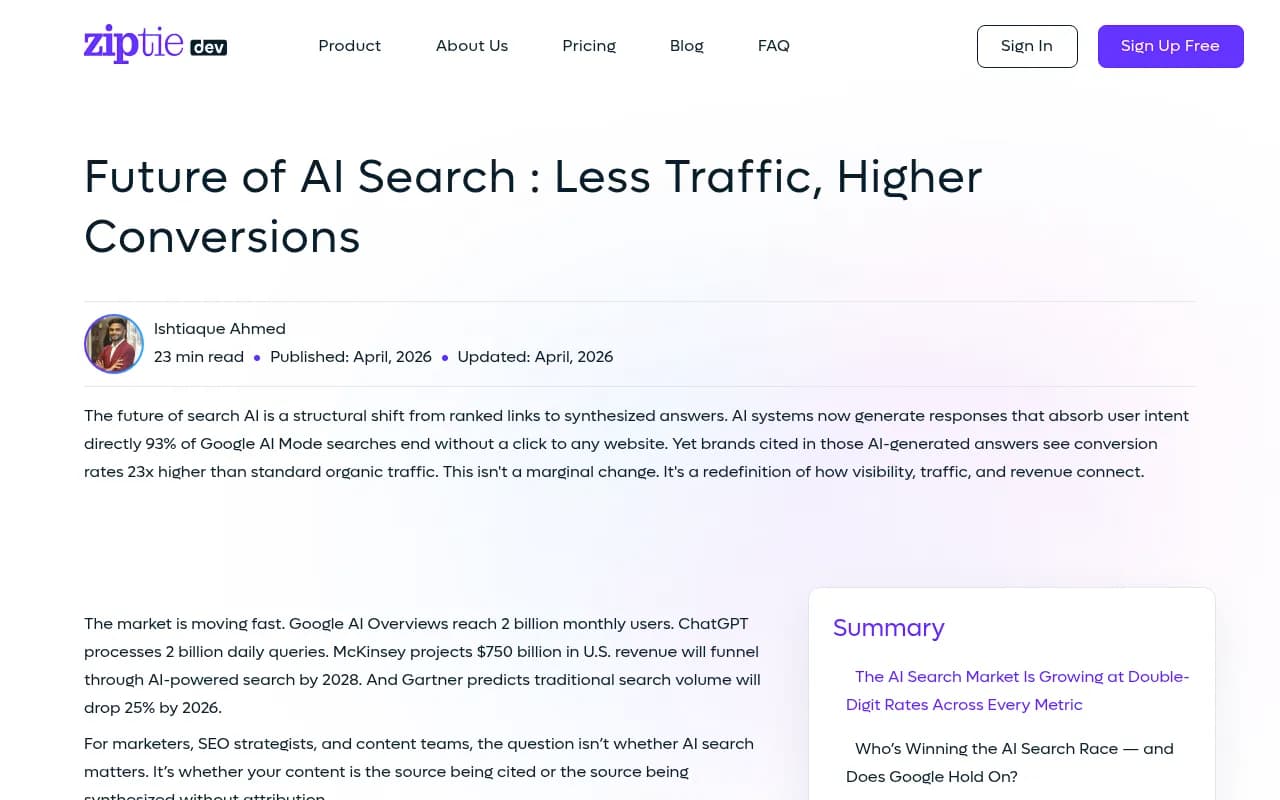
According to ZipTie.dev's research, AI search traffic is growing 165x faster than organic search traffic, though it still represents under 2% of total traffic for most sites. That 2% is doing disproportionate revenue work because of the conversion rate differential.
McKinsey projects $750 billion in U.S. revenue will flow through AI-powered search by 2028. Gartner predicts traditional search volume will drop 25% by 2026. Those aren't abstract market forecasts -- they're a description of where your buyers are going.
80% of people say that half of their purchasing decisions are now made with AI tools like ChatGPT. That statistic, from Exposure Ninja's 2026 research, is the one that should reframe how you think about content gaps. If half of purchase decisions involve AI consultation, then a gap in AI visibility is a gap in your ability to influence half of your potential buyers.
The ROI of fixing a content gap isn't just about the traffic you'd get from being cited. It's about the decisions being made without your input.
Practical framework: prioritizing which gaps to fix first
Not all content gaps are worth the same investment. Here's how to prioritize:
High commercial intent + high volume: These are the gaps that directly influence purchase decisions. "Best [category] for [use case]" prompts, comparison queries, and "should I use X or Y" questions fall here. Fix these first.
Competitor-exclusive citations: If a competitor is being cited for a prompt and you're not, that's a competitive gap with a direct revenue implication. The cost of the gap is proportional to how often that competitor gets recommended instead of you.
High-volume informational with downstream commercial intent: "How does [your category] work" and "what is [your solution type]" queries shape buyer mental models early in the funnel. Being cited here builds the brand familiarity that influences later purchase decisions.
Low-competition gaps: Some prompts have no strong incumbent citation. These are often faster wins -- you don't need to displace a well-established source, you just need to show up.
Tools that give you difficulty scores alongside volume estimates make this prioritization much faster. Without that data, you're guessing at which gaps are worth the investment.
The compounding effect: why early movers win
There's a dynamic in AI citation that mirrors what happened in early SEO: the sources that get cited first tend to stay cited. AI models develop preferences for sources they've found reliable, and those preferences are slow to change.
This means the ROI of fixing content gaps now is higher than the ROI of fixing them in 18 months. The brands building AI citation authority today are creating a moat that will be expensive for competitors to cross later.
The flip side is also true: every month you're invisible for a high-value prompt is a month your competitor is building citation history that makes them harder to displace.
The math on "fix now vs. fix later" is straightforward. If a gap is worth $50,000 in influenced pipeline per month, waiting six months to address it costs $300,000 in opportunity. The cost of a platform that helps you find and fix gaps is a rounding error by comparison.
Putting it together
The ROI of action features in AI search platforms comes down to one question: how fast can you close the loop between "we're invisible here" and "we're being cited here"?
Monitoring tells you the gap exists. Action features -- content generation grounded in prompt data, answer gap analysis, AI crawler logs, page-level citation tracking -- are what close it.
The platforms worth investing in are the ones that treat AI search optimization as a process, not a report. Find the gaps with real prompt data. Generate content engineered to close them. Track the results from crawl to citation to revenue. Repeat.
That loop, run consistently, is where the ROI actually lives. The content gap isn't just a visibility problem. It's a revenue problem with a measurable solution.