Key takeaways
- 80% of B2B software buyers now use AI tools as much or more than search engines for vendor discovery — and GenAI chatbots are the #1 source influencing vendor shortlists at 17.1%.
- Most AI search platforms are monitoring-only dashboards: they show you where you're invisible but give you no way to fix it.
- The platforms worth paying for in 2026 close the loop: they identify content gaps, help you create content engineered for AI citations, and track whether it's working.
- For B2B SaaS specifically, the buyer research content that gets cited tends to be comparison pages, use-case guides, original data, and answer-format content — not generic blog posts.
- Promptwatch is the only platform in 2026 rated as a leader across both AI visibility tracking and content generation, making it the strongest fit for SaaS teams that need the full loop.
Why "monitoring only" isn't enough for B2B SaaS anymore
Here's the situation most B2B SaaS marketing teams are in right now: their SEO metrics look fine on paper, but pipeline from organic search is quietly declining. CAC keeps climbing. And the content calendar stays full of articles that no AI model ever cites.
The reason isn't a strategy failure. It's a structural shift in how software buyers research vendors.
According to data from Digital Commerce 360, 80% of B2B buyers in technology and software now use AI tools as much or more than search engines for vendor discovery. GenAI chatbots rank as the number one source influencing vendor shortlists at 17.1% — ahead of software review sites, peer recommendations, and vendor websites.
That means when a VP of Engineering asks ChatGPT "what's the best CI/CD tool for a mid-size engineering team," the answer they get shapes their shortlist before they ever visit your site. If you're not in that answer, you're not on the shortlist.
The problem with most AI visibility platforms is that they stop at telling you this. They show you a dashboard of prompts where competitors appear and you don't. That's useful information. But it doesn't tell you what content to create, how to write it so AI models will cite it, or whether your new content is actually getting picked up.
For B2B SaaS teams with long sales cycles and technically sophisticated buyers, that gap between "knowing you're invisible" and "doing something about it" is where most programs stall.
What B2B SaaS buyer research content actually looks like
Before getting into platforms, it's worth being specific about what kind of content gets cited in AI answers for B2B software queries.
AI models don't cite generic thought leadership. They cite content that directly answers a question a buyer would ask. In practice, that means:
- Comparison pages ("X vs Y for enterprise teams")
- Use-case guides ("how to use [category] for [specific workflow]")
- Original research with specific statistics
- Answer-format content that directly addresses "how do I..." or "what's the best..." questions
- Third-party mentions: review sites, Reddit threads, YouTube videos, and listicles
The last point matters more than most teams realize. Research from Onely suggests external sources carry a 6.5x citation multiplier compared to your own site. That means your AI visibility strategy has to include offsite content, not just your blog.
This is why the platform you choose matters so much. A tool that only monitors your own site is missing more than half the picture.
The platforms worth considering in 2026
Platforms that close the full loop (track + create)
These are the tools that go beyond dashboards to help you actually produce content that gets cited.
Promptwatch is the clearest example of a platform built around the full optimization cycle rather than just monitoring. It identifies which prompts competitors are visible for but you're not (Answer Gap Analysis), generates content grounded in real prompt data and citation patterns (Content Agents), and then tracks whether that content gets crawled and cited by AI models over time.

What makes this relevant for B2B SaaS specifically: the Content Agents don't generate generic filler. They pull in prompt volume data, competitor citation analysis, persona targeting, and brand guidance to produce articles, comparisons, and briefs designed to answer the exact questions AI models are already exposing. The AI Crawler Logs show you when ChatGPT or Perplexity actually reads your new pages and when those pages move from crawl to citation — which is the feedback loop most teams are missing entirely.
Promptwatch also tracks Reddit threads and YouTube videos that influence AI recommendations, which is particularly valuable for B2B SaaS categories where community discussions heavily shape what AI models recommend.
AirOps takes a content engineering approach, building workflows that connect research, writing, and optimization for AI search visibility. It's more technical than Promptwatch and better suited to teams that want to build custom content pipelines rather than use a turnkey system.
Search Atlas combines AI-powered SEO automation with content generation and publishing. It's a reasonable option for teams that want a single platform for both traditional SEO and AI search content, though its AI visibility tracking is less deep than dedicated GEO platforms.
Jasper has evolved from a writing tool into a marketing platform with agents and content pipelines. It's strong for content production at scale but doesn't have the AI citation tracking or gap analysis that makes a platform genuinely useful for GEO.
Platforms that monitor well but don't help you act
These tools are worth knowing about, but be clear-eyed about what they do and don't do.
Profound is a solid enterprise AI visibility platform. It tracks brand mentions across ChatGPT, Perplexity, and 9+ AI search engines with good depth. The limitation is that it's primarily a monitoring platform — it shows you the data but doesn't generate content or close the gap.
Profound

AthenaHQ is monitoring-focused with a clean interface. Good for teams that want visibility data without the complexity of a full GEO platform. But like Profound, it stops at the dashboard.

Otterly.AI covers ChatGPT, Perplexity, and Google AI Overviews. It's a reasonable starting point for smaller teams, but it lacks crawler logs, visitor analytics, and content generation.
Otterly.AI

Peec AI is a capable monitoring tool for marketing teams that want to track AI search visibility without a large budget. The trade-off is that it doesn't help you do anything about what you find.

Scrunch AI offers AI-powered tracking and visibility data. Worth evaluating for teams that prioritize clean reporting over action capabilities.
Content generation tools that support AI search (but aren't GEO platforms)
These tools help you create content but don't have the AI visibility tracking infrastructure to tell you whether it's working.
Averi AI is specifically built for B2B SaaS content operations. It focuses on building a compounding content engine — useful if your primary need is content production volume rather than AI citation optimization.
MarketMuse is a content intelligence platform that helps you identify topic gaps and build content strategy. It's strong for traditional SEO content planning and has some AI search relevance, but it's not a GEO platform.
Surfer SEO remains one of the better content optimization tools for on-page SEO. It doesn't track AI citations, but the content it helps you produce tends to be well-structured enough to perform reasonably in AI search.
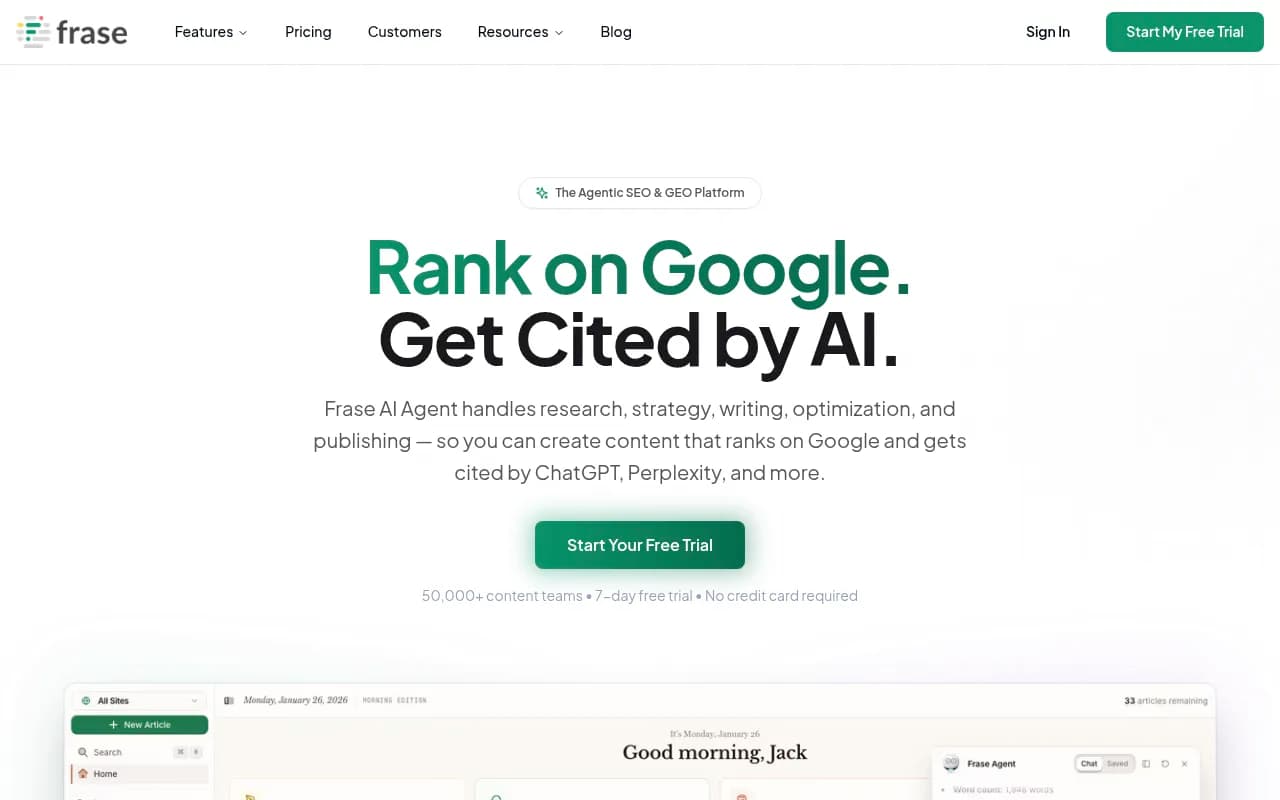
Frase handles content research and brief generation efficiently. Good for teams that need to produce a lot of content quickly and want research grounded in SERP data.
Comparison: which platform fits which B2B SaaS team
| Platform | AI citation tracking | Content generation | Crawler logs | Reddit/YouTube tracking | Best for |
|---|---|---|---|---|---|
| Promptwatch | Yes (10 models) | Yes (Content Agents) | Yes | Yes | Full GEO loop: track, create, optimize |
| AirOps | Partial | Yes (custom pipelines) | No | No | Technical teams building custom workflows |
| Profound | Yes (9+ models) | No | No | No | Enterprise monitoring without content needs |
| AthenaHQ | Yes | No | No | No | Clean monitoring dashboard |
| Otterly.AI | Yes (3 models) | No | No | No | Small teams starting with AI visibility |
| Peec AI | Yes | No | No | No | Budget-conscious monitoring |
| Averi AI | No | Yes | No | No | B2B SaaS content production at scale |
| MarketMuse | No | Partial (briefs) | No | No | Content strategy and topic planning |
| Surfer SEO | No | Yes (optimization) | No | No | On-page content optimization |
| Jasper | No | Yes | No | No | Marketing content at volume |
What to actually look for when evaluating these platforms
A few things that separate genuinely useful platforms from ones that look good in demos:
Real UI tracking vs API-only. Some platforms query AI models through APIs, which can return different results than what users actually see in ChatGPT or Perplexity's interface. Shopping recommendations, featured citations, and conversational follow-ups often differ between API and user-facing outputs. Platforms that track real user interface behavior give you more accurate data.
Prompt volume and difficulty data. Not all prompts are worth targeting. A platform that tells you "you're not visible for this query" without telling you how many people ask it or how hard it is to rank for is giving you incomplete information. Prompt volume estimates and difficulty scoring let you prioritize.
Page-level citation tracking. Knowing your brand is mentioned is useful. Knowing which specific pages are being cited, by which models, and how often is what lets you make decisions. If a platform only reports brand-level visibility, you can't tell which content is working.
The gap between crawl and citation. AI models crawl your content before they cite it. Understanding that timeline — when a page was crawled, when it first appeared in citations, how citation frequency changes over time — is the feedback loop that makes optimization possible. Most monitoring tools don't show this at all.
Offsite coverage. For B2B SaaS, third-party mentions on review sites, Reddit, and YouTube often drive more AI citations than your own content. A platform that only tracks your own site is missing a significant part of the picture.
A practical approach for B2B SaaS teams in 2026
The teams getting real results from AI search visibility in 2026 aren't treating it as a separate channel. They're integrating it with their existing content and demand gen programs.
A few things that tend to work:
Map prompts to buying stages. B2B software buyers use AI differently at different stages. Early-stage queries tend to be category-level ("what tools help with X"). Mid-funnel queries get more specific ("best X for Y use case"). Late-stage queries are comparison-focused ("X vs Y for enterprise"). You need content that answers all three, not just the top-of-funnel questions.
Invest in original research. AI models cite original data because it's unique and authoritative. A benchmark report, a survey of your customer base, or an analysis of your own platform data gives AI models something to cite that competitors can't replicate. This is one of the highest-ROI content investments a B2B SaaS team can make for AI visibility.
Don't ignore third-party presence. Getting mentioned in G2 listicles, Capterra comparisons, and relevant Reddit threads matters for AI citations. This isn't traditional link building — it's about ensuring the external sources AI models trust are saying accurate, positive things about your product.
Track the right metrics. Organic traffic from AI search converts at roughly 6x the rate of traditional search traffic, according to data from Onely. That means even modest AI visibility improvements can have outsized pipeline impact. But you need to measure it properly — AI referral traffic often shows up as direct or gets misattributed in standard analytics.
Give it time. The timeline from publishing new content to seeing it cited by AI models is typically 2-6 months. Teams that abandon the strategy after 6 weeks because they don't see immediate results are quitting before the compounding effects kick in.
The bottom line
The B2B SaaS teams that will win in AI search over the next 18 months aren't the ones with the biggest content budgets. They're the ones that understand exactly which questions their buyers are asking AI models, create content specifically designed to answer those questions, and track whether it's working at the page level.
That requires a platform that does more than show you a dashboard of where you're invisible. It requires one that helps you close the gap.
For most B2B SaaS marketing teams, Promptwatch is the most complete option available in 2026 — it's the only platform that covers the full cycle from gap identification through content generation to citation tracking, with the crawler logs and offsite analysis that make the feedback loop actually useful. Teams with more technical resources might build custom workflows with AirOps. Teams that genuinely only need monitoring can start with Profound or Otterly.AI and add content capabilities later.
But if you're serious about AI search visibility as a growth channel, monitoring alone won't get you there.