Tidio Review 2026
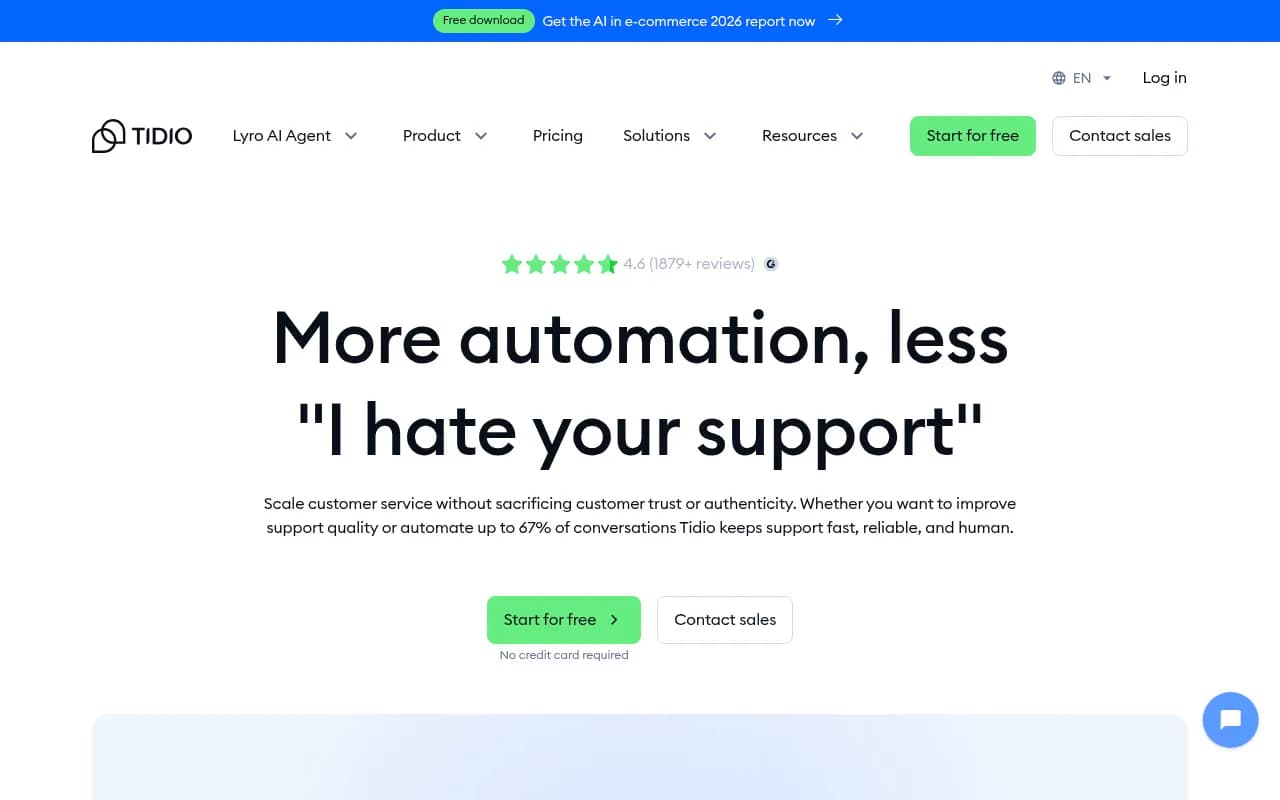
Tidio is an AI-powered customer service platform combining Lyro AI Agent, live chat, and helpdesk tools. Trusted by 300K+ businesses, it automates up to 67% of conversations while keeping support human and on-brand.
Key takeaways
- Tidio combines an AI agent (Lyro), live chat, helpdesk, and automation flows into one platform -- genuinely useful for small to mid-size e-commerce and SaaS teams
- Claims a 67% AI resolution rate with a money-back guarantee if it doesn't hit 50% -- an unusually bold commitment for this category
- Pricing is conversation-based, not seat-based, which can get expensive fast as chat volume grows
- Strong Shopify and e-commerce integrations make it a natural fit for online retail; less compelling for complex B2B support workflows
- Free plan available, but meaningful AI features require paid tiers starting around $24/month
Tidio is a customer service platform built around the idea that AI and human agents should work together rather than compete. The company, founded in 2013 and headquartered in San Francisco (with roots in Poland), has grown to serve over 300,000 businesses worldwide. Its flagship AI product, Lyro, is positioned as an AI agent that handles repetitive support questions while escalating complex cases to human agents -- the kind of handoff that most chatbot tools handle poorly.
The target audience is primarily small and mid-size businesses, especially in e-commerce. Brands like Under Armour, The Body Shop, Dermalogica, and Stanley appear in their customer list, which tells you something about where Tidio fits: consumer-facing brands that deal with high volumes of repetitive questions (order status, returns, product info) and need to deflect tickets without alienating customers. It's not built for enterprise IT support or complex B2B service desks.
Tidio has been around long enough to have gone through several product iterations. The original product was a live chat widget. Over time they added chatbot automation, then a full helpdesk, and most recently the Lyro AI agent -- which is clearly now the centerpiece of their pitch. The 2024-2025 period saw them lean hard into AI, rebranding much of their messaging around Lyro and launching Lyro Smart Actions, which lets the AI take actions (not just answer questions) within connected systems.
Key features
Lyro AI Agent is the core product. It's trained on your own data sources -- website content, help center articles, uploaded documents -- and generates conversational responses rather than pulling from a fixed FAQ list. In practice, this means it handles nuanced follow-up questions better than rule-based chatbots. Tidio claims a 67% resolution rate, which they back with a money-back guarantee: if Lyro doesn't hit 50% resolution for your business, you get a refund. That's a meaningful commitment. The agent also provides CSAT scores and actionable suggestions for improving its own performance, which is a nice feedback loop.
- Trains on verified data sources (URLs, PDFs, help center articles)
- Responds in brand voice with configurable tone settings
- Handles context across a conversation, not just single-turn Q&A
- Escalates to human agents when it hits the edge of its knowledge
- Lyro Smart Actions: can execute tasks like checking order status, issuing refunds, or updating customer records via integrations
Live chat is Tidio's original product and still a strong one. The widget is fast to install (under 5 minutes, no developer required), works across web and mobile, and supports multiple agents. Visitor tracking shows you who's on your site in real time, and you can trigger proactive chat messages based on behavior -- time on page, cart value, exit intent. The interface is clean and agents can manage multiple conversations simultaneously without it feeling chaotic.
Help desk consolidates conversations from live chat, email, and social channels into a single inbox. Tickets can be assigned, tagged, and prioritized. There's a shared inbox view for teams, internal notes for agent collaboration, and canned responses for common questions. It's not as feature-rich as dedicated helpdesk tools like Zendesk or Freshdesk, but for teams that don't need complex SLA management or multi-tier escalation, it covers the basics well.
Flows is Tidio's visual automation builder. You create branching conversation trees that trigger based on visitor behavior, time of day, page visited, or customer data. Common use cases include lead capture forms, abandoned cart recovery, post-purchase follow-ups, and booking call scheduling. Flows can run independently of Lyro or hand off to Lyro mid-conversation. The builder is drag-and-drop and doesn't require coding, though complex flows can get unwieldy.
Lyro Smart Actions deserves its own mention because it's what separates Tidio from basic chatbot tools. Rather than just answering questions, Lyro can take actions within connected systems. If a customer asks "where's my order?", Lyro can actually look it up in Shopify and return the real answer -- not a generic "contact support" response. This requires integration setup, but once configured it meaningfully changes what the AI can do.
Analytics and reporting covers conversation volume, resolution rates, CSAT scores, agent performance, and Lyro-specific metrics. The Lyro dashboard shows which questions it's handling well, which it's failing on, and what content gaps exist in your knowledge base. This is genuinely useful for improving AI performance over time rather than just deploying it and hoping for the best.
Multichannel support brings conversations from email, live chat, Instagram, Messenger, and WhatsApp into one inbox. The coverage isn't as broad as some competitors (no Twitter/X DMs, for example), but the channels that matter most for e-commerce are covered.
Mobile apps for iOS and Android let agents respond to conversations on the go. The apps are functional rather than exceptional -- you can manage conversations and respond to tickets, but complex workflow management is better done on desktop.
Who is it for
Tidio fits best for e-commerce businesses handling 50 to 5,000 support conversations per month that want to automate a meaningful chunk of that volume without hiring more agents. A Shopify store doing $2M+ in annual revenue with a two or three person support team is the sweet spot. The Shopify integration is deep enough that Lyro can pull order data, track shipments, and handle returns -- which covers probably 60-70% of what e-commerce support teams deal with daily.
SaaS companies with self-serve products and high inbound chat volume are another good fit, particularly if their support questions are repetitive and well-documented. If your knowledge base is solid, Lyro has good material to train on and will perform well. If your product is complex and your support questions require judgment calls, Lyro will struggle and you'll end up with a lot of escalations.
Small agencies managing customer service for multiple clients can use Tidio, but the pricing model (per conversation, per site) gets complicated at scale. Tidio does have an agency tier, but it's not as purpose-built for multi-client management as some alternatives.
Who should probably look elsewhere: large enterprise teams that need complex SLA management, multi-tier escalation, and deep ITSM integrations. Also, businesses where support conversations are highly technical or require access to proprietary internal systems that Tidio doesn't integrate with. And anyone whose primary support channel is phone -- Tidio is entirely text-based.
Integrations and ecosystem
Tidio's integration list is solid for its target market. The Shopify integration is the strongest -- it's native, deep, and enables Lyro Smart Actions out of the box. WooCommerce, Squarespace, and WordPress are also supported for e-commerce use cases.
For CRM and marketing, HubSpot and Mailchimp integrations let you sync contact data and trigger email sequences from chat interactions. Zendesk integration exists for teams that use Tidio for chat but Zendesk for ticket management, though this creates some workflow complexity.
Zapier connects Tidio to hundreds of other tools for teams that need custom automation. The Tidio API is available for developers who want to build custom integrations or pull conversation data into their own systems.
Notable integrations include:
- Shopify (deep, native, enables Smart Actions)
- WooCommerce, WordPress, Squarespace, Wix
- HubSpot, Mailchimp
- Zendesk
- Zapier (120+ tools via Zapier)
- Instagram, Messenger, WhatsApp (for multichannel inbox)
- Google Analytics
There's no native Salesforce integration, which is a gap for mid-market companies. Slack integration for agent notifications is available but basic.
The GitHub presence (github.com/TidioPoland) suggests some open-source tooling, though Tidio itself is not an open-source product.
Pricing and value
Tidio's pricing is conversation-based rather than seat-based, which is worth understanding before you commit. You pay based on how many "billable conversations" happen per month, not how many agents use the platform.
- Free plan: Available with limited conversations and basic features. Good for testing the widget and basic automation, but Lyro AI is not meaningfully available at this tier.
- Starter: Around $24/month (annual billing) for 100 conversations. Includes live chat, basic flows, and limited Lyro access.
- Growth: Higher tiers unlock more conversations, more Lyro capacity, and advanced features like analytics and priority support. Pricing scales with conversation volume.
- Tidio+: Custom pricing for larger teams, includes dedicated support, custom integrations, and SLA guarantees.
The conversation-based model means costs can spike unexpectedly during high-traffic periods (holiday season for e-commerce, product launches for SaaS). A business that averages 500 conversations per month might suddenly hit 2,000 in December and face a significant overage bill. This is the most common complaint in user reviews.
Compared to alternatives: Intercom is significantly more expensive and targets larger companies. Freshchat is cheaper but less polished. Drift (now Salesloft) has moved upmarket. For the SMB e-commerce segment, Tidio's pricing is competitive if your conversation volume is predictable.
The resolution rate guarantee is a genuine differentiator. If Lyro doesn't hit 50% resolution, you get money back. That's not something most competitors offer.
Strengths and limitations
What Tidio does well:
- The Lyro AI agent genuinely handles complex, multi-turn conversations better than most chatbot tools in this price range. The CSAT feedback loop and improvement suggestions are practical, not just decorative.
- Shopify integration is among the best in the category. Lyro Smart Actions pulling live order data is a real capability, not a demo feature.
- Setup is fast. A basic Lyro deployment can be live in under an hour without developer involvement. For small teams without technical resources, this matters.
- The resolution rate guarantee is unusual and builds trust. It signals that Tidio is confident enough in Lyro's performance to put money behind it.
Honest limitations:
- Conversation-based pricing is unpredictable and can get expensive fast. Teams with variable chat volume will find budgeting difficult.
- The helpdesk is functional but not deep. Teams that need advanced SLA management, complex ticket routing, or detailed reporting will outgrow it quickly.
- Lyro's performance depends heavily on the quality of your knowledge base. If your documentation is thin or inconsistent, the AI will underperform and you'll spend significant time training it.
- No phone or voice support. Tidio is entirely text-based, which is fine for most e-commerce use cases but a hard limit for businesses where voice matters.
- The Flows builder, while powerful, can become difficult to manage as automation complexity grows. There's no version control or testing environment for flows.
Bottom line
Tidio is a strong choice for e-commerce businesses and SMBs that want to automate a meaningful portion of customer support without replacing their human team entirely. The Lyro AI agent is genuinely capable for its price range, the Shopify integration is best-in-class, and the resolution rate guarantee removes some of the risk from committing to the platform.
Teams that need enterprise-grade helpdesk features, predictable flat-rate pricing, or voice support should look at alternatives. But for a Shopify store or SaaS product with a small support team drowning in repetitive questions, Tidio is one of the more practical options available in 2026.
Frequently asked questions
What is Tidio?
Is there a free plan?
How does Tidio's pricing work?
What is Lyro AI and how well does it work?
What integrations does Tidio support?
Who is Tidio best suited for?
Similar and alternative tools to Tidio