Chatbase Review 2026
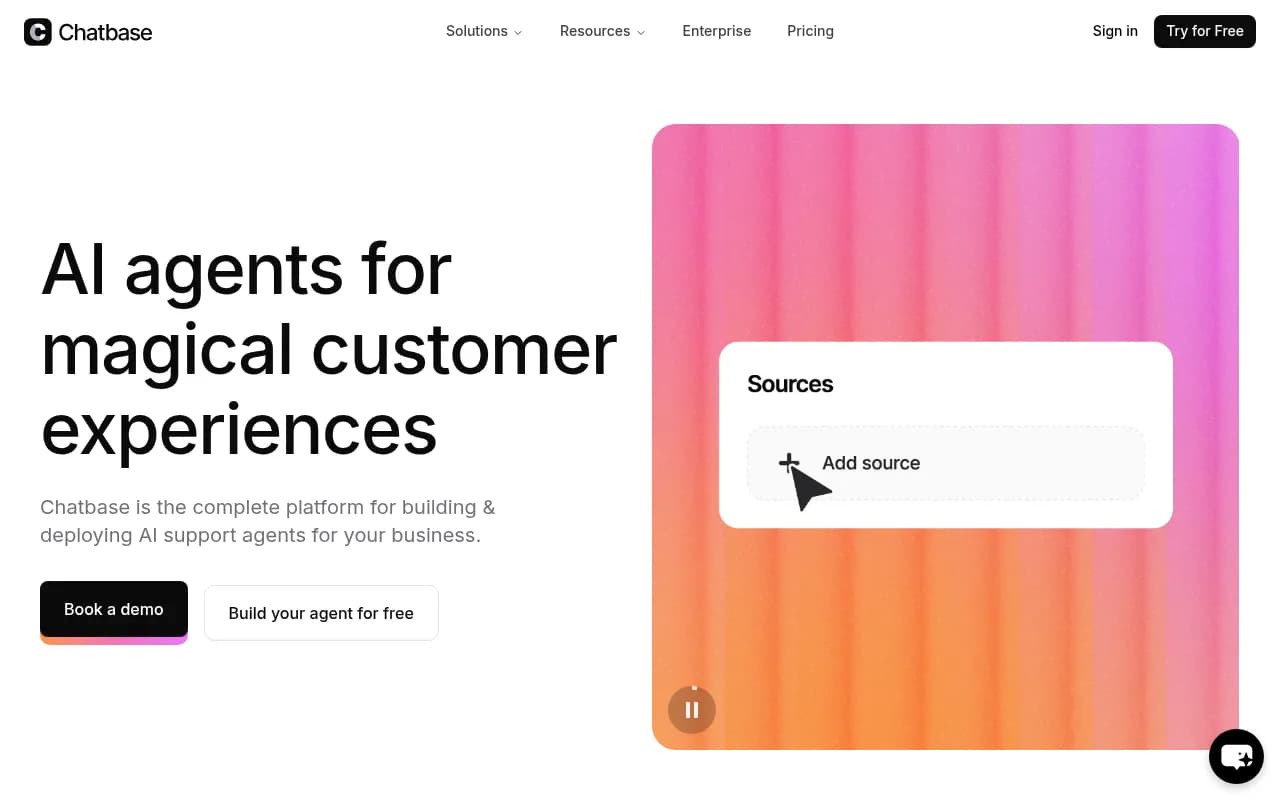
Chatbase is an AI customer service platform used by 10,000+ businesses to build, deploy, and manage AI support agents. Train on your own data, connect to CRMs and helpdesks, and automate support workflows without writing code.
Key takeaways
- Chatbase is a no-code AI customer support platform that lets businesses build and deploy AI agents trained on their own data, with integrations to Zendesk, Salesforce, Stripe, WhatsApp, and more
- Genuinely accessible to non-technical teams -- you can have a working agent live in under an hour, which is a real differentiator vs. more developer-heavy alternatives
- SOC 2 Type II certified and GDPR compliant, making it viable for enterprise and regulated industries
- Free plan available (1 agent, 100 credits/month), with paid plans starting at $40/month
- Not a GEO or AI visibility tool -- it builds chatbots, not brand monitoring or AI search optimization
Chatbase started as a simple "ChatGPT for your documents" tool and has grown into something considerably more serious: a full AI customer service platform used by brands like Chuck E. Cheese, IHG, Miele, and National Grid. The core idea hasn't changed much -- you train an AI agent on your business data, then deploy it to handle customer questions -- but the execution has matured significantly. What was once a basic document Q&A widget is now a platform with agentic workflows, CRM integrations, smart escalation to human agents, and enterprise-grade security.
The target audience is broad but the sweet spot is clear: customer support teams at mid-market companies who are drowning in repetitive tickets and want to automate without hiring a developer or spending six months on a custom build. Chatbase sits in a crowded market alongside tools like Intercom Fin, Tidio, Freshdesk's Freddy AI, and Botpress -- but it's carved out a position by being genuinely easy to set up while still offering enough depth for serious deployments.
The company has been around since roughly 2023 and grew quickly off the back of the ChatGPT wave. It's now at 10,000+ business customers, which is a meaningful number for a relatively young product. The OpenAI Head of Startups quote on their homepage -- calling Chatbase "a strong signal of how customer support will evolve" -- is the kind of endorsement that carries weight in this space.
Key features
Knowledge base training and data sources The foundation of any Chatbase agent is what you train it on. You can feed it website URLs (it crawls and indexes them), uploaded documents (PDFs, Word files, text files), Notion pages, and plain text. The agent uses this as its primary knowledge source. In practice, this means you can point it at your help center, your product docs, and your internal FAQs, and it will synthesize answers from all of them. The system syncs with your sources over time, so when you update a doc, the agent picks up the changes without you having to retrain from scratch.
Agentic actions and workflow automation This is where Chatbase has moved beyond basic chatbot territory. You can configure the agent to actually do things -- not just answer questions. That means connecting to external systems via API and letting the agent pull live data (order status, subscription details, account info) or trigger actions (update an address, cancel a subscription, create a support ticket). You define what the agent is allowed to do in natural language, which keeps the setup accessible to non-developers. The distinction between a "chatbot that answers questions" and an "agent that resolves issues" is real here -- a customer asking "where's my order?" can get a live answer pulled from your order management system, not a canned response.
Multi-model comparison and selection Chatbase lets you experiment with different underlying LLMs and compare their performance for your specific use case. This is a practical feature that most competitors don't surface -- the right model for a technical SaaS support bot is different from the right model for a retail customer service agent. Being able to test configurations before committing is genuinely useful.
Smart escalation to human agents When the AI can't resolve something -- or when you've defined rules that require human review -- Chatbase hands off to a live agent via chat or creates a helpdesk ticket. You configure escalation rules in natural language, which is a nice touch. The handoff includes conversation context so the human agent isn't starting from scratch. This is table stakes for any serious customer support deployment, and Chatbase handles it cleanly.
Omnichannel deployment A single agent can be deployed across your website (as an embedded chat widget), WhatsApp, Slack, Facebook Messenger, and email. The widget is customizable and supports white-labeling on paid plans, so you can remove Chatbase branding entirely. For businesses that need to meet customers across multiple channels without managing separate bots for each, this is a significant time saver.
Multilingual support The platform handles 80+ languages with automatic language detection. The agent responds in the language the customer writes in, without any manual configuration. For e-commerce brands or SaaS companies with international customer bases, this removes a real operational headache.
Analytics and conversation insights The analytics dashboard shows resolution rates, conversation volumes, escalation rates, and customer satisfaction signals. You can review individual conversations to see where the agent struggled, then use those insights to improve your knowledge base or adjust agent instructions. This feedback loop -- review, refine, redeploy -- is how the agent gets better over time rather than staying static.
Enterprise security and compliance Chatbase is SOC 2 Type II certified and GDPR compliant. Data is encrypted at rest and in transit. Critically, your data is not used to train the underlying models -- a concern that comes up constantly in enterprise sales conversations. Verified variables ensure users can only access their own data through the agent, which matters when the agent is pulling from live CRM or order management systems.
White-label and API access For agencies building AI support products for clients, or for companies that want to embed Chatbase deeply into their own product, there's a full API with client libraries. White-labeling removes all Chatbase branding. These features push Chatbase into territory where it can serve as infrastructure, not just a standalone tool.
Who is it for
The clearest fit is a customer support team at a company with 50-500 employees that's handling a high volume of repetitive inquiries -- order status, account questions, basic troubleshooting -- and wants to automate without a major engineering investment. Think an e-commerce brand doing $10M+ in revenue, a SaaS company with a growing free user base generating support load, or a franchise operation (the Chuck E. Cheese use case is a good example) that needs consistent support across locations.
Agencies building AI-powered support products for clients are another strong fit. The white-label option and API access make it possible to build a branded product on top of Chatbase's infrastructure, which is a faster path to market than building from scratch. The pricing structure at higher tiers supports multi-client deployments.
Enterprise teams at larger organizations -- the IHGs and National Grids of the world -- can use Chatbase too, but they'll likely need the custom enterprise tier and will want to evaluate the security documentation carefully. The SOC 2 certification and GDPR compliance clear the most common procurement hurdles.
Who should probably look elsewhere: developers who want full control over the agent architecture and prefer to build on raw APIs (Botpress or a direct OpenAI integration might suit them better). Also, companies whose support needs are primarily voice-based -- Chatbase is text-first. And anyone looking for a tool that goes beyond customer support into sales automation or complex multi-step internal workflows might find the platform's focus on support use cases limiting.
Integrations and ecosystem
Chatbase's integration list covers the most important categories for customer support:
- Helpdesks: Zendesk (for ticket creation and escalation)
- CRMs: Salesforce
- Payments: Stripe (for subscription and billing queries)
- Productivity: Notion, Slack
- Scheduling: Cal.com, Calendly
- Messaging channels: WhatsApp, Facebook Messenger
- Automation platforms: Zapier, Make (formerly Integromat)
The Zapier and Make integrations are important because they extend Chatbase's reach to hundreds of other tools without native integrations. If you use a helpdesk that isn't Zendesk, or a CRM that isn't Salesforce, you can likely bridge the gap through Zapier.
The REST API gives developers direct access to create and manage agents, send messages, and retrieve conversation data. Client libraries are available for common languages. There's no mention of a native mobile app for managing agents on the go -- administration is web-based.
Pricing and value
Chatbase's pricing structure (based on available information as of 2026):
- Free plan: 1 agent, 100 credits/month, basic features. Enough to test the concept but not for production use.
- Hobby/Starter: Around $40/month. Suitable for small businesses with moderate traffic.
- Growth tiers: Scale up from there with more agents, more messages, and access to features like white-labeling and advanced analytics.
- Enterprise: Custom pricing, includes dedicated support, custom security reviews, and SLA guarantees.
Compared to alternatives: Intercom Fin is significantly more expensive and better suited to companies already on the Intercom platform. Tidio is cheaper but less capable for complex agentic workflows. Botpress is more powerful but requires more technical investment. Chatbase sits in a reasonable middle ground -- not the cheapest option, but the pricing reflects a product that's genuinely production-ready without requiring a developer to set it up.
The free plan is real but limited. You can build a basic agent and see how it behaves, but 100 credits/month won't tell you much about how it performs under actual customer load. The lack of a time-limited trial for paid features is a minor frustration -- you're committing to a paid plan to properly evaluate the more interesting capabilities.
Strengths and limitations
What Chatbase does well:
- Setup speed: Getting a working agent live in under an hour is genuinely achievable. The onboarding is well-designed and the natural language configuration for agent behavior removes a lot of friction.
- Agentic depth: The ability to connect to live systems and take actions -- not just answer questions -- puts Chatbase ahead of simpler chatbot builders. This is the difference between a FAQ bot and something that actually resolves issues.
- Enterprise credibility: SOC 2 Type II and GDPR compliance, combined with the customer roster (IHG, National Grid), means Chatbase can pass procurement reviews that would stop lighter-weight tools.
- Omnichannel without complexity: Deploying the same agent across web, WhatsApp, and Messenger without managing separate configurations is a real operational win.
- Multilingual out of the box: 80+ languages with automatic detection, no extra configuration required.
Honest limitations:
- No voice support: If your customers call in, Chatbase doesn't help. Voice AI is a growing category and Chatbase is text-only.
- Advanced customization requires technical skill: The natural language configuration gets you far, but complex agentic workflows with multiple conditional branches can get unwieldy without some technical comfort. Botpress or a custom build gives more control.
- Pricing transparency: The website doesn't publish a full pricing table, which makes it harder to evaluate before signing up. You have to dig through third-party reviews to get specific numbers.
- Limited analytics depth: The reporting covers the basics well, but teams that want deep conversation intelligence -- sentiment analysis, topic clustering, CSAT scoring -- may find the analytics dashboard insufficient compared to dedicated conversation analytics tools.
Bottom line
Chatbase is a solid, production-ready AI customer support platform that hits a genuine sweet spot: capable enough for real enterprise deployments, accessible enough that a non-technical support manager can set it up without engineering help. The agentic features -- live data access, workflow automation, smart escalation -- separate it from the wave of basic chatbot builders that flooded the market in 2023.
Best use case in one sentence: a mid-market e-commerce or SaaS company that wants to automate 60-70% of its support ticket volume without hiring a developer or waiting six months for a custom build.
Frequently asked questions
What is Chatbase?
Does Chatbase have a free plan?
How much does Chatbase cost?
What integrations does Chatbase support?
Is Chatbase secure enough for enterprise use?
How does Chatbase compare to Intercom Fin or Tidio?
Similar and alternative tools to Chatbase