LangChain Review 2026
Development framework providing tools and abstractions for building applications with large language models including prompt templates and chains.
Key Takeaways:
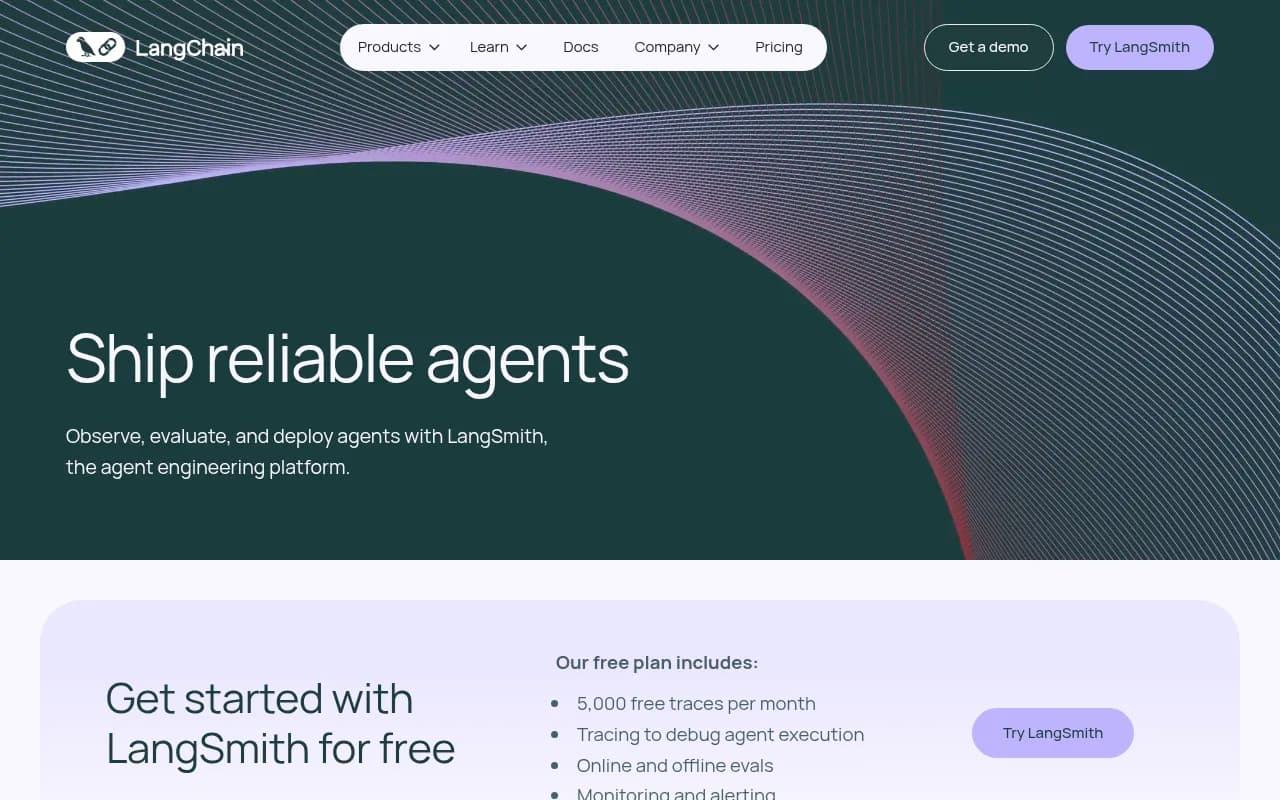
- Dual offering: Open-source frameworks (LangChain, LangGraph, Deep Agents) for building agents + LangSmith platform for observability, evaluation, and deployment
- Massive adoption: 90M+ monthly downloads, 100k+ GitHub stars, used by LinkedIn, Coinbase, Klarna, Rakuten, The Home Depot, and 1M+ developers
- Best for: Engineering teams building production AI agents, from startups to enterprises needing full lifecycle tooling (not just a framework)
- Free tier: 5,000 traces/month on LangSmith with full observability and evaluation features
- Limitations: Steeper learning curve than simpler frameworks, LangSmith pricing scales quickly for high-volume production use
LangChain started in October 2022 as an open-source Python library for chaining LLM calls and quickly became the most downloaded agent framework in the world. By 2024, the company had evolved into a full platform play: the open-source frameworks (LangChain, LangGraph, Deep Agents) handle agent construction, while LangSmith provides the engineering platform for observability, testing, deployment, and monitoring. This dual approach -- free frameworks plus paid platform -- mirrors how companies like Databricks (Spark + platform) and HashiCorp (Terraform + Terraform Cloud) built developer-first businesses. The result is a complete agent engineering stack used by LinkedIn, Coinbase, Klarna, Rakuten, Elastic, Workday, The Home Depot, and over 1 million developers.
The target audience spans three groups: individual developers prototyping AI agents who use the free frameworks, engineering teams at startups building production agents who need LangSmith's observability and evaluation tools, and enterprise AI teams at companies like Bristol Myers Squibb or Bridgewater who require deployment infrastructure, compliance features, and support. If you're building a simple chatbot or one-off script, LangChain might be overkill. If you're shipping agents that handle customer support, research workflows, or enterprise search at scale, this is the stack.
Open-Source Frameworks (Free)
LangChain: The original framework, now focused on quick-start agents with high-level abstractions. Provides prompt templates, chains (sequences of LLM calls), retrieval-augmented generation (RAG) patterns, and 1,000+ integrations with model providers (OpenAI, Anthropic, Google, Cohere, Mistral, local models via Ollama), vector databases (Pinecone, Weaviate, Chroma, Qdrant), and tools (Google Search, Wikipedia, Zapier, SQL databases). Available in Python and JavaScript/TypeScript. Best for developers who want to prototype fast without writing boilerplate for API calls, retries, or parsing. The framework handles model switching (swap OpenAI for Claude in one line), memory management (conversation history, entity extraction), and output parsing (structured JSON from unstructured LLM responses). Compared to raw API calls or lighter libraries like LiteLLM, LangChain trades simplicity for power -- more abstractions, steeper learning curve, but faster iteration once you learn the patterns.
LangGraph: The low-level framework for building custom agents with full control. Released in 2024, LangGraph treats agents as state machines (graphs) where each node is a function (call an LLM, query a database, invoke a tool) and edges define the flow. This architecture supports complex patterns like multi-agent systems (one agent delegates to specialists), human-in-the-loop workflows (pause for approval before executing), and cyclical reasoning (agent loops until it solves a problem). LangGraph is what teams use when LangChain's abstractions are too rigid -- you define the graph structure, state schema, and control flow yourself. It's more code than LangChain but gives you the flexibility to build agents that match your exact requirements. Used heavily by teams building copilots (Rippling), research assistants (Morningstar), and customer support agents (Klarna) where the agent workflow is non-linear and domain-specific.
Deep Agents: The newest framework (2025) for long-running, complex tasks that require planning, memory, and sub-agents. Deep Agents introduces hierarchical agent architectures where a coordinator agent breaks down a task ("research competitors and write a report"), spawns sub-agents to handle pieces (one agent searches the web, another analyzes data, another writes), and synthesizes results. Includes built-in memory systems (short-term for current task, long-term for learned facts), planning modules (generate a multi-step plan before acting), and reflection loops (agent critiques its own output and iterates). This is the framework for agents that run for hours or days, not seconds -- think automated research workflows, multi-day customer onboarding sequences, or complex data analysis pipelines. Still early but represents where the industry is heading: agents that handle entire jobs, not just single queries.
LangSmith Platform (Paid)
The frameworks get you building, but LangSmith is what you need to ship agents to production and keep them working reliably. It's an engineering platform with four core modules:
Observability (Tracing): Every agent execution generates a trace -- a detailed log of every step (LLM calls, tool invocations, retrieval queries, errors). You see the exact prompt sent to the model, the response, latency, token usage, and any failures. This is critical because agents are non-deterministic (same input, different output) and opaque (you can't inspect what happened without logs). LangSmith's tracing works with any framework (LangChain, LangGraph, custom code) via Python and TypeScript SDKs. You instrument your code once, and every production run gets logged. The UI lets you filter traces by user, session, error type, or latency, then drill into individual runs to debug. For example, if a customer support agent is giving wrong answers, you trace the run, see it retrieved outdated docs, and fix the retrieval query. Competitors like Helicone, LangFuse, and Arize offer tracing, but LangSmith's integration with the frameworks and evaluation tools makes it stickier.
Evaluation (Testing & Monitoring): Agents are hard to test because "correct" is subjective and changes as you learn what users want. LangSmith's evaluation system lets you turn production traces into test datasets (export 100 real user queries), define evaluators (LLM-as-judge, rule-based checks, human reviewers), and score agent performance. You can run evaluations offline (before deploying) or online (monitor live traffic). The platform includes pre-built evaluators for common checks (hallucination detection, tone analysis, factual accuracy) and lets you write custom ones. For example, you might evaluate a research agent on "did it cite sources?" and "is the summary accurate?" using an LLM judge, then track how scores trend over time as you iterate. The evaluation module also supports A/B testing (compare two agent versions on the same queries) and regression testing (ensure new changes don't break existing behavior). This is where LangSmith pulls ahead of pure observability tools -- it closes the loop from monitoring to improvement.
Deployment (Agent Infrastructure): Standard cloud infrastructure (AWS Lambda, Cloud Run) isn't built for agents. Agents run for minutes or hours, need to pause for human input, and require memory across sessions. LangSmith Deployment provides managed infrastructure for agent workloads: APIs that handle long-running tasks (no timeouts), built-in memory (conversation history, user preferences), auto-scaling (spin up capacity for spikes), and human-in-the-loop primitives (pause agent, wait for approval, resume). You deploy a LangGraph agent with one click, and LangSmith handles the rest. The deployment includes enterprise features like SOC 2 compliance, SSO, role-based access control, and private VPC hosting. This is the module enterprises pay for -- Klarna, Rakuten, and The Home Depot aren't running agents on Lambda, they're using LangSmith's infrastructure to ensure reliability and compliance. Compared to building your own agent runtime (queues, workers, state management), LangSmith Deployment saves months of engineering time.
Agent Builder (No-Code): Released in late 2025, Agent Builder is a no-code interface for creating agents without writing code. You define the agent's goal ("answer customer questions about our product"), connect data sources (Notion docs, Google Drive, Slack), and configure tools (web search, calculator, API calls). The agent uses LangGraph under the hood but abstracts away the code. This is aimed at non-technical users (product managers, operations teams, marketers) who want to automate workflows without involving engineers. For example, a sales team could build an agent that researches prospects (scrapes LinkedIn, finds company news) and drafts personalized outreach emails. The agent runs on LangSmith's infrastructure and can be shared with teammates. It's early, but the vision is clear: democratize agent building beyond developers. Competitors like Relevance AI and Zapier Central offer similar no-code agent builders, but LangSmith's advantage is the underlying platform -- agents built in Agent Builder get the same observability, evaluation, and deployment features as code-based agents.
Integrations & Ecosystem
LangChain's 1,000+ integrations cover every part of the agent stack. Model providers: OpenAI, Anthropic, Google (Gemini), Cohere, Mistral, Meta (Llama via Replicate or Ollama), AWS Bedrock, Azure OpenAI. Vector databases: Pinecone, Weaviate, Chroma, Qdrant, Milvus, Supabase, PGVector. Tools: Google Search, Bing Search, Wikipedia, Wolfram Alpha, Zapier, SQL databases (Postgres, MySQL, Snowflake), APIs (REST, GraphQL). Data loaders: PDF, CSV, JSON, HTML, Markdown, Notion, Google Drive, Confluence, Slack. The framework is designed to be modular -- swap one vector database for another in a single line of code. LangSmith integrates with CI/CD pipelines (GitHub Actions, GitLab CI), monitoring tools (Datadog, Grafana), and collaboration platforms (Slack for alerts). The Python and TypeScript SDKs work with any codebase, so you can instrument existing agents without rewriting them.
Pricing & Value
LangSmith pricing is usage-based with a generous free tier:
- Free Plan: 5,000 traces/month, full observability, online and offline evaluations, monitoring and alerts. Enough for prototyping and small production apps (a few hundred users).
- Startup Plan: 50% discount on seat pricing, 30,000 free traces/month, one free Developer deployment with unlimited agent runs. Designed for early-stage companies (pre-Series A).
- Paid Plans: Pricing scales with traces (logged agent runs) and seats (team members). Exact numbers aren't public, but based on competitor pricing (Helicone, LangFuse) and user reports, expect $200-500/month for 50k-100k traces and 5-10 seats. Enterprise plans include private deployments, SSO, SLAs, and dedicated support.
The open-source frameworks are free forever, so you can build agents without paying anything. You only pay for LangSmith when you need observability, evaluation, or deployment infrastructure. Compared to building your own logging, testing, and deployment stack, LangSmith is a bargain -- you'd spend $50k-100k in engineering time to replicate the platform. Compared to competitors, LangSmith is mid-priced: cheaper than full observability platforms like Arize ($1k+/month), more expensive than lightweight tracing tools like Helicone ($50-200/month). The value proposition is the integration: frameworks + platform in one ecosystem.
Strengths
- Complete stack: Only platform that offers open-source frameworks, observability, evaluation, and deployment in one place. You don't need to stitch together 5 tools.
- Massive ecosystem: 1,000+ integrations, 90M monthly downloads, 100k+ GitHub stars. If you need to connect to a tool or model, LangChain supports it.
- Production-grade: Used by LinkedIn, Coinbase, Klarna, Rakuten, The Home Depot. These companies aren't using toys -- they're running agents at scale on LangSmith.
- Framework flexibility: Works with LangChain, LangGraph, Deep Agents, or custom code. You're not locked into one abstraction level.
- Evaluation focus: The evaluation module is more mature than competitors. Turning production data into test datasets and running LLM-as-judge evaluators is seamless.
Limitations
- Learning curve: LangChain's abstractions (chains, agents, retrievers, memory) take time to learn. Developers coming from raw API calls often find it overwhelming. LangGraph is even more complex -- you need to understand state machines and graph structures.
- Pricing opacity: LangSmith's paid plans don't list prices publicly. You have to contact sales, which is frustrating for small teams who want to budget.
- Trace volume costs: If you're running millions of agent executions per month, trace storage costs add up. Some teams report $1k-5k/month bills for high-volume production apps. You can sample traces (log 10% of runs) to reduce costs, but then you lose visibility.
- Overkill for simple use cases: If you're building a basic chatbot or one-off script, LangChain's abstractions are unnecessary. Libraries like LiteLLM or direct API calls are simpler and faster.
Bottom Line
LangChain is the default choice for engineering teams building production AI agents in 2026. The open-source frameworks (LangChain, LangGraph, Deep Agents) give you the building blocks, and LangSmith provides the platform to ship, monitor, and improve agents at scale. If you're a solo developer prototyping, start with the free frameworks and LangSmith's free tier. If you're a startup or enterprise shipping agents to customers, LangSmith's observability, evaluation, and deployment tools are worth the cost -- you'll save months of engineering time and ship more reliable agents. The learning curve is real, but the ecosystem, integrations, and production track record make it the safest bet for serious agent development. Best use case in one sentence: engineering teams at startups or enterprises building customer-facing AI agents (support, research, copilots) who need full lifecycle tooling from prototyping to production monitoring.
Similar and alternative tools to LangChain