Vertex AI Review 2026
Google's fully-managed AI development platform for building generative AI applications. Access Gemini 3, Vertex AI Studio, Agent Builder, and 200+ foundation models. Train custom ML models, deploy at scale, and build enterprise agents with integrated MLOps tools. Used by enterprises for production A
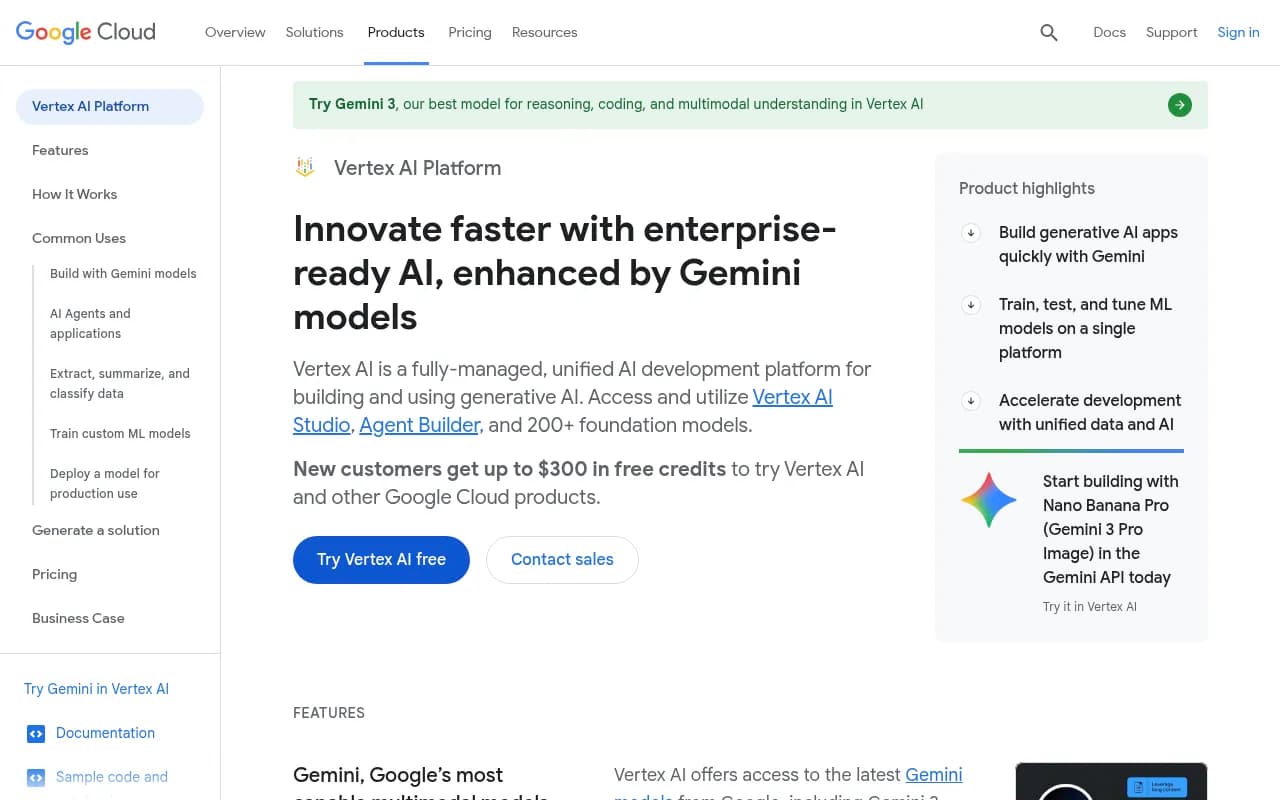
Summary
- Enterprise-grade AI platform with access to Gemini 3 and 200+ foundation models (first-party, third-party like Claude, and open models like Llama 3.2)
- Unified environment for both generative AI (prompt engineering, model tuning) and custom ML training (notebooks, pipelines, deployment)
- Built-in MLOps tools for the full lifecycle: evaluation, pipelines, model registry, feature store, monitoring
- Vertex AI Agent Builder for creating production-ready enterprise agents grounded in your data
- Integrated with BigQuery and Google Cloud infrastructure for data scientists and ML engineers
- Pricing starts at $0.0001 per 1,000 characters for text generation; new customers get $300 in free credits
Google Cloud's Vertex AI is an enterprise AI development platform that combines generative AI capabilities (via Gemini models and Model Garden) with traditional ML training and deployment tools. It's designed for organizations that need a production-grade environment to build, train, tune, and deploy AI models at scale. The platform serves data scientists, ML engineers, and developers building everything from chatbots and content generation tools to custom computer vision models and enterprise agents.
Launched as part of Google Cloud's AI portfolio, Vertex AI consolidates what were previously separate services (AI Platform, AutoML) into a single unified platform. It's used by companies like GA Telesis, Booking.com, and thousands of other enterprises that need enterprise-grade security, compliance, and scalability for their AI workloads.
Gemini models and generative AI
Vertex AI provides access to Google's Gemini model family, including Gemini 3 Pro (the latest as of 2026). Gemini is multimodal -- it can process text, images, video, and code as input and generate responses across those modalities. You can prompt Gemini in Vertex AI Studio using natural language, upload images or videos, and get structured outputs like JSON or HTML. The platform includes sample prompts for tasks like extracting text from images, converting mockups to code, and answering questions about uploaded media.
Beyond Gemini, Vertex AI's Model Garden offers 200+ foundation models. This includes first-party models (Imagen for image generation, Chirp for speech, Veo for video), third-party models (Anthropic's Claude family), and open models (Gemma, Llama 3.2). You can test, customize, and deploy any of these models directly from the Model Garden interface. The platform supports multiple tuning options: prompt tuning, adapter tuning, and full fine-tuning depending on the model and your use case.
Vertex AI Studio is the no-code interface for designing and testing prompts. It includes AI-powered prompt writing tools that suggest improvements to your prompts based on best practices. You can save prompts, version them, and share them with your team. For developers, the Vertex AI SDK (available in Python, JavaScript, Java, Go) lets you call models programmatically. You can also use API keys for quick testing without setting up a full Google Cloud project.
Model evaluation and optimization
Vertex AI includes an enterprise-grade evaluation service for assessing generative AI models. You can run automated evaluations on metrics like groundedness (does the model cite sources accurately?), safety (does it produce harmful content?), and task-specific metrics (summarization quality, classification accuracy). The evaluation service supports both automatic metrics and human evaluation workflows where you can have reviewers rate model outputs.
For optimization, Vertex AI supports extensions that let models retrieve real-time information (via APIs or search) and trigger actions (like sending emails or updating databases). This is how you build agents that can interact with external systems, not just generate text. The platform also includes grounding capabilities that let you connect models to your enterprise data sources (like internal documentation or product catalogs) so responses are based on your specific information, not just the model's training data.
Custom ML training and deployment
For teams that need to train custom models (not just use pre-trained foundation models), Vertex AI provides a full suite of ML training tools. Vertex AI Notebooks (including Colab Enterprise and Workbench) are Jupyter-based environments natively integrated with BigQuery. You can query massive datasets in BigQuery, run experiments in notebooks, and train models without moving data around.
Vertex AI Training supports custom training jobs using any ML framework (TensorFlow, PyTorch, scikit-learn, XGBoost). You write your training code, specify the machine type and accelerators (GPUs, TPUs), and Vertex AI handles the infrastructure. Training jobs can scale to distributed training across multiple machines. You can also use AutoML for automated model training if you don't want to write code -- just upload your data and AutoML will train and tune a model for you.
Once a model is trained, you register it in Model Registry and deploy it for predictions. Vertex AI Prediction supports both online predictions (real-time API endpoints) and batch predictions (process large datasets asynchronously). You can deploy models to CPU or GPU instances, configure autoscaling, and use custom prediction routines if you need to preprocess inputs or postprocess outputs. The platform includes prebuilt containers for common frameworks so you don't have to build Docker images yourself.
MLOps and production workflows
Vertex AI provides purpose-built MLOps tools for managing the full ML lifecycle. Vertex AI Pipelines lets you orchestrate multi-step workflows (data preprocessing, training, evaluation, deployment) as code. Pipelines are defined using Kubeflow Pipelines or TensorFlow Extended (TFX) and run on managed infrastructure. You can schedule pipelines to run on a cadence or trigger them based on events (like new data arriving).
Feature Store is a managed service for storing, serving, and sharing ML features. Instead of recomputing features every time you train a model or make predictions, you store them in Feature Store and retrieve them on demand. This ensures consistency between training and serving and lets teams reuse features across projects.
Model Monitoring tracks deployed models for input skew (are the inputs you're seeing in production different from training data?) and prediction drift (are the model's predictions changing over time?). If monitoring detects issues, you can set up alerts to notify your team. This is how you catch model degradation before it impacts users.
Vertex AI Evaluation (mentioned earlier for generative AI) also works for custom models. You can evaluate classification, regression, and forecasting models on standard metrics and compare multiple model versions to pick the best one.
Agent Builder and enterprise agents
Vertex AI Agent Builder is a platform for building, scaling, and governing enterprise agents. Agents are AI systems that can reason, plan, and take actions to accomplish tasks. Agent Builder provides the infrastructure to build agents that are grounded in your enterprise data (via search, databases, APIs) and can execute multi-step workflows.
The Agent Development Kit (ADK) is a framework for building sophisticated agents using code. You define the agent's capabilities (what tools it can use, what data it can access), and ADK handles orchestration, memory, and error handling. Agents built with ADK can be deployed to production and scaled to handle thousands of concurrent users.
For governance, Vertex AI integrates with Gemini Enterprise (Google's enterprise AI offering) to register, manage, and monitor agents across your organization. You can set policies for which agents can access which data, track agent usage, and audit agent actions.
Integrations and ecosystem
Vertex AI is deeply integrated with the Google Cloud ecosystem. BigQuery integration lets you train models on data warehouses without exporting data. Cloud Storage is used for storing datasets, model artifacts, and pipeline outputs. Vertex AI also integrates with Looker Studio for custom reporting and dashboards.
For external integrations, Vertex AI provides a REST API and client libraries in multiple languages. You can call Vertex AI from any application or service. The platform also supports importing models trained elsewhere (like on-premises or other clouds) and deploying them on Vertex AI infrastructure.
Vertex AI supports multi-language and multi-region deployments. You can train models in one region and deploy them in another. The platform is available in 20+ Google Cloud regions worldwide.
Pricing and value
Vertex AI pricing is usage-based. For generative AI, you pay per 1,000 characters of input (prompt) and output (response). Gemini models start at $0.0001 per 1,000 characters. Imagen (image generation) starts at $0.0001 per image. For custom training, you pay for the machine type and accelerators used per hour. Training costs vary by region and hardware (CPU, GPU, TPU).
Vertex AI Notebooks charge for compute and storage (same rates as Compute Engine and Cloud Storage) plus a management fee. Vertex AI Pipelines charge $0.03 per pipeline run plus the cost of resources used during the run. Vertex AI Vector Search (for semantic search and retrieval) charges based on data size, queries per second, and number of nodes.
New customers get $300 in free credits to try Vertex AI and other Google Cloud products. There's no free tier after credits expire, but you can estimate costs using Google Cloud's pricing calculator.
Compared to competitors like AWS SageMaker or Azure Machine Learning, Vertex AI's pricing is competitive for generative AI workloads (especially if you're already using Google Cloud). For custom ML training, costs depend heavily on your specific workload (data size, model complexity, hardware requirements). Vertex AI's integration with BigQuery can reduce data movement costs if your data is already in Google Cloud.
Strengths
- Unified platform: Generative AI and custom ML training in one place. You don't need separate tools for foundation models and custom models.
- Gemini access: Direct access to Google's latest multimodal models. Gemini 3 is competitive with GPT-4 and Claude 3 for many tasks.
- Model Garden breadth: 200+ models including first-party, third-party, and open models. More variety than most competitors.
- BigQuery integration: Train models on massive datasets without exporting data. This is a huge advantage if you're already using BigQuery.
- MLOps maturity: Feature Store, Model Monitoring, Pipelines, and Model Registry are production-grade tools that many competitors lack or charge extra for.
- Enterprise security: Google Cloud's security and compliance certifications (SOC 2, ISO 27001, HIPAA, etc.) apply to Vertex AI. This matters for regulated industries.
Limitations
- Google Cloud lock-in: Vertex AI is tightly coupled to Google Cloud. If you're on AWS or Azure, you'll need to move workloads or use multi-cloud (which adds complexity).
- Learning curve: The platform is powerful but complex. Teams new to Google Cloud or ML will need time to ramp up. Documentation is extensive but can be overwhelming.
- Pricing opacity: Usage-based pricing makes it hard to predict costs upfront. You need to run proof-of-concepts to estimate real-world costs.
- Limited model customization for some foundation models: Not all models in Model Garden support fine-tuning. Some are deploy-only.
- Agent Builder is still maturing: While Agent Builder is promising, it's newer than competitors like LangChain or AutoGPT. The ecosystem of pre-built agent templates and integrations is smaller.
Bottom line
Vertex AI is the right choice for enterprises that need a production-grade AI platform and are already using Google Cloud (or willing to adopt it). It's particularly strong for teams that want to use both generative AI (Gemini, Claude, Llama) and custom ML models in the same environment. The BigQuery integration is a killer feature for data-heavy workloads. The MLOps tools are mature and enterprise-ready.
Skip Vertex AI if you're on AWS or Azure and don't want to move workloads, or if you need a simpler, lower-cost solution for basic generative AI tasks (like OpenAI's API or Anthropic's Claude API). Vertex AI is overkill for small teams or hobbyists -- the platform is designed for enterprise scale and complexity.
Best use case in one sentence: Large enterprises building production AI applications that need access to multiple foundation models, custom ML training, and enterprise-grade MLOps tools, all integrated with Google Cloud infrastructure.
Frequently asked questions
What is Vertex AI?
How much does Vertex AI cost?
Is Vertex AI free to use?
What models are available in Vertex AI?
Who should use Vertex AI?
What is Vertex AI Agent Builder?
What MLOps tools does Vertex AI include?
Can Vertex AI handle multimodal AI tasks?
How does Vertex AI integrate with other Google Cloud services?
What companies use Vertex AI?
Similar and alternative tools to Vertex AI
