Botpress Review 2026
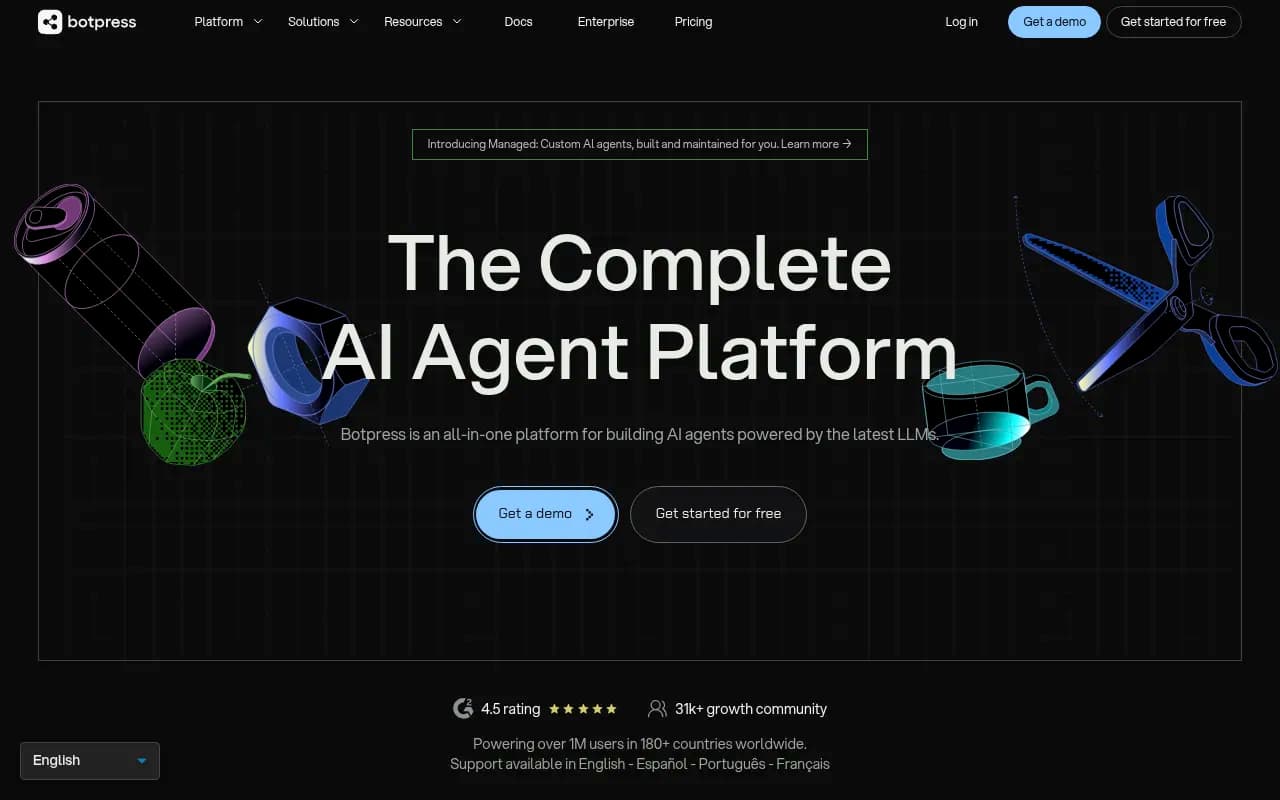
Botpress is a complete AI agent platform for building, deploying, and monitoring LLM-powered chatbots and autonomous agents. Ideal for developers and businesses needing multi-channel deployment, deep integrations, and a generous free tier.
Key takeaways
- Botpress is a full-stack AI agent platform with a visual studio, custom inference engine (LLMz), and cloud hosting -- not just a chatbot builder
- Genuinely generous free tier with pay-as-you-go pricing; paid plans start around $89/month for Plus
- Strong developer experience: full API access, custom JavaScript execution in a sandboxed environment, and detailed observability tools
- Large, active community (31,000+ Discord members) that meaningfully reduces the learning curve
- Best suited for developers, technical product teams, and agencies building production-grade conversational AI -- not a no-code tool for non-technical users
Botpress has been around long enough to earn a reputation as one of the more serious AI agent platforms on the market. Founded in Montreal, the company started as an open-source chatbot framework before pivoting toward a cloud-first, LLM-native platform. The open-source roots are still visible -- the GitHub repository is public and actively maintained -- but the product has evolved well beyond a simple bot builder. Today it positions itself as a complete infrastructure layer for building, deploying, and monitoring AI agents across channels, tools, and data sources.
The target audience is developers and technical teams who want real control over agent behavior without building everything from scratch. That said, Botpress has put real work into making the visual studio approachable enough for non-engineers to prototype in. The result is a platform that sits in an interesting middle ground: powerful enough for production use, accessible enough that a product manager can sketch out a flow without writing code.
Context matters here. The AI agent space has gotten crowded fast. Tools like Voiceflow, Landbot, and Intercom's Fin all compete for similar use cases. What separates Botpress is the combination of a custom inference engine, isolated runtime architecture, and a genuinely open integration ecosystem. It's not trying to be a simple FAQ bot builder -- it's going after teams that need agents capable of multi-step reasoning, tool use, and stateful conversations across complex workflows.
Key features
LLMz custom inference engine
The core of every Botpress agent runs on LLMz, a proprietary inference engine built specifically for agent orchestration. Unlike standard tool-calling setups that rely on external orchestration layers and rigid prompt templates, LLMz handles everything internally: interpreting instructions, managing memory, selecting tools, executing JavaScript in a sandboxed environment, and returning structured outputs. In practice, this means agents can handle genuinely complex multi-step logic without the developer needing to wire together separate services. It's a meaningful architectural difference from platforms that just wrap the OpenAI API.
Agent Studio (visual builder)
The visual builder is where most users spend their time. It's a node-based flow editor that lets you define conversation paths, connect integrations, set conditions, and configure agent behavior without writing code. The studio supports both structured flows (for predictable, rule-based paths) and autonomous agent behavior (where the LLM decides what to do next). You can mix both approaches in the same agent, which is genuinely useful for real-world use cases where some paths need to be deterministic and others don't.
Autonomous engine
Botpress has a dedicated autonomous mode where agents operate without a predefined flow. The agent receives instructions, a set of available tools, and context -- then decides how to respond. This is closer to how modern AI assistants work and is well-suited for open-ended support scenarios. The tradeoff is predictability: autonomous agents are harder to test exhaustively, and Botpress's observability tools become critical here.
Knowledge bases
Agents can be connected to knowledge bases built from uploaded documents, URLs, or structured data. The platform handles chunking, embedding, and retrieval internally. In practice, this means you can point an agent at your documentation or product catalog and have it answer questions without manually writing Q&A pairs. The quality of retrieval is solid, though like all RAG implementations, it works best when the source material is well-organized.
Human handoff
Botpress has a built-in human handoff system that lets agents escalate conversations to live agents when needed. It supports routing logic (so you can send different conversation types to different teams), conversation assignment, and context passing so the human agent sees the full conversation history. This integrates with external helpdesk tools like Zendesk as well.
Multi-channel deployment
Agents can be deployed across web chat, WhatsApp, Telegram, Slack, Facebook Messenger, and voice interfaces -- all from a single build. The Hub (Botpress's integration marketplace) lists available channels and integrations. This is a real time-saver compared to platforms where each channel requires a separate implementation.
Tables
Botpress Tables is a built-in structured data store that agents can read from and write to during conversations. Think of it as a lightweight database layer that lives inside the platform. Agents can look up records, update fields, and use table data to personalize responses -- without needing an external database for simple use cases.
Developer tools and API
The developer experience is a genuine strength. The REST API covers bot management, messaging, and table operations. Custom code can be injected at lifecycle events, and the platform exposes full observability over agent actions and executions. The API reference is well-documented, and the code examples on the site use clean, readable JavaScript. For teams that want to build on top of Botpress programmatically -- or integrate it into a larger system -- the API is capable enough to support that.
Managed service
A newer offering called "Managed" lets Botpress's own team build and maintain your AI agent for you. This is aimed at businesses that want the outcome (a working AI agent) without the internal overhead of building it. Pricing for this tier is custom and sits above the self-serve plans.
Who is it for
Botpress fits best for developers and technical product teams building customer-facing AI agents at scale. A typical user might be a software engineer at a mid-sized SaaS company who needs to build a support bot that can handle account inquiries, escalate to Zendesk, and pull data from a CRM -- all without spinning up custom infrastructure. The platform handles the hosting, the LLM orchestration, and the channel integrations, so the developer can focus on the agent logic itself.
Agencies building AI agents for clients are another strong fit. The platform's multi-workspace structure, partner program, and "Hire an Expert" marketplace suggest Botpress has deliberately cultivated this segment. An agency managing five or ten client bots across different industries would find the integration breadth and deployment flexibility genuinely useful.
The free tier and active Discord community also make Botpress accessible to independent developers and students learning to build with LLMs. The 31,000-member Discord is unusually active for a developer tool -- community members regularly share templates, debug each other's flows, and discuss best practices. That kind of ecosystem has real value when you're stuck.
Who should probably look elsewhere: non-technical business users who want a simple FAQ bot without touching any configuration. Botpress has made the studio more approachable, but it still assumes some comfort with concepts like flows, variables, and API calls. Tools like Tidio or Intercom's Fin are better fits for that persona. Similarly, enterprise teams with strict data residency requirements should verify Botpress's hosting options before committing -- the cloud-first architecture may not satisfy every compliance requirement out of the box.
Integrations and ecosystem
The Botpress Hub is the central marketplace for integrations, channels, and LLM connections. On the channel side, it covers WhatsApp, Telegram, Slack, Facebook Messenger, Instagram, Microsoft Teams, and web chat. Integration-wise, the list includes Zendesk, HubSpot, Linear, Stripe, Zapier, and more. The Zapier connection alone opens up hundreds of downstream automation possibilities without custom code.
LLM support is flexible -- the platform isn't locked to a single provider. You can connect to OpenAI, Anthropic, Google, and other models through the Hub's LLM section, which matters for teams that want to swap models as the landscape evolves or use different models for different tasks.
The REST API is comprehensive and well-documented at botpress.com/docs/api-reference. It covers bot creation and management, conversation handling, table operations, and messaging. Webhooks are supported for event-driven workflows.
There's no dedicated mobile app, but the web studio works reasonably well on tablet-sized screens. The platform is cloud-hosted by default, with the open-source self-hosted option available for teams that need it (though the cloud version gets more active development).
The GitHub repository (github.com/botpress/botpress) is public and actively maintained, which is useful for teams that want to inspect the codebase, contribute, or build custom integrations.
Pricing and value
Botpress uses a pay-as-you-go model as the default, which is free to start. The free tier is genuinely usable -- not a crippled demo -- and includes enough to build and test a real agent. Paid plans, based on third-party pricing research for 2026, run approximately:
- Free / Pay-as-you-go: $0 to start, usage-based charges apply as you scale
- Plus: ~$89/month, suitable for small teams or solo developers with moderate usage
- Team: ~$495/month, for teams needing higher limits and collaboration features
- Managed: ~$1,495/month and up (custom), where Botpress builds and maintains the agent for you
Annual billing discounts are available. The pay-as-you-go structure means costs scale with actual usage (primarily LLM tokens and messages), which is fair for teams with variable traffic but can get unpredictable at high volumes.
Compared to alternatives: Voiceflow's paid plans start around $50/month but have more limited developer tooling. Intercom's Fin is significantly more expensive and locked into the Intercom ecosystem. For pure developer flexibility at this price point, Botpress is competitive.
The free tier is a genuine differentiator. Many competitors either time-limit their trials or cripple free plans to the point of uselessness. Botpress lets you build something real before paying anything, which is the right approach for a developer-focused tool.
Strengths and limitations
What it does well:
- The LLMz inference engine is a real architectural advantage -- agents handle complex multi-step logic more reliably than platforms that bolt tool-calling onto a generic LLM wrapper
- The free tier is genuinely useful, not a marketing trick. You can build and deploy a real agent without spending anything
- The Discord community (31k+ members) is one of the most active in the chatbot/AI agent space, and community support is fast and substantive
- Multi-channel deployment from a single build saves significant time for teams targeting more than one channel
- Developer tooling -- API, custom code injection, observability -- is mature and well-documented
Honest limitations:
- The learning curve is real. The studio is more approachable than raw code, but it still assumes technical literacy. Non-developers will hit walls quickly
- Autonomous agent behavior can be hard to test and debug exhaustively. The observability tools help, but unpredictable LLM behavior in production is a genuine challenge the platform doesn't fully solve
- Pricing at scale can get complex. The pay-as-you-go model is great for getting started, but teams with high message volumes need to model costs carefully before committing
- Self-hosted deployment, while available via the open-source repo, lags behind the cloud version in features and gets less active development attention
Bottom line
Botpress is a strong choice for developers and technical teams who need a production-ready AI agent platform with real infrastructure behind it -- not just a chatbot builder with an LLM API key bolted on. The combination of a custom inference engine, generous free tier, broad integration ecosystem, and active community makes it one of the more complete options in this space in 2026.
Best use case in one sentence: building and deploying multi-channel AI customer support or workflow automation agents where you need real control over agent behavior, tool use, and escalation logic.
Frequently asked questions
What is Botpress?
Is Botpress free to use?
Is Botpress open source?
Who is Botpress best suited for?
What channels can Botpress agents be deployed on?
How does Botpress compare to Voiceflow or Intercom Fin?
Similar and alternative tools to Botpress