Siteline AI Review 2026
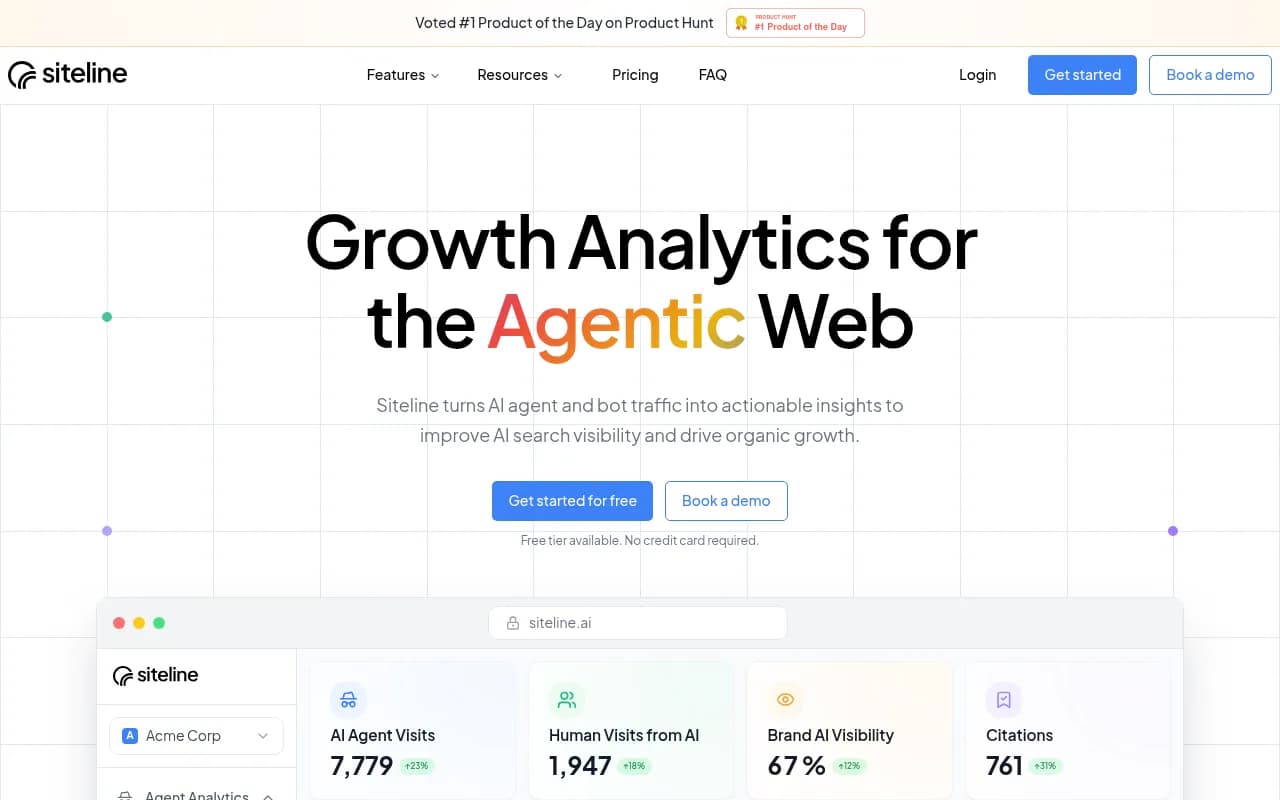
Siteline is an AI search visibility and agent analytics platform that helps growth teams, SEO agencies, and marketers understand how AI bots crawl their site, where they're cited in AI responses, and how that traffic converts into real customers.
Key takeaways
- Siteline combines AI crawler analytics with prompt tracking, giving you visibility into both how AI bots crawl your site and where your brand appears in AI-generated responses
- Lacks content generation, answer gap analysis, AI writing agent, Reddit/YouTube tracking, ChatGPT Shopping monitoring, and traffic attribution depth that Promptwatch offers -- it's primarily an analytics and monitoring tool
- Best fit for growth teams and SEO agencies at companies with meaningful web traffic who want to understand AI bot behavior at the infrastructure level (Cloudflare, Vercel, AWS CloudFront, etc.)
- Pricing starts at $49/month, making it one of the more affordable entry points in the AI visibility space
- Voted #1 Product of the Day on Product Hunt, with 1,000+ companies using it including Retool, Apollo, and Preply
Siteline is an AI search visibility and agent analytics platform built for growth teams and SEO professionals who want to understand what AI bots are doing on their website -- and then connect that activity to real business outcomes. The core premise is straightforward: a growing share of web traffic (the company cites 30%) now comes from AI agents, crawlers, and bots acting on behalf of human users, and most analytics tools are completely blind to it. Google Analytics doesn't distinguish AI bot traffic. Semrush doesn't show you how ChatGPT crawls your pages. Siteline does.
The platform sits at an interesting intersection: part server-side analytics (think Cloudflare or CDN-level bot detection), part AI prompt tracking (monitoring where your brand appears in ChatGPT, Perplexity, and other AI responses), and part conversion attribution (connecting AI bot activity to eventual human visits and signups). It's a broader scope than most tools in this space, which tend to focus narrowly on either crawler logs or prompt monitoring.
Siteline appears to have launched in 2024-2025, riding the wave of interest in GEO (Generative Engine Optimization) and AEO (Answer Engine Optimization). It's gained traction quickly -- the Product Hunt #1 badge and a customer list that includes recognizable SaaS names like Retool and Apollo suggest real adoption, not just hype. The platform is purpose-built for the agentic web era, which is a meaningful positioning choice: rather than bolting AI features onto a traditional SEO tool, Siteline was designed from scratch around AI traffic as a first-class channel.
Key features
Agent analytics and crawler detection
This is where Siteline genuinely differentiates itself from pure prompt-tracking tools. By integrating at the CDN or server level (Cloudflare, Vercel, Azure CDN, AWS CloudFront, Next.js, WordPress), Siteline captures actual HTTP requests from AI crawlers -- which pages they hit, how often, what errors they encounter, and which AI platforms are doing the crawling. This is real traffic data, not simulated. For companies with complex documentation sites or large content libraries, knowing that ChatGPT's crawler is hitting your pricing page but ignoring your docs is genuinely useful.
- Tracks traffic by AI platform, page, and topic
- Identifies configuration issues (one customer, Emlid, used it to find a Cloudflare misconfiguration blocking AI crawlers)
- Shows page-level coverage -- which pages are being fetched vs. ignored
- Supports up to 1M analytics events on Starter, 5M on Scale, 20M on Pro
Prompt tracking and AI visibility monitoring
Beyond crawler logs, Siteline also runs simulated prompts across major AI platforms to track where your brand appears in AI-generated responses. This is the more familiar GEO/AEO feature set -- you define prompts relevant to your business, and the platform checks whether your brand is mentioned, cited, or recommended.
- 500 prompt runs/month on Starter, up to 4,000 on Pro
- Covers "all major AI platforms" (specific model list not fully detailed in public docs)
- Tracks products and competitors (10 on Starter, 50 on Scale, unlimited on Pro)
- Customized recommendations based on visibility gaps
Human referral visit attribution
One of the more interesting claims Siteline makes is connecting AI bot activity to actual human visits. The idea: when an AI crawler reads your page and later cites it in a response, a human user clicks through. Siteline tries to close that loop by tracking the referral chain from AI bot visit to human conversion. This is a meaningful capability -- most tools in this space show you impressions or citations but can't tell you whether any of it drove traffic.
Multi-platform website integration
The integration story is genuinely practical. Rather than requiring a JavaScript snippet (which wouldn't capture server-side bot traffic anyway), Siteline integrates at the infrastructure layer:
- Cloudflare Workers or Rules
- Vercel middleware
- Azure CDN and AWS CloudFront configurations
- WordPress plugin
- Next.js middleware
- HTTP API for custom setups
This approach captures traffic that client-side analytics tools miss entirely, which is the right technical call for this use case.
Competitor and product tracking
Siteline lets you monitor how competitors appear in AI responses alongside your own brand. At the Scale tier you can track up to 50 products or competitors, which is enough for most agency use cases. The unlimited tier on Pro makes it viable for agencies managing large competitive landscapes.
Customized recommendations
All paid tiers include "customized recommendations" -- the platform surfaces actionable suggestions based on your visibility data. The specifics of what these recommendations look like in practice aren't fully detailed in public materials, but based on customer testimonials (one company saw +150% AI visibility, another +85% AI citations), the recommendations appear to be driving real results for at least some users.
Agency-specific features
Siteline has built agency workflows into the platform from the start. Agencies can set up separate client workspaces, analyze clients' products and competitors independently, and manage multiple website integrations. The Scale plan at $99/month with 5 website integrations is a reasonable entry point for small agencies.
Reporting and data exports
Data exports are available on all paid tiers. The Enterprise plan adds Reporting API access for custom dashboards and integrations. Slack notifications are available on Scale and above, which is a practical touch for teams that want alerts without logging into another dashboard.
Who is it for
Siteline's sweet spot is growth teams and SEO professionals at B2B SaaS companies who are starting to take AI search seriously as a channel. Think: a marketing team at a 50-200 person SaaS company that's noticed referral traffic from ChatGPT or Perplexity in their analytics and wants to understand it better. The infrastructure-level integration means it's particularly valuable for companies with complex tech stacks (Next.js apps, Cloudflare-fronted sites) where standard analytics tools leave gaps.
SEO agencies managing multiple client sites are another strong fit. The Scale plan's 5 website integrations and 50 competitor slots, combined with the agency account type, make it workable for agencies running AI visibility programs for 3-5 clients simultaneously. The Pro plan at $299/month with unlimited websites and competitors is where larger agencies would land.
Companies with documentation-heavy products -- developer tools, technical platforms, anything with extensive docs -- will find the crawler analytics particularly useful. Knowing which documentation pages AI crawlers are reading (and which they're skipping) directly informs content strategy. The Emlid case study is a good example: they used Siteline to confirm their docs were being fetched by AI and to fix a Cloudflare configuration that was blocking crawlers.
Who should probably look elsewhere: companies that want to actively generate content optimized for AI search, not just monitor their current visibility. Siteline is an analytics tool -- it tells you what's happening and offers recommendations, but it doesn't have a built-in content generation workflow. Similarly, brands that need deep Reddit and YouTube tracking (both meaningful sources of AI citations) won't find that here.
Integrations and ecosystem
Siteline's integration story is infrastructure-first, which is both a strength and a constraint. The supported platforms cover most modern web stacks:
- Cloudflare: Workers or Rules integration
- Vercel: Middleware integration
- AWS CloudFront and Azure CDN: CDN-level integration
- WordPress: Plugin available
- Next.js: Middleware support
- HTTP API: For custom or unsupported setups
The documentation is available at docs.siteline.ai. There's a GitHub presence (github.com/siteline-ai) suggesting some open tooling or SDKs, though the extent of open-source components isn't fully detailed.
Slack integration is available on Scale and Pro plans for notifications. The Enterprise tier adds Reporting API access for building custom dashboards or feeding data into BI tools like Looker or Tableau.
There's no mention of a native Google Search Console integration, which is a notable gap -- GSC data would be useful context for comparing traditional search performance against AI visibility trends.
Pricing and value
Siteline's pricing is straightforward and competitive at the entry level:
- Starter: $49/month -- 500 prompt runs, 10 products/competitors, 2 website integrations, 1M analytics events. Reasonable for a single company just getting started.
- Scale: $99/month -- 1,100 prompt runs, 50 products/competitors, 5 website integrations, 5M analytics events, Slack support. The most practical tier for most users.
- Pro: $299/month -- 4,000 prompt runs, unlimited products/competitors, unlimited website integrations, 20M analytics events. For power users and larger agencies.
- Enterprise: Custom -- High-volume everything, Reporting API, dedicated account management.
A free trial is available with no credit card required, which lowers the barrier to testing. The Starter tier at $49/month is notably cheaper than most competitors in this space -- Promptwatch's Essential plan starts at $99/month, and tools like Profound and Scrunch are priced higher still.
The value proposition is strongest at the Scale tier. For $99/month you get both crawler analytics and prompt tracking across multiple sites, which is a combination most competitors don't offer at that price point. The trade-off is that you're getting monitoring and recommendations, not active content optimization tools.
Strengths and limitations
What Siteline does well:
- Infrastructure-level crawler analytics is genuinely differentiated. Most GEO tools only run simulated prompts; Siteline actually captures real bot traffic at the CDN/server level. This is technically the right approach and surfaces data that prompt-only tools miss.
- Affordable entry point at $49-99/month makes it accessible for smaller teams and agencies that can't justify $250-500/month for enterprise GEO platforms.
- Practical integrations with Cloudflare, Vercel, and AWS CloudFront mean setup is straightforward for modern web stacks, and the data is real rather than simulated.
- Human referral attribution -- connecting AI bot activity to actual human visits -- is a meaningful capability that helps justify AI visibility investment to leadership.
Honest limitations:
- No content generation or gap analysis. Siteline tells you where you're invisible but doesn't help you create content to fix it. There's no built-in AI writing agent, no answer gap analysis showing which prompts competitors rank for that you don't, and no content optimization workflow. For teams that want to act on the data, this is a significant gap. Promptwatch's built-in content generation and Answer Gap Analysis address exactly this problem.
- No Reddit or YouTube tracking. Both platforms are meaningful sources of AI citations -- Reddit threads and YouTube videos regularly appear in ChatGPT and Perplexity responses. Siteline doesn't surface these signals, which means you're missing part of the picture of why AI models recommend (or don't recommend) your brand.
- No ChatGPT Shopping tracking. For e-commerce or product-led companies, monitoring when your products appear in ChatGPT's shopping carousels is increasingly important. This isn't a feature Siteline offers.
- Limited prompt volume at lower tiers. 500 prompt runs/month on Starter is tight if you're tracking a competitive market with many relevant queries. Promptwatch's Essential plan at $99/month includes more comprehensive tracking with additional features.
- No query fan-out or prompt difficulty scoring. Understanding which prompts are high-volume and winnable requires more than just tracking -- you need prioritization data. Siteline's recommendations are described as "customized" but the platform doesn't appear to offer the kind of prompt intelligence (volume estimates, difficulty scores, query fan-outs) that more advanced platforms provide.
Bottom line
Siteline is a solid choice for growth teams and SEO agencies that want to understand AI bot traffic at the infrastructure level and connect it to business outcomes -- particularly if they're running on modern stacks like Cloudflare or Vercel. The crawler analytics are genuinely differentiated, the pricing is accessible, and the free trial makes it easy to validate whether the data is useful for your specific situation.
That said, it's fundamentally a monitoring and analytics tool. If you need to move from "understanding the problem" to "fixing it" -- generating content that gets cited, identifying specific answer gaps, or tracking prompt-level opportunities with volume and difficulty data -- you'll hit the ceiling quickly. For teams that want the full optimization loop (find gaps, create content, track results), Promptwatch covers that ground more completely, including AI content generation, Answer Gap Analysis, Reddit/YouTube tracking, and ChatGPT Shopping monitoring that Siteline doesn't offer.
Best use case: A B2B SaaS company with a Cloudflare-fronted site that wants to understand exactly how AI crawlers interact with their content and where they're being cited, without needing a full content optimization platform.
Frequently asked questions
What is Siteline?
How much does Siteline cost?
How is Siteline different from tools like Semrush or Google Analytics?
Does Siteline generate content or just monitor AI visibility?
Is Siteline good for agencies?
Which AI platforms does Siteline monitor?
Similar and alternative tools to Siteline AI