Key Takeaways
- AthenaHQ costs $295/month for self-serve plans with a credit-based model, while Amionai starts at $375/month for agencies managing 5 clients -- different pricing structures for different use cases
- Amionai is built specifically for agencies with white-label solutions and multi-client management, while AthenaHQ targets in-house marketing teams with enterprise clients like Coinbase and ZoomInfo
- Both platforms track the major LLMs (ChatGPT, Perplexity, Claude, Google AI Overviews), but neither offers the content generation and gap analysis features found in platforms like Promptwatch
- AthenaHQ provides more granular citation source analysis and automated content optimization recommendations, while Amionai focuses on weekly action plans and competitor benchmarking
- Amionai doesn't offer a free trial, while AthenaHQ has a discounted first month ($95) -- lower barrier to entry with AthenaHQ
- If you're tracking AI visibility and want to go beyond monitoring to actually create content that ranks in AI search, tools like Promptwatch fill that gap with AI content generation grounded in citation data
Overview: Two approaches to AI visibility tracking
Amionai: Agency-first AI monitoring
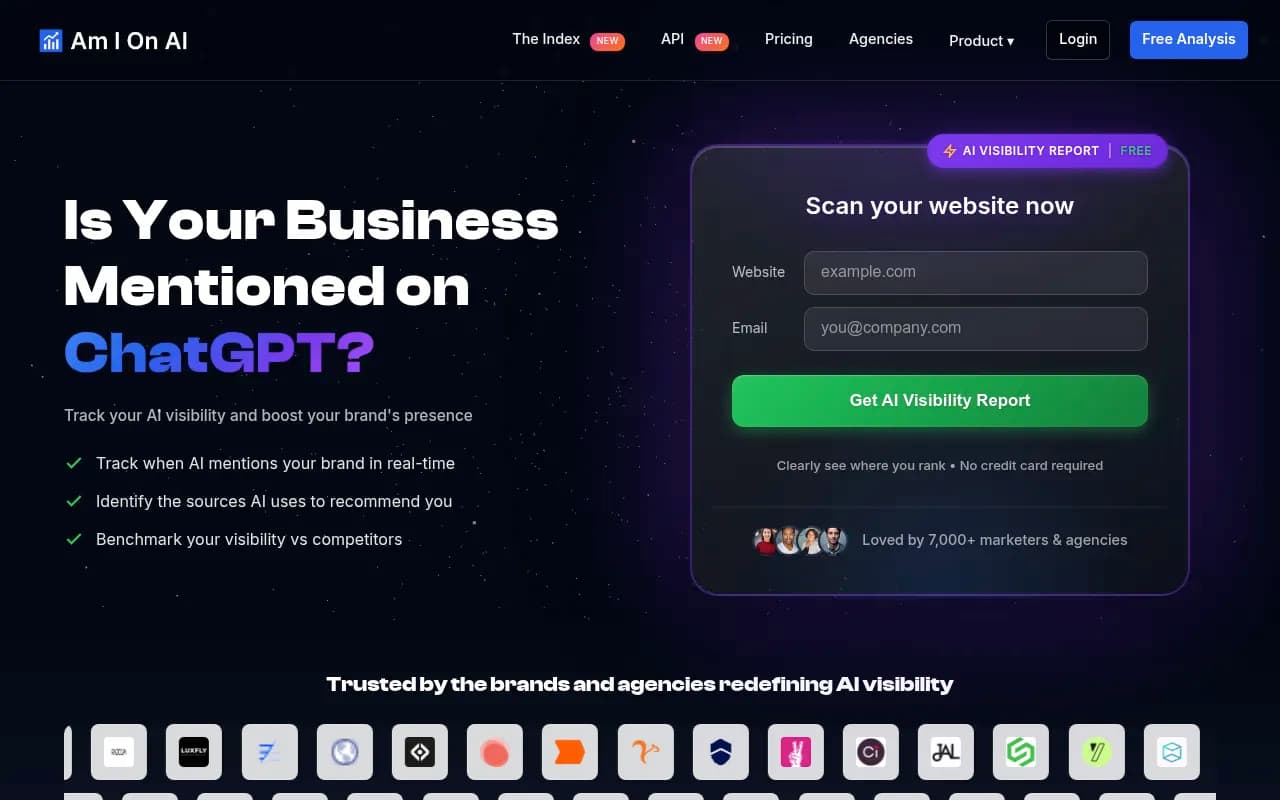
Amionai positions itself as an AI visibility monitoring platform designed for agencies and brands that need to track how they appear in AI-powered search results. The platform provides weekly action plans, competitor analysis, and white-label solutions specifically for agencies managing multiple clients. Used by brands like Ceragon, Vultr, Bookaway, and Nas.io, it focuses on real-time brand mention tracking and identifying the sources AI uses to recommend you.
The agency focus is clear in the pricing structure -- plans start at $375/month for 5 clients and scale up to $670/month for 10 clients. There's no free trial, which suggests they're targeting established agencies rather than individual marketers testing the waters.
AthenaHQ: Enterprise AI search optimization

AthenaHQ calls itself an "end-to-end AEO & GEO platform" and targets in-house marketing teams at larger companies. Their client roster includes Coinbase, ZoomInfo, SoFi, OneSignal, and Volkswagen -- enterprise brands with dedicated marketing teams. The platform monitors AI search results across ChatGPT, Perplexity, Google AI Overviews, Claude, and other LLMs, with a focus on citation tracking and automated content optimization recommendations.
Pricing is credit-based at $295/month for self-serve plans (with a $95 first month discount), plus custom enterprise pricing. Each credit equals one AI query. They've been featured in Forbes and the Wall Street Journal, and they're Y Combinator-backed, which signals venture funding and a growth trajectory aimed at the enterprise market.
Side-by-side comparison
| Feature | Amionai | AthenaHQ |
|---|---|---|
| Starting price | $375/mo (5 clients) | $295/mo ($95 first month) |
| Target audience | Agencies, multi-client management | In-house marketing teams, enterprise |
| Free trial | No | Discounted first month |
| LLM coverage | ChatGPT, Perplexity, Claude, others | ChatGPT, Perplexity, Claude, Google AI Overviews, 8+ LLMs |
| White-label | Yes | Not mentioned |
| Citation tracking | Source identification | Detailed citation source analysis |
| Competitor analysis | Yes, benchmarking | Yes, visibility comparison |
| Action plans | Weekly action plans | Automated content optimization recommendations |
| Content generation | No | No |
| Multi-client management | Built-in (agency plans) | Not emphasized |
| Annual discount | Not mentioned | 17% off |
| API access | Not mentioned | Not mentioned |
| Notable clients | Ceragon, Vultr, Bookaway, Nas.io | Coinbase, ZoomInfo, SoFi, Volkswagen |
Pricing: Agency bundles vs credit-based model
Amionai pricing
Amionai's pricing is structured around agency client counts:
| Plan | Price | Clients |
|---|---|---|
| Agency Starter | $375/mo | 5 clients |
| Agency Growth | $670/mo | 10 clients |
No free trial is available. The pricing suggests you're paying per client slot, which makes sense for agencies that need to track multiple brands. What's not clear from their website is what happens if you're a single brand -- do you still pay the $375/mo minimum? The lack of a solo plan or free trial is a barrier for individual marketers or smaller teams.
AthenaHQ pricing
AthenaHQ uses a credit-based model:
| Plan | Price | Notes |
|---|---|---|
| Self-Serve | $295/mo | $95 first month, credit-based (1 credit = 1 AI query) |
| Enterprise | Custom | Custom pricing for larger teams |
| Annual | 17% discount | Available on all plans |
The credit system means you're paying per query, which could be more cost-effective if you're tracking a limited set of prompts, or more expensive if you're running hundreds of queries per month. The $95 first month is a lower barrier to entry than Amionai's no-trial approach.
Pricing verdict
If you're an agency managing 5-10 clients, Amionai's bundled pricing might be simpler than tracking credits across multiple brands. If you're an in-house team tracking one brand, AthenaHQ's self-serve plan at $295/mo (or $95 to start) is more accessible. Neither platform is cheap -- both are targeting professional users, not hobbyists.
LLM coverage and monitoring capabilities
Both platforms track the major AI search engines, but with different levels of detail.
Amionai's monitoring
Amionai tracks ChatGPT, Perplexity, Claude, and "other LLMs" (not specified). The platform focuses on:
- Real-time brand mention tracking
- Source identification (what content AI uses to recommend you)
- Competitor benchmarking
- Weekly action plans
The weekly action plan approach suggests a cadence of regular check-ins rather than real-time alerts. This works if you're treating AI visibility as a strategic initiative rather than a daily operational task.
AthenaHQ's monitoring
AthenaHQ explicitly lists 8+ LLMs including ChatGPT, Perplexity, Google AI Overviews, and Claude. Their monitoring includes:
- Cross-platform AI visibility tracking
- Citation source analysis (which pages, domains, and content AI models cite)
- Automated content optimization recommendations
- ROI tracking for AI optimization efforts
The citation source analysis is more granular than Amionai's "source identification" -- AthenaHQ breaks down exactly which pages and domains are being cited, which is useful for link building and content strategy.
Monitoring verdict
AthenaHQ has more explicit LLM coverage (8+ vs unspecified) and more detailed citation analysis. Amionai's weekly action plans are useful for agencies that want a structured workflow, but AthenaHQ's automated recommendations feel more actionable on a day-to-day basis.
Agency features vs enterprise features
Amionai's agency focus
Amionai is built for agencies:
- White-label solutions (rebrand the platform for your clients)
- Multi-client management (track 5-10 clients in one dashboard)
- Weekly action plans (structured deliverables for client reporting)
- Competitor benchmarking (show clients how they stack up)
The white-label feature is a big deal for agencies that want to offer AI visibility monitoring as a service without sending clients to a third-party branded platform. This is a clear differentiator -- AthenaHQ doesn't mention white-labeling at all.
AthenaHQ's enterprise focus
AthenaHQ targets in-house teams at larger companies:
- Executive-level dashboards (ROI tracking, strategic insights)
- End-to-end GEO workflow management (unified command center for AI optimization)
- Automated content optimization (recommendations based on citation analysis)
- Enterprise clients (Coinbase, ZoomInfo, SoFi)
The "executive dashboard" and "ROI tracking" language signals that AthenaHQ is selling to CMOs and VPs of Marketing who need to justify AI visibility spend. The platform is designed for internal teams, not agencies reselling to clients.
Feature set verdict
If you're an agency, Amionai's white-label and multi-client management are exactly what you need. If you're an in-house team, AthenaHQ's executive dashboards and workflow management are more relevant. These are fundamentally different products for different buyers.
What's missing from both platforms
Both Amionai and AthenaHQ are monitoring platforms. They show you where you're visible (or invisible) in AI search results, but they don't help you create the content that will actually improve your visibility.
Neither platform offers:
- Content gap analysis (which prompts are you missing vs competitors?)
- AI content generation (create articles optimized for AI citations)
- Crawler log analysis (see how AI models are actually crawling your site)
- Prompt volume and difficulty scoring (prioritize high-value prompts)
This is where platforms like Promptwatch come in -- they close the loop between monitoring and optimization by showing you what's missing, then helping you create content that ranks in AI search.

If you're serious about AI visibility, you'll likely need both a monitoring tool (Amionai or AthenaHQ) and an optimization tool (Promptwatch) to actually move the needle.
User experience and workflow
Amionai's workflow
Amionai's weekly action plan approach suggests a structured, recurring workflow:
- Platform scans AI search results for your brand and competitors
- You receive a weekly action plan with recommendations
- You implement changes and track progress over time
This works well for agencies that need predictable deliverables for client reporting. The downside is that weekly cadence might feel slow if you're actively optimizing and want to see results faster.
AthenaHQ's workflow
AthenaHQ positions itself as a "command center" for AI optimization:
- Real-time tracking across 8+ LLMs
- Automated content optimization recommendations
- Citation source analysis to identify link building opportunities
- Executive dashboards for strategic decision-making
The "command center" language suggests a more hands-on, real-time approach. You're not waiting for a weekly report -- you're actively monitoring and optimizing.
Workflow verdict
Amionai's weekly cadence is better for agencies that want structured reporting. AthenaHQ's real-time approach is better for in-house teams that are actively optimizing and want immediate feedback.
Customer base and credibility
Amionai's clients
Amionai lists clients like Ceragon, Vultr, Bookaway, Nas.io, and Mindshare. These are mid-market B2B and B2C brands, plus one agency (Mindshare). The client list suggests they're serving a mix of direct brands and agencies, but the agency focus is clear in the pricing.
AthenaHQ's clients
AthenaHQ's client roster is more enterprise-heavy: Coinbase, ZoomInfo, SoFi, Volkswagen, OneSignal. These are publicly traded companies and well-funded startups with significant marketing budgets. The Y Combinator backing and media coverage (Forbes, Wall Street Journal) add credibility.
Credibility verdict
AthenaHQ has the stronger enterprise credibility with bigger-name clients and media coverage. Amionai's client list is solid but less flashy. If you're selling AI visibility monitoring to a Fortune 500 CMO, AthenaHQ's client roster will carry more weight.
Pros and cons
Amionai pros
- White-label solutions for agencies
- Multi-client management built-in
- Weekly action plans provide structure
- Competitor benchmarking
- Clear agency-focused pricing
Amionai cons
- No free trial (high barrier to entry)
- Expensive for single brands ($375/mo minimum)
- Less detailed citation analysis than AthenaHQ
- Unclear LLM coverage ("other LLMs" not specified)
- No content generation or gap analysis
AthenaHQ pros
- Discounted first month ($95) lowers barrier to entry
- Detailed citation source analysis
- Automated content optimization recommendations
- 8+ LLMs explicitly listed
- Strong enterprise client roster
- Y Combinator-backed with media coverage
- 17% annual discount available
AthenaHQ cons
- Credit-based pricing can be confusing
- No white-label option for agencies
- No multi-client management (not agency-focused)
- No content generation or gap analysis
- Enterprise pricing not transparent
Who should pick which tool
Pick Amionai if:
- You're an agency managing 5-10 clients and need white-label solutions
- You want structured weekly action plans for client reporting
- You need multi-client management in one dashboard
- You're comfortable with no free trial and higher upfront cost
- Your clients are mid-market brands that need competitor benchmarking
Pick AthenaHQ if:
- You're an in-house marketing team at an enterprise company
- You want detailed citation source analysis for link building
- You need executive dashboards to justify AI visibility spend
- You want to test the platform with a discounted first month
- You're tracking one brand (or a small number) and don't need multi-client management
- You value automated content optimization recommendations over weekly reports
Pick neither if:
- You need content generation and gap analysis, not just monitoring -- look at Promptwatch instead
- You're a solo marketer or small team with a limited budget (both platforms are $300+/month)
- You want crawler log analysis or prompt volume scoring (neither platform offers this)
Final verdict
Amionai and AthenaHQ are solving the same problem (AI visibility monitoring) for different buyers. Amionai is the agency play -- white-label, multi-client, structured reporting. AthenaHQ is the enterprise play -- detailed analytics, executive dashboards, bigger-name clients.
If you're an agency, Amionai's white-label and multi-client features justify the higher price. If you're an in-house team, AthenaHQ's citation analysis and automated recommendations are more useful. Neither platform helps you create content that will actually improve your AI visibility -- they just show you the problem. For that, you'll need an optimization platform like Promptwatch that closes the gap between monitoring and action.