Key Takeaways
- Amionai targets agencies with white-label solutions starting at $375/mo for 5 clients, while Gumshoe AI uses pay-per-report pricing at $0.10/conversation with a free tier
- Amionai provides weekly action plans and competitor analysis built into the platform, whereas Gumshoe AI focuses on persona-based tracking and cited source analysis
- Gumshoe AI offers a free tier (3 reports) making it accessible for testing, while Amionai has no free trial and requires agency-level commitment
- Both platforms track ChatGPT, Perplexity, and Gemini, but Amionai claims broader LLM coverage with Claude included
- Amionai is built for agencies managing multiple clients with white-label reporting, while Gumshoe AI suits individual brands and marketers who want granular persona insights
- Neither platform offers content generation or optimization tools -- they're monitoring-focused dashboards that show you the data but leave the fixing to you
Overview
Amionai
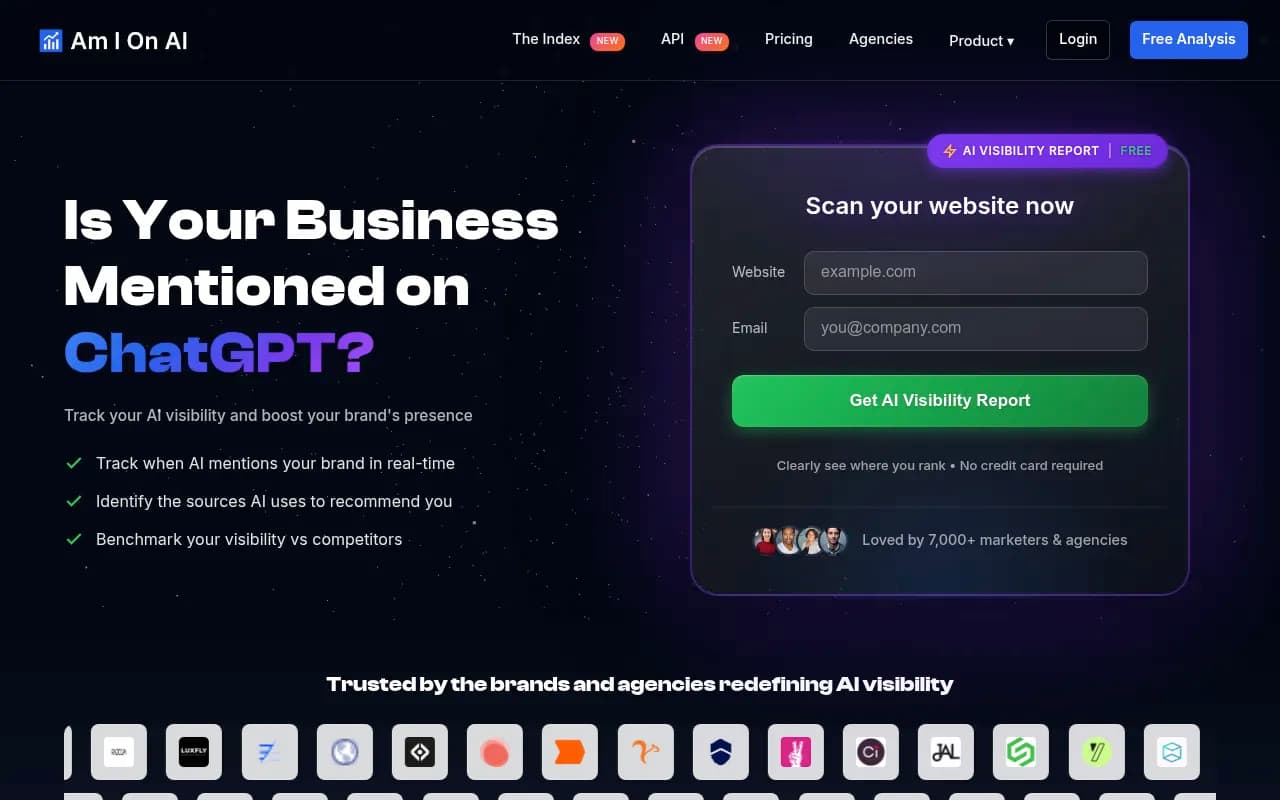
Amionai positions itself as an AI visibility monitoring platform designed specifically for agencies and brands tracking how they appear in AI-powered search results. The platform monitors ChatGPT, Perplexity, Claude, and other LLMs, delivering weekly action plans and competitor benchmarking. With 7,000+ marketers and agencies using it (according to their site), Amionai's core value is helping you see where you rank against competitors and what AI platforms are saying about your brand.
The platform includes white-label solutions, making it attractive for agencies who want to resell AI visibility monitoring to their clients. Pricing starts at $375/mo for 5 clients and scales to $670/mo for 10 clients -- clearly agency-oriented tiers.
Gumshoe AI
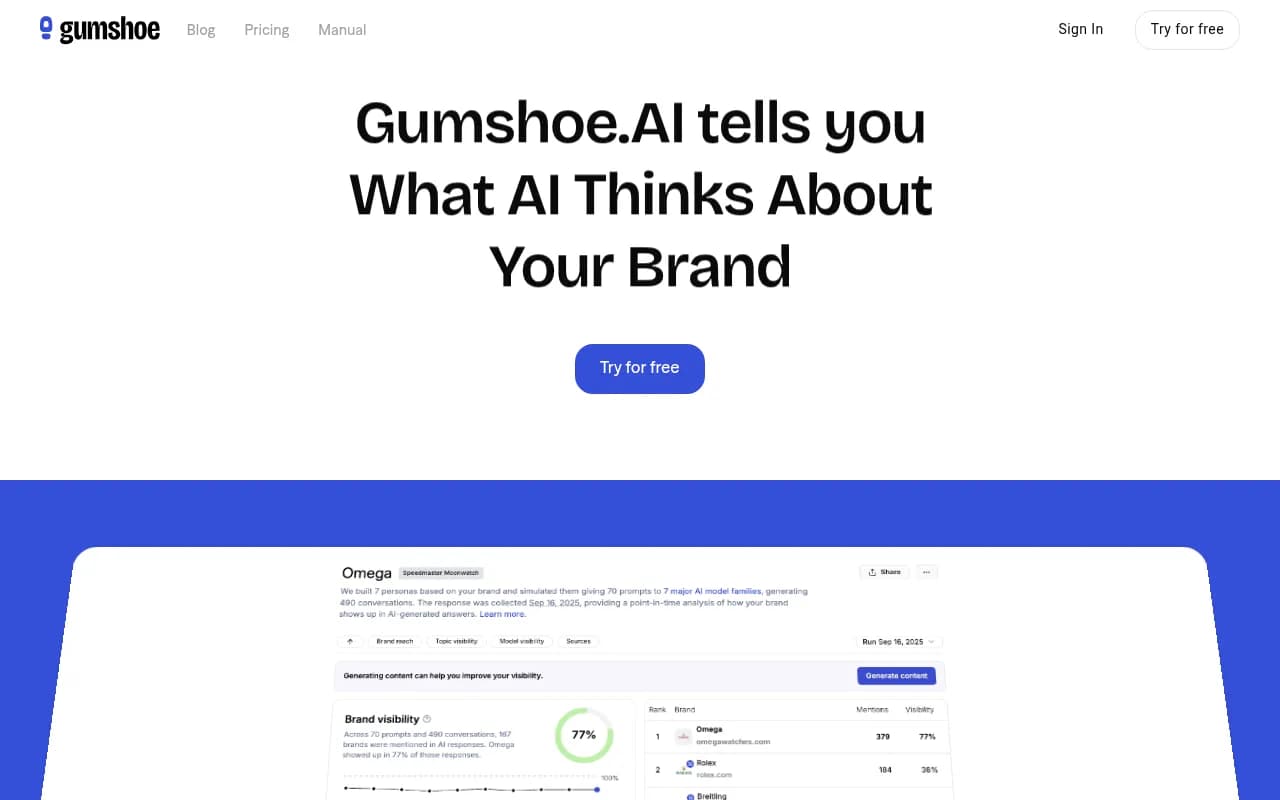
Gumshoe AI takes a different approach with pay-per-report pricing and persona-based tracking. Instead of monthly subscriptions, you pay $0.10 per conversation analyzed, with your first 3 reports free. The platform tracks Google Gemini, ChatGPT, and Perplexity, focusing on how different buyer personas see your brand across these AI models.
Gumshoe's standout feature is its emphasis on cited sources -- showing you exactly which content AI models reference when they mention (or don't mention) your brand. This makes it useful for content strategists who want to understand what's driving AI recommendations. The platform also offers scheduled reports, trend tracking, and AI-assisted content generation on paid plans.
Side-by-Side Comparison
| Feature | Amionai | Gumshoe AI |
|---|---|---|
| Pricing | $375/mo (5 clients) to $670/mo (10 clients) | Free tier (3 reports) + $0.10/conversation |
| Free tier | No | Yes (3 reports) |
| AI models tracked | ChatGPT, Perplexity, Claude, other LLMs | ChatGPT, Gemini, Perplexity |
| Persona tracking | Not mentioned | Yes, core feature |
| Competitor analysis | Yes, built-in | Yes, competitive rank |
| White-label reporting | Yes | Not mentioned |
| Action plans | Weekly action plans | Optimization recommendations |
| Cited sources | Yes | Yes, detailed view |
| Content generation | No | AI-assisted (paid plans) |
| Scheduled reports | Not specified | Yes (paid plans) |
| Target audience | Agencies, multi-client management | Individual brands, marketers |
| API access | Not mentioned | Enterprise only |
Pricing comparison
The pricing models couldn't be more different.
| Plan | Amionai | Gumshoe AI |
|---|---|---|
| Free tier | None | 3 report runs |
| Entry level | $375/mo (5 clients) | $0.10/conversation (pay as you go) |
| Mid tier | $670/mo (10 clients) | Same pay-per-use rate |
| Enterprise | Not listed | Custom pricing |
Amionai's pricing assumes you're an agency managing multiple clients. If you're a single brand, you're paying $375/mo minimum for a 5-client tier you don't need. That's $4,500/year.
Gumshoe AI's pay-per-report model is radically different. If you run 100 conversations per month, you're paying $10. Run 1,000 conversations, you're at $100. The break-even point vs Amionai's cheapest tier is around 3,750 conversations per month -- far more than most brands would run.
For individual brands or marketers testing AI visibility, Gumshoe's free tier and low entry cost is a clear win. For agencies managing 5+ clients who need white-label reports, Amionai's flat rate makes more sense.
AI model coverage
Amionai claims to track "ChatGPT, Perplexity, Claude, and other LLMs" but doesn't specify the full list. Their site mentions real-time tracking when AI mentions your brand, suggesting they monitor multiple models simultaneously.
Gumshoe AI explicitly lists three models: Google Gemini, OpenAI's ChatGPT, and Perplexity. The platform shows model-by-model visibility, letting you see which AI tools mention your brand most often.
Neither platform approaches the breadth of tools like Promptwatch, which tracks 10 AI models including DeepSeek, Grok, Mistral, Meta AI, and Google AI Overviews alongside the standard ChatGPT/Perplexity/Claude set.

Verdict: Amionai appears to have broader coverage with Claude included, but Gumshoe's explicit model breakdown gives you clearer visibility into which specific AI tools are citing you.
Competitor analysis and benchmarking
Both platforms offer competitive benchmarking, but with different angles.
Amionai provides competitor analysis as a core feature, showing you how your brand stacks up against rivals across AI platforms. The weekly action plans presumably include competitive insights -- what competitors are doing that you're not.
Gumshoe AI includes "Competitive Rank" that shows how you compare to competitors across topics and models. You can see topic-by-topic and model-by-model where competitors are beating you. The cited sources feature also reveals what content competitors are getting cited for.
What's missing from both: neither platform offers Answer Gap Analysis showing you the specific prompts competitors rank for that you don't. You can see you're losing, but not exactly what content gaps to fill. That's where platforms with prompt intelligence and content gap features pull ahead.
Verdict: Roughly equivalent. Both show you competitive standing, neither tells you exactly how to close the gap.
Persona and topic tracking
Gumshoe AI makes persona tracking a headline feature. You can assess your brand's performance across different buyer personas -- seeing how a CFO persona vs a marketing manager persona encounters your brand in AI search. This is genuinely useful for B2B brands where different roles have different needs.
The platform also breaks down visibility by topic area, showing you which subject areas your brand dominates and which you're invisible in.
Amionai doesn't mention persona tracking explicitly. Their focus is on brand monitoring and competitor analysis, with weekly action plans that presumably cover topic areas but without the persona segmentation.
Verdict: Gumshoe AI wins here. Persona-based tracking is a differentiator that helps you understand not just if you're visible, but to whom.
Cited sources and content insights
Both platforms surface cited sources -- the actual content AI models reference when they mention your brand.
Gumshoe AI emphasizes this heavily, showing you "your brand's top cited sources by AI models to inform your content strategy." This is the bridge between monitoring and action: you see what's working, you make more of it.
Amionai includes source identification as well, helping you "identify the sources AI uses to recommend you." The weekly action plans likely incorporate this data.
What neither platform does: show you AI crawler logs (which pages AI bots are actually reading on your site), Reddit/YouTube discussions influencing AI recommendations, or prompt volume estimates to prioritize which queries matter most. These are table-stakes features in more comprehensive platforms.
Verdict: Tie. Both surface cited sources, neither goes deep enough to show you the full picture of how AI models discover and use your content.
Action plans and optimization
Amionai delivers weekly action plans -- presumably a curated list of what to do next based on your visibility data and competitor movements. This is helpful for teams who want someone else to interpret the data.
Gumshoe AI offers "optimization recommendations" and "AI-assisted content generation" on paid plans. The content generation is interesting -- it suggests Gumshoe isn't just monitoring, it's helping you create content to improve visibility.
But here's the reality: both platforms are still primarily monitoring dashboards. They show you problems and suggest directions, but they don't close the loop with content gap analysis, AI-optimized content creation, and tracking the results of your fixes. You're getting a diagnosis, not a treatment plan.
Verdict: Gumshoe AI edges ahead with AI-assisted content generation, but both platforms leave most of the heavy lifting to you.
White-label and agency features
Amionai is explicitly built for agencies. White-label solutions are a core offering, and the pricing tiers (5 clients, 10 clients) assume you're reselling this service. If you're an agency offering AI visibility monitoring to clients, Amionai packages it for you.
Gumshoe AI doesn't mention white-label capabilities. The pricing model (pay per conversation) works for agencies in theory -- you could charge clients a markup on reports -- but there's no indication the platform is designed for multi-client management or white-label delivery.
Verdict: Amionai is the clear agency choice. Gumshoe AI is built for individual brands.
Reporting and integrations
Amionai's site doesn't detail reporting formats or integrations. Presumably the weekly action plans come via email or dashboard.
Gumshoe AI mentions "storage integrations" in the free tier and "custom integrations and APIs" at the enterprise level. Scheduled reports are available on paid plans. This suggests more flexibility in how you consume the data.
Neither platform mentions Looker Studio integration, API access for custom workflows, or server log analysis -- features you'd find in more technical platforms.
Verdict: Gumshoe AI offers more integration flexibility, but both are limited compared to platforms with full API access and data export.
Pros and cons
Amionai pros
- White-label solutions for agencies
- Weekly action plans reduce interpretation burden
- Competitor analysis built-in
- Broader LLM coverage (includes Claude)
- Trusted by 7,000+ marketers and agencies
Amionai cons
- No free trial or free tier
- Pricing assumes agency use -- expensive for single brands
- No persona tracking mentioned
- Limited detail on integrations and reporting
- Monitoring-focused, no content generation
Gumshoe AI pros
- Free tier (3 reports) for testing
- Pay-per-report pricing scales with usage
- Persona-based tracking for B2B insights
- Cited sources inform content strategy
- AI-assisted content generation on paid plans
- Scheduled reports and trend tracking
Gumshoe AI cons
- Only 3 AI models tracked (vs Amionai's broader coverage)
- No white-label for agencies
- Pay-per-report can get expensive at scale
- Still primarily a monitoring tool, not an optimization platform
- Enterprise features (API, custom integrations) locked behind custom pricing
Who should pick which tool
Choose Amionai if:
- You're an agency managing AI visibility for multiple clients
- You need white-label reporting to resell the service
- You want weekly action plans delivered without having to interpret raw data
- You're tracking brands across Claude in addition to ChatGPT/Perplexity
- You have budget for $375+/mo and need a flat-rate solution
Choose Gumshoe AI if:
- You're an individual brand or in-house marketer
- You want to test AI visibility monitoring without upfront cost (free tier)
- Persona-based tracking matters for your B2B audience
- You prefer pay-as-you-go pricing that scales with usage
- You want cited source analysis to inform content strategy
- You're looking for AI-assisted content generation alongside monitoring
Consider alternatives if:
- You need more than monitoring -- you want content gap analysis, AI content generation, and optimization tools in one platform
- You're tracking AI crawler behavior on your site (crawler logs, indexing issues)
- You want Reddit and YouTube insights that influence AI recommendations
- You need prompt volume estimates and difficulty scoring to prioritize efforts
- You're looking for multi-language or multi-region tracking with customizable personas
Final verdict
Amionai and Gumshoe AI serve different audiences with different pricing philosophies. Amionai is the agency play -- white-label, flat-rate, multi-client. Gumshoe AI is the marketer's tool -- persona-driven, pay-per-use, accessible.
For agencies, Amionai's white-label and client management make it the obvious pick despite the higher entry cost. For individual brands testing AI visibility, Gumshoe's free tier and granular persona tracking offer better value and deeper insights.
But both platforms share the same fundamental limitation: they're monitoring dashboards, not optimization platforms. They show you where you're invisible and who's beating you, but they don't close the loop with content gap analysis, AI-optimized content creation, and tracking the impact of your fixes. You're getting visibility into the problem, not a system for solving it.
If you're serious about AI search visibility in 2026, you need a platform that does more than monitor -- one that shows you the gaps, helps you create content that ranks, and tracks the results. That's the difference between knowing you have a problem and actually fixing it.