Key Takeaways
- Pricing gap is massive: Ahrefs starts at $83/mo with transparent tiers; Bluefish requires custom quotes estimated at $4,000+/mo for enterprise-only plans
- Ahrefs is a full marketing platform: SEO, backlinks, rank tracking, content tools, PPC research, and social management -- AI monitoring is one piece. Bluefish is AI-focused only.
- Bluefish goes deeper on AI influence: Custom audiences, tailored prompts, and "how AI thinks" analysis. Ahrefs Brand Radar uses fixed prompts and lacks this depth.
- Self-service vs white-glove: Ahrefs is self-serve with a free trial. Bluefish requires sales demos and is built for Fortune 500 teams with dedicated support.
- Neither has content generation or crawler logs: Both are monitoring-focused. If you need content gap analysis and AI writing tools, Promptwatch covers that angle with its action loop (find gaps, generate content, track results).
- Best for different audiences: Pick Ahrefs if you're a small-to-mid-size team that needs SEO + AI tracking in one tool. Pick Bluefish if you're an enterprise brand with budget for deep customization and hands-on support.
Overview
Ahrefs: All-in-one SEO platform with AI search tracking
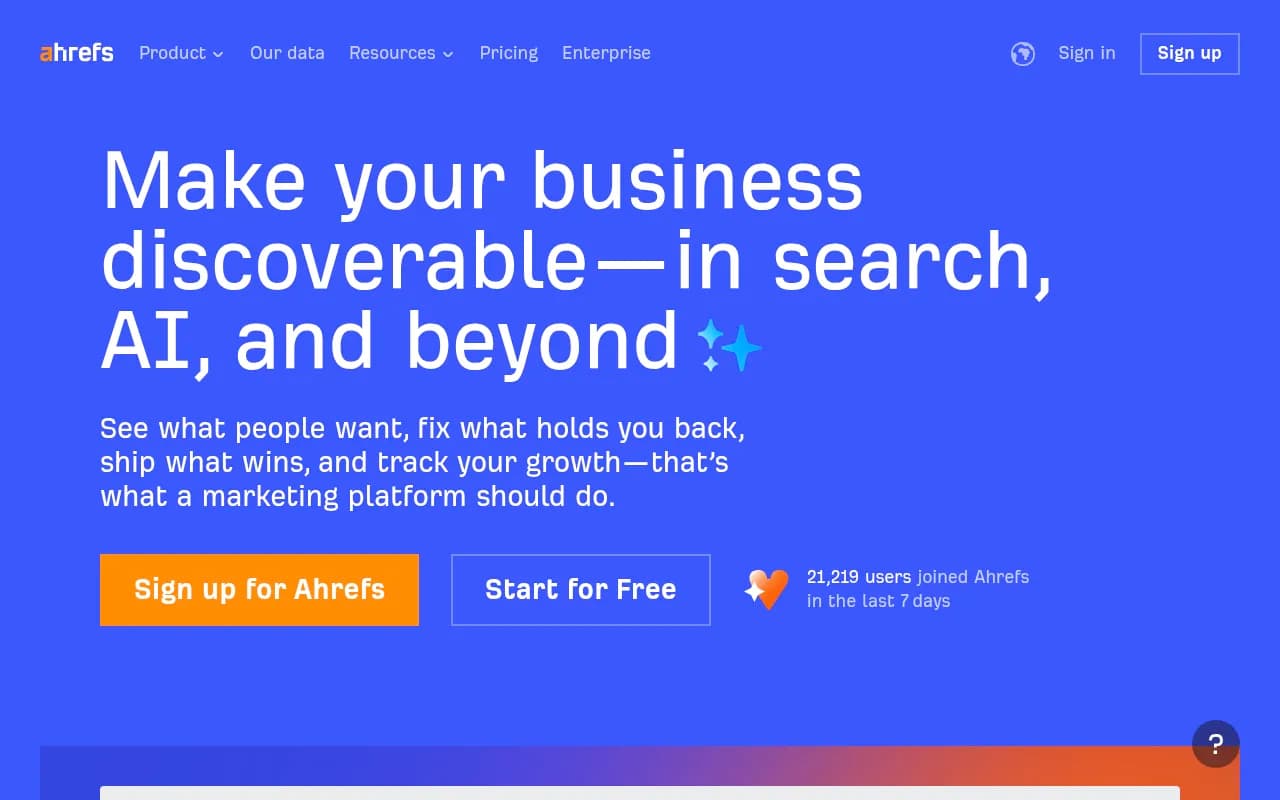
Ahrefs is the Swiss Army knife of digital marketing. It's been the go-to SEO platform for years -- 44% of Fortune 500 companies use it -- and recently added AI search monitoring through Brand Radar. You get site audits, backlink analysis, keyword research, rank tracking, content workflows, PPC research, and social media management, all powered by the web's largest backlink index. The AI monitoring piece is newer and less developed than the core SEO tools, but it's there if you want everything under one roof.
Bluefish AI: Enterprise AI marketing platform for Fortune 500 brands
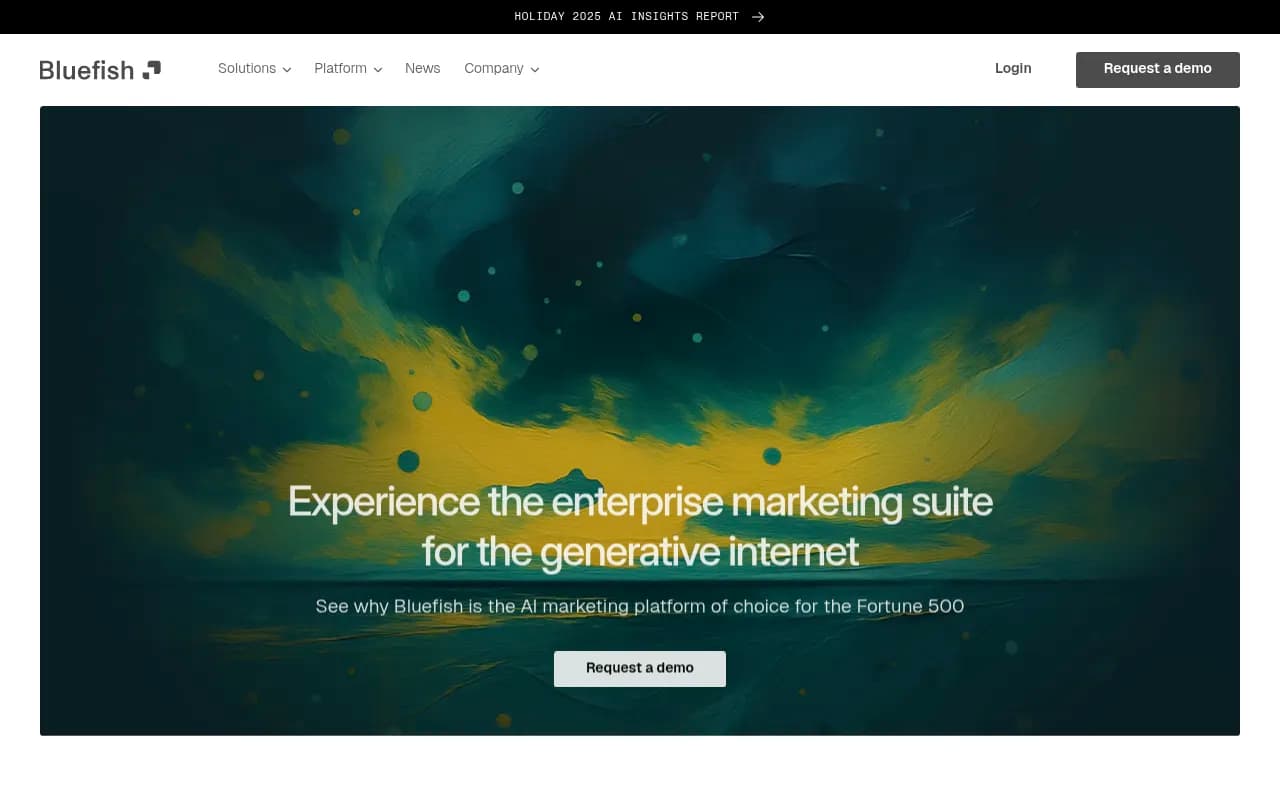
Bluefish AI is purpose-built for enterprise marketing teams at Fortune 500 companies. It's laser-focused on AI search and agentic commerce -- tracking how your brand shows up in ChatGPT, Perplexity, Claude, and other AI engines. The pitch is depth and control: custom audiences, tailored prompts, and analytics that go beyond surface-level share-of-voice metrics. It's not trying to be an all-in-one platform. It's trying to be the best at one thing: helping big brands understand and influence their AI presence.
Side-by-Side Comparison
| Feature | Ahrefs | Bluefish AI |
|---|---|---|
| Starting price | $83/mo (Lite) | Custom quote (~$4,000+/mo) |
| Free trial | Yes | No (demo required) |
| Target audience | SMBs to enterprise | Enterprise only (Fortune 500) |
| Core focus | SEO + AI monitoring | AI search & commerce only |
| AI models tracked | Fixed set via Brand Radar | Major AI engines (custom) |
| Custom prompts | No (fixed prompts) | Yes (tailored to brand) |
| Custom audiences | No | Yes |
| Backlink analysis | Yes (industry-leading) | No |
| Keyword research | Yes (massive database) | No |
| Site audits | Yes | No |
| Content generation | No | No |
| Crawler logs | No | No |
| PPC research | Yes | No |
| Social media tools | Yes | No |
| Self-service | Yes | No (sales-led) |
| Infosec/compliance | Standard | Enterprise-grade |
Pricing: Transparent tiers vs enterprise quotes
The pricing difference is the first thing you'll notice.
Ahrefs pricing
Ahrefs has clear, public pricing with four main tiers:
| Plan | Price/month | What you get |
|---|---|---|
| Starter | $29 | Very limited (1 user, 5 projects, basic features) |
| Lite | $83 | 1 user, 5 projects, 500 credits/mo, core SEO tools |
| Standard | $166 | 3 users, 10 projects, 1,500 credits/mo, full features |
| Advanced | $333 | 5 users, 25 projects, 3,000 credits/mo, API access |
| Enterprise | Custom | Unlimited users, custom limits, dedicated support |
Annual billing saves 20%. There's a free trial (Ahrefs Webmaster Tools) with limited features. Most small-to-mid-size teams land on Standard ($166/mo). The AI monitoring (Brand Radar) is included in all paid plans but uses a fixed set of prompts -- you can't customize them.
Bluefish AI pricing
Bluefish doesn't publish pricing. You request a demo, talk to sales, and get a custom quote. Based on industry estimates and the enterprise positioning, expect $4,000+/month. This is typical for enterprise marketing platforms that require onboarding, custom configuration, and ongoing support. If you're a small team or startup, Bluefish isn't built for you -- they'll likely tell you that upfront.
Verdict: Ahrefs wins on accessibility. Bluefish wins if you have enterprise budget and need white-glove service.
AI search monitoring: Fixed prompts vs custom depth
Both platforms track how your brand appears in AI search results, but the approach is different.
Ahrefs Brand Radar
Brand Radar is Ahrefs' AI monitoring feature. It tracks mentions of your brand across AI engines like ChatGPT, Perplexity, and Google AI Overviews. You see share-of-voice, competitor comparisons, and which sources AI models cite when they mention you.
The limitation: it uses a fixed set of prompts. You can't customize the queries or tailor them to your specific audience segments. It's a broad-strokes view -- useful for tracking general brand visibility, but not deep enough if you need to understand how AI responds to niche use cases or specific customer personas.
Bluefish AI monitoring
Bluefish's entire platform is built around AI monitoring. You get custom audiences (segment by persona, region, intent), tailored prompts (write your own or work with their team), and what they call "how AI thinks" analysis -- understanding not just if you're mentioned, but how AI models frame your brand vs competitors.
They also track agentic commerce (AI-driven shopping recommendations) and claim to go beyond share-of-voice to measure influence and sentiment. The trade-off: you need to invest time in setup and configuration. This isn't a plug-and-play dashboard.
Verdict: Ahrefs is faster to set up but less customizable. Bluefish is deeper but requires more effort.
SEO and content tools: Full suite vs none
This is where the platforms diverge completely.
Ahrefs SEO toolkit
Ahrefs is an SEO powerhouse. You get:
- Site Explorer: Backlink analysis, organic traffic estimates, top pages
- Keywords Explorer: Keyword research with difficulty scores, search volume, SERP analysis
- Site Audit: Technical SEO crawls, health scores, issue prioritization
- Rank Tracker: Monitor your rankings across search engines and locations
- Content Explorer: Find top-performing content in your niche, analyze what works
- Batch Analysis: Bulk URL analysis for backlinks, traffic, and metrics
The backlink index is the largest in the industry (over 40 trillion links). The keyword database covers billions of keywords across 170+ countries. If you're doing SEO, Ahrefs is one of the top two platforms (the other being Semrush).
Bluefish SEO toolkit
Bluefish doesn't do SEO. It's not trying to. If you need backlink analysis, keyword research, or site audits, you'll need a separate tool.
Verdict: Ahrefs is the clear winner if SEO matters to you. Bluefish is irrelevant here.
Content creation and optimization: Both fall short
Neither platform has built-in content generation or optimization tools designed for AI search.
Ahrefs content features
Ahrefs has a Content Explorer for finding high-performing content and a basic content audit feature, but it doesn't generate content or suggest specific optimizations for AI visibility. You can use the keyword and SERP data to inform your content strategy, but you're writing and optimizing manually.
Bluefish content features
Bluefish focuses on measurement and monitoring. It tells you how you're performing in AI search, but it doesn't help you create or optimize content to improve that performance. You see the gaps, but you're on your own to fill them.
Verdict: Both platforms are monitoring-focused. If you need content gap analysis and AI-optimized content generation, tools like Promptwatch fill that gap with built-in AI writing agents that create content grounded in citation data and prompt volumes.

Data and integrations: Ahrefs API vs Bluefish customization
Ahrefs integrations
Ahrefs has an API (available on Advanced and Enterprise plans) that lets you pull data into your own systems. There are also integrations with Google Analytics, Google Search Console, and various third-party tools via Zapier. The data export options are solid -- CSV, PDF, and API access for custom reporting.
Bluefish integrations
Bluefish emphasizes custom data segmentation and export for enterprise data teams. They mention passing infosec reviews easily and providing more ways to customize and segment data than competitors. Specific integration details aren't public, but the pitch is "we'll work with your stack."
Verdict: Ahrefs has more documented integrations. Bluefish offers custom setup for enterprise needs.
User experience: Self-serve vs hands-on support
Ahrefs UX
Ahrefs is self-service. You sign up, log in, and start using it. The interface is dense -- there's a lot of data and a learning curve -- but it's well-documented. Ahrefs Academy has free courses, and the support team is responsive. Most users are up and running within a day or two.
Bluefish UX
Bluefish requires a demo and onboarding. You're assigned a team that helps configure your custom audiences, prompts, and dashboards. The interface is built for enterprise users who want control and depth, not simplicity. The trade-off: you get hands-on support and a platform tailored to your needs, but you can't just sign up and poke around.
Verdict: Ahrefs is faster and easier for independent teams. Bluefish is better if you want (and can afford) dedicated support.
What's missing from both platforms
Neither Ahrefs nor Bluefish offers:
- AI crawler logs: Real-time tracking of which pages ChatGPT, Claude, Perplexity, etc. are crawling on your site
- Content generation: Built-in AI writing tools to create content optimized for AI search
- Answer gap analysis: Identifying specific prompts where competitors are visible but you're not
- Reddit/YouTube tracking: Monitoring discussions that influence AI recommendations
- Traffic attribution: Connecting AI visibility to actual website traffic and conversions
If these capabilities matter to you, platforms like Promptwatch are built around the action loop: find gaps, generate content, track results. Ahrefs and Bluefish stop at monitoring.
Pros and cons
Ahrefs pros
- Industry-leading SEO toolkit (backlinks, keywords, site audits)
- Transparent pricing starting at $83/mo
- Self-service with free trial
- Massive data index (40+ trillion backlinks)
- PPC research and social media tools included
- API access for custom reporting
Ahrefs cons
- AI monitoring (Brand Radar) uses fixed prompts -- no customization
- No content generation or optimization for AI search
- No crawler logs or traffic attribution for AI
- Steep learning curve for new users
- Credits system can be confusing
Bluefish AI pros
- Deep AI monitoring with custom audiences and tailored prompts
- Built for enterprise with strong infosec and compliance
- "How AI thinks" analysis goes beyond share-of-voice
- Tracks agentic commerce and shopping recommendations
- Hands-on support and custom configuration
Bluefish AI cons
- No transparent pricing (custom quotes only, $4,000+/mo estimated)
- No SEO, backlink, or keyword research tools
- No content generation or optimization features
- Requires sales demo -- no self-service or free trial
- Overkill (and unaffordable) for small teams
Who should pick which tool
Pick Ahrefs if:
- You're a small-to-mid-size team (or even a solo marketer) that needs SEO and AI monitoring in one platform
- You want transparent pricing and self-service access
- Backlink analysis, keyword research, and site audits are core to your workflow
- You're okay with basic AI monitoring (fixed prompts, broad-strokes visibility)
- You need PPC research and social media tools as part of the package
Pick Bluefish AI if:
- You're a Fortune 500 brand or large enterprise with a serious AI marketing budget
- You need deep customization (custom audiences, tailored prompts, persona-based tracking)
- You want hands-on support and a platform configured specifically for your brand
- AI search and agentic commerce are strategic priorities, and you're willing to pay for depth
- You already have SEO covered with other tools and just need AI monitoring
Consider alternatives if:
- You need content generation and optimization for AI search, not just monitoring. Promptwatch combines gap analysis, AI writing tools, and crawler logs with visibility tracking -- the full action loop.
- You're a mid-market company that wants more AI depth than Ahrefs but can't justify Bluefish's enterprise pricing. Promptwatch starts at $99/mo with transparent tiers.
Final verdict
Ahrefs and Bluefish AI aren't really competitors -- they're built for different audiences.
Ahrefs is the better choice for 90% of teams. You get a full marketing platform (SEO, AI monitoring, PPC, social) with transparent pricing and self-service access. The AI monitoring isn't as deep as Bluefish, but it's good enough for most use cases, and you're getting a ton of other tools in the package. Start with the Lite plan ($83/mo) or Standard ($166/mo) and see if Brand Radar meets your needs.
Bluefish AI is the better choice if you're a large enterprise with a dedicated AI marketing budget and a need for custom depth. The custom audiences, tailored prompts, and "how AI thinks" analysis are real differentiators -- but only if you can afford the $4,000+/mo price tag and have the resources to invest in setup and ongoing optimization.
For teams that want the best of both worlds -- monitoring plus content creation and optimization -- neither platform delivers the full picture. That's where platforms like Promptwatch come in, with answer gap analysis, AI content generation, and crawler logs that close the loop between visibility and action.