Key Takeaways
- AirOps is a content creation platform first, Bluefish is a monitoring platform first -- AirOps focuses on building content that ranks in AI search, while Bluefish tracks performance without helping you create or optimize content
- Pricing transparency gap -- AirOps starts at $199/mo with a free tier; Bluefish requires custom quotes estimated at $4,000+/mo with no self-service option
- Target audience split -- AirOps serves mid-market brands and growth teams that need to ship content fast; Bluefish targets Fortune 500 marketing departments with large budgets
- Content generation is the dividing line -- AirOps includes AI writing workflows and content gap analysis; Bluefish offers none of this
- Neither platform offers crawler logs or real-time AI indexing insights -- both miss a critical piece of the optimization loop that platforms like Promptwatch provide
- If you need to actually create content that ranks in AI search, AirOps wins. If you only need enterprise-grade dashboards and custom audience segmentation, Bluefish might fit.
Overview
AirOps: Content engineering for AI search
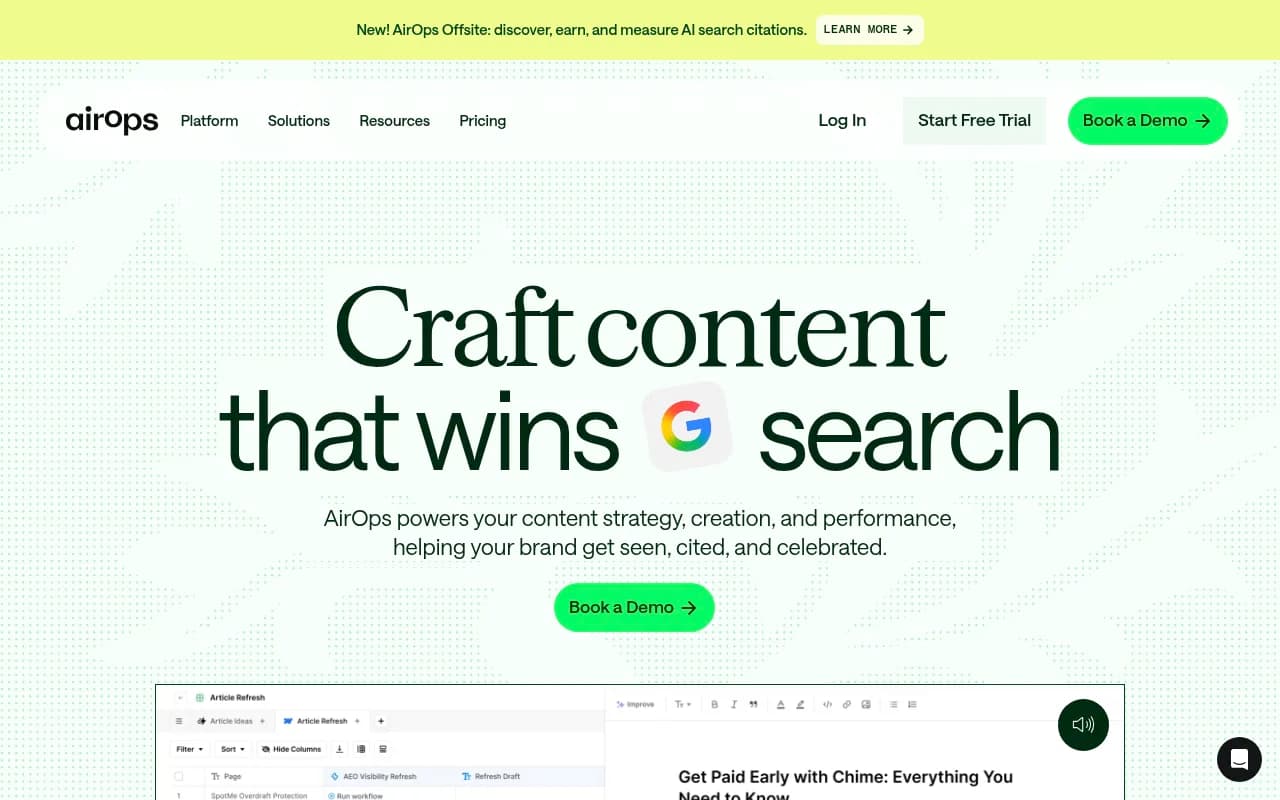
AirOps positions itself as an "end-to-end content engineering platform" -- the idea is you use it to research what content is missing, write that content with AI assistance, and then track how it performs in AI search engines like ChatGPT, Perplexity, and Google AI Overviews. Customers include Webflow, Chime, Ramp, and Carta. The platform combines content gap analysis, AI writing workflows, and performance tracking in one tool. Pricing starts at $199/mo with a free tier available.
Bluefish AI: Enterprise monitoring for Fortune 500 brands
Bluefish AI is built for large enterprise marketing teams at Fortune 500 companies. It's a monitoring and analytics platform that tracks brand visibility across AI channels -- AI search, agentic commerce, and AI-native experiences. The focus is on custom audiences, tailored prompts, and deep performance analytics. Bluefish does not include content creation, content gap analysis, or optimization workflows. Pricing is custom quote-based, estimated at $4,000+/month, with no transparent tiers or self-service signup.
Side-by-Side Comparison
| Feature | AirOps | Bluefish AI |
|---|---|---|
| Starting price | $199/mo (Starter) | ~$4,000+/mo (custom quote) |
| Free tier | Yes (1,000 tasks/mo) | No |
| Content creation | Yes (AI writing workflows) | No |
| Content gap analysis | Yes | No |
| AI search monitoring | Yes (ChatGPT, Perplexity, Google AI) | Yes (multiple AI channels) |
| Custom audiences | Limited | Yes (enterprise-grade) |
| Crawler logs | No | No |
| Reddit/YouTube tracking | Mentioned in case studies | Not specified |
| Citation tracking | Yes | Yes |
| Competitor analysis | Yes | Yes |
| API access | Yes | Not specified |
| Target customer | Mid-market, growth teams | Fortune 500, large enterprises |
Content creation and optimization
This is where the two platforms diverge completely.
AirOps is built around content workflows. You start with content gap analysis -- the platform shows you which topics and questions your competitors are ranking for in AI search but you're not. Then you use the built-in AI writing agent to generate articles, listicles, and other content types. The writing agent pulls from real citation data and competitor analysis to create content engineered to get cited by ChatGPT and Perplexity. Webflow used AirOps to 5x their content refresh velocity and saw a 6% increase in AI-attributed signups. Chime tripled their AI search citations from 24 to 68 priority questions.
Bluefish AI does not offer content creation or content gap analysis at all. It's a monitoring platform. You can see where you're visible and where you're not, but the platform doesn't help you fix the gaps. There's no AI writing agent, no content workflows, no optimization suggestions. If you want to improve your visibility, you're on your own to figure out what content to create and how to create it.
This is the core trade-off. AirOps is an action platform -- it shows you the problem and helps you solve it. Bluefish is a reporting platform -- it shows you the problem and stops there.
Worth noting: if you want the full optimization loop -- including real-time crawler logs that show exactly when and how AI models are indexing your content -- Promptwatch covers that angle with features neither AirOps nor Bluefish offer.

Monitoring and analytics
Both platforms track AI search visibility, but with different depth and focus.
AirOps monitors ChatGPT, Perplexity, Google AI Overviews, and other AI search engines. You get citation tracking, visibility scores, and performance metrics tied to specific content pieces. The analytics are designed to inform content decisions -- which topics are working, which aren't, what to write next. Case studies mention Reddit tracking (LegalZoom webinar) but it's not clear how deep this goes.
Bluefish AI emphasizes "in-depth control over AI performance" with custom audiences, tailored prompts, and what they call understanding how AI "thinks." The platform tracks AI search, agentic commerce, and AI-native experiences. The focus is on enterprise-scale analytics -- segmentation, custom reporting, and performance frameworks that matter to large marketing teams. Bluefish claims to go "beyond superficial metrics" but doesn't specify what that means in practice.
The difference: AirOps analytics feed into content creation. Bluefish analytics feed into executive dashboards.
Neither platform offers AI crawler logs -- you can't see when ChatGPT or Perplexity crawlers hit your site, which pages they read, or errors they encounter. This is a gap in both tools.
Pricing comparison
| Plan | AirOps | Bluefish AI |
|---|---|---|
| Free tier | 1,000 tasks/mo | None |
| Starter | $199/mo (10,000 tasks/mo) | N/A |
| Scale | Custom pricing | N/A |
| Enterprise | Custom pricing | ~$4,000+/mo (estimated, custom quote) |
AirOps has transparent pricing with a self-service free tier. You can sign up, test the platform, and upgrade when you're ready. Bluefish requires a sales call and custom quote -- no pricing on the website, no free trial mentioned. The estimated $4,000+/month price point is based on typical enterprise GEO platform pricing for Fortune 500 clients.
For mid-market companies and growth teams, AirOps is accessible. For Fortune 500 brands with large budgets, Bluefish's custom pricing model fits the enterprise sales cycle.
Target audience and positioning
AirOps is for marketing teams that need to ship content fast. The customer list -- Webflow, Chime, Ramp, Carta, LegalZoom, Docebo, Apollo -- skews toward mid-market SaaS and fintech companies with aggressive growth targets. These are teams that need to produce high volumes of quality content and track how it performs in AI search. The platform is self-service with a free tier, so you can start small and scale.
Bluefish AI is explicitly positioned as "the AI marketing platform of choice for the Fortune 500." The website emphasizes enterprise scale, infosec compliance, and custom segmentation. This is a platform for large marketing departments that need dashboards, custom audiences, and deep analytics but have separate teams or agencies handling content creation. The sales process is quote-based with no self-service option.
If you're a 5-20 person marketing team trying to increase AI search visibility, AirOps is the obvious choice. If you're a 100+ person marketing org at a Fortune 500 company and you just need monitoring, Bluefish might fit.
What's missing from both platforms
Neither AirOps nor Bluefish offers:
- AI crawler logs -- real-time logs showing when ChatGPT, Claude, Perplexity crawlers hit your site, which pages they read, and errors they encounter
- Prompt volume and difficulty scoring -- neither platform tells you which prompts are high-volume and winnable vs low-volume and competitive
- Query fan-outs -- understanding how one prompt branches into sub-queries
- Multi-language and multi-region tracking -- monitoring AI responses in different languages and countries with customizable personas
These are table stakes for a complete GEO platform. Both AirOps and Bluefish are strong in their respective lanes (content creation vs enterprise monitoring) but incomplete as standalone solutions.
Pros and cons
AirOps pros:
- Content creation workflows built in -- you can actually fix visibility gaps
- Transparent pricing with a free tier
- Strong mid-market customer base with public case studies
- Content gap analysis shows exactly what's missing
- Self-service signup and onboarding
AirOps cons:
- No crawler logs or real-time indexing insights
- Limited enterprise-grade segmentation and custom audiences
- Monitoring features less robust than pure monitoring platforms
- Unclear depth of Reddit/YouTube tracking
Bluefish AI pros:
- Built for enterprise scale with custom audiences and segmentation
- Tracks AI commerce and AI-native experiences beyond just search
- Passes infosec reviews (important for Fortune 500)
- Deep performance analytics and custom reporting
Bluefish AI cons:
- No content creation or optimization workflows
- No content gap analysis -- you're on your own to figure out what to write
- Opaque pricing with no self-service option
- Estimated $4,000+/mo makes it inaccessible for most companies
- No crawler logs or indexing insights
Who should pick which tool
Pick AirOps if:
- You're a mid-market company or growth-stage startup
- You need to create content that ranks in AI search, not just monitor performance
- You want transparent pricing and a free tier to test with
- Your team is 5-50 people and you need to move fast
- You care more about action (writing content) than reporting (dashboards)
Pick Bluefish AI if:
- You're a Fortune 500 brand with a large marketing budget
- You already have content creation handled (in-house team or agency)
- You need enterprise-grade monitoring with custom audiences and segmentation
- You're willing to go through a sales process and pay $4,000+/mo
- Your primary need is performance tracking and executive reporting, not content production
Consider alternatives if:
- You need crawler logs and real-time AI indexing insights -- neither platform offers this
- You want prompt volume data and difficulty scoring to prioritize which content to create
- You need multi-language and multi-region tracking with customizable personas
- You want an all-in-one platform that combines monitoring, content gap analysis, content generation, and optimization tools in one place
Final verdict
AirOps and Bluefish AI are solving different problems for different customers. AirOps is a content engineering platform for mid-market teams that need to ship content fast and track results. Bluefish is an enterprise monitoring platform for Fortune 500 marketing departments that need dashboards and custom analytics.
If you need to actually create content that ranks in AI search, AirOps is the clear winner -- it's the only one of the two that includes content creation workflows. If you're a large enterprise that only needs monitoring and you have content creation handled elsewhere, Bluefish might fit, but you're paying a premium for custom segmentation and white-glove service.
The bigger question: do you need a platform that only does one thing (content creation or monitoring) or do you need the full optimization loop? Most companies need both -- find the gaps, create content to fill them, track the results, and iterate. Neither AirOps nor Bluefish offers the complete picture on its own.