Key Takeaways
- Pricing gap is massive: Ceyo starts at $49/mo with transparent tiers. Bluefish requires custom quotes estimated at $4,000+/mo for enterprise plans -- a 80x difference at entry level.
- Target audience split: Bluefish is built exclusively for Fortune 500 marketing teams with infosec requirements and custom audiences. Ceyo serves startups, SMBs, and agencies that need AI visibility without enterprise overhead.
- Feature depth vs accessibility: Bluefish offers deeper performance analytics and custom prompt tailoring. Ceyo covers the core monitoring needs (visibility, sentiment, competitor tracking) without the complexity.
- Neither generates content: Both platforms stop at monitoring and insights. If you need content creation to actually improve your AI visibility, you'll need a separate tool or a platform like Promptwatch that combines tracking with AI content generation.
- LLM coverage: Ceyo explicitly tracks ChatGPT, Gemini, Claude, and Perplexity. Bluefish mentions "all AI native experiences" but doesn't specify which models on their public site.
- Self-service vs white-glove: Ceyo has a signup page and standard plans. Bluefish requires a sales demo for everything -- no self-service option.
Overview
Bluefish AI
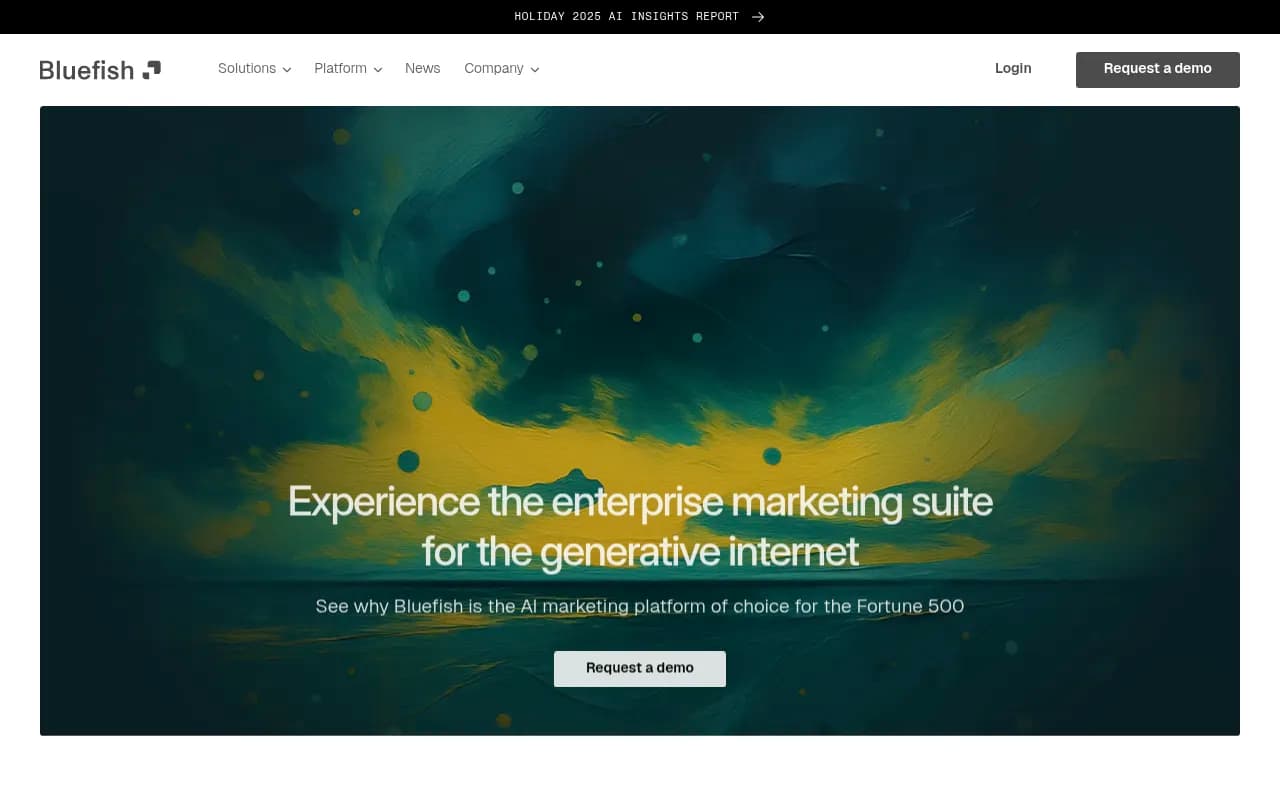
Bluefish positions itself as "the AI marketing platform of choice for the Fortune 500." It's an enterprise-grade GEO platform focused on brand reputation management across AI channels. The pitch centers on "authority, influence and control" -- going beyond surface metrics to understand how AI models "think" about your brand.
The platform emphasizes custom audiences, tailored prompts, and deep performance analytics. Bluefish passes enterprise infosec reviews and offers data segmentation capabilities that generic datasets can't match. It's designed for large marketing teams that need granular control and are willing to pay for it.
What it doesn't do: content generation, crawler log analysis, or any optimization features beyond insights and recommendations. You're paying for monitoring depth and enterprise infrastructure.
Ceyo
Ceyo
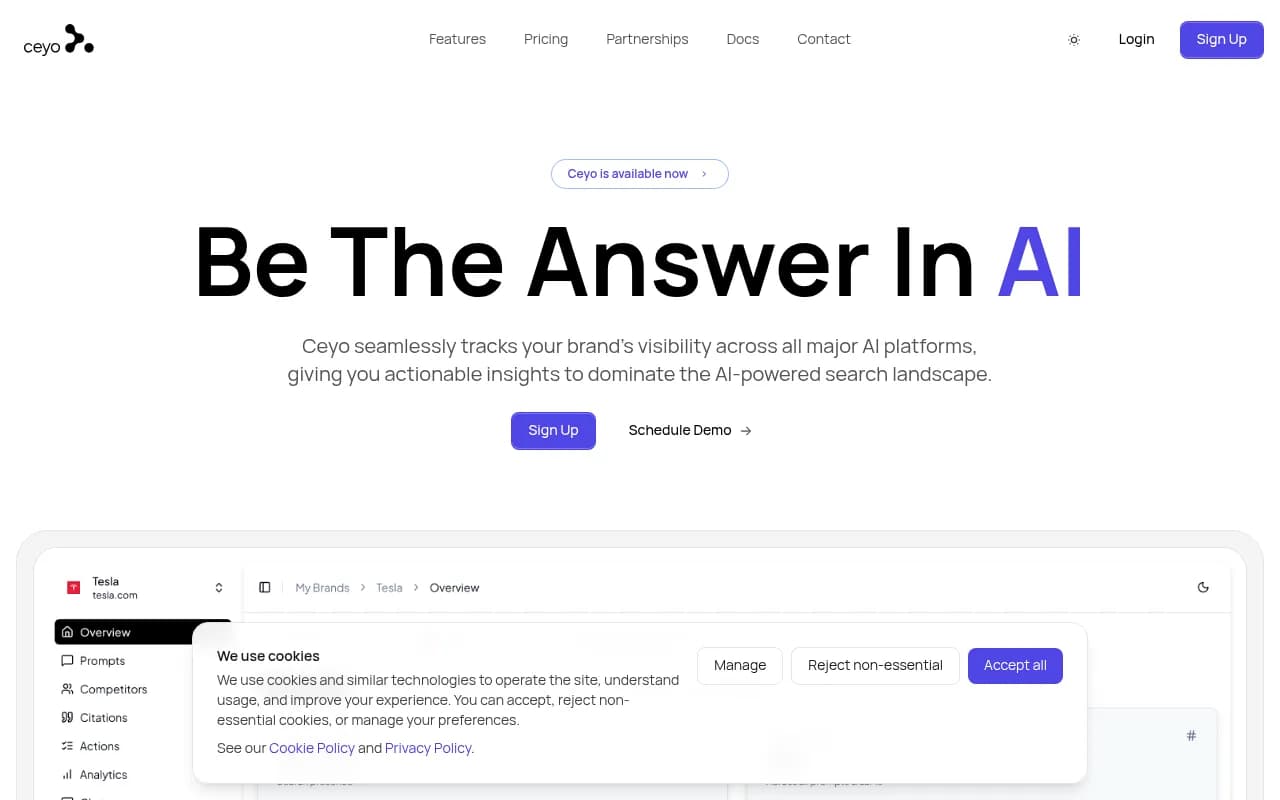
Ceyo takes a more straightforward approach: track your brand's visibility across ChatGPT, Gemini, Claude, and Perplexity, get actionable insights, improve your presence. The platform monitors thousands of prompts, tracks sentiment and competitor mentions, and surfaces which queries drive your brand's visibility in LLM responses.
It's built for accessibility. You can sign up directly, see transparent pricing, and start tracking without a sales call. The feature set covers what most companies actually need from a GEO tool: visibility metrics, sentiment analysis, prompt performance, competitor benchmarking.
What it lacks: the enterprise customization depth of Bluefish, advanced workflow automation, and (like Bluefish) any content creation capabilities. But for most teams, that's fine -- they need to see where they stand before worrying about custom audience segmentation.
Side-by-Side Comparison
| Feature | Bluefish AI | Ceyo |
|---|---|---|
| Starting price | $4,000+/mo (estimated) | $49/mo |
| Pricing transparency | Custom quotes only | Public tiers (Core/Standard/Enterprise) |
| Self-service signup | ❌ Demo required | ✅ Direct signup |
| LLM coverage | "All AI native experiences" (unspecified) | ChatGPT, Gemini, Claude, Perplexity |
| Prompt tracking | Custom tailored prompts | Thousands of prompts |
| Sentiment analysis | ✅ | ✅ |
| Competitor tracking | ✅ | ✅ |
| Custom audiences | ✅ Advanced | ❌ |
| Performance analytics | Deep, enterprise-grade | Standard visibility metrics |
| Content generation | ❌ | ❌ |
| Crawler logs | ❌ | ❌ |
| API access | Likely (enterprise) | Unknown |
| Infosec compliance | Enterprise-grade | Standard |
| Target customer | Fortune 500 | Startups, SMBs, agencies |
| Annual billing discount | Unknown | ✅ |
Pricing comparison
This is where the two platforms diverge completely.
| Plan | Bluefish AI | Ceyo |
|---|---|---|
| Entry tier | Custom quote ($4,000+/mo estimated) | Core: $49/mo |
| Mid tier | Custom quote | Standard: ~$149-299/mo (estimated) |
| Enterprise | Custom quote | Custom pricing |
| Free trial | Unknown | Likely available |
| Annual discount | Unknown | Yes |
| Transparent pricing | No | Yes |
Bluefish doesn't publish any pricing. Based on their Fortune 500 positioning and "enterprise scale" messaging, industry estimates put their entry point around $4,000-$6,000/month minimum. That's consistent with other white-glove enterprise GEO platforms.
Ceyo starts at $49/mo for their Core plan. They list Standard and Enterprise tiers but don't show exact pricing for those on the public site. Still, the gap between $49 and $4,000 tells you everything about who each platform is built for.
If you're a startup or mid-market company, Bluefish's pricing is a non-starter. If you're a Fortune 500 brand with a seven-figure marketing budget, Ceyo might feel too lightweight.
Feature depth and customization
Bluefish's core value proposition is depth. They emphasize "going beyond superficial metrics" with custom audiences, tailored prompts, and advanced performance tools. The platform lets enterprise teams segment data in ways that matter for their specific market position.
Example use case from their messaging: In competitive markets, generic datasets aren't enough. Bluefish gives you the control to define exactly which prompts matter, which audience segments to track, and how to measure influence beyond simple visibility scores.
The trade-off: complexity. You need a dedicated team to extract value from this level of customization. Bluefish isn't a tool you hand to a junior marketer and expect results in week one.
Ceyo focuses on comprehensive prompt analytics out of the box. Track visibility, sentiment, and brand mentions across thousands of prompts without custom configuration. The platform shows you which queries drive your brand's presence, average position, impact level, and competing brands for each prompt.
Their dashboard (visible in screenshots) displays prompt-level data in a scannable table: visibility percentage, sentiment (positive/neutral/negative), average position, impact level, competing brands with logos, category, and geography. It's designed for quick insights, not deep segmentation.
Verdict: Bluefish wins on depth and flexibility. Ceyo wins on time-to-value and ease of use. Pick based on your team's sophistication and budget.
LLM coverage and tracking
Ceyo explicitly lists the four major LLMs they track: ChatGPT, Gemini, Claude, and Perplexity. That covers the platforms most people actually use for AI search.
Bluefish's website mentions "all AI native experiences" and "AI search and agentic commerce" but doesn't specify which models. Their Holiday 2025 AI Insights Report suggests they track multiple platforms, but the lack of transparency here is frustrating. Enterprise buyers will get this detail in sales calls, but it should be public.
Both platforms appear to track AI commerce channels (shopping recommendations in ChatGPT, product suggestions in Perplexity), though neither breaks out this feature in detail on their public sites.
Neither platform mentions tracking Google AI Overviews, Grok, DeepSeek, Meta AI, or Mistral -- models that more comprehensive platforms like Promptwatch include.

Verdict: Ceyo gets points for transparency. Bluefish likely covers more but won't tell you without a demo.
Analytics and insights
Bluefish emphasizes "understanding how AI thinks" about your brand. Their analytics go beyond visibility scores to measure influence and impact. The platform helps teams "optimize beyond just visibility and share-of-voice" with performance frameworks tailored to what matters for each brand.
They also highlight workflow automation -- presumably for alert triggers, report generation, and optimization recommendations. The exact capabilities aren't detailed publicly.
Ceyo's analytics focus on prompt-level performance: visibility percentage, sentiment classification, average position in responses, impact level (high/medium/low), and competitor presence. Their dashboard shows this data in a table format that makes it easy to spot patterns and prioritize which prompts to optimize for.
Both platforms offer competitor tracking, but neither shows exactly how deep that goes. Can you see which specific content competitors are getting cited for? Which domains they're winning on? That level of citation analysis is missing from both public descriptions.
Verdict: Bluefish offers more sophisticated analytics for teams that know what to do with them. Ceyo gives you the core metrics most teams actually need.
What both platforms are missing
Neither Bluefish nor Ceyo generates content. They tell you where you're invisible in AI search, but they don't help you fix it. You get insights and recommendations, then you're on your own to create content that might improve your visibility.
This is the gap that separates monitoring platforms from optimization platforms. Seeing the problem is step one. Actually solving it requires content creation, and that's where both tools stop.
Other missing pieces:
- Crawler logs: Neither platform shows you when AI models crawl your website, which pages they read, or errors they encounter. That's critical for understanding why you might not be getting cited.
- Prompt intelligence: No volume estimates or difficulty scores to help you prioritize which prompts are worth optimizing for.
- Citation analysis: Limited detail on which specific pages, domains, or content types AI models cite in their responses.
- Reddit/YouTube tracking: No visibility into discussions on platforms that heavily influence AI recommendations.
- Traffic attribution: No way to connect AI visibility to actual website traffic or conversions.
If you need these capabilities, you're looking at a different tier of GEO platform entirely.
User interface and ease of use
Ceyo's screenshots show a clean, table-based interface. Prompt data is organized in rows with clear columns for each metric. It looks like a tool you could hand to anyone on your marketing team without extensive training.
Bluefish's screenshots show more complex visualizations -- heatmaps, multi-dimensional charts, custom dashboards. The interface looks powerful but also looks like it requires onboarding and training to use effectively.
This matches their target audiences. Ceyo is built for teams that need to get value quickly. Bluefish is built for teams that have the resources to invest in learning a sophisticated tool.
Verdict: Ceyo is easier to use. Bluefish is more powerful if you have the team to support it.
Enterprise features and security
Bluefish explicitly positions itself as enterprise-grade. They mention consistently passing infosec reviews, custom data segmentation, and infrastructure built for Fortune 500 requirements. If you need SOC 2 compliance, SSO, custom contracts, and dedicated support, Bluefish is designed for that.
Ceyo doesn't emphasize enterprise features on their public site. That doesn't mean they lack security -- most modern SaaS tools have reasonable security practices -- but they're not leading with it. Their Enterprise tier likely includes some of these features, but you'd need to ask.
Verdict: Bluefish is the clear winner for enterprise buyers with strict compliance requirements.
Support and onboarding
Bluefish requires a demo to get started. That means white-glove onboarding, dedicated account management, and ongoing support. For a $4,000+/month tool, you'd expect that level of service.
Ceyo has a self-service signup, which suggests more standard support -- likely email/chat support with documentation and help articles. Their partner logos (BrandFirm, Zigt, Enreach) suggest they work with agencies, which implies some level of support infrastructure.
Verdict: Bluefish offers more hands-on support. Ceyo is self-service with standard support channels.
Pros and cons
Bluefish AI pros
- Deep, enterprise-grade analytics and performance frameworks
- Custom audiences and tailored prompt tracking
- Built for Fortune 500 compliance and security requirements
- Advanced data segmentation and workflow automation
- White-glove onboarding and dedicated support
Bluefish AI cons
- Pricing starts around $4,000+/mo -- prohibitive for most companies
- No transparent pricing or self-service option
- Requires sales demo and likely lengthy procurement process
- Steep learning curve and complexity
- No content generation or optimization features
- Doesn't specify which LLMs it tracks publicly
- Missing crawler logs, prompt intelligence, and citation depth
Ceyo pros
- Transparent pricing starting at $49/mo
- Self-service signup -- no demo required
- Clean, easy-to-use interface
- Covers the four major LLMs (ChatGPT, Gemini, Claude, Perplexity)
- Comprehensive prompt analytics out of the box
- Good fit for startups, SMBs, and agencies
Ceyo cons
- Limited customization compared to enterprise platforms
- No advanced audience segmentation or custom prompt tailoring
- Missing content generation features
- No crawler logs or deep citation analysis
- Less suitable for Fortune 500 enterprise requirements
- Limited public information about mid-tier and enterprise features
Who should pick Bluefish AI
You're a Fortune 500 brand or large enterprise with:
- A seven-figure marketing budget
- Dedicated team members who will own this tool full-time
- Complex compliance and security requirements
- Need for custom audience segmentation and tailored prompt tracking
- Competitive markets where generic datasets aren't enough
- Willingness to go through a sales process and lengthy procurement
Bluefish is overkill for startups and mid-market companies. The pricing alone puts it out of reach, and the complexity requires resources most smaller teams don't have.
Who should pick Ceyo
You're a startup, SMB, or agency that needs:
- AI visibility tracking without enterprise overhead
- Transparent pricing and self-service access
- Quick time-to-value with minimal training
- Coverage of the major LLMs (ChatGPT, Gemini, Claude, Perplexity)
- Prompt-level analytics and competitor tracking
- A tool that won't require dedicated headcount to manage
Ceyo makes sense for teams that want to understand their AI visibility without committing to enterprise pricing or complexity. It's a monitoring tool that does what it says on the tin.
Final verdict
These platforms serve completely different markets. Bluefish is a Bentley -- luxurious, powerful, and priced for people who don't look at the sticker. Ceyo is a Honda Civic -- reliable, affordable, and gets you where you need to go.
If you're a Fortune 500 brand with enterprise requirements and budget, Bluefish offers the depth and customization you need. If you're anyone else, Ceyo gives you solid AI visibility tracking at a price that makes sense.
The bigger question: do you just need monitoring, or do you need optimization? Both platforms stop at insights. If you want to actually improve your AI visibility with content generation, crawler log analysis, and prompt intelligence, you're looking at a different category of tool entirely. That's where platforms like Promptwatch come in -- they show you the gaps, then help you create content to fill them.
For pure monitoring: Ceyo wins for 95% of companies. Bluefish wins for the 5% with enterprise budgets and requirements.