Key Takeaways
- Price gap is massive: GeoGen starts at €20/mo with transparent tiers, while Bluefish requires custom quotes estimated at $4,000+/month -- a 200x difference for entry-level access
- Target audience couldn't be more different: Bluefish is built for Fortune 500 marketing teams with enterprise infosec requirements; GeoGen serves small to mid-sized brands who need basic AI visibility tracking
- Neither platform offers content generation: Both are monitoring-only tools -- you'll see where you're invisible in AI search but won't get help creating content to fix it
- Feature depth vs accessibility trade-off: Bluefish offers custom audiences, tailored prompts, and deep performance analytics; GeoGen provides straightforward tracking with less customization
- Self-service vs sales-driven: GeoGen lets you sign up and start tracking immediately; Bluefish requires a demo and sales conversation before you see pricing
- Both lack optimization capabilities: No crawler logs, no content gap analysis, no AI writing tools -- these are dashboards, not optimization platforms
Overview
Bluefish AI
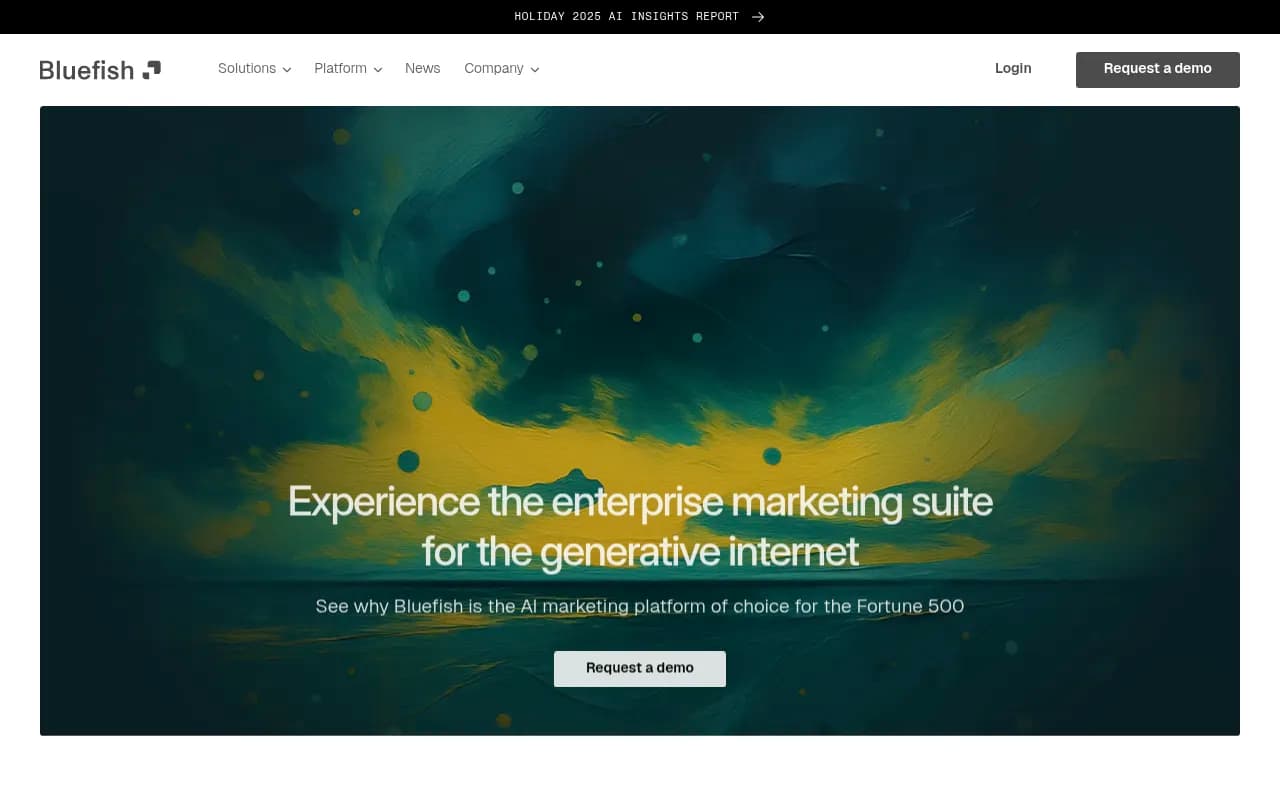
Bluefish AI positions itself as "the AI marketing platform of choice for the Fortune 500." It's an enterprise-focused GEO platform that helps large brands monitor their presence across AI search engines and what they call "agentic commerce channels." The platform emphasizes depth over breadth -- custom audiences, tailored prompts, and performance analytics designed for competitive markets where generic datasets aren't enough. Bluefish markets heavily on passing enterprise infosec reviews and providing data teams with segmentation and customization options.
The catch: no transparent pricing, no self-service signup, and a feature set that stops at monitoring. You won't find content generation, crawler logs, or the optimization tools that more comprehensive platforms offer.
GeoGen
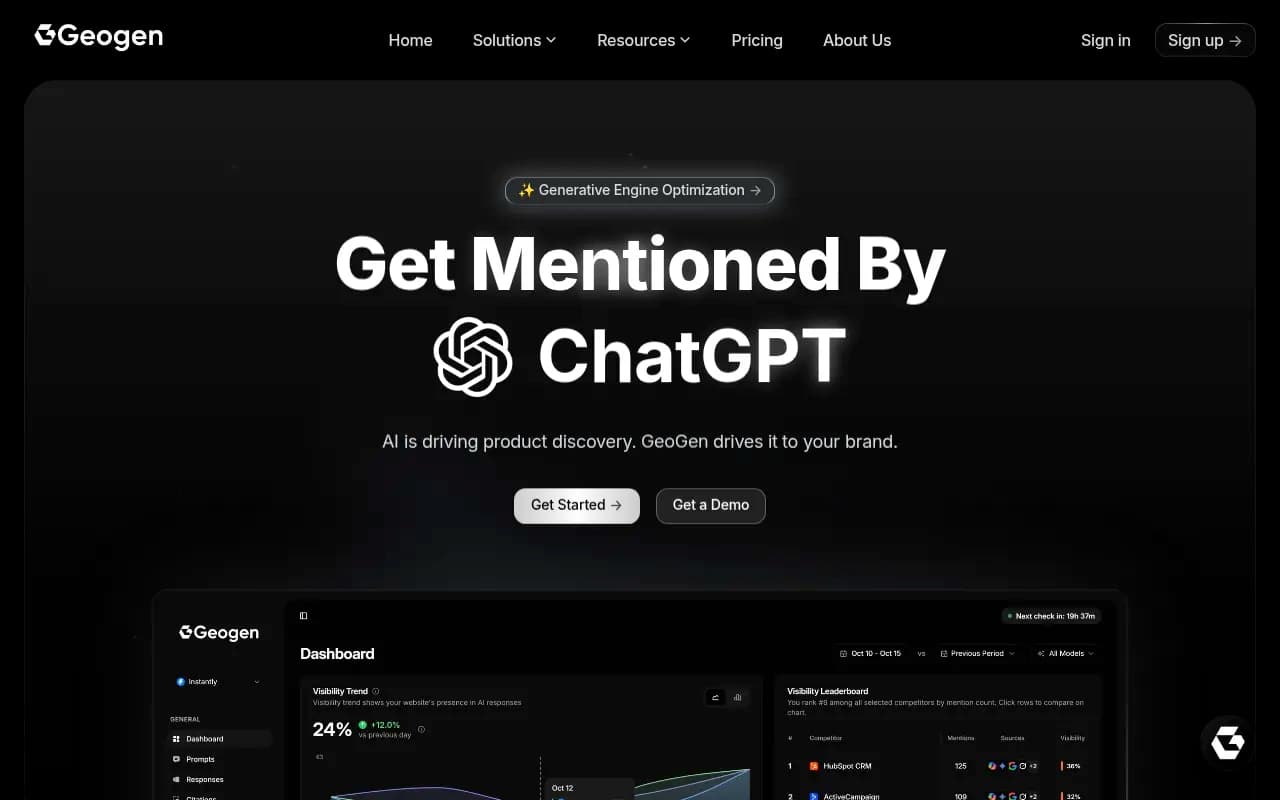
GeoGen takes the opposite approach. It's a straightforward GEO tracking platform for brands that want to monitor their visibility across ChatGPT, Perplexity, Gemini, Grok, and Microsoft Copilot without enterprise complexity. You can sign up today, pick a plan from €20/mo to €399/mo, and start tracking brand mentions and competitor rankings.
The platform promises "AI Visibility analytics and improvement" and offers recommendations to improve your AI search presence. But like Bluefish, it's fundamentally a monitoring dashboard. The "improvement" part is limited to suggestions -- you won't get tools to actually create or optimize content.
Side-by-side comparison
| Feature | Bluefish AI | GeoGen |
|---|---|---|
| Starting price | ~$4,000+/mo (estimated) | €20/mo (Micro plan) |
| Pricing transparency | Custom quotes only | Transparent tiers |
| Free trial | Demo required | Not specified |
| Target audience | Fortune 500, enterprise teams | Small to mid-sized brands |
| Self-service signup | No | Yes |
| AI models tracked | Multiple (not specified) | ChatGPT, Perplexity, Gemini, Grok, Copilot |
| Custom audiences | Yes | No |
| Tailored prompts | Yes | Standard prompts |
| Content generation | No | No |
| Crawler logs | No | No |
| Competitor analysis | Yes (deep analytics) | Yes (basic rankings) |
| API access | Likely (enterprise) | Not specified |
| Infosec compliance | Enterprise-grade | Not specified |
Pricing: The 200x gap
This is where the comparison gets stark.
| Plan | Bluefish AI | GeoGen |
|---|---|---|
| Entry level | Custom quote (~$4,000+/mo estimated) | €20/mo (Micro) |
| Mid-tier | Custom quote | €99/mo, €199/mo options |
| High-tier | Custom quote | €399/mo (Pro) |
| Enterprise | Custom quote | Custom pricing available |
| Annual discount | Unknown | 20% off |
| Transparency | None -- requires sales demo | Full pricing on website |
Bluefish doesn't publish pricing anywhere. Based on their enterprise positioning and feature set, estimates put their entry point at $4,000/month or higher. You'll need to request a demo and go through a sales process to get a quote.
GeoGen's pricing is right on their website. €20/mo gets you started with the Micro plan. €399/mo gets you the Pro plan with full features. Annual billing knocks 20% off. You know exactly what you're paying before you sign up.
For a small brand or agency testing AI visibility tracking, that €20/mo vs $4,000+/mo difference is the entire decision.
Feature depth: Enterprise analytics vs straightforward tracking
Bluefish's core pitch is that they go "beyond superficial metrics" with custom audiences, tailored prompts, and deep performance tools. Their website emphasizes that "category leaders choose Bluefish for depth and control" and that "generic datasets aren't enough" in competitive markets.
What this means in practice: you can define custom audience segments, create tailored prompt sets that match your specific market, and get granular performance analytics. Their platform is built for data teams who want to slice and segment AI visibility data in ways that match their internal reporting frameworks.
GeoGen keeps it simpler. You track brand mentions across five major AI models, see competitor rankings, and get recommendations. The interface appears more plug-and-play -- less customization, but also less complexity to manage.
Neither platform offers the optimization features you'd find in more comprehensive GEO tools. No content gap analysis showing which prompts competitors rank for but you don't. No AI writing agent to generate articles that target those gaps. No crawler logs showing how AI models are actually accessing your website.
If you're looking for a platform that helps you fix visibility problems (not just see them), tools like Promptwatch bridge that gap with content generation, answer gap analysis, and crawler monitoring.

AI model coverage
GeoGen explicitly lists five AI models: ChatGPT, Perplexity, Gemini, Grok, and Microsoft Copilot. That's the core set most brands care about in 2026.
Bluefish mentions "AI search and agentic commerce" channels but doesn't specify which models they track on their public website. Given their enterprise focus, they likely cover the major players plus potentially newer or niche models. But the lack of transparency here is frustrating -- you won't know exactly what you're monitoring until you're in a sales conversation.
User experience and accessibility
GeoGen wins on accessibility. You can sign up, pick a plan, and start tracking today. The interface (based on their dashboard screenshots) looks clean and modern. You're not navigating enterprise complexity.
Bluefish requires a demo request. Their website is polished and professional, but you can't just create an account and explore. For enterprise buyers used to lengthy procurement processes, this is normal. For a small brand or solo marketer, it's a barrier.
Enterprise features and compliance
Bluefish makes a big deal about passing infosec reviews "with ease" and being "built for enterprise." If you're at a Fortune 500 company with strict security requirements, this matters. You need a vendor who can handle your compliance paperwork, sign BAAs, and meet your data governance standards.
GeoGen doesn't mention enterprise compliance or security certifications on their website. That doesn't mean they're insecure -- it means they're not targeting that buyer. If you need SOC 2, ISO 27001, or specific compliance frameworks, you'll need to ask.
What's missing from both platforms
Neither Bluefish nor GeoGen offers:
- Content generation: You see where you're invisible, but you don't get help creating content to fix it
- Crawler logs: No visibility into how AI models are actually crawling your website, what pages they're reading, or errors they're encountering
- Answer gap analysis: No systematic breakdown of which prompts competitors rank for but you don't
- Prompt intelligence: No volume estimates or difficulty scores to help you prioritize which prompts to target
- Reddit/YouTube tracking: No monitoring of discussions that influence AI recommendations
- Traffic attribution: No way to connect AI visibility to actual website traffic or revenue
These are monitoring dashboards. They show you data. They don't help you act on it.
Pros and cons
Bluefish AI pros
- Deep customization with custom audiences and tailored prompts
- Built for enterprise compliance and infosec requirements
- Advanced performance analytics and segmentation
- Data team-friendly with export and customization options
- Positioned as the choice for Fortune 500 brands
Bluefish AI cons
- No transparent pricing -- requires sales demo
- Estimated $4,000+/month puts it out of reach for most brands
- No self-service signup or trial
- Lacks content generation and optimization features
- No crawler logs or traffic attribution
- AI model coverage not specified publicly
GeoGen pros
- Transparent pricing starting at €20/mo
- Self-service signup -- start tracking immediately
- Clean, accessible interface
- Covers five major AI models explicitly
- 20% discount on annual billing
- Good fit for small to mid-sized brands
GeoGen cons
- Limited customization compared to enterprise platforms
- No content generation or optimization tools
- No crawler logs or answer gap analysis
- Less depth in performance analytics
- No mention of enterprise compliance or security certifications
- Monitoring-only -- doesn't help you fix visibility problems
Who should pick which tool
Pick Bluefish AI if:
- You're at a Fortune 500 company or large enterprise
- You have a marketing budget that can handle $4,000+/month for AI visibility tracking
- You need custom audiences and tailored prompts for competitive markets
- Enterprise infosec compliance is a requirement
- You have a data team that wants deep segmentation and customization
- You're willing to go through a sales process to get pricing and access
Pick GeoGen if:
- You're a small to mid-sized brand or agency
- You want transparent pricing and self-service signup
- €20-€399/mo fits your budget better than $4,000+/mo
- You need straightforward AI visibility tracking without enterprise complexity
- You want to start monitoring today, not after a sales demo
- Basic competitor analysis and brand mention tracking is enough
Pick neither if:
- You need content generation to actually fix visibility gaps
- You want crawler logs to see how AI models access your site
- You need answer gap analysis to find winnable prompts
- You want a platform that helps you optimize, not just monitor
In that case, look at platforms like Promptwatch that combine monitoring with content generation, crawler logs, and optimization tools.
Final verdict
Bluefish AI and GeoGen serve completely different markets. Bluefish is an enterprise platform for Fortune 500 brands with big budgets and complex requirements. GeoGen is an accessible monitoring tool for small to mid-sized brands who want to track AI visibility without enterprise complexity.
The pricing gap -- €20/mo vs $4,000+/mo -- tells you everything. If you're a small brand or agency, Bluefish isn't even an option. If you're a Fortune 500 marketing team, GeoGen probably lacks the depth and compliance features you need.
But here's the bigger issue: both platforms stop at monitoring. You'll see where you're invisible in AI search, but you won't get help creating content to fix it. You'll see competitor rankings, but you won't get answer gap analysis showing exactly what's missing from your site. You'll track brand mentions, but you won't see crawler logs showing how AI models are actually accessing your pages.
For most brands in 2026, the real question isn't Bluefish vs GeoGen -- it's whether a monitoring-only dashboard is enough, or whether you need a platform that helps you optimize.