Key Takeaways
- GetMint offers transparent pricing starting at €229/mo with unlimited seats, while Bluefish AI requires custom quotes estimated at $4,000+/month -- a 17x price difference for entry-level access
- Bluefish AI is built exclusively for Fortune 500 enterprises with custom audiences and deep infosec compliance, while GetMint serves 200+ brands and agencies of all sizes with self-service onboarding
- GetMint includes content optimization and generation tools to help you fix visibility gaps, while Bluefish AI focuses purely on monitoring and measurement without optimization features
- Neither platform offers AI crawler logs or Reddit/YouTube tracking -- capabilities found in more comprehensive platforms like Promptwatch
- Bluefish AI emphasizes "understanding how AI thinks" with advanced performance analytics, while GetMint prioritizes actionable insights and project-based scaling
- For mid-market brands and agencies needing transparent pricing and optimization tools, GetMint is the clear choice. For Fortune 500 enterprises with complex custom requirements and large budgets, Bluefish AI may justify its premium.
Overview
Bluefish AI
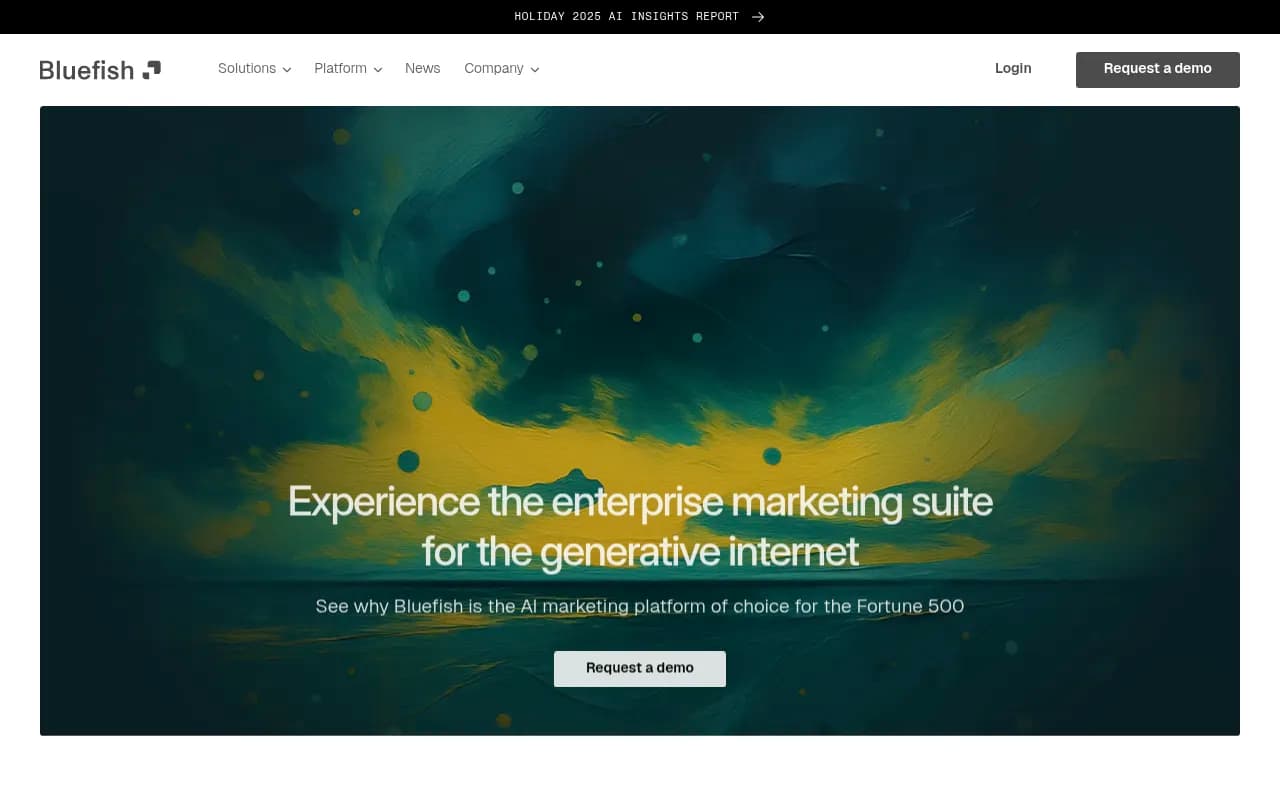
Bluefish AI positions itself as "the AI marketing platform of choice for the Fortune 500." It's an enterprise-focused GEO platform that monitors brand visibility across AI search engines and agentic commerce channels. The platform emphasizes custom audiences, tailored prompts, and what they call "understanding how AI thinks" -- going beyond basic share-of-voice metrics to deeper performance analytics.
Bluefish AI targets large marketing teams at major corporations. Their website features enterprise-grade messaging around infosec compliance, custom data segmentation, and differentiation in competitive markets. They offer AI monitoring, GEO optimization, GEO measurement, and AI commerce tracking.
The catch: no transparent pricing, no self-service signup, and no content generation or optimization features. Everything runs through custom quotes and sales demos.
GetMint
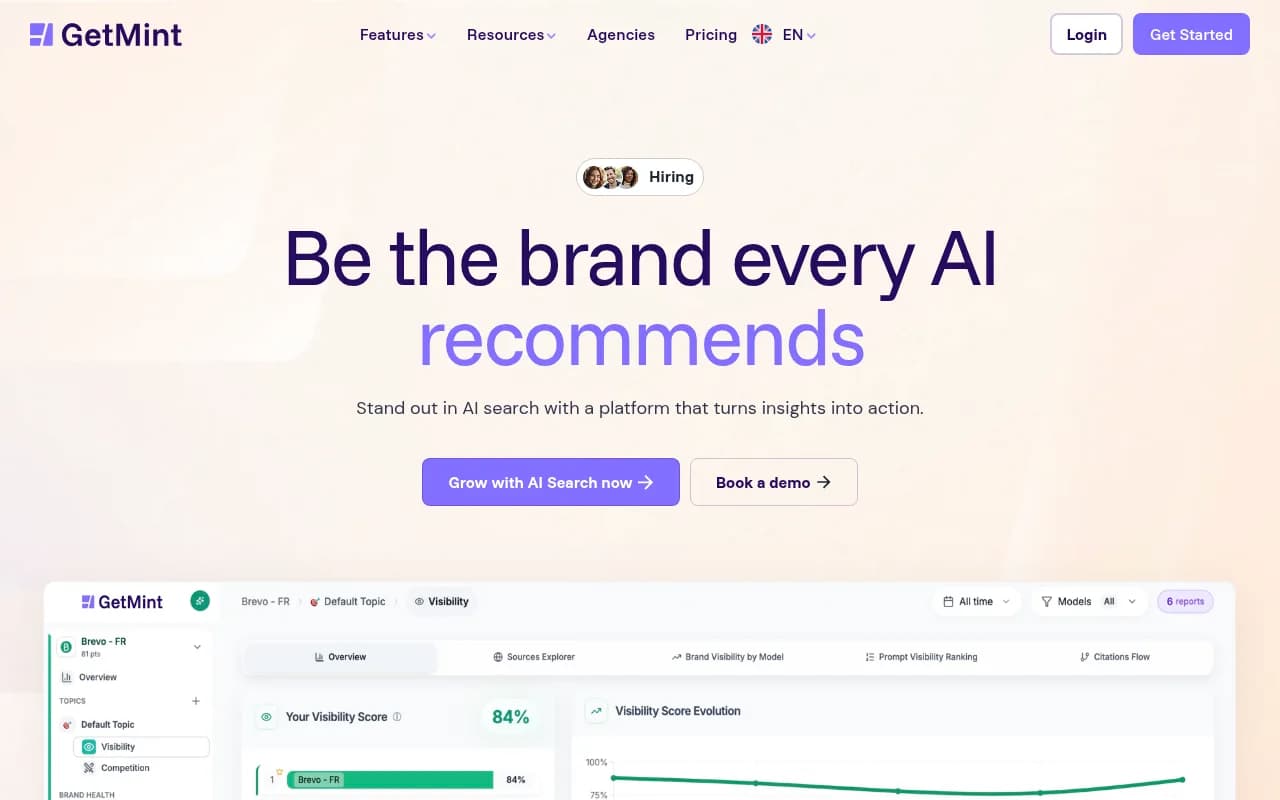
GetMint calls itself "the first platform for Generative Engine Optimization (GEO)" -- a claim that's debatable given the crowded 2026 landscape, but they've built a solid end-to-end platform. They monitor brand visibility across ChatGPT, Claude, Gemini, Perplexity, and other major LLMs, with a focus on actionable insights and optimization.
GetMint serves 200+ brands and agencies with transparent pricing (Growth €229/mo, Pro €499/mo) and unlimited seats. Their approach combines real-time monitoring with tools to actually improve your visibility -- not just track it. They offer project-based scaling, which makes sense for agencies managing multiple clients.
The platform includes content optimization features that Bluefish AI lacks, though the live website data cuts off before detailing exactly what those features are. GetMint positions itself as accessible to mid-market brands, not just Fortune 500 enterprises.
Side-by-Side Comparison
| Feature | Bluefish AI | GetMint |
|---|---|---|
| Starting price | $4,000+/mo (estimated) | €229/mo (~$250/mo) |
| Pricing transparency | Custom quotes only | Public tiers |
| Free trial | No | Yes |
| Seats included | Custom | Unlimited |
| Target audience | Fortune 500 enterprises | Mid-market brands, agencies |
| Self-service signup | No -- demo required | Yes |
| AI models monitored | Major LLMs + agentic commerce | ChatGPT, Claude, Gemini, Perplexity, others |
| Content optimization | No | Yes |
| Content generation | No | Unclear from data |
| Custom audiences | Yes -- core differentiator | Not mentioned |
| Crawler logs | No | No |
| Reddit/YouTube tracking | No | No |
| Infosec compliance | Enterprise-grade, passes reviews | Not emphasized |
Pricing: $4,000/mo vs €229/mo
This is the most dramatic difference between these platforms.
Bluefish AI has no public pricing. Their website pushes you toward "Request a demo" and custom quotes. Based on their Fortune 500 positioning and enterprise focus, industry estimates put their entry point around $4,000-$6,000 per month, possibly higher for complex deployments. This pricing model makes sense for their target market -- large corporations with dedicated budgets and complex requirements -- but it locks out smaller brands entirely.
GetMint publishes clear pricing:
- Growth: €229/mo
- Pro: €499/mo
- Both tiers include unlimited seats
- Project-based scaling (likely means you pay per brand/domain tracked)
- Free trial available
The 17x price gap means these platforms aren't really competing for the same customers. A mid-market SaaS company with a $3,000/month marketing budget can't even consider Bluefish AI. A Fortune 500 brand with a $500,000 annual AI visibility budget might not take GetMint seriously.
| Plan | Bluefish AI | GetMint |
|---|---|---|
| Entry tier | ~$4,000+/mo (estimated) | €229/mo (~$250/mo) |
| Mid tier | Custom | €499/mo (~$545/mo) |
| Enterprise | Custom | Custom (likely available) |
| Free trial | No | Yes |
| Annual discount | Unknown | Likely |
Feature depth: Monitoring vs optimization
Both platforms monitor AI search visibility, but they take different approaches to what happens next.
Bluefish AI emphasizes depth of analysis. Their messaging focuses on "understanding how AI thinks" and "optimizing beyond just visibility and share-of-voice." They offer:
- Custom audiences tailored to your specific customer segments
- Tailored prompts that match how your actual buyers search
- Advanced performance analytics with custom segmentation
- AI commerce tracking (monitoring product recommendations in AI shopping experiences)
- Automated optimization workflows (though no details on what this means)
What they don't offer: content generation, content optimization tools, or crawler logs. Bluefish AI shows you the problem but doesn't help you create the solution. For an enterprise with a full content team, that's fine -- they just need the data. For a smaller brand, that's a gap.
GetMint positions itself as end-to-end GEO. They monitor visibility and provide tools to improve it. Their feature set includes:
- Real-time monitoring across major LLMs
- Actionable insights (not just dashboards)
- Content optimization features (specifics unclear from available data)
- Project-based scaling for agencies managing multiple clients
- Unlimited seats at both pricing tiers
What they don't offer: custom audiences, crawler logs, Reddit/YouTube tracking, or the enterprise-grade custom segmentation that Bluefish AI emphasizes.
If you need someone to hand you a detailed diagnosis and let your team build the fix, Bluefish AI fits. If you need a platform that helps you create the fix, GetMint is closer -- though neither platform offers the content generation capabilities found in tools like Promptwatch, which uses 880M+ citations to generate articles engineered for AI search visibility.

Target audience: Fortune 500 vs everyone else
Bluefish AI doesn't hide who they're built for. Their homepage says "the AI marketing platform of choice for the Fortune 500" three times. Their messaging emphasizes:
- Passing infosec reviews with ease
- Custom data segmentation for data teams
- Differentiation in competitive markets where "generic datasets aren't enough"
- Enterprise scale and control
This is a platform built for brands with:
- Marketing budgets over $1M annually
- Dedicated data teams
- Complex compliance requirements
- Multiple stakeholders who need custom reporting
- Competitive categories where small advantages matter
If you're a regional insurance company, a mid-market SaaS startup, or a digital agency with 20 clients, Bluefish AI isn't designed for you. The pricing model alone ensures that.
GetMint serves 200+ brands and agencies. Their messaging focuses on accessibility:
- Transparent pricing with a free trial
- Unlimited seats (agencies can onboard entire teams)
- Project-based scaling (manage multiple clients without per-seat fees)
- Self-service signup
This is a platform built for:
- Mid-market brands with $50k-$500k marketing budgets
- Digital agencies managing multiple clients
- In-house marketing teams that need visibility without enterprise complexity
- Brands that want to test GEO without a six-figure commitment
The 200+ customer count vs Bluefish AI's Fortune 500 focus tells you everything. GetMint optimizes for volume and accessibility. Bluefish AI optimizes for depth and enterprise requirements.
AI models and monitoring coverage
Both platforms monitor the major AI search engines, but details differ.
Bluefish AI tracks:
- Major LLMs (ChatGPT, Claude, Gemini, Perplexity implied but not explicitly listed)
- Agentic commerce channels (AI shopping recommendations)
- Custom prompt sets tailored to your brand
Their emphasis on "AI commerce" is interesting -- they're tracking when AI models recommend products for purchase, not just informational queries. For e-commerce brands and consumer products, this matters. If ChatGPT is recommending your competitor's product when someone asks "best running shoes for marathon training," you need to know.
GetMint explicitly lists:
- ChatGPT
- Claude
- Gemini
- Perplexity
- "All major LLMs"
No mention of AI commerce tracking or shopping recommendations. Their focus seems to be informational search visibility -- brand mentions, citations, and recommendations in conversational AI responses.
Neither platform monitors:
- AI crawler logs (which pages AI bots are actually reading on your site)
- Reddit discussions that influence AI recommendations
- YouTube content that AI models cite
- DeepSeek, Grok, Mistral, Meta AI, or Copilot (at least not explicitly mentioned)
For comprehensive coverage including crawler logs and Reddit/YouTube tracking, you'd need a platform like Promptwatch, which monitors 10 AI models and shows you exactly which pages AI crawlers are accessing on your site.
Custom audiences and prompt tailoring
This is where Bluefish AI claims a major advantage.
Bluefish AI emphasizes custom audiences as a core differentiator. Their messaging: "In competitive markets, generic datasets aren't enough." They let you:
- Define custom audience segments that match your actual customer personas
- Tailor prompts to how those segments actually search
- Segment performance data by audience
Example: If you're a B2B SaaS company, you might create separate audiences for "IT directors at mid-market companies" vs "CTOs at enterprises" vs "developers evaluating tools." Each audience searches differently. Generic prompts miss that nuance.
This is genuinely valuable for large brands with distinct customer segments. It's also complex and requires expertise to set up properly -- which is fine when you have a dedicated team and a vendor relationship.
GetMint doesn't mention custom audiences. Their approach seems to be standard prompt sets and monitoring -- you track how your brand appears for a defined set of queries, but you're not segmenting by custom personas.
For most mid-market brands, standard prompt monitoring is enough. For Fortune 500 brands competing in crowded categories, custom audiences might justify Bluefish AI's premium.
Content optimization and generation
This is where GetMint has an advantage -- at least in theory.
GetMint explicitly mentions content optimization as part of their platform. The live website data doesn't detail exactly what this means, but the positioning is clear: they help you improve visibility, not just monitor it.
In the broader GEO landscape, content optimization usually means:
- Identifying content gaps (prompts where competitors appear but you don't)
- Analyzing why competitors get cited
- Recommending content improvements
- Sometimes generating content designed to rank in AI search
GetMint claims to offer this. How well they execute is unclear from available data.
Bluefish AI offers no content optimization or generation features. Their platform is monitoring and analytics only. They'll show you where you're losing visibility, but they won't help you create the content to fix it.
For enterprises with full content teams, this is fine -- they just need the data. For smaller brands, this is a significant gap. You're paying $4,000+/month for a diagnosis but still need to figure out the treatment yourself.
If content generation is important to you, neither platform matches what Promptwatch offers -- an AI writing agent that generates articles, listicles, and comparisons grounded in 880M+ citations and engineered specifically to rank in AI search results.
Data depth and analytics
Bluefish AI's core pitch is analytics depth.
They emphasize:
- "Understanding how AI thinks" (not just tracking mentions)
- Custom segmentation and filtering for data teams
- Advanced performance metrics beyond share-of-voice
- Automated optimization workflows
Their messaging suggests they provide more granular data and more ways to slice it than competitors. For a data-driven enterprise marketing team, this matters. You're not just tracking "Are we mentioned?" -- you're tracking "How are we positioned? What context surrounds our mentions? How does this vary by audience segment and prompt type?"
The trade-off: complexity. This level of depth requires expertise to interpret and act on.
GetMint focuses on "actionable insights" -- a vaguer claim, but it suggests they prioritize clarity over depth. Their messaging implies they show you what matters and what to do about it, without overwhelming you with data.
For most brands, actionable insights beat comprehensive data. You need to know "Competitor X is beating us for these 20 prompts because they have content about Y" more than you need 50 custom data segments.
For Fortune 500 brands with dedicated analysts, comprehensive data beats simplified insights. You have the expertise to extract value from complexity.
Enterprise features and compliance
Bluefish AI makes a big deal about enterprise readiness:
- "Consistently passes infosec reviews with ease"
- Built for enterprise scale
- Custom data access for data teams
- Presumably SOC 2, GDPR, and other compliance certifications (not explicitly stated but implied)
If you're a publicly traded company or a regulated industry (finance, healthcare), this matters. You can't just sign up for a random SaaS tool -- it needs to pass legal, security, and compliance review. Bluefish AI is built for that process.
GetMint doesn't emphasize enterprise compliance. That doesn't mean they lack it -- many mid-market SaaS platforms have solid security -- but it's not part of their positioning. Their focus is accessibility and ease of use, not enterprise procurement processes.
If you need to pass a rigorous vendor review, Bluefish AI is the safer bet. If you're a mid-market brand that can sign up for tools without a six-month procurement process, this doesn't matter.
What's missing from both platforms
Neither Bluefish AI nor GetMint offers:
AI crawler logs: Real-time tracking of which pages AI bots (ChatGPT, Claude, Perplexity crawlers) are accessing on your website. This tells you what content AI models are actually reading vs what they're ignoring -- critical for optimization.
Reddit and YouTube tracking: AI models heavily cite Reddit discussions and YouTube videos. If you're not monitoring these channels, you're missing a huge part of what influences AI recommendations.
Prompt volume and difficulty data: How often is a prompt actually used? How hard is it to rank for? Without this, you're optimizing blind.
Multi-language and multi-region monitoring: Can you track how your brand appears in Spanish prompts in Mexico vs English prompts in the US? Not clear from either platform.
Traffic attribution: Can you connect AI visibility to actual website traffic and revenue? This is the ultimate question for ROI.
These gaps are common across monitoring-focused GEO platforms. For a more complete solution that includes crawler logs, Reddit/YouTube tracking, prompt intelligence, and traffic attribution, you'd need a platform like Promptwatch.
Bluefish AI pros and cons
Pros:
- Built specifically for Fortune 500 enterprises with complex requirements
- Custom audiences and tailored prompts for sophisticated segmentation
- Deep analytics that go beyond basic share-of-voice metrics
- AI commerce tracking for product recommendations
- Enterprise-grade infosec and compliance
- Advanced data segmentation for data teams
Cons:
- No transparent pricing -- custom quotes only, estimated $4,000+/month
- No self-service signup or free trial
- No content optimization or generation features
- No AI crawler logs, Reddit tracking, or YouTube monitoring
- Complexity requires dedicated expertise to extract value
- Completely inaccessible to mid-market brands and agencies
GetMint pros and cons
Pros:
- Transparent pricing starting at €229/mo -- 17x cheaper than Bluefish AI's estimated entry point
- Unlimited seats at all tiers (great for agencies)
- Free trial available
- Self-service signup
- Content optimization features (details unclear)
- Project-based scaling for agencies managing multiple clients
- Serves 200+ brands and agencies successfully
Cons:
- No custom audience segmentation
- Less analytics depth than Bluefish AI
- No AI commerce tracking
- No crawler logs, Reddit tracking, or YouTube monitoring
- Content optimization details are vague
- May lack enterprise-grade compliance features
Who should pick Bluefish AI
Bluefish AI makes sense if you:
- Work at a Fortune 500 company or large enterprise
- Have a marketing budget over $1M annually
- Need custom audience segmentation for distinct customer personas
- Have a dedicated data team that can extract value from complex analytics
- Compete in a crowded category where small advantages matter
- Need to pass rigorous infosec and compliance reviews
- Track product recommendations in AI commerce channels
- Already have a content team and just need visibility data
Bluefish AI is overkill (and financially inaccessible) for mid-market brands, startups, and most agencies.
Who should pick GetMint
GetMint makes sense if you:
- Run a mid-market brand with a $50k-$500k marketing budget
- Work at a digital agency managing multiple clients
- Need transparent pricing and a free trial before committing
- Want unlimited seats for your entire team
- Need content optimization tools, not just monitoring
- Value actionable insights over comprehensive data depth
- Want self-service signup without a sales process
- Don't need custom audience segmentation or enterprise compliance
GetMint is the practical choice for 95% of brands exploring GEO in 2026.
Final verdict
These platforms target completely different markets. Bluefish AI is a Bentley -- built for Fortune 500 enterprises with complex requirements and large budgets. GetMint is a Toyota -- reliable, accessible, and practical for most buyers.
For mid-market brands and agencies, GetMint wins on price, transparency, and accessibility. The €229/mo starting point with unlimited seats and a free trial makes it easy to test GEO without a massive commitment. The content optimization features (however limited) give you tools to improve, not just monitor.
For Fortune 500 enterprises with dedicated teams and complex segmentation needs, Bluefish AI's custom audiences and deep analytics might justify the premium. The AI commerce tracking is genuinely differentiated. But you're paying 17x more for features that most brands don't need.
If you want a platform that combines monitoring with actual optimization -- including content generation, crawler logs, Reddit/YouTube tracking, and traffic attribution -- neither platform delivers the full package. That's where a comprehensive GEO platform like Promptwatch comes in, offering the action loop that most monitoring-only tools miss: find the gaps, generate content that ranks, track the results.