Key Takeaways
- Pricing gap is massive: Bluefish requires custom quotes (estimated $4,000+/month for enterprise) with no self-service option. Orchly starts at $49/month with a free 14-day trial and transparent pricing tiers.
- Target audience couldn't be more different: Bluefish is built exclusively for Fortune 500 brands with dedicated marketing teams. Orchly targets small-to-midsize businesses, agencies, and solo marketers who need affordable AI visibility tracking.
- Content generation is Orchly's differentiator: Orchly includes AI content agents that write, refresh, and publish SEO/AEO-optimized content automatically. Bluefish has zero content creation features -- it's monitoring and analytics only.
- Enterprise depth vs accessibility: Bluefish offers custom audiences, tailored prompts, and deep performance analytics designed for large teams. Orchly prioritizes ease of use and automation over customization depth.
- Both lack crawler logs and optimization tools: Neither platform offers AI crawler log analysis or the kind of content gap analysis found in platforms like Promptwatch, which shows exactly what content you're missing and helps you create it.
- Orchly is actionable out of the box: It tells you what to fix and helps you do it with built-in content agents and optimization workflows. Bluefish shows you the data but leaves the execution entirely to your team.
Overview
Bluefish AI
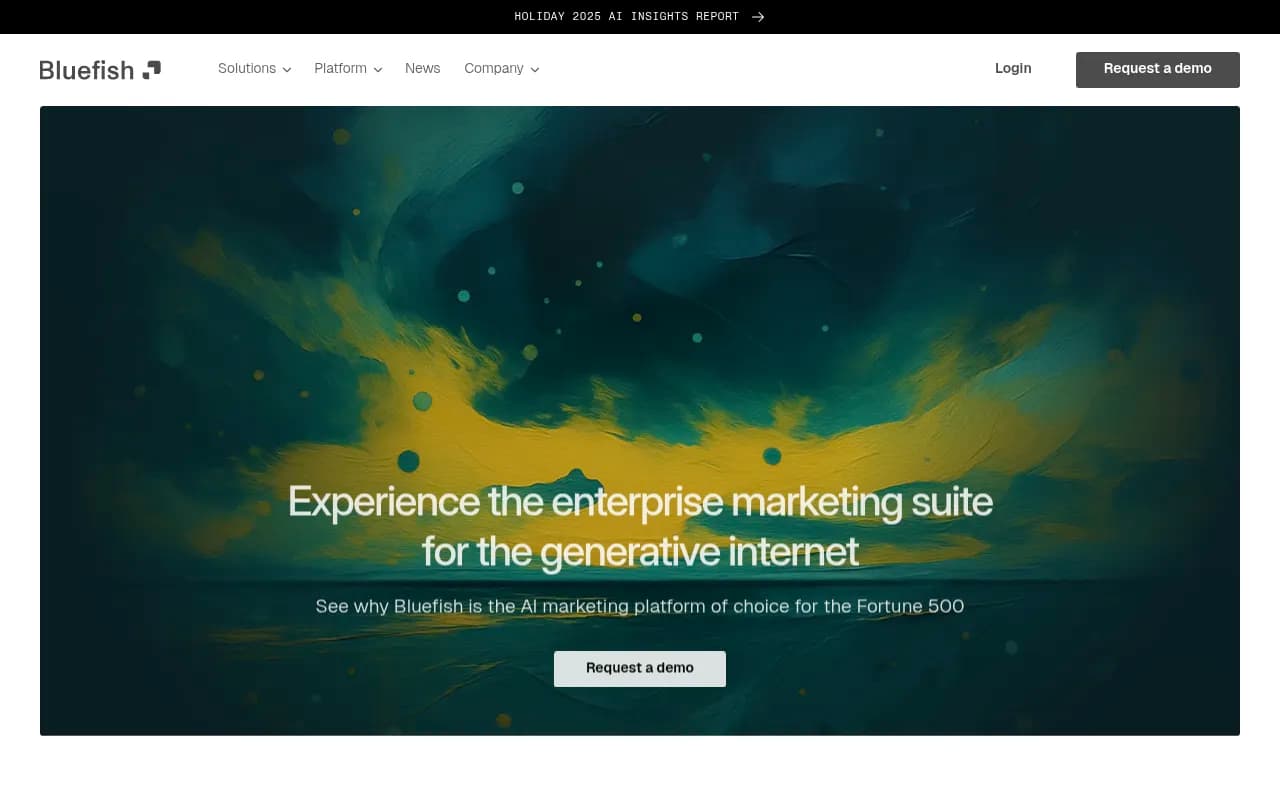
Bluefish AI positions itself as "the AI marketing platform of choice for the Fortune 500." It's an enterprise-focused monitoring platform that tracks brand visibility across AI search engines (ChatGPT, Perplexity, Claude, Google AI products) and what they call "agentic commerce" channels. The platform emphasizes custom audiences, tailored prompts, and deep performance analytics -- features designed for large marketing teams with complex segmentation needs.
Bluefish doesn't offer self-service pricing. You request a demo, go through a sales process, and get a custom quote. Based on industry estimates and the enterprise positioning, expect $4,000+ per month minimum. There's no free trial, no transparent tiers, and no way to test the platform without talking to sales first.
The platform recently launched "Collections" for measuring ROI of digital marketing campaigns in the AI channel, and they published research showing Super Bowl ads influence AI recommendations -- both signals that they're targeting brands with massive ad budgets.
Orchly
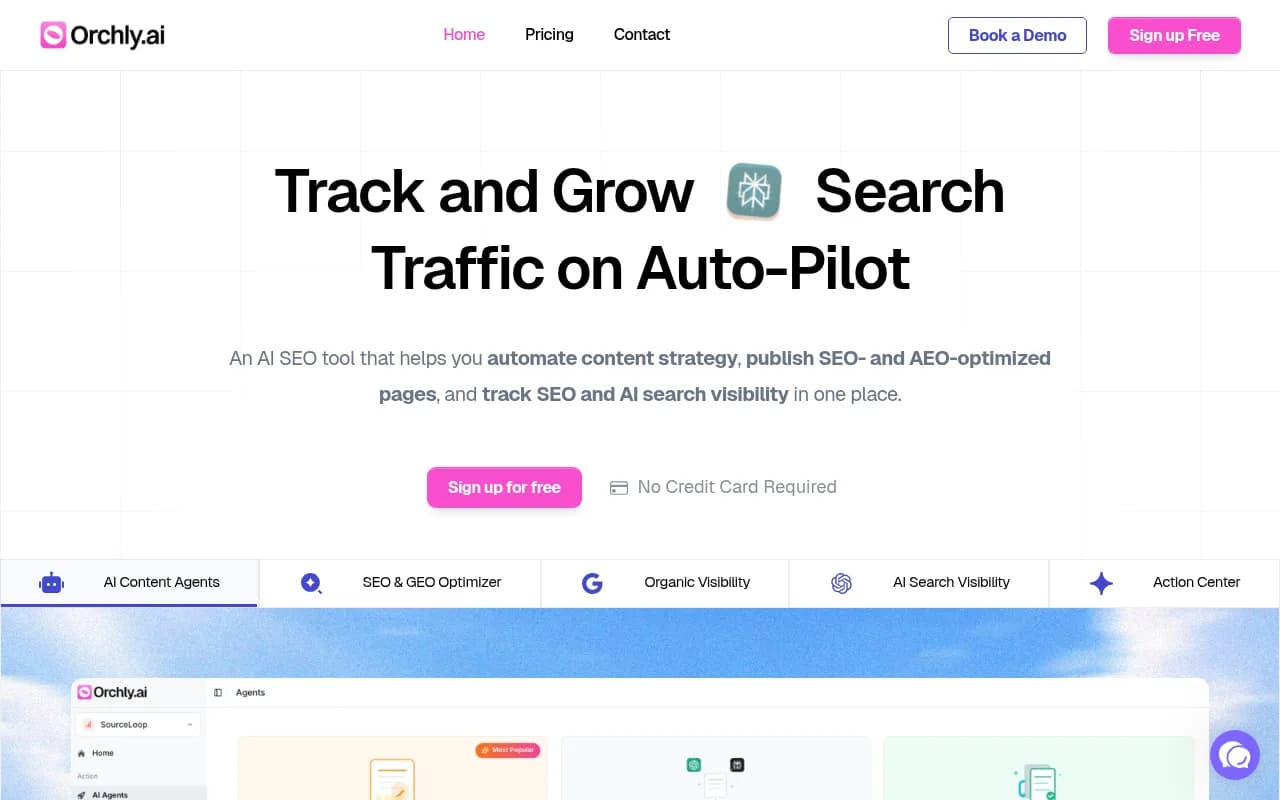
Orchly is a freemium AI SEO automation platform that combines visibility tracking with content operations. It monitors brand mentions across ChatGPT, Perplexity, Claude, Google AI products, and traditional Google search. But unlike pure monitoring tools, Orchly includes AI content agents that write, refresh, and publish optimized content automatically.
Pricing is transparent: free 14-day trial, then $49/month (Essential), $125/month (Pro), or custom enterprise pricing. Annual plans save 25%. You can sign up and start tracking immediately without talking to anyone.
Orchly's pitch is "track and grow search traffic on autopilot" -- it's built for teams that want to see where they rank in AI search and then actually do something about it without hiring a content team. The platform includes an "Action Center" that highlights specific opportunities (which pages to improve, which content to create next, which backlinks to build) and then helps you execute with built-in content agents.
Side-by-Side Comparison
| Feature | Bluefish AI | Orchly |
|---|---|---|
| Starting price | Custom quote ($4,000+/mo est.) | $49/mo (Essential) |
| Free trial | No | 14 days |
| Self-service signup | No -- demo required | Yes |
| Target audience | Fortune 500 enterprises | SMBs, agencies, solo marketers |
| AI platforms tracked | ChatGPT, Perplexity, Claude, Google AI, agentic commerce | ChatGPT, Perplexity, Claude, Google AI, Gemini |
| Traditional SEO tracking | No | Yes (Google organic visibility) |
| Content generation | No | Yes (AI content agents) |
| Content optimization | No | Yes (150+ factors, structured data, links) |
| Custom audiences | Yes (enterprise feature) | No |
| Tailored prompts | Yes (enterprise feature) | Standard prompt sets |
| Competitor benchmarking | Yes | Yes |
| Action recommendations | Limited (shows data, no execution tools) | Yes (Action Center with specific tasks) |
| White-label reports | Unknown | Yes |
| API access | Unknown | Unknown |
| Crawler logs | No | No |
Pricing: Enterprise vs accessible
| Plan | Bluefish AI | Orchly |
|---|---|---|
| Free tier | None | 14-day trial |
| Starter | N/A | $49/mo (Essential) |
| Mid-tier | N/A | $125/mo (Pro) |
| Enterprise | Custom quote (est. $4,000+/mo) | Custom pricing |
| Annual discount | Unknown | 25% off |
| Minimum commitment | Unknown (likely annual contract) | Monthly or annual |
Bluefish doesn't publish pricing. You request a demo, go through their sales process, and get a custom quote based on your company size, number of users, and feature requirements. Industry chatter suggests $4,000+ per month for enterprise plans, possibly much higher for Fortune 500 deployments with extensive customization.
Orchly's pricing is straightforward: $49/month gets you started with essential AI visibility tracking and content automation. $125/month (Pro) adds more advanced features. Enterprise plans are available for larger teams that need custom limits or white-label reporting. Annual billing saves 25% across all tiers.
The pricing gap reflects the target audience gap. Bluefish is selling to CMOs at billion-dollar companies who have dedicated AI marketing budgets. Orchly is selling to marketing managers at $5M-$50M companies who need results without blowing their entire budget on one tool.
Feature depth: Custom enterprise vs automated workflows
AI visibility tracking
Both platforms monitor brand mentions across major AI search engines -- ChatGPT, Perplexity, Claude, Google AI products. Both let you compare your visibility against competitors and track changes over time.
Bluefish emphasizes "understanding how AI thinks" with deep performance analytics and custom audience segmentation. You can create tailored prompt sets that match your specific customer segments and track visibility across those custom audiences. This is valuable if you're a global brand with distinct regional markets or product lines that need separate tracking.
Orchly uses standard prompt sets and doesn't offer the same level of audience customization. You track your brand visibility across a predefined set of queries relevant to your industry. For most small-to-midsize businesses, this is sufficient -- you don't need custom audience segmentation when you're just trying to figure out if ChatGPT recommends you at all.
Bluefish also tracks "agentic commerce" channels -- AI-powered shopping and recommendation engines. Orchly doesn't explicitly mention this, though it does track general AI search visibility which would include some shopping-related queries.
Verdict: Bluefish wins on depth and customization for enterprise needs. Orchly wins on accessibility and getting started quickly.
Content creation and optimization
This is where the platforms diverge completely.
Bluefish has zero content creation features. It shows you where you rank in AI search, how competitors are performing, and what sources AI models are citing -- but it doesn't help you create or optimize content. You take the insights back to your content team and they figure out what to do with it.
Orchly includes AI content agents that write, refresh, and publish content automatically. You can deploy agents for specific content workflows (blog posts, product pages, comparison articles, etc.), train them on your brand data, and set them to auto-schedule and publish. The platform also includes an SEO/AEO optimizer that enriches content with structured data, NLP keywords, internal/external links, and formatting optimized for both Google and LLM search engines.
Orchly analyzes 150+ factors to find SEO and GEO opportunities, then helps you fix them. It automates internal linking, adds contextual external links to trusted sources, applies rich formatting (images, videos, tables), and resolves technical SEO issues that block AI crawlers.
Verdict: Orchly wins decisively if you need content creation and optimization. Bluefish isn't even playing in this space.
Actionability and workflow integration
Bluefish's "Collections" feature (launched February 2026) lets you measure ROI of digital marketing campaigns in the AI channel. You can group prompts into collections that represent specific campaigns or initiatives, then track how those campaigns impact AI visibility over time. This is useful for enterprise teams running coordinated campaigns across multiple channels who need to prove AI visibility ROI to executives.
But Bluefish doesn't tell you what to do with the data beyond "here's how you're performing." There's no action center, no content gap analysis, no recommendations engine. You get the analytics, you interpret them, you decide what to change, and you execute those changes with your existing tools and team.
Orchly's Action Center is the opposite approach. It highlights specific opportunities: which pages should you improve, which content should you create next, which backlinks are worth building, which Reddit discussions are shaping AI search visibility for your keywords, which technical issues are blocking growth. Then it gives you tools to act on those opportunities immediately -- content agents to write the missing content, optimization workflows to fix the technical issues, link-building suggestions.
Verdict: Orchly is built around taking action. Bluefish is built around understanding performance. Pick based on whether you have a team to execute or need the tool to do it for you.
Traditional SEO tracking
Orchly tracks both AI search visibility and traditional Google organic visibility in one platform. You see how you rank in Google search results alongside how you show up in ChatGPT and Perplexity. This unified view is helpful for teams that need to balance traditional SEO and AI search optimization.
Bluefish focuses exclusively on AI channels. There's no traditional SEO tracking, no Google Search Console integration, no keyword rank tracking for organic search. If you need both, you'll need a separate SEO tool alongside Bluefish.
Verdict: Orchly wins if you need unified SEO + AI visibility tracking. Bluefish is AI-only.
Enterprise features and scale
Bluefish emphasizes that it's "built for enterprise" -- it consistently passes infosec reviews, offers extensive customization and segmentation, and provides data teams with more ways to slice and analyze data than competitors. The platform is designed for large marketing teams with complex organizational structures, multiple stakeholders, and rigorous security requirements.
Orchly doesn't position itself as an enterprise platform. It offers white-label reports and custom enterprise pricing, but the core product is designed for smaller teams that need simplicity and automation over customization depth.
Verdict: Bluefish wins for Fortune 500 requirements. Orchly wins for teams under 50 people.
What both platforms are missing
Neither Bluefish nor Orchly offers AI crawler log analysis -- the ability to see which AI models are actually crawling your website, which pages they're reading, how often they return, and what errors they encounter. This is a critical gap because you can't optimize for AI visibility if you don't know whether AI crawlers are even finding your content.
Neither platform offers the kind of content gap analysis that shows you exactly which prompts competitors are visible for but you're not, or which specific topics and angles are missing from your website. Tools like Promptwatch surface these gaps by analyzing 880M+ citations and showing you the precise content you need to create to rank in AI search.

Both platforms also lack Reddit and YouTube tracking depth. Orchly mentions "which Reddit discussions shape AI search visibility" but doesn't provide the same level of Reddit/YouTube citation analysis that more comprehensive GEO platforms offer.
Pros and cons
Bluefish AI pros
- Custom audiences and tailored prompts for enterprise segmentation needs
- Deep performance analytics designed for large marketing teams
- Tracks agentic commerce channels beyond just search
- Collections feature for campaign ROI measurement
- Built to pass Fortune 500 infosec reviews
- Strong focus on understanding "how AI thinks"
Bluefish AI cons
- No transparent pricing -- requires demo and custom quote
- Estimated $4,000+/month puts it out of reach for most businesses
- Zero content creation or optimization features
- No traditional SEO tracking
- No AI crawler logs or content gap analysis
- Shows you the data but doesn't help you act on it
- No free trial or self-service option to test before committing
Orchly pros
- Transparent pricing starting at $49/month with free trial
- Combines AI visibility tracking with content automation
- AI content agents write, refresh, and publish optimized content
- Action Center highlights specific opportunities and helps you execute
- Tracks both AI search and traditional Google organic visibility
- 150+ factor SEO/AEO optimizer with automated fixes
- White-label reports for agencies
- Self-service signup -- start tracking immediately
Orchly cons
- No custom audience segmentation for enterprise needs
- Standard prompt sets without tailored customization
- Doesn't track agentic commerce channels explicitly
- Less depth in performance analytics compared to enterprise platforms
- No AI crawler logs or advanced content gap analysis
- Content quality depends on how well you train the AI agents
Who should pick which platform
Pick Bluefish AI if you:
- Work at a Fortune 500 company with a dedicated AI marketing budget
- Need custom audience segmentation and tailored prompt tracking
- Have a content team that can execute on insights independently
- Require deep performance analytics for executive reporting
- Need to track agentic commerce channels and AI shopping recommendations
- Can afford $4,000+/month and are willing to go through a sales process
- Want a platform that passes rigorous enterprise infosec reviews
Pick Orchly if you:
- Run a small-to-midsize business or agency with a limited budget
- Need AI visibility tracking plus content creation in one tool
- Want to start tracking immediately without talking to sales
- Need actionable recommendations, not just analytics dashboards
- Want to automate content workflows with AI agents
- Need unified tracking for both AI search and traditional SEO
- Prefer transparent pricing and the ability to test before committing
- Don't need enterprise-level customization or segmentation
Consider alternatives if you:
- Need AI crawler log analysis to see which AI models are actually reading your site
- Want content gap analysis that shows exactly what you're missing vs competitors
- Need Reddit and YouTube citation tracking depth
- Want a platform that combines monitoring, content generation, and optimization in one comprehensive package (tools like Promptwatch cover this ground more thoroughly)
Final verdict
Bluefish AI and Orchly aren't really competitors -- they're solving different problems for different audiences at wildly different price points.
Bluefish is an enterprise analytics platform for Fortune 500 brands that need custom segmentation, deep performance insights, and the ability to prove AI visibility ROI to executives. It's monitoring-only with no content creation features, which means you need a separate content team to act on the insights. At an estimated $4,000+/month with no transparent pricing or free trial, it's accessible only to companies with serious AI marketing budgets.
Orchly is an affordable automation platform for small-to-midsize businesses that need to track AI visibility and actually do something about it without hiring a content team. It combines monitoring with AI content agents and optimization workflows, giving you both the insights and the tools to improve. At $49/month with a free trial and self-service signup, it's accessible to any business that wants to start showing up in AI search results.
If you're a CMO at a billion-dollar company with a dedicated AI marketing team, Bluefish gives you the depth and customization you need. If you're a marketing manager at a $10M company trying to figure out why ChatGPT never recommends you, Orchly gives you visibility and automation at a price you can actually afford. The choice is less about features and more about which audience you belong to.