Key Takeaways
- Bluefish AI targets Fortune 500 enterprises with custom pricing (estimated $4,000+/month) while Promptmonitor starts at $29/month with transparent tiers -- a 100x+ price difference for basic monitoring
- Neither platform offers content generation, AI crawler logs, or prompt intelligence features that platforms like Promptwatch provide for optimization
- Bluefish emphasizes "custom audiences" and "tailored prompts" but lacks self-service options; Promptmonitor offers simpler dashboards with basic source tracking
- Both are monitoring-only tools -- they show you data but don't help you fix visibility gaps or create content that ranks in AI search
- Promptmonitor has a 7-day free trial and clear pricing; Bluefish requires sales demos and custom quotes with no transparent pricing
- For most teams under 50 people, Promptmonitor's pricing makes more sense; for Fortune 500 brands with dedicated AI marketing budgets, Bluefish positions itself as the "enterprise choice"
Overview
Bluefish AI
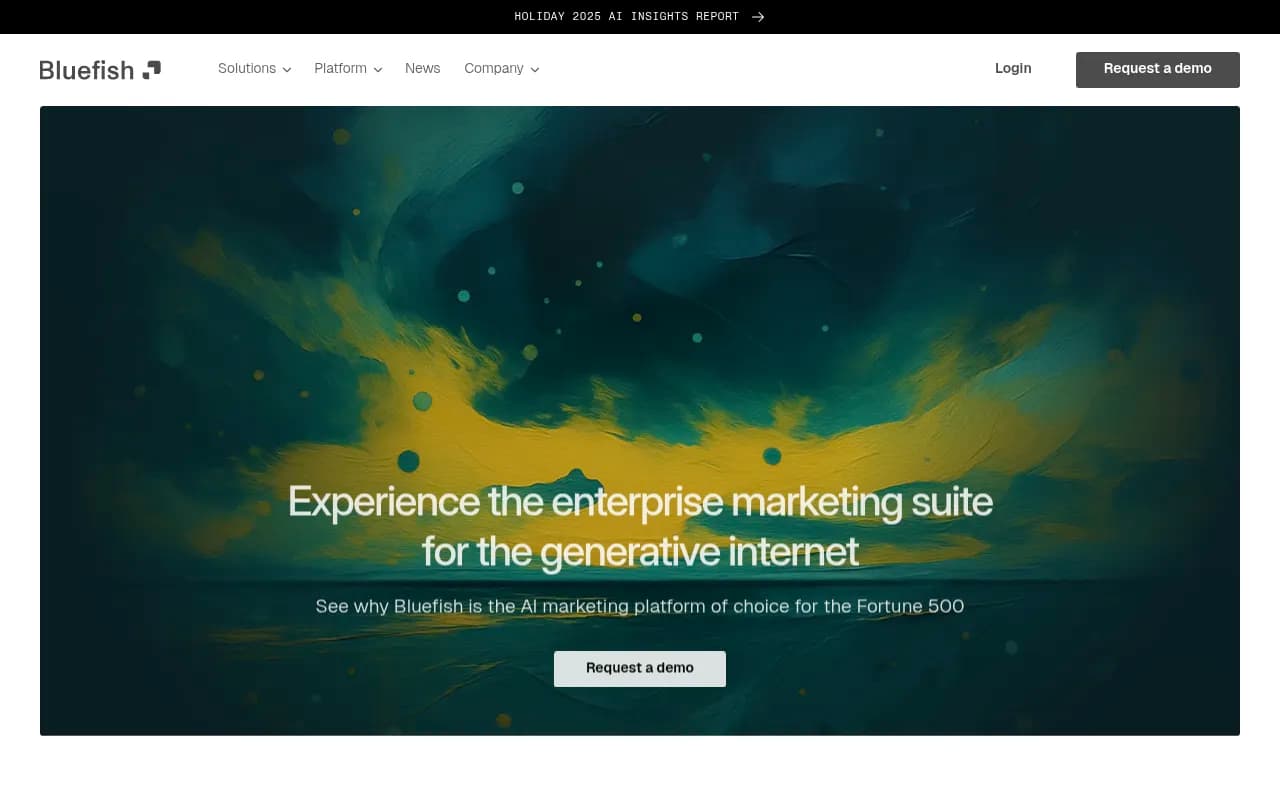
Bluefish AI markets itself as "the AI marketing platform of choice for the Fortune 500." It's built for large enterprise marketing teams that need to monitor brand presence across AI search engines and what they call "agentic commerce channels." The platform emphasizes depth and control with custom audience segmentation, tailored prompt libraries, and performance analytics.
The catch: no transparent pricing, no self-service signup, and a feature set that stops at monitoring. You get dashboards showing where your brand appears in ChatGPT, Claude, Perplexity, and other LLMs -- but no tools to actually improve those results. No content gap analysis. No AI writing agent. No crawler logs showing how AI engines discover your site.
Bluefish passes enterprise infosec reviews and offers data customization for large teams. That matters if you're a Fortune 500 CMO. It matters less if you're a startup or mid-market company that needs to move fast.
Promptmonitor
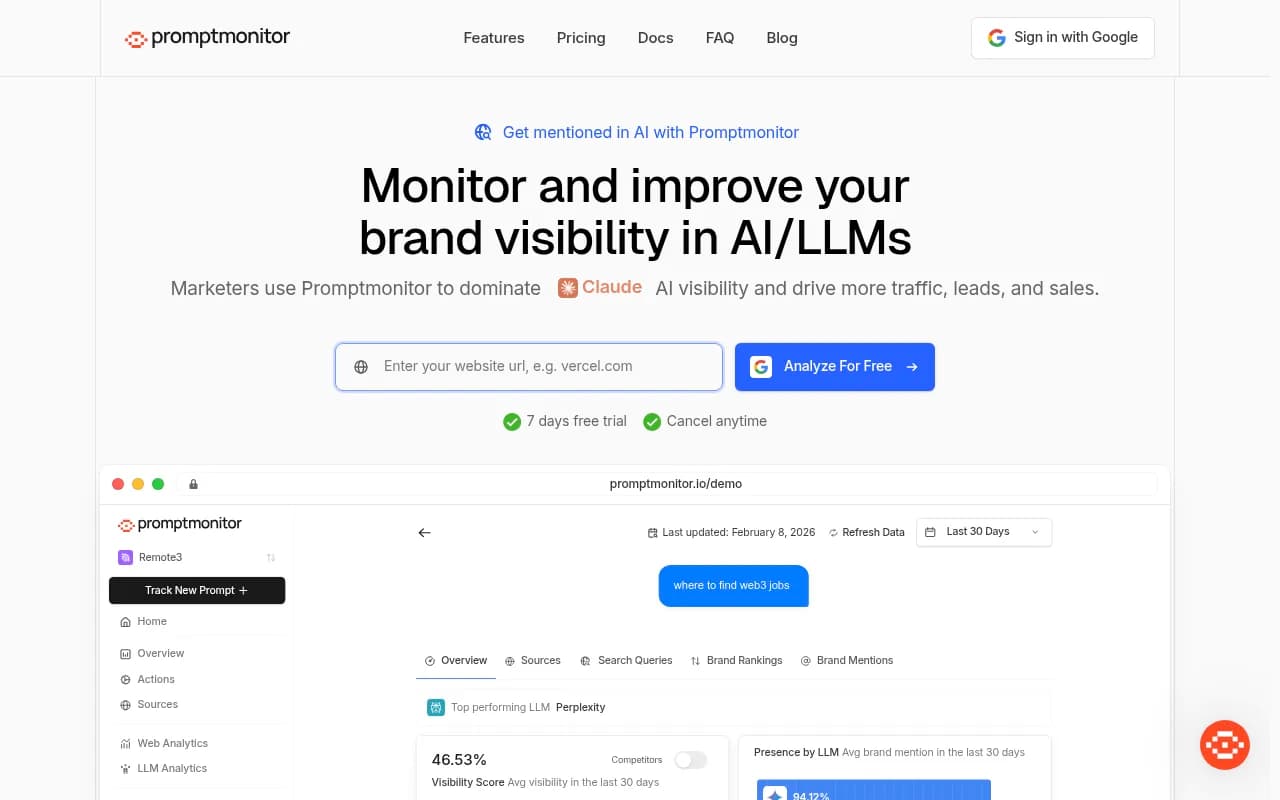
Promptmonitor takes a simpler approach: track brand mentions across ChatGPT, Claude, Gemini, and Perplexity with straightforward dashboards and source tracking. Plans start at $29/month with a 7-day free trial. You can sign up, add your prompts, and start monitoring within minutes.
The platform shows visibility scores, presence by LLM, and which sources AI models cite when mentioning your brand. It tracks whether you're mentioned or not, calculates consistency across models, and surfaces competitor comparisons.
What it doesn't do: help you fix the gaps. Like Bluefish, Promptmonitor is a monitoring dashboard. It tells you where you're invisible but leaves you to figure out what content to create, which pages to optimize, or why AI models aren't citing you. No content generation. No crawler logs. No prompt intelligence showing search volumes or difficulty scores.
For teams that just need basic visibility tracking without enterprise complexity, Promptmonitor's pricing and simplicity make sense. For teams that want to actually optimize their AI search presence, both platforms fall short.
Side-by-Side Comparison
| Feature | Bluefish AI | Promptmonitor |
|---|---|---|
| Starting Price | Custom quote (~$4,000+/mo) | $29/mo (Starter) |
| Free Trial | No (demo only) | 7 days |
| Self-Service Signup | No | Yes |
| LLMs Monitored | ChatGPT, Claude, Perplexity, Gemini, others | ChatGPT, Claude, Perplexity, Gemini |
| Custom Audiences | Yes | No |
| Source Tracking | Yes | Yes |
| Visibility Scoring | Yes (advanced) | Yes (basic) |
| Competitor Tracking | Yes | Yes |
| AI Crawler Logs | No | No |
| Content Gap Analysis | No | No |
| AI Content Generation | No | No |
| Prompt Intelligence | No | No |
| Reddit/YouTube Tracking | No | No |
| Traffic Attribution | No | No |
| API Access | Likely (enterprise) | Unknown |
| Target Audience | Fortune 500, large enterprises | Startups, SMBs, agencies |
Pricing: Enterprise opacity vs transparent tiers
This is where the two platforms diverge completely.
Bluefish AI pricing
Bluefish doesn't publish pricing. You request a demo, talk to sales, and get a custom quote. Based on their enterprise positioning and feature set, estimates put their plans at $4,000+ per month -- possibly much higher for large organizations.
That pricing model works if you're a Fortune 500 brand with a seven-figure marketing budget and a team that needs white-glove service, custom integrations, and dedicated support. It doesn't work if you're a startup trying to track AI visibility on a tight budget.
No free trial. No self-service option. You're committing to a sales process before you see the product.
Promptmonitor pricing
| Plan | Price | Projects | Prompts | LLMs |
|---|---|---|---|---|
| Starter | $29/mo | 1 | 10 | 3 |
| Growth | $39/mo | 3 | 30 | 4 |
| Pro | $129/mo | 10 | 100 | 5 |
| Agency | Custom | Custom | Custom | Custom |
Promptmonitor's pricing is transparent and accessible. You can start at $29/month, track 10 prompts across 3 LLMs, and see if the platform works for you. The 7-day free trial lets you test before committing.
For most small to mid-sized teams, the Growth plan at $39/month covers basic monitoring needs. The Pro plan at $129/month gives you room to scale. Even the Pro tier is 30x cheaper than Bluefish's estimated entry point.
The Agency plan introduces custom pricing, but at least you have transparent lower tiers to start with.
Verdict: If you're not a Fortune 500 company, Promptmonitor's pricing makes infinitely more sense. If you are a Fortune 500 company, you're probably already talking to Bluefish's sales team.
Feature depth: Enterprise customization vs simplicity
Custom audiences and tailored prompts
Bluefish's main differentiator is customization. They emphasize "custom audiences" and "tailored prompts" -- the ability to segment tracking by persona, geography, or use case. If you're a global brand selling to multiple customer segments, this matters. You can see how AI recommends your brand to enterprise buyers vs consumers, or how visibility differs across regions.
Promptmonitor doesn't offer this. You track prompts. You see results. There's no audience segmentation or persona-based tracking.
For most teams, this isn't a dealbreaker. If you're tracking 30 prompts and trying to understand basic AI visibility, you don't need enterprise-grade audience segmentation. You need to know: are we being mentioned? Which sources are cited? How do we compare to competitors?
Bluefish's customization is valuable at scale. It's overkill for everyone else.
Monitoring dashboards and analytics
Both platforms offer visibility dashboards showing brand mentions, presence by LLM, and trends over time.
Bluefish positions its analytics as "deeper" and more "actionable" -- with performance tools that help teams "focus on metrics that matter." In practice, this means more segmentation options, more ways to slice data, and more customization for how you view results.
Promptmonitor's dashboards are simpler. You see visibility scores (presence + cross-model consistency), presence by LLM (percentage mentioned), and a timeline showing when you were mentioned or not. It's clean and easy to scan.
Neither platform shows you why you're not being mentioned or what to do about it. That's the core limitation of monitoring-only tools. They surface the problem but don't help you solve it.
Tools like Promptwatch go further by showing content gaps (which prompts competitors rank for but you don't), generating AI-optimized content to fill those gaps, and tracking crawler logs to see how AI engines discover your site.

Source tracking and competitor analysis
Both platforms track which sources AI models cite when mentioning your brand. This is useful -- you can see if AI is pulling from your website, Reddit threads, news articles, or competitor content.
Bluefish emphasizes its ability to track "agentic commerce" channels -- AI-driven shopping recommendations and product suggestions. This is relevant if you're an e-commerce brand trying to appear in ChatGPT Shopping or similar features.
Promptmonitor tracks sources but doesn't break out commerce-specific channels. You see citations, but not with the same level of segmentation.
Both platforms offer competitor tracking. You can see how your visibility compares to rivals. Bluefish's competitor features are likely more robust given their enterprise focus, but Promptmonitor covers the basics.
Verdict: Bluefish offers more depth and customization. Promptmonitor offers simplicity and speed. For most teams, Promptmonitor's features are sufficient. For Fortune 500 brands with complex needs, Bluefish's depth might justify the cost.
What both platforms are missing
Here's the uncomfortable truth: both Bluefish AI and Promptmonitor are monitoring dashboards. They show you data. They don't help you optimize.
No AI crawler logs
Neither platform shows you real-time logs of AI crawlers (ChatGPT, Claude, Perplexity) hitting your website. You don't know which pages they're reading, how often they return, or what errors they encounter. This is a blind spot. If AI models aren't indexing your content properly, monitoring tools won't tell you why.
No content gap analysis
Both platforms show you where you're visible. Neither shows you where you're not visible but should be. They don't surface the specific prompts competitors rank for that you're missing. They don't tell you which content to create to close those gaps.
No AI content generation
Once you identify gaps, you're on your own to create content. Neither platform offers an AI writing agent or content generation tools. You export data, hand it to your content team, and hope they create something that ranks in AI search.
No prompt intelligence
Neither platform shows prompt volumes, difficulty scores, or query fan-outs. You don't know which prompts are high-value and winnable vs low-volume or hyper-competitive. You're tracking prompts blindly without strategic prioritization.
No traffic attribution
Both platforms track visibility -- whether you're mentioned or not. Neither tracks actual traffic or conversions from AI search. You can't connect AI visibility to revenue. You're optimizing in the dark.
These are the features that separate monitoring tools from optimization platforms. If you want to actually improve your AI search presence (not just watch it), you need a platform that closes the loop: find gaps, generate content, track results, measure traffic.
User experience and setup
Bluefish AI
No self-service signup. You request a demo, sit through a sales call, negotiate pricing, and go through an enterprise onboarding process. This takes weeks. Once you're in, you likely get dedicated support and custom setup.
For Fortune 500 teams with procurement processes and infosec reviews, this is normal. For startups and mid-market companies, it's friction.
Promptmonitor
Sign up in minutes. Add your prompts. Start tracking. The interface is straightforward -- no steep learning curve. You can invite team members, set up projects, and see results within hours.
The 7-day free trial lets you test the platform without committing. If it works, upgrade. If it doesn't, cancel.
Verdict: Promptmonitor wins on speed and accessibility. Bluefish wins on enterprise support and white-glove service.
Who should choose Bluefish AI
Bluefish makes sense if:
- You're a Fortune 500 brand with a dedicated AI marketing budget (think $50K+ annually)
- You need custom audience segmentation and persona-based tracking across multiple regions
- You have a large marketing team that requires deep data customization and segmentation
- You're tracking AI visibility across commerce channels and need specialized reporting
- You're comfortable with enterprise sales cycles, custom quotes, and no self-service options
- You value white-glove support and dedicated account management
Bluefish doesn't make sense if:
- You're a startup or SMB with limited budget
- You need to move fast and test AI visibility tracking without a sales process
- You want transparent pricing and self-service signup
- You need optimization tools (content generation, gap analysis, crawler logs) not just monitoring
- You're looking for a platform that helps you fix visibility gaps, not just track them
Who should choose Promptmonitor
Promptmonitor makes sense if:
- You're a startup, SMB, or agency with a limited budget ($29-$129/month range)
- You need basic AI visibility tracking without enterprise complexity
- You want transparent pricing and a free trial to test before committing
- You value simplicity and speed over deep customization
- You're tracking a manageable number of prompts (10-100) and don't need persona segmentation
- You're comfortable exporting data and handling optimization separately
Promptmonitor doesn't make sense if:
- You need enterprise-grade customization and audience segmentation
- You're tracking hundreds of prompts across multiple brands and regions
- You require white-glove support and dedicated account management
- You want optimization tools (content generation, gap analysis) built into the platform
- You're a Fortune 500 brand with complex AI marketing needs
Final verdict
Bluefish AI and Promptmonitor occupy completely different market segments. Bluefish targets Fortune 500 enterprises with custom pricing and deep customization. Promptmonitor targets startups and SMBs with transparent pricing and simple dashboards.
For 95% of teams, Promptmonitor's pricing and accessibility make more sense. You get basic AI visibility tracking for $29-$129/month without sales calls or custom quotes. The platform does what it promises: shows you where your brand is mentioned in AI search.
For Fortune 500 brands with seven-figure marketing budgets and complex segmentation needs, Bluefish offers enterprise-grade features and support. The custom pricing and sales process are friction, but that's standard for enterprise software.
The bigger issue: both platforms are monitoring-only tools. They show you data but don't help you optimize. No content gap analysis. No AI content generation. No crawler logs. No prompt intelligence. You're watching your AI visibility without tools to improve it.
If you want a platform that actually helps you close visibility gaps -- not just track them -- look at tools that combine monitoring with optimization. The difference between seeing a problem and fixing it is the difference between a dashboard and a platform.