Key Takeaways
- Pricing: LLMrefs is 60% more expensive (€73/mo vs €33/mo for Briljant Pro) but includes unlimited projects and team seats -- Briljant charges per site
- Prompt approach: Briljant tests 3,000 fixed prompts monthly; LLMrefs uses keyword-based tracking with automated prompt generation for more flexibility
- Market focus: Briljant is Dutch-first with localized support and GDPR compliance; LLMrefs covers 50+ countries and is built for international SEO teams
- AI engine coverage: LLMrefs tracks 11 AI engines including Grok, Meta AI, and Microsoft Copilot; Briljant focuses on ChatGPT, Google AI, and Perplexity
- Team structure: LLMrefs includes unlimited team seats at base price; Briljant appears to be single-user focused
- Best for Dutch SMBs: Briljant's lower price and local support make it the simpler choice for Netherlands-based businesses just starting with GEO
Overview
Briljant
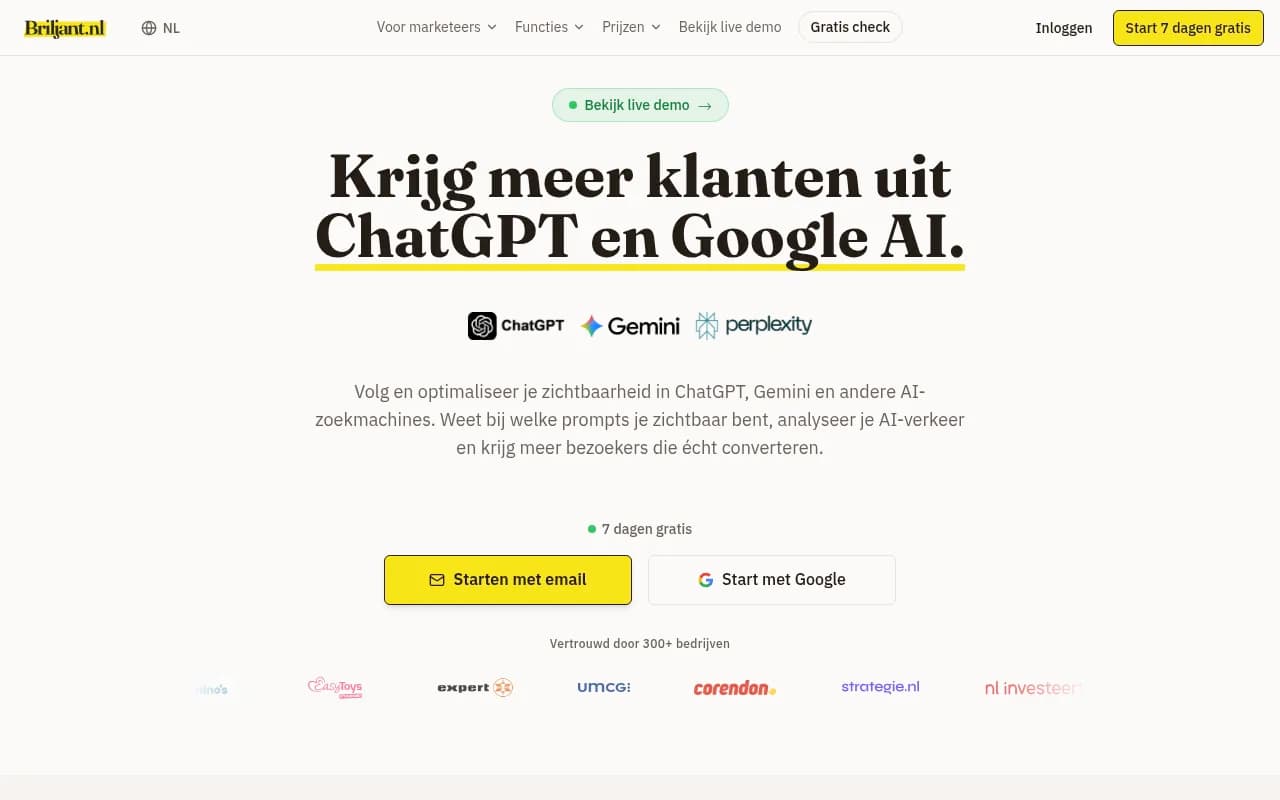
Briljant is a Netherlands-based GEO platform designed specifically for Dutch businesses and agencies. It monitors brand visibility across ChatGPT, Google AI, and Perplexity by testing 3,000 prompts per month. The platform emphasizes technical audits and content optimization to improve AI discoverability, with a focus on GDPR compliance and localized support for European markets. At €33/month (€399/year), it positions itself as an accessible entry point for companies new to generative engine optimization.
LLMrefs
LLMrefs
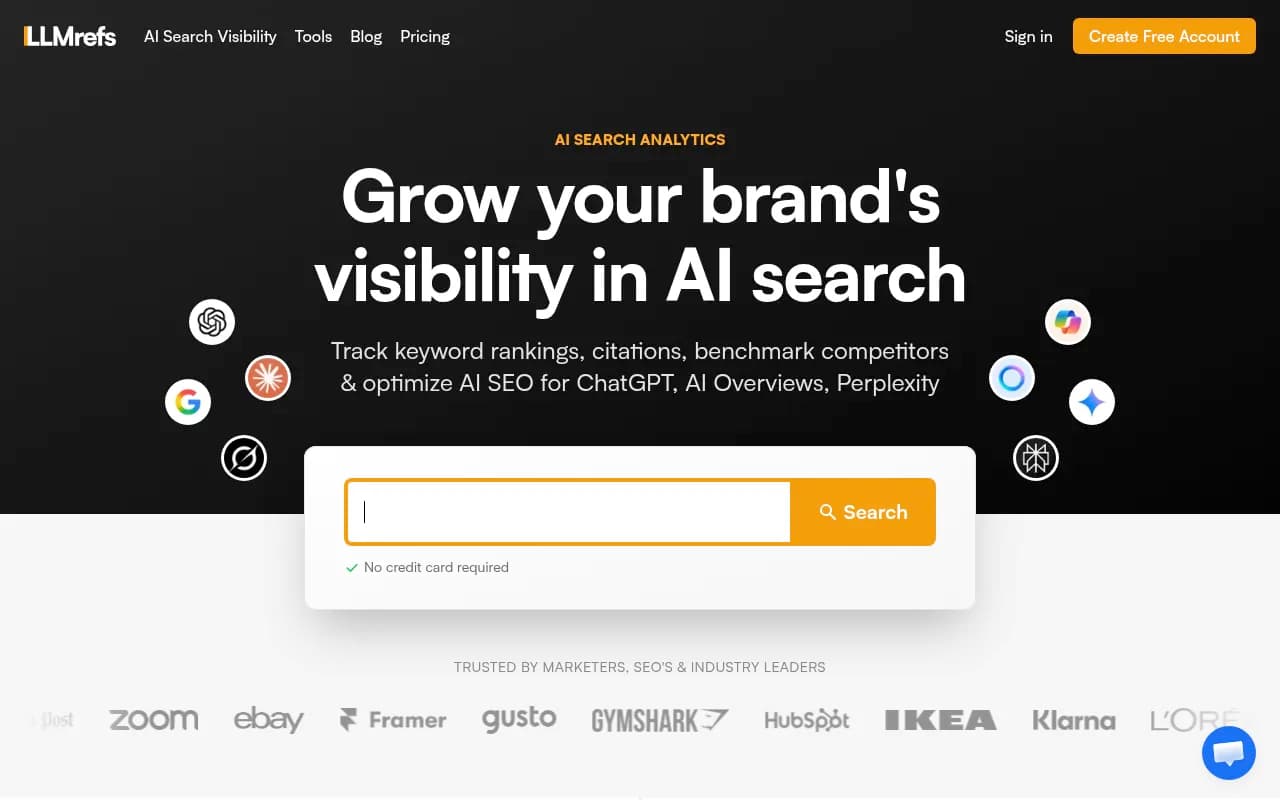
LLMrefs takes a keyword-centric approach to AI search analytics, tracking brand mentions and citations across 11 generative AI engines including ChatGPT, Google AI Overviews, Perplexity, Claude, Gemini, Grok, Meta AI, and Microsoft Copilot. Instead of fixed prompt lists, it generates prompts automatically based on keywords you want to rank for. Built for SEO teams and agencies managing multiple clients, it includes unlimited projects, domains, and team seats at $79/month. The platform covers 50+ countries and focuses on competitor benchmarking and source citation analysis.
Side-by-side comparison
| Feature | Briljant | LLMrefs |
|---|---|---|
| Monthly price | €33 (€399/year) | $79 (~€73) |
| Free trial | 7 days | 7 days |
| Prompts/month | 3,000 fixed prompts | 500 keyword-based (auto-generated) |
| AI engines tracked | 3 (ChatGPT, Google AI, Perplexity) | 11 (ChatGPT, Perplexity, Claude, Gemini, Grok, Meta AI, Copilot, AI Overviews, AI Mode, DeepSeek, Mistral) |
| Projects included | 1 site | Unlimited |
| Team seats | Single user (unclear) | Unlimited |
| Countries/regions | Netherlands-focused | 50+ countries |
| Competitor tracking | Yes | Yes |
| Citation analysis | Limited info | Yes, with source URLs |
| Keyword rankings | No (prompt-based only) | Yes |
| GDPR compliance | Emphasized | Standard |
| Support language | Dutch | English |
| Best for | Dutch SMBs, local agencies | International SEO teams, multi-client agencies |
Prompt tracking philosophy
This is where the two platforms diverge most sharply.
Briljant tests 3,000 prompts per month from a fixed library. You're monitoring how AI engines respond to a predefined set of queries. This works well if the prompts align with your business, but you can't customize which questions get asked. The 3,000-prompt volume sounds high, but you're sharing that library with whatever Briljant has decided to track -- not necessarily the specific queries your customers are asking.
LLMrefs flips the model. You input keywords ("best running shoes", "CRM for small business", etc.) and the platform generates relevant prompts automatically. You get 500 prompts per month, but they're tailored to the keywords you actually care about. This keyword-first approach mirrors traditional SEO workflows, making it easier for SEO teams to map AI visibility back to their existing keyword strategies. The trade-off: 500 prompts is significantly less volume than 3,000, so you need to be selective about which keywords to track.
For a Dutch bakery tracking local visibility, Briljant's fixed prompts might cover the basics. For an agency managing 10 SaaS clients with distinct keyword targets, LLMrefs' customization is the only way to get relevant data.
AI engine coverage
| AI Engine | Briljant | LLMrefs |
|---|---|---|
| ChatGPT | ✓ | ✓ |
| Perplexity | ✓ | ✓ |
| Google AI Overviews | ✓ | ✓ |
| Google AI Mode | ✗ | ✓ |
| Claude | ✗ | ✓ |
| Gemini | ✗ | ✓ |
| Grok | ✗ | ✓ |
| Meta AI | ✗ | ✓ |
| Microsoft Copilot | ✗ | ✓ |
| DeepSeek | ✗ | ✓ |
| Mistral | ✗ | ✓ |
Briljant covers the big three: ChatGPT, Google AI, and Perplexity. For most European businesses, that's where the majority of AI search traffic comes from right now. But LLMrefs' 11-engine coverage future-proofs your tracking as adoption spreads across Claude (popular with developers), Grok (X integration), and Meta AI (Instagram/WhatsApp integration).
If you're only worried about today's traffic, Briljant's three engines are fine. If you're planning for 2027 and beyond, LLMrefs gives you visibility into emerging channels before they become critical.
Pricing breakdown
| Plan | Briljant Pro | LLMrefs Standard |
|---|---|---|
| Monthly | €33 | $79 (~€73) |
| Annual | €399 (€33/mo) | Not listed |
| Sites/projects | 1 | Unlimited |
| Prompts | 3,000/month | 500/month |
| Team seats | Unclear | Unlimited |
| Domains tracked | 1 | Unlimited |
| Free trial | 7 days | 7 days, no card |
Briljant is cheaper upfront -- €33/month vs LLMrefs' $79 (~€73). But that €33 gets you one site. If you're an agency tracking five clients, you're looking at €165/month with Briljant vs $79 total with LLMrefs. The unlimited projects and team seats in LLMrefs make it the better deal for agencies and in-house teams managing multiple brands.
For a single business tracking one domain, Briljant's lower price is hard to beat. For everyone else, LLMrefs' scalability wins.
Geographic and language support
Briljant is explicitly built for the Dutch market. The interface is in Dutch, support is in Dutch, and the platform emphasizes GDPR compliance for European data regulations. If you're a Netherlands-based business serving Dutch customers, this localization is a feature, not a limitation. You get support from people who understand your market.
LLMrefs covers 50+ countries and operates in English. You can track AI visibility in the US, UK, Germany, Japan, Australia -- wherever your customers are searching. For international brands or agencies with global clients, this geographic flexibility is non-negotiable.
The language barrier cuts both ways. Dutch businesses might prefer Briljant's native support. International teams need LLMrefs' multi-country tracking.
Competitor benchmarking
Both platforms include competitor tracking, but the implementation differs.
Briljant's competitor comparison shows where rivals appear in AI responses for the same 3,000 prompts you're tracking. You see relative visibility but can't drill into specific competitor keywords unless they're already in the fixed prompt set.
LLMrefs lets you add competitor domains and see exactly which keywords they rank for in AI search, complete with citation sources. You can reverse-engineer their AI SEO strategy by identifying the prompts where they're getting cited and you're not. This is closer to traditional competitive keyword research, adapted for AI engines.
For high-level "are we keeping up?" monitoring, Briljant works. For "what are they doing that we're not?" strategic analysis, LLMrefs gives you more actionable data.
Technical features and optimization
Briljant emphasizes technical audits to improve AI discoverability. The platform identifies issues preventing AI engines from understanding your content, though specifics on what those audits cover aren't detailed in their marketing. The focus seems to be on making your existing content more AI-friendly.
LLMrefs focuses on citation analysis -- showing you which pages, domains, and sources AI engines reference when answering prompts. You see the exact URLs being cited, which helps you understand what type of content gets picked up. This is useful for content strategy but doesn't directly audit your site's technical setup.
Neither platform offers the content gap analysis or AI writing tools you'd find in more comprehensive platforms like Promptwatch, which combines tracking with content generation to close visibility gaps. If you're looking for a tool that not only shows you where you're invisible but helps you create the content to fix it, that's worth exploring alongside either of these monitoring-focused options.

Team collaboration
LLMrefs includes unlimited team seats at the base $79/month price. You can invite your entire marketing team, SEO specialists, and content writers without paying per user. This makes it viable for agencies where multiple people need access to client data.
Briljant's pricing page doesn't clearly specify team seat limits. The €33/month price point suggests single-user access, though this isn't explicitly confirmed. For solo marketers or small businesses where one person handles AI visibility, this isn't a problem. For teams, it's a potential blocker.
Reporting and analytics
Briljant provides AI analytics and reporting showing your visibility trends over time across the three tracked engines. The interface appears straightforward -- you see where you're mentioned, where you're not, and how that changes month to month.
LLMrefs offers keyword ranking reports, citation tracking, and competitor benchmarking dashboards. The keyword-centric view makes it easier to tie AI visibility back to business goals ("we rank #3 for 'best CRM' in ChatGPT") compared to prompt-based tracking.
Both platforms lack the deep integrations you'd find in enterprise tools. No Looker Studio connectors, no API access mentioned, no traffic attribution to connect AI visibility to actual revenue. You're getting visibility data, not a full analytics stack.
Pros and cons
Briljant pros
- Significantly cheaper for single-site tracking (€33 vs €73/mo)
- Dutch language support and localized customer service
- GDPR compliance emphasized for European markets
- 3,000 prompts tested monthly (high volume)
- Technical audit features for AI optimization
Briljant cons
- Only 3 AI engines tracked (misses Claude, Grok, Meta AI, etc.)
- Fixed prompt library -- no keyword customization
- Single-site limitation at base price
- Netherlands-focused (not ideal for global brands)
- Less detailed competitor analysis
LLMrefs pros
- 11 AI engines covered (most comprehensive)
- Keyword-based tracking with auto-generated prompts
- Unlimited projects, domains, and team seats
- 50+ country coverage for international tracking
- Detailed citation and source analysis
- No credit card required for trial
LLMrefs cons
- 60% more expensive than Briljant (€73 vs €33/mo)
- Only 500 prompts/month (vs 3,000 for Briljant)
- English-only interface and support
- No technical audit features mentioned
Who should pick which tool
Pick Briljant if:
- You're a Dutch business serving primarily Netherlands-based customers
- You need affordable single-site tracking and don't plan to scale to multiple domains
- Dutch language support and local customer service matter to you
- You're fine with ChatGPT, Google AI, and Perplexity coverage (the big three)
- You want high prompt volume (3,000/month) even if you can't customize them
- GDPR compliance is a top priority and you prefer EU-based vendors
Pick LLMrefs if:
- You're an agency or in-house team tracking multiple brands/clients
- You need visibility across 11 AI engines including Claude, Grok, and Meta AI
- You want to track specific keywords and generate custom prompts
- You operate in multiple countries or serve international markets
- You need unlimited team seats without per-user pricing
- You want detailed competitor keyword analysis and citation tracking
- You're comfortable with English-language tools and support
Final verdict
For Dutch SMBs just starting with GEO, Briljant is the simpler, cheaper entry point. For agencies and international teams, LLMrefs' scalability and broader AI engine coverage justify the higher price.
The core question: are you tracking one site in the Netherlands, or multiple brands across global markets? That determines which platform fits. Briljant optimizes for local simplicity. LLMrefs optimizes for scale and flexibility. Both do AI visibility tracking competently -- they just serve different customers.