Key Takeaways
- GeoGen is 63% cheaper at entry level: €20/mo vs $59/mo makes GeoGen the budget pick for small brands just starting with AI visibility tracking
- Both are monitoring-only dashboards: Neither platform offers content generation, crawler log analysis, or deep optimization features -- you see the data but you're on your own to fix it
- Identical AI engine coverage: ChatGPT, Perplexity, Gemini, Grok, Copilot -- both track the same engines with no meaningful difference in model support
- AIclicks has a 3-day trial, GeoGen doesn't: Test AIclicks risk-free; with GeoGen you're committing to at least one month at the Micro tier
- Neither scales well for agencies or enterprises: Prompt limits are tight (GeoGen Pro maxes at 500 prompts for €399/mo, AIclicks Business caps at 1,000 prompts for $499/mo), and neither offers white-label or multi-client management
- If you need more than monitoring, look elsewhere: Tools like Promptwatch add content gap analysis, AI content generation, and crawler logs on top of tracking -- turning visibility data into action instead of leaving you stuck with a dashboard
Overview
GeoGen: European budget option for basic AI tracking
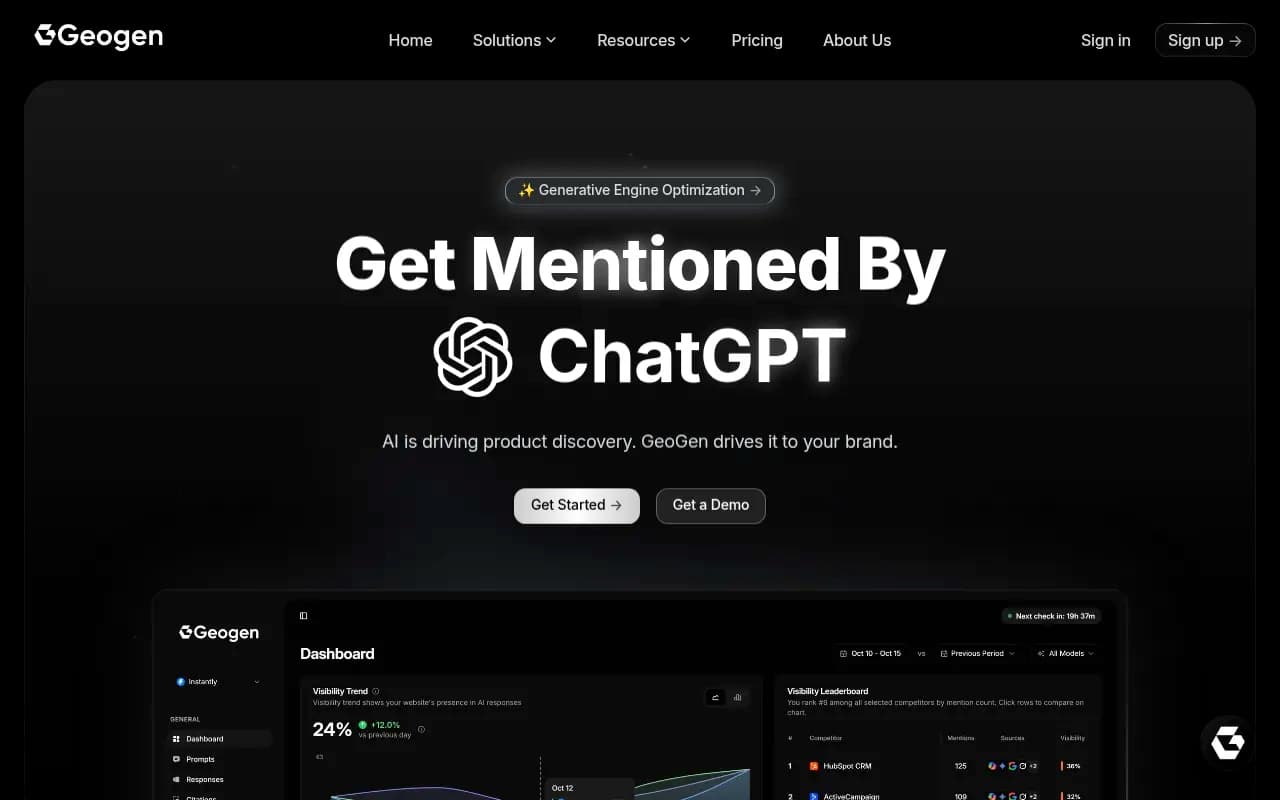
GeoGen is a Netherlands-based GEO platform that tracks brand mentions across ChatGPT, Perplexity, Gemini, Grok, and Copilot. It's built for small to mid-sized brands that want to know if they're showing up in AI search results without spending a fortune. The interface is straightforward -- you add your brand, define prompts, and see where you rank. Competitor tracking is included, and you get basic recommendations for improving visibility. The pricing starts at €20/mo for the Micro plan (1 brand, 50 prompts), scaling up to €399/mo for Pro (3 brands, 500 prompts). Annual billing saves 20%.
What GeoGen doesn't do: content generation, crawler log analysis, Reddit/YouTube tracking, or traffic attribution. It's a monitoring dashboard. You see the problem, but you're on your own to solve it.
AIclicks: Slightly more polished, slightly more expensive
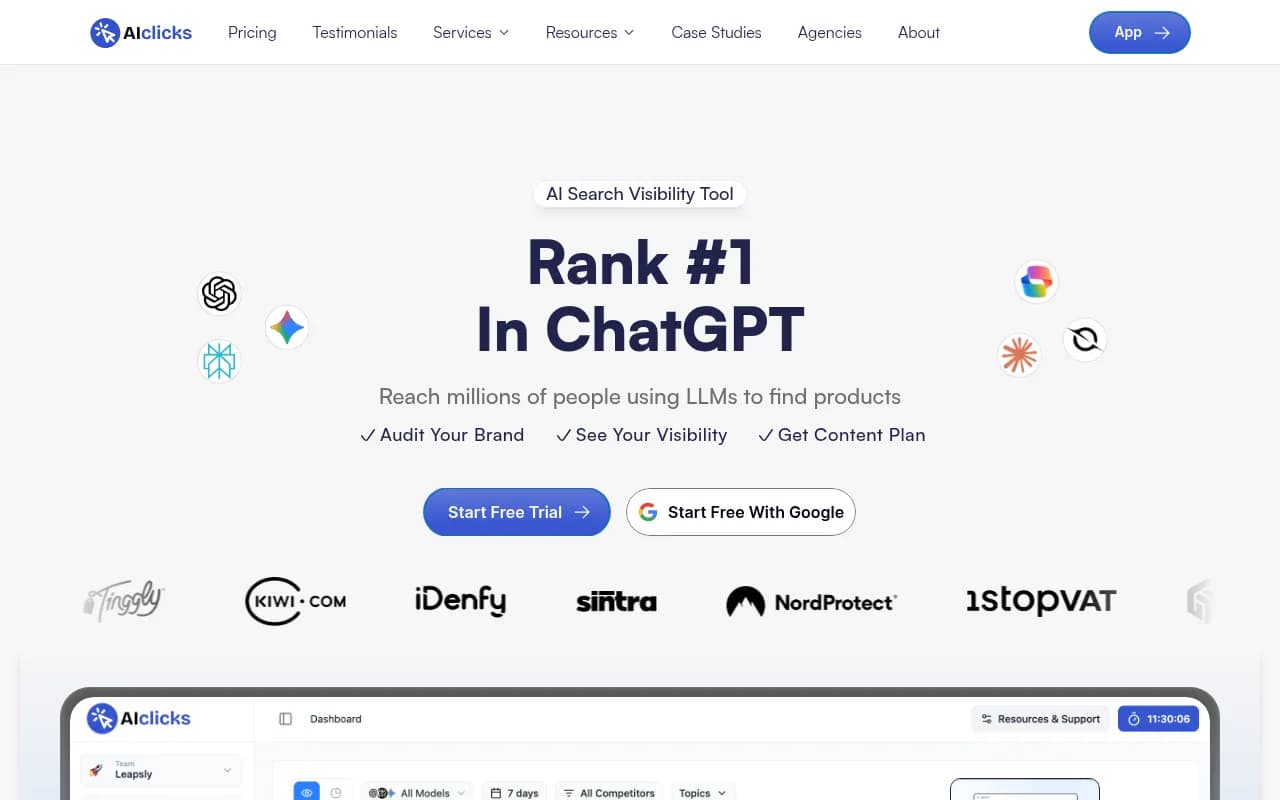
AIclicks covers the same ground as GeoGen -- tracking brand mentions in ChatGPT, Perplexity, Gemini, and other AI engines. It markets itself as used by "1,000+ brands and agencies" and emphasizes a cleaner UI with prompt discovery features that surface what people are actually asking AI tools. Pricing starts at $59/mo for Starter (1 brand, 100 prompts), moving to $189/mo for Pro (3 brands, 300 prompts) and $499/mo for Business (5 brands, 1,000 prompts). There's a 3-day free trial and annual billing saves two months.
Like GeoGen, AIclicks is monitoring-focused. You get visibility reports, competitor comparisons, and optimization suggestions, but no built-in tools to actually create the content that would improve your rankings. It's a dashboard that tells you what's wrong without helping you fix it.
Side-by-Side Comparison
| Feature | GeoGen | AIclicks |
|---|---|---|
| Starting price | €20/mo (~$22) | $59/mo |
| Free trial | No | 3 days |
| AI engines tracked | ChatGPT, Perplexity, Gemini, Grok, Copilot | ChatGPT, Perplexity, Gemini, Grok, Copilot |
| Prompt limits (entry tier) | 50 prompts | 100 prompts |
| Prompt limits (top tier) | 500 prompts (€399/mo) | 1,000 prompts ($499/mo) |
| Competitor tracking | Yes | Yes |
| Content generation | No | No |
| Crawler log analysis | No | No |
| Reddit/YouTube tracking | No | No |
| Traffic attribution | No | No |
| API access | Not advertised | Not advertised |
| White-label/multi-client | No | No |
| Annual discount | 20% | 2 months free |
| Target audience | Small EU brands, budget-conscious users | Small to mid-sized brands, US market |
Pricing: GeoGen wins on entry cost, AIclicks scales slightly better
| Plan | GeoGen | AIclicks |
|---|---|---|
| Entry tier | €20/mo (Micro: 1 brand, 50 prompts) | $59/mo (Starter: 1 brand, 100 prompts) |
| Mid tier | €99/mo (Standard: 2 brands, 200 prompts) | $189/mo (Pro: 3 brands, 300 prompts) |
| Top tier | €399/mo (Pro: 3 brands, 500 prompts) | $499/mo (Business: 5 brands, 1,000 prompts) |
| Enterprise | Custom | Not advertised |
| Free trial | No | 3 days |
| Annual discount | 20% off | 2 months free (~17% off) |
GeoGen is the clear winner for budget-conscious users. €20/mo gets you started with basic tracking, which is less than half what AIclicks charges. But if you need to scale beyond 200-300 prompts, AIclicks' Business plan at $499/mo gives you 1,000 prompts vs GeoGen's 500 prompts at €399/mo. Neither platform is cheap at scale -- you're paying $0.50-$1.00 per prompt per month, which adds up fast.
For context, Promptwatch starts at $99/mo with 50 prompts but includes content generation, crawler logs, and traffic attribution -- features neither GeoGen nor AIclicks offer at any price.

Feature deep-dive: Where they differ (and where they don't)
AI engine coverage
Both platforms track ChatGPT, Perplexity, Gemini, Grok, and Microsoft Copilot. No difference here. Neither tracks DeepSeek, Mistral, or Meta AI, which are growing fast in 2026. If you need broader coverage, you're looking at platforms like Promptwatch (10 models) or enterprise-grade tools.
Verdict: Tie. Coverage is identical and adequate for most brands.
Prompt tracking and discovery
GeoGen lets you manually add prompts to track. You define what questions matter to your brand, and it monitors how often you're mentioned in responses. Basic but functional.
AIclicks adds a prompt discovery layer -- it surfaces popular prompts related to your industry that you might not have thought to track. This is genuinely useful if you're new to GEO and don't know what people are asking AI tools. But once you've built your prompt list, the difference disappears.
Verdict: AIclicks has a slight edge for beginners who need help finding relevant prompts. GeoGen is fine if you already know what to track.
Competitor analysis
Both platforms let you add competitor brands and see how often they're mentioned vs you. You get basic share-of-voice metrics and can spot when a competitor is dominating a specific prompt.
What's missing from both: detailed citation analysis (which pages are being cited?), prompt gap analysis (which prompts are competitors winning that you're not even tracking?), or heatmaps showing competitive positioning across multiple dimensions. These are table-stakes features in more advanced platforms.
Verdict: Tie. Both offer basic competitor tracking that's better than nothing but not deep enough for serious competitive intelligence.
Optimization recommendations
GeoGen provides generic suggestions like "add more content about X" or "improve your page on Y topic." It's not wrong, but it's not actionable either. You still have to figure out what content to create and how to structure it.
AIclicks gives similar recommendations with slightly more specificity around which prompts to target. Still vague. Neither platform shows you the content gaps on your site or generates the actual content you need.
This is where monitoring-only tools hit a wall. Knowing you're invisible for a prompt is step one. Knowing what content to create is step two. Actually creating that content is step three. GeoGen and AIclicks stop at step one.
Verdict: Tie. Both tell you what's wrong without helping you fix it.
Content generation and optimization
Neither platform offers this. You're on your own to create content, optimize existing pages, or figure out what AI engines want to see. If you need content gap analysis or AI-powered content generation grounded in citation data, you need a platform that goes beyond monitoring -- something like Promptwatch, which includes an AI writing agent trained on 880M+ citations.
Verdict: Both lose. This is a critical gap for any brand serious about improving AI visibility, not just tracking it.
Crawler logs and indexing insights
Neither GeoGen nor AIclicks provides real-time logs of AI crawlers hitting your website. You don't know if ChatGPT or Claude are even reading your pages, how often they return, or what errors they encounter. This is a blind spot that makes optimization guesswork.
Platforms like Promptwatch include crawler log analysis as a core feature, showing exactly which pages AI engines are indexing and where they're getting stuck.
Verdict: Both lose. No crawler visibility means you're flying blind on whether your content is even being discovered.
Traffic attribution and ROI tracking
Neither platform connects AI visibility to actual traffic or revenue. You can see that you're mentioned in ChatGPT responses, but you have no idea if anyone clicked through or converted. This makes it hard to justify the investment or prioritize which prompts matter most.
Verdict: Both lose. If you need to prove ROI, you'll need to layer in Google Analytics or use a platform with built-in attribution.
User interface and experience
AIclicks has a slightly more polished interface with better data visualization. The dashboard feels modern, and the prompt discovery flow is intuitive. GeoGen's UI is functional but less refined -- it gets the job done without being pretty.
For a monitoring tool you'll check weekly, this matters less than you'd think. Both are easy enough to navigate once you've set up your prompts.
Verdict: AIclicks wins on polish, but it's not a dealbreaker either way.
Pros and cons
GeoGen pros
- Cheapest entry point in the GEO space at €20/mo
- European company (good for GDPR-conscious brands)
- Annual discount is straightforward (20% off)
- Covers all major AI engines
GeoGen cons
- No free trial -- you're committing to at least one month
- Prompt limits are tight even at the Pro tier (500 prompts max)
- No content generation or optimization tools
- No crawler logs or traffic attribution
- Generic optimization recommendations that don't help much
- Doesn't scale well for agencies (no multi-client management)
AIclicks pros
- 3-day free trial lets you test before committing
- Prompt discovery helps beginners find relevant queries
- Slightly better UI and data visualization
- Higher prompt limits at the top tier (1,000 vs 500)
- Covers all major AI engines
AIclicks cons
- 2.7x more expensive than GeoGen at entry level ($59 vs €20)
- Still monitoring-only -- no content generation or deep optimization
- No crawler logs or traffic attribution
- Prompt limits are still tight for agencies or large brands
- No white-label or multi-client features
- Optimization suggestions are vague
Who should pick which tool?
Choose GeoGen if:
- You're a small brand or solopreneur testing AI visibility tracking for the first time
- Budget is tight and you need the cheapest option that covers the basics
- You're based in Europe and prefer an EU-based vendor
- You only need to track 50-200 prompts
- You're comfortable figuring out content optimization on your own
Choose AIclicks if:
- You want a free trial before committing
- You need help discovering which prompts to track (good for beginners)
- You prefer a more polished interface
- You need to scale to 500-1,000 prompts
- You're willing to pay 2-3x more for slightly better UX
Choose neither if:
- You need content generation or optimization tools, not just monitoring
- You want crawler log analysis to see if AI engines are indexing your site
- You need traffic attribution to connect visibility to revenue
- You're an agency managing multiple clients (neither offers white-label or multi-client features)
- You need to track more than 1,000 prompts or require API access
- You want a platform that helps you fix problems, not just report them
If any of those apply, look at platforms like Promptwatch that combine monitoring with content gap analysis, AI content generation, crawler logs, and traffic attribution. The price difference is smaller than you'd think once you factor in the time saved and the actual results you get.
Final verdict
GeoGen and AIclicks are nearly identical monitoring-only GEO platforms. GeoGen wins on price (€20/mo vs $59/mo at entry), making it the better pick for budget-conscious small brands. AIclicks wins on UX polish and offers a free trial, which matters if you're not sure you need AI visibility tracking yet.
But here's the real issue: both platforms show you the problem without helping you solve it. You'll see that you're invisible for key prompts, that competitors are dominating certain queries, and that your brand mention share is low. Then what? You're stuck manually creating content, guessing at what AI engines want, and hoping it works.
For brands serious about AI visibility in 2026, monitoring alone isn't enough. You need platforms that close the loop from tracking to action -- showing you content gaps, generating optimized articles, tracking crawler behavior, and connecting visibility to revenue. That's the difference between a dashboard that makes you feel informed and a platform that actually moves the needle.
If you're just dipping your toes in GEO and want the cheapest option, go with GeoGen. If you want a prettier dashboard and a free trial, pick AIclicks. But if you want to actually improve your AI search rankings instead of just watching them, you need a different kind of tool entirely.