Key takeaways
- LLMrefs is 4-5x cheaper for most use cases: $79/mo gets you unlimited prompts, projects, and team seats. GeoGen charges €99-€399/mo for 1000-5000 prompts and limits team access to higher tiers.
- LLMrefs tracks 11 AI engines vs GeoGen's 5: LLMrefs covers ChatGPT, Perplexity, Claude, Gemini, Google AI Overviews, Grok, Copilot, Meta AI, and more. GeoGen only monitors ChatGPT, Perplexity, Gemini, Grok, and Copilot.
- Keyword-first vs prompt-first workflows: LLMrefs auto-generates prompts from keywords and tracks rankings like traditional SEO. GeoGen requires you to manually create each prompt and charges per prompt.
- Team collaboration is free on LLMrefs, paid on GeoGen: LLMrefs includes unlimited seats. GeoGen's Micro plan is single-user, and team seats cost extra starting at the €199/mo tier.
- Both lack content optimization features: Neither tool helps you fix visibility gaps or generate content. They're monitoring dashboards, not optimization platforms. If you need content gap analysis and AI writing tools, Promptwatch adds that layer on top of tracking.
- LLMrefs is better for agencies and teams: Unlimited projects, domains, and seats make multi-client management straightforward. GeoGen's per-prompt pricing and project limits get expensive fast.
Overview
GeoGen
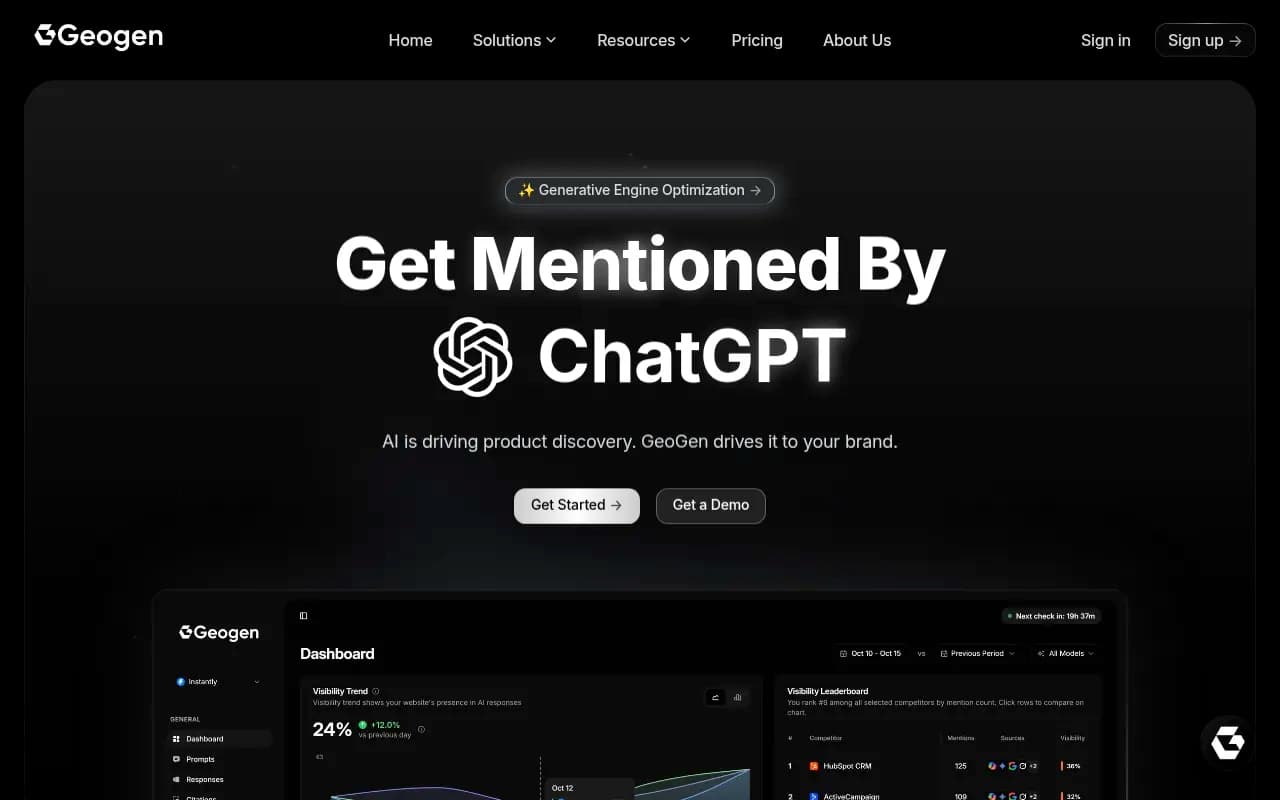
GeoGen is a European GEO platform (based in the Netherlands) that tracks brand mentions across ChatGPT, Perplexity, Gemini, Grok, and Microsoft Copilot. It uses a prompt-based model where you manually create prompts and GeoGen runs them across the five supported AI engines. Pricing starts at €20/mo for 100 prompts and scales up to €399/mo for 5000 prompts. Team seats and advanced features are locked behind higher tiers. The interface is clean and the platform is straightforward, but the per-prompt pricing model can get expensive if you're tracking a lot of keywords or running frequent checks.
LLMrefs
LLMrefs
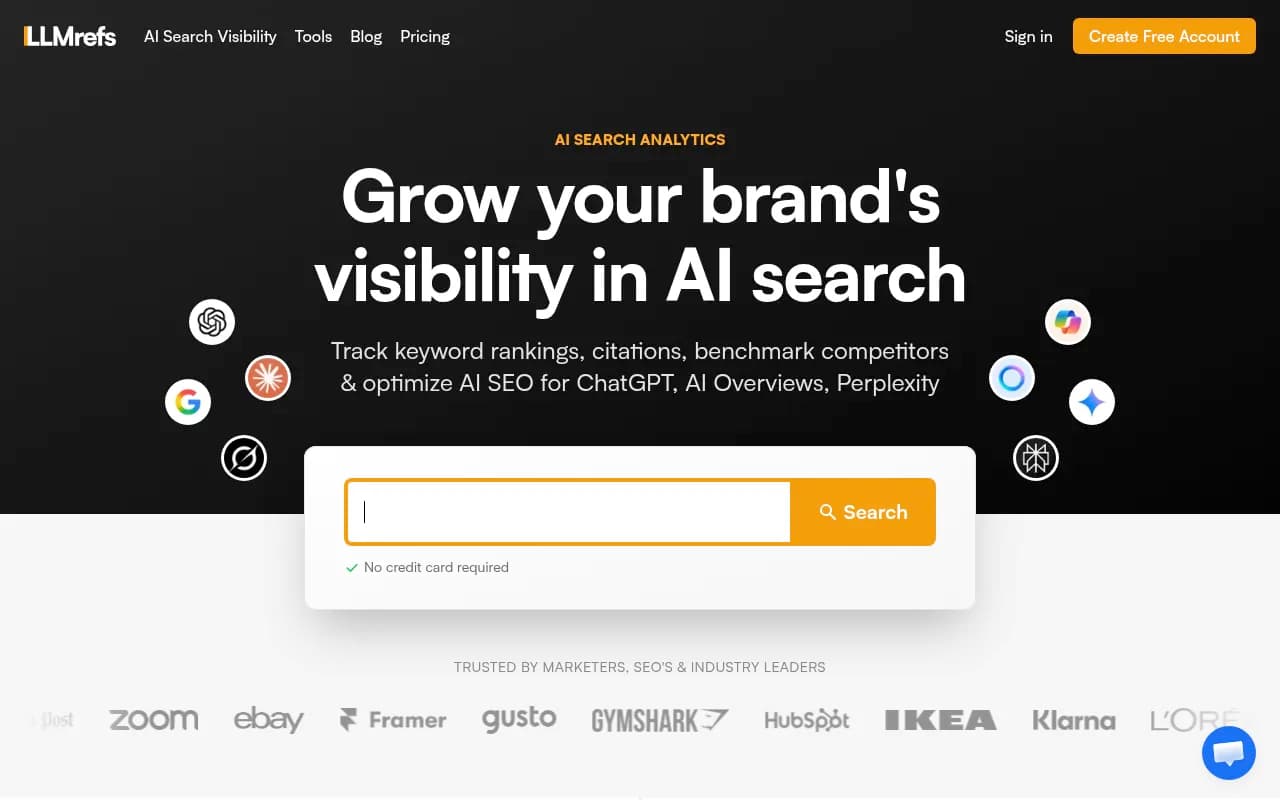
LLMrefs takes a keyword-first approach to AI search tracking. Instead of manually creating prompts, you enter keywords (like you would in Ahrefs or Semrush) and LLMrefs auto-generates relevant prompts, then tracks your rankings and citations across 11 AI engines. The pricing is simple: $79/mo for unlimited prompts, unlimited projects, unlimited domains, and unlimited team seats. It's built for SEO teams and agencies who want to track AI visibility the same way they track Google rankings -- by keyword, not by individual prompt. The platform includes competitor benchmarking, source citation analysis, and tracking across 50+ countries.
Side-by-side comparison
| Feature | GeoGen | LLMrefs |
|---|---|---|
| Pricing | €20-€399/mo (100-5000 prompts) | $79/mo (unlimited prompts) |
| AI engines tracked | 5 (ChatGPT, Perplexity, Gemini, Grok, Copilot) | 11 (ChatGPT, Perplexity, Claude, Gemini, AI Overviews, Grok, Copilot, Meta AI, more) |
| Prompt limits | 100-5000/mo depending on tier | Unlimited |
| Team seats | Single-user on Micro, paid add-on on higher tiers | Unlimited on all plans |
| Projects/domains | 1-10 depending on tier | Unlimited |
| Keyword tracking | Manual prompt creation | Keyword-first with auto-generated prompts |
| Competitor benchmarking | Yes (uses prompt quota) | Yes (unlimited) |
| Citation analysis | Basic mention tracking | Full source citation breakdown |
| Multi-country support | Limited | 50+ countries |
| Free trial | Not mentioned | 7 days, no credit card |
| Annual discount | 20% off | Not mentioned |
| API access | Not mentioned | Not mentioned |
Pricing breakdown
Pricing is where these two tools diverge sharply. GeoGen charges per prompt. LLMrefs charges a flat rate for unlimited everything.
| Plan | GeoGen | LLMrefs |
|---|---|---|
| Entry tier | €20/mo (100 prompts, 1 project, single user) | $79/mo (unlimited prompts, projects, domains, seats) |
| Mid tier | €99/mo (1000 prompts, 3 projects, single user) | Same $79/mo plan |
| High tier | €199/mo (2500 prompts, 5 projects, team seats) | Same $79/mo plan |
| Top tier | €399/mo (5000 prompts, 10 projects, team seats) | Same $79/mo plan |
| Enterprise | Custom pricing | Not offered |
| Annual discount | 20% off | Not mentioned |
If you're tracking 500 keywords with 2-3 prompt variations each (1000-1500 prompts), GeoGen costs €99-€199/mo. LLMrefs costs $79/mo regardless of how many prompts you run. For agencies managing multiple clients, LLMrefs is a no-brainer -- unlimited projects and seats vs GeoGen's tiered limits.
AI engine coverage
LLMrefs monitors nearly twice as many AI engines as GeoGen.
GeoGen tracks 5 engines:
- OpenAI ChatGPT
- Perplexity AI
- Google Gemini
- xAI Grok
- Microsoft Copilot
LLMrefs tracks 11 engines:
- OpenAI ChatGPT
- Perplexity AI
- Google Gemini
- Google AI Overviews
- Google AI Mode
- Anthropic Claude
- xAI Grok
- Microsoft Copilot
- Meta AI
- Plus a few others
The big gaps in GeoGen's coverage: no Claude, no Google AI Overviews (the AI snippets in Google search results), no Meta AI. If you care about visibility in Claude or AI Overviews, GeoGen won't help. LLMrefs covers the full landscape.
Workflow and usability
The core difference here is keyword-first vs prompt-first.
GeoGen's approach: You manually create each prompt. Want to track "best running shoes"? You write the prompt: "What are the best running shoes?" Then GeoGen runs it across the 5 engines and shows you which brands get mentioned. Want variations? You create more prompts: "Best running shoes for beginners", "Top running shoes 2026", etc. Each one counts against your monthly quota.
This works fine if you're tracking a small set of high-value prompts. It becomes tedious and expensive if you're tracking hundreds of keywords.
LLMrefs' approach: You enter a keyword: "running shoes". LLMrefs auto-generates relevant prompts ("best running shoes", "top running shoes for marathons", "running shoes vs trail shoes", etc.) and tracks your rankings across all of them. You're thinking in keywords, not individual prompts. It's closer to how SEO teams already work.
For teams used to Ahrefs or Semrush, LLMrefs feels familiar. GeoGen requires a mental shift to prompt-based thinking.
Team collaboration
LLMrefs includes unlimited team seats at every pricing tier, including the $79/mo plan. Invite your entire marketing team, your agency clients, your contractors -- no extra cost.
GeoGen's Micro plan (€20/mo) is single-user only. The Standard plan (€99/mo) is also single-user. Team seats start at the Growth plan (€199/mo). If you're an agency managing 5 clients, you're paying €199/mo minimum just to share access.
This is a huge practical difference. Most teams need more than one person looking at the data.
Competitor benchmarking
Both tools let you track competitors, but the implementation differs.
GeoGen: You add competitor domains and GeoGen shows you when they get mentioned in AI responses. The catch: competitor tracking uses your prompt quota. If you're on the 1000-prompt plan and you're tracking 3 competitors, you're effectively splitting those 1000 prompts across your brand + 3 competitors. Heavy competitor analysis eats into your tracking budget.
LLMrefs: Competitor benchmarking is unlimited. Add as many competitors as you want, track them across all your keywords, and it doesn't affect your prompt quota (because there is no prompt quota). You get citation share percentages, ranking comparisons, and source overlap analysis.
For competitive intelligence, LLMrefs is the better tool.
Citation and source analysis
Both platforms show you which sources AI engines cite when they mention brands.
GeoGen: Basic mention tracking. You see that your brand was mentioned and which sources were cited in the response. The data is there but not deeply analyzed.
LLMrefs: Full citation breakdown. You see exactly which URLs were cited, how often, and which competitors share those same citations. You can identify high-value sources to target for backlinks or content partnerships. The citation analysis is more granular.
If you're trying to reverse-engineer why competitors rank better in AI search, LLMrefs gives you more to work with.
Multi-country and multi-language support
LLMrefs supports tracking across 50+ countries. You can see how your brand appears in AI search results in the US, UK, Germany, France, Japan, etc. Useful for global brands or agencies with international clients.
GeoGen's multi-country support is limited. The website doesn't specify how many countries are supported, which suggests it's not a core feature.
What's missing from both tools
Neither GeoGen nor LLMrefs helps you fix visibility problems. They show you where you're invisible, but they don't tell you what content to create or how to optimize existing pages.
This is where monitoring-only tools hit a wall. You see the gaps, but you're stuck figuring out what to do about them. If you want content gap analysis, AI writing tools, and optimization recommendations, you'd need to layer in something like Promptwatch, which connects tracking to content creation.

Both tools also lack:
- AI crawler logs (seeing which pages AI engines actually read on your site)
- Traffic attribution (connecting AI visibility to actual website visits)
- Reddit/YouTube tracking (sources that heavily influence AI recommendations)
- ChatGPT Shopping monitoring (product recommendation carousels)
They're solid for basic visibility tracking, but they're not full-stack GEO platforms.
Pros and cons
GeoGen pros
- Clean, straightforward interface
- European company (good for GDPR-conscious brands)
- 20% annual discount available
- Prompt-based model works well for small, focused tracking
GeoGen cons
- Per-prompt pricing gets expensive fast
- Only 5 AI engines (missing Claude, AI Overviews, Meta AI)
- Team seats locked behind €199/mo tier
- Limited multi-country support
- Competitor tracking eats into prompt quota
- No content optimization features
LLMrefs pros
- Flat $79/mo for unlimited prompts, projects, domains, seats
- Tracks 11 AI engines (most comprehensive coverage)
- Keyword-first workflow familiar to SEO teams
- Unlimited competitor benchmarking
- 50+ country support
- 7-day free trial, no credit card required
- Better citation analysis
LLMrefs cons
- No annual discount mentioned
- No enterprise tier for large orgs needing custom features
- Still a monitoring tool, not an optimization platform
- Less established brand (GeoGen has more visible client logos)
Who should pick which tool
Pick GeoGen if:
- You're tracking a small set of high-value prompts (under 500/mo)
- You only care about ChatGPT, Perplexity, Gemini, Grok, and Copilot
- You prefer a European vendor for data privacy reasons
- You're a solo marketer and don't need team seats
- You like the prompt-based mental model
Pick LLMrefs if:
- You're tracking hundreds or thousands of keywords
- You need comprehensive AI engine coverage (Claude, AI Overviews, Meta AI)
- You're an agency managing multiple clients
- You need team collaboration without paying extra
- You want unlimited competitor benchmarking
- You're used to keyword-based SEO tools and want the same workflow for AI search
- You need multi-country tracking
- You want better citation analysis
Final verdict
LLMrefs is the better value for most teams. $79/mo for unlimited prompts, projects, and seats beats GeoGen's €99-€399/mo tiered pricing. The keyword-first workflow is more intuitive for SEO teams, and tracking 11 AI engines vs 5 gives you a fuller picture of your AI visibility.
GeoGen works if you're tracking a small number of prompts and prefer the European vendor angle, but the per-prompt pricing model doesn't scale well. Once you're tracking 1000+ prompts or managing multiple clients, LLMrefs is 4-5x cheaper and more flexible.
Both tools are monitoring dashboards, not optimization platforms. They tell you where you're invisible but don't help you fix it. For a complete GEO workflow -- tracking, content gap analysis, and AI content generation -- you'd need to combine either tool with something that handles the optimization side.