Key takeaways
- AthenaHQ has public, self-serve pricing ($295/month) -- Goodie AI requires a custom quote, which almost always means higher cost and a longer sales cycle
- Goodie AI tracks 11 AI models including Amazon Rufus; AthenaHQ covers 8+ LLMs but skips Rufus, which matters a lot for e-commerce brands
- Both platforms are primarily monitoring-focused -- neither offers the kind of AI content generation or crawler log analysis that more complete platforms provide
- AthenaHQ has a free 10-minute audit you can run right now; Goodie AI requires a demo booking before you see anything
- AthenaHQ is backed by Y Combinator and has been featured in Forbes and the Wall Street Journal, giving it more third-party validation than Goodie AI at this stage
- For teams that need to go beyond tracking and actually fix their AI visibility gaps, both tools leave you doing the heavy lifting yourself
Overview
Goodie AI
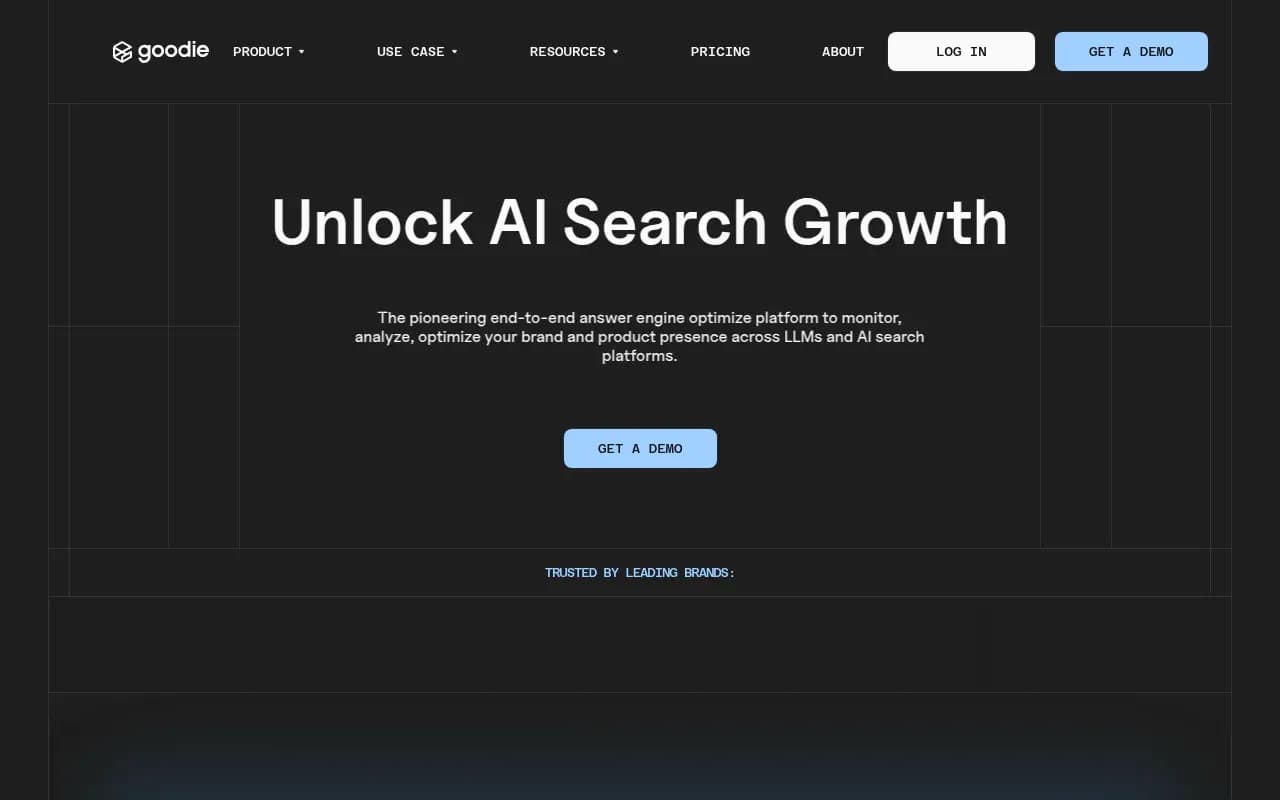
Goodie AI (higoodie.com) positions itself as an "end-to-end answer engine optimization platform" covering the full loop: research, monitor, action, measure. In practice, its strongest suit is monitoring -- tracking brand mentions, citations, sentiment, and competitive share across 11 AI models. The Amazon Rufus integration is genuinely rare and valuable for retail and e-commerce brands. The enterprise-only, quote-based model means you won't find out what it costs without talking to sales first.
AthenaHQ

AthenaHQ (athenahq.ai) is a Y Combinator-backed GEO platform used by Coinbase, SoFi, Wix, and PagerDuty, among others. It covers 8+ LLMs and frames itself as a command center for AEO/GEO managers, CMOs, SEO teams, and PR teams. The self-serve pricing at $295/month (with a $95 introductory first month) makes it far more accessible than Goodie AI. It runs on a credit-based model where one credit equals one AI query. Content optimization recommendations are part of the pitch, though the depth of those recommendations is more advisory than generative.
Side-by-side comparison
| Feature | Goodie AI | AthenaHQ |
|---|---|---|
| Pricing model | Custom/quote only | Self-serve $295/mo; Enterprise custom |
| Free trial / audit | No | Free 10-min audit |
| AI models tracked | 11 (incl. Amazon Rufus) | 8+ LLMs |
| Amazon Rufus tracking | Yes | No |
| ChatGPT tracking | Yes | Yes |
| Google AI Overviews | Yes | Yes |
| Perplexity | Yes | Yes |
| Claude | Yes | Yes |
| Gemini | Yes | Yes |
| Competitor monitoring | Yes | Yes |
| Citation tracking | Yes | Yes |
| Sentiment analysis | Yes | Yes |
| Content optimization | Claimed (limited detail) | Yes (recommendations) |
| AI content generation | No | No |
| AI crawler logs | Not documented | Not documented |
| Reddit/YouTube tracking | Not documented | Not documented |
| Prompt volume/difficulty | Not documented | Not documented |
| Traffic attribution | Claimed | Claimed |
| API access | Not documented | Not documented |
| Target audience | Enterprise brands, agencies | Marketing teams, enterprise |
| Self-serve signup | No | Yes |
| Notable clients | Dermalogica, Skylum, Vectara | Coinbase, SoFi, Wix, PagerDuty |
Head-to-head feature deep-dive
Pricing and accessibility
This is where the two platforms diverge most sharply. AthenaHQ publishes its pricing. You can sign up, pay $95 for your first month, and start tracking within the hour. Goodie AI gives you nothing until you book a demo -- no pricing page, no trial, no self-serve option. That's a deliberate enterprise sales motion, and it's not inherently bad, but it means smaller teams or anyone who wants to evaluate before committing will hit a wall immediately.
AthenaHQ's credit-based model (1 credit = 1 AI query) is worth understanding before you sign up. Depending on how many prompts you track and how frequently you refresh them, costs can scale up faster than a flat monthly fee would suggest. Still, the transparency is a meaningful advantage.
Verdict: AthenaHQ wins on accessibility. Goodie AI may be competitive on price at enterprise scale, but you can't know without going through sales.
AI model coverage
| AI Model | Goodie AI | AthenaHQ |
|---|---|---|
| ChatGPT | Yes | Yes |
| Google AI Overviews | Yes | Yes |
| Google AI Mode | Yes | Yes |
| Perplexity | Yes | Yes |
| Claude | Yes | Yes |
| Gemini | Yes | Yes |
| Grok | Yes | Yes |
| Meta AI | Yes | Yes |
| Microsoft Copilot | Yes | Yes |
| DeepSeek | Yes | Yes |
| Amazon Rufus | Yes | No |
Goodie AI's 11-model coverage is a real differentiator, specifically the Amazon Rufus integration. Rufus is Amazon's AI shopping assistant, and if your brand sells on Amazon or competes in e-commerce, knowing whether Rufus recommends you (or your competitors) is genuinely valuable data that AthenaHQ simply doesn't provide.
Verdict: Goodie AI wins on model breadth, especially for retail and e-commerce use cases.
Monitoring and competitive intelligence
Both platforms track brand mentions, citations, and competitive share across AI responses. Both offer sentiment analysis. Both let you monitor how competitors appear in AI-generated answers. This is the core of what both tools do, and neither has a dramatic edge here based on publicly available information.
AthenaHQ's dashboard is described as a "unified command center" with board-ready reporting and executive-level visibility dashboards. That framing suggests a cleaner UI and better reporting structure, which matters when you're presenting to stakeholders who don't live in the tool daily.
Goodie AI's monitoring appears more granular at the model level, with dedicated pages for each AI model it tracks. Whether that translates to better data or just better marketing is hard to assess without a live demo.
Verdict: Roughly even, with AthenaHQ having a slight edge on reporting presentation and Goodie AI having more model-level granularity.
Content optimization and action-taking
This is where both tools show their limits. AthenaHQ includes "automated content optimization recommendations" -- meaning it tells you what to fix, not how to fix it or generates the fix for you. Goodie AI claims an "action" phase in its closed-loop model, but the specifics of what that action looks like in practice aren't clearly documented.
Neither platform generates content. Neither has a built-in AI writing agent. Neither shows you AI crawler logs to help you understand how AI engines are actually reading your site. If you want to go from "I know I'm invisible for this prompt" to "I've published content that gets me cited," both tools leave that work entirely to you.
Worth noting: if the content generation and gap-closing workflow is what you're after, Promptwatch is built specifically around that loop -- find gaps, generate content grounded in citation data, track results.

Verdict: AthenaHQ is slightly more explicit about its optimization recommendations. Neither tool is a true optimization platform in the full sense.
Ease of getting started
AthenaHQ: sign up, pay, start tracking. There's also a free 10-minute audit that gives you a taste of your current AI visibility without any commitment. That's a low-friction way to see whether the platform surfaces anything useful before you spend money.
Goodie AI: book a demo, wait for a sales call, get a custom quote, negotiate terms. This process can take days or weeks. For enterprise procurement teams, that's normal. For a growth marketer who wants to start tracking AI visibility this week, it's a dealbreaker.
Verdict: AthenaHQ wins by a wide margin on getting started quickly.
Target audience fit
AthenaHQ explicitly maps its features to different roles: AEO/GEO managers, CMOs, SEO teams, PR teams, and content marketers. That role-based framing suggests the product has been designed with different user types in mind, which usually means better UX for non-specialist users.
Goodie AI targets enterprise brands and agencies. The demo-only model reinforces this -- it's built for organizations with procurement processes and dedicated digital marketing teams, not solo practitioners or small agencies.
Verdict: AthenaHQ is more accessible to a broader range of team types. Goodie AI is purpose-built for enterprise.
Pricing comparison
| Plan | Goodie AI | AthenaHQ |
|---|---|---|
| Free tier | No | Free 10-min audit |
| Entry-level | Custom quote | $295/month ($95 first month) |
| Annual discount | Unknown | ~17% off |
| Enterprise | Custom | Custom |
| Pricing transparency | None | Full public pricing |
Pros and cons
Goodie AI
Pros:
- Tracks 11 AI models, including Amazon Rufus -- unique in the market
- Enterprise-grade monitoring with sentiment and competitive share tracking
- Claims a full research-monitor-action-measure loop
- Dedicated model pages suggest deep per-model analysis
Cons:
- No public pricing -- requires a sales demo to learn anything
- No self-serve trial or free audit
- Content optimization capabilities are vague in public documentation
- No documented API, crawler logs, or prompt volume data
- Smaller public client list and less third-party press coverage than AthenaHQ
AthenaHQ
Pros:
- Transparent self-serve pricing at $295/month
- Free 10-minute audit with no commitment
- Y Combinator-backed with Forbes and WSJ coverage
- Strong client roster (Coinbase, SoFi, Wix, PagerDuty)
- Role-based feature framing makes it accessible to non-specialists
- Annual billing discount of ~17%
Cons:
- Credit-based model can get expensive at scale
- No Amazon Rufus tracking
- Content optimization is recommendations-only, not generative
- No documented AI crawler logs or Reddit/YouTube tracking
- Monitoring-focused -- doesn't close the full optimization loop independently
Who should pick which tool
Pick Goodie AI if:
- You're an enterprise brand or agency with a formal procurement process
- You sell on Amazon and need Rufus tracking as part of your AI visibility picture
- You want dedicated per-model analysis across 11 AI engines
- You have the budget and timeline for a custom enterprise contract
Pick AthenaHQ if:
- You want to start tracking AI visibility this week without a sales call
- You're a marketing team, SEO team, or agency that needs a self-serve option
- You want board-ready reporting and executive dashboards out of the box
- You're evaluating multiple tools and want to run a free audit first
- Your AI model coverage needs don't include Amazon Rufus
Consider neither if:
- You need content generation, AI crawler logs, or prompt volume data -- both tools leave those gaps open. Platforms built around the full optimization loop (not just monitoring) will serve you better in that case.
Final verdict
AthenaHQ is the more practical choice for most teams in 2026. The self-serve pricing, free audit, and transparent costs remove the friction that Goodie AI's demo-only model creates. Goodie AI has a genuine edge in model coverage -- Amazon Rufus tracking alone could justify it for e-commerce brands -- but you won't know what it costs until you've sat through a sales call.
Both tools are fundamentally monitoring platforms. If you're looking for something that not only shows you where you're invisible in AI search but also helps you do something about it, you'll need to look beyond either of these two.