Key takeaways
- Botify is a full enterprise SEO platform that added GEO/AEO features; Goodie AI was built from the ground up for AI search visibility. That origin story matters a lot for how each tool actually works.
- Botify costs $10,000-$50,000+/month on annual contracts. Goodie AI is also custom-priced but almost certainly cheaper -- though neither publishes numbers, so you're flying blind until you talk to sales.
- Goodie AI tracks 11 AI models including Amazon Rufus, which is a notable differentiator for e-commerce brands. Botify's AI monitoring coverage is less specific about which models it tracks.
- Botify's technical SEO depth (crawl analysis, log file analysis, JavaScript rendering) is unmatched -- if you have a large, complex site with crawlability problems, Botify does things Goodie AI simply doesn't.
- Both tools require a demo/sales call to even see pricing. Neither has a free tier or self-serve trial. That's a real friction point if you want to evaluate quickly.
- For teams that want AI visibility monitoring without a six-figure annual commitment, neither of these is the right starting point.
Overview
Goodie AI
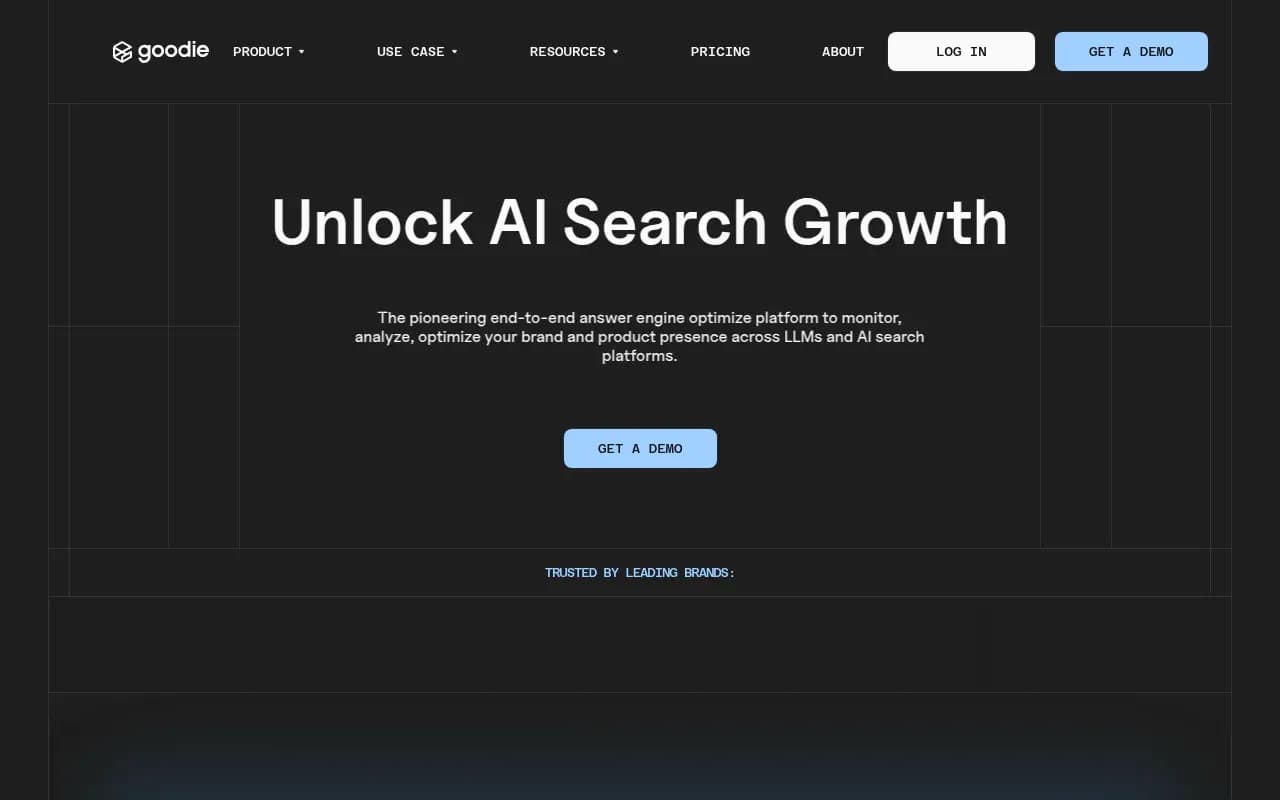
Goodie AI (higoodie.com) is a purpose-built AEO and AI search visibility platform. It tracks brand mentions, citations, sentiment, and competitive share across 11 AI models -- ChatGPT, Gemini, Perplexity, Claude, Grok, Meta AI, Google AI Overviews, Google AI Mode, Microsoft Copilot, DeepSeek, and Amazon Rufus. The platform frames itself around a four-stage loop: Research, Monitor, Action, Measure. Clients include Dermalogica, Skylum, and Vectara.
It's a relatively young platform that has moved fast to cover the AI search space. The focus is narrow in a good way -- everything is oriented around AI answer engine visibility, not traditional SEO. The trade-off is that you won't find deep technical SEO crawling or log file analysis here.
Botify
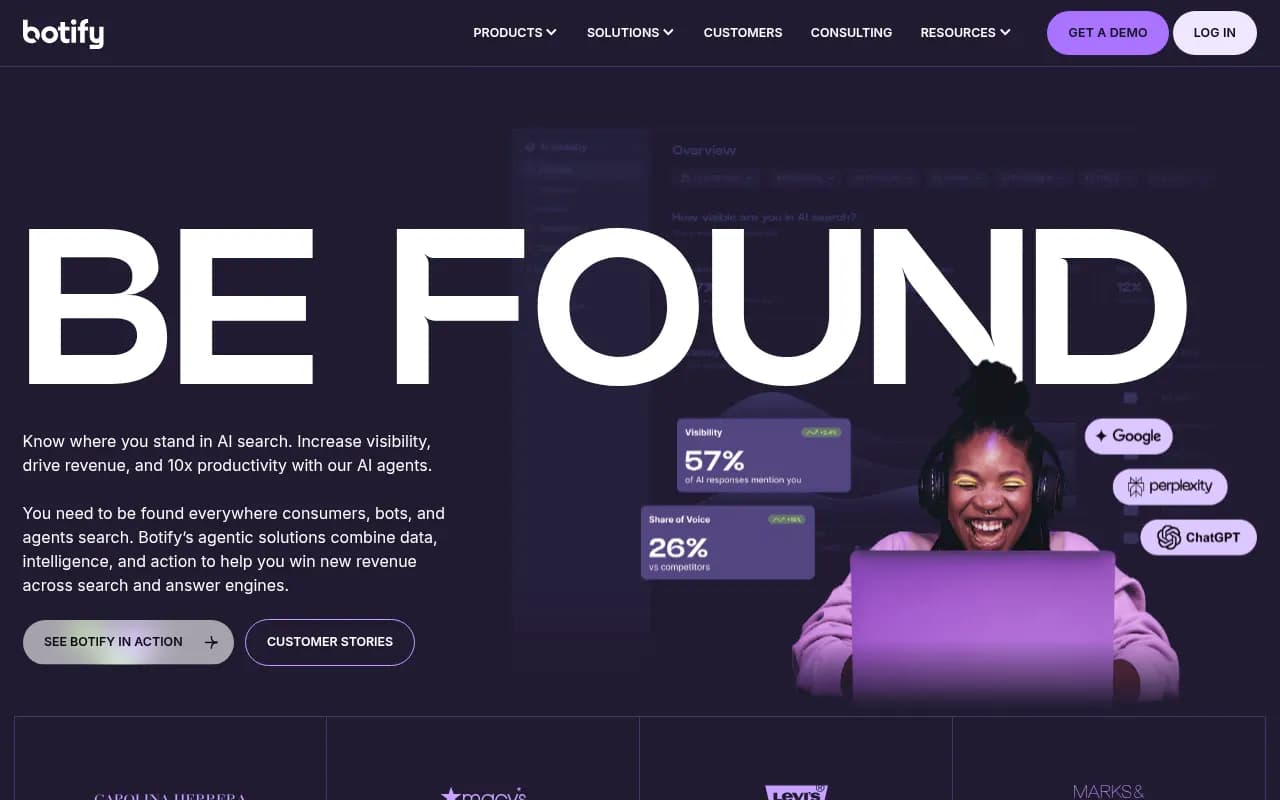
Botify is a veteran enterprise SEO platform that has been expanding aggressively into AI search. Its core product has always been technical SEO at scale -- crawl analysis, log file analysis, JavaScript rendering, and page performance for large websites with millions of URLs. In 2025-2026 it added GEO and AEO capabilities, and recently launched "Agentic Feeds" to help brands get their content surfaced by AI agents and answer engines.
Botify was named a Strong Performer in the Forrester Wave 2025 for SEO platforms. Its client list includes Ralph Lauren, Carolina Herrera, and other large retail and media brands. The platform is built for enterprise teams with dedicated SEO resources -- it's not something you spin up in an afternoon.
Side-by-side comparison
| Feature | Goodie AI | Botify |
|---|---|---|
| Primary focus | AEO / AI citation monitoring | Enterprise SEO + GEO/AEO |
| AI models tracked | 11 (incl. Amazon Rufus) | Multiple (GEO-focused, less specific) |
| Technical SEO crawling | No | Yes -- core feature |
| Log file analysis | No | Yes |
| JavaScript rendering | No | Yes |
| AI citation tracking | Yes -- core feature | Yes -- newer addition |
| Competitive share of voice | Yes | Yes |
| Content optimization | Gap identification | Agentic automation workflows |
| Agentic AI features | Limited | Yes -- Agentic Feeds product |
| Amazon Rufus tracking | Yes | Not confirmed |
| Pricing model | Custom/quote only | Custom enterprise, ~$10k-$50k+/mo |
| Free tier | No | No |
| Self-serve signup | No | No |
| Target customer | Enterprise brands, agencies | Large enterprise, e-commerce, media |
| Forrester recognition | Not listed | Strong Performer 2025 |
Head-to-head feature deep-dive
AI model coverage
Goodie AI is specific about its 11-model coverage: ChatGPT, Gemini, Perplexity, Claude, Grok, Meta AI, Google AI Overviews, Google AI Mode, Microsoft Copilot, DeepSeek, and Amazon Rufus. That last one is worth calling out. Amazon Rufus is the AI shopping assistant built into Amazon's app and website -- tracking it is genuinely useful for consumer brands selling on Amazon, and most AEO platforms don't cover it.
Botify's AI visibility features focus on the major answer engines (ChatGPT, Perplexity, Google AI Overviews) but the platform doesn't publish a specific list of models it monitors. Given that Botify's GEO features are newer additions to a platform built around traditional search, the depth of AI model tracking is probably narrower than Goodie AI's.
Verdict: Goodie AI wins on AI model breadth and specificity, especially for e-commerce brands that care about Amazon Rufus.
Technical SEO capabilities
This is where the comparison gets lopsided. Botify's technical SEO suite is one of the most comprehensive in the industry. It crawls millions of URLs, analyzes server logs to see how Googlebot and AI crawlers actually interact with your site, handles JavaScript rendering, and surfaces crawl budget issues that would otherwise be invisible. For large sites -- think e-commerce with 500,000+ product pages, or media sites with millions of articles -- this kind of infrastructure analysis is genuinely valuable.
Goodie AI doesn't do any of this. It's not trying to. The platform is focused on what AI models say about your brand, not on the technical health of your website.
Verdict: Botify wins decisively on technical SEO. If crawl analysis and log file data are on your requirements list, Goodie AI isn't even in the conversation.
AI visibility monitoring and citation tracking
Goodie AI's core loop -- Research, Monitor, Action, Measure -- is built entirely around AI search visibility. The monitoring layer tracks brand mentions, citations, and sentiment across its 11 models. The Research phase surfaces real customer prompts and search volume patterns. The Action phase identifies optimization gaps. The Measure phase connects visibility to business outcomes.
Botify's GEO monitoring is newer and sits alongside (rather than at the center of) its broader platform. It tracks AI search performance and competitive positioning, but the framing is more "be found everywhere" than "optimize specifically for AI citations." Botify's recent Agentic Feeds launch is interesting -- it's designed to help brands get their content structured in ways that AI agents can consume and recommend. That's a forward-looking bet on how AI-driven discovery will work.
Verdict: Goodie AI is more purpose-built for AI citation monitoring. Botify's agentic approach is interesting but less mature on the pure monitoring side.
Content optimization and action features
Goodie AI's "Action" phase claims to identify optimization gaps and help execute improvements across owned and earned assets. The website is light on specifics about what "execute improvements" actually means in practice -- whether that's content recommendations, a writing tool, or just a list of gaps to hand off to your content team.
Botify's approach here is more developed. Its AI agents and automation workflows can handle SEO tasks at scale -- the kind of repetitive optimization work that would take a human team weeks. The Agentic Feeds product is specifically designed to structure and deliver content to AI agents. For large sites, this automation angle is genuinely compelling.
Verdict: Botify has more developed automation and action capabilities. Goodie AI's action features are less transparent about depth.
Pricing and accessibility
Neither tool makes this easy. Both require a sales conversation before you see any numbers. Botify's pricing is known to be substantial -- $10,000 to $50,000+ per month on annual contracts is the range that gets cited in industry discussions. That's a serious commitment that puts it out of reach for most teams outside of large enterprise.
Goodie AI's pricing is completely opaque. "Custom/quote-based" could mean anything. Given its positioning and client base (Dermalogica, Skylum -- not Fortune 500 giants), it's probably more accessible than Botify, but there's no way to know without talking to their sales team.
If you want to explore AI visibility monitoring without committing to an enterprise sales process, it's worth knowing that Promptwatch publishes transparent pricing starting at $99/month with a free trial -- useful context for understanding what the market looks like at different price points.

Verdict: Neither tool wins here -- both have opaque pricing and no self-serve option. Botify is almost certainly more expensive.
Ease of use and time to value
Goodie AI's website mentions that its dashboards are intuitive and that brands can get monitoring set up quickly. Industry reviews from 2025 noted that Goodie AI's setup is relatively fast compared to heavier platforms.
Botify explicitly mentions a "30-day time-to-value" target, which tells you something about the complexity involved. Getting Botify fully configured for a large enterprise site takes time -- integrating log files, setting up crawls, configuring the GEO monitoring layer. The platform is powerful but it's not plug-and-play.
Verdict: Goodie AI is faster to set up. Botify requires more implementation effort but delivers more depth once configured.
Reporting and attribution
Goodie AI's Measure phase promises attribution that connects AI visibility to business outcomes. The specifics aren't detailed on the website, but this is a real challenge in the AEO space -- connecting AI citations to actual traffic and revenue is hard.
Botify has a longer track record with ROI measurement, citing a "5x ROI within 3 years" benchmark. Its reporting infrastructure is mature, with integrations into analytics platforms and the ability to tie crawl and visibility data to organic revenue.
Verdict: Botify has more proven attribution infrastructure. Goodie AI's attribution claims are harder to evaluate without a demo.
Pricing comparison
| Plan | Goodie AI | Botify |
|---|---|---|
| Free tier | None | None |
| Starter/self-serve | Not available | Not available |
| Entry-level paid | Custom quote (undisclosed) | ~$10,000+/month (estimated) |
| Mid-tier | Custom quote | ~$20,000-$30,000/month (estimated) |
| Enterprise | Custom quote | ~$50,000+/month (estimated) |
| Contract type | Custom | Annual contracts standard |
| Trial | Demo only | Demo only |
Both tools are enterprise-only with no public pricing. Budget accordingly.
Pros and cons
Goodie AI
Pros:
- Purpose-built for AI search visibility -- everything is oriented around AEO
- Tracks 11 AI models including Amazon Rufus (rare)
- Faster setup and more focused dashboards
- Covers sentiment and competitive share of voice across AI models
- Likely more accessible pricing than Botify (though unconfirmed)
Cons:
- No technical SEO capabilities whatsoever
- Pricing is completely opaque -- no tiers, no ballpark numbers
- Action/optimization features are vague on specifics
- No free trial or self-serve option
- Relatively newer platform with a smaller track record
Botify
Pros:
- Best-in-class technical SEO crawling and log file analysis
- Agentic Feeds is a genuinely forward-looking product for AI-driven discovery
- Strong track record with large enterprise clients
- Forrester Wave recognition adds credibility
- Mature attribution and ROI measurement
Cons:
- Very expensive -- $10k-$50k+/month puts it out of reach for most teams
- GEO/AEO features are newer additions, not the platform's heritage
- Heavy implementation -- 30-day time-to-value is the optimistic estimate
- No self-serve option, no free trial
- Overkill if you only need AI citation monitoring
Who should pick which tool
Pick Goodie AI if:
- Your primary need is tracking how your brand appears in AI search results
- You sell on Amazon and want to monitor Rufus recommendations
- You want a focused AEO platform without paying for a full enterprise SEO suite
- You're an agency managing AI visibility for multiple brands
- You need to get up and running quickly
Pick Botify if:
- You have a large, complex website where technical SEO is a real bottleneck
- You need log file analysis and crawl budget optimization alongside AI visibility
- Your team has the resources to implement and manage an enterprise platform
- You want agentic automation to handle SEO tasks at scale
- Budget is not a constraint and you need a single platform for all of search
Consider neither if:
- You're a mid-market company or agency without an enterprise budget
- You want to evaluate the tool before committing to a sales conversation
- You need transparent pricing to get internal budget approval
- You want AI content generation alongside monitoring (neither tool is strong here)
Final verdict
These two tools are solving related but different problems. Goodie AI is a focused AI citation monitoring platform -- it does one thing and does it specifically. Botify is an enterprise SEO platform that has expanded into AI search, bringing serious technical infrastructure but also serious cost and complexity.
If AI visibility monitoring is your core need and you don't have a massive technical SEO problem to solve, Goodie AI is the more appropriate tool. If you're running a large e-commerce or media site where crawl efficiency and technical SEO directly affect revenue, and you have the budget for it, Botify's broader capabilities justify the investment.
Neither is the right answer for teams that want to start quickly, see pricing upfront, or need content optimization alongside monitoring -- that's a different category of tool entirely.