Key takeaways
- Brandlight.ai has public pricing starting at $199/mo with a free tier; Goodie AI is quote-only with zero pricing transparency
- Both tools are primarily monitoring platforms -- neither has built-in content generation or AI-native content gap analysis
- Goodie AI tracks Amazon Rufus, which is a real differentiator for e-commerce and retail brands; Brandlight does not appear to cover it
- Brandlight's $30M Series A and Fortune 500 client list (Mastercard, Humana, Estee Lauder) signals a more mature enterprise product
- Goodie AI covers 11 AI models vs Brandlight's focus on the major five or six -- useful if you need breadth across newer models
- For teams that want to actually fix visibility gaps (not just measure them), neither tool fully closes the loop -- worth knowing before you commit
Overview
Goodie AI
Goodie AI (higoodie.com) is an AEO and AI search visibility platform that tracks how brands appear across 11 AI models, including ChatGPT, Gemini, Perplexity, Claude, Grok, DeepSeek, Copilot, Meta AI, Google AI Overviews, Google AI Mode, and -- notably -- Amazon Rufus. The platform frames itself around a "closed loop" of research, monitor, action, and measure. In practice, the monitoring and research legs are solid; the "action" piece is less developed than the marketing suggests. Goodie is built for enterprise brands and agencies, and getting access requires a demo request. There are no self-serve plans and no public pricing.
Brandlight.ai
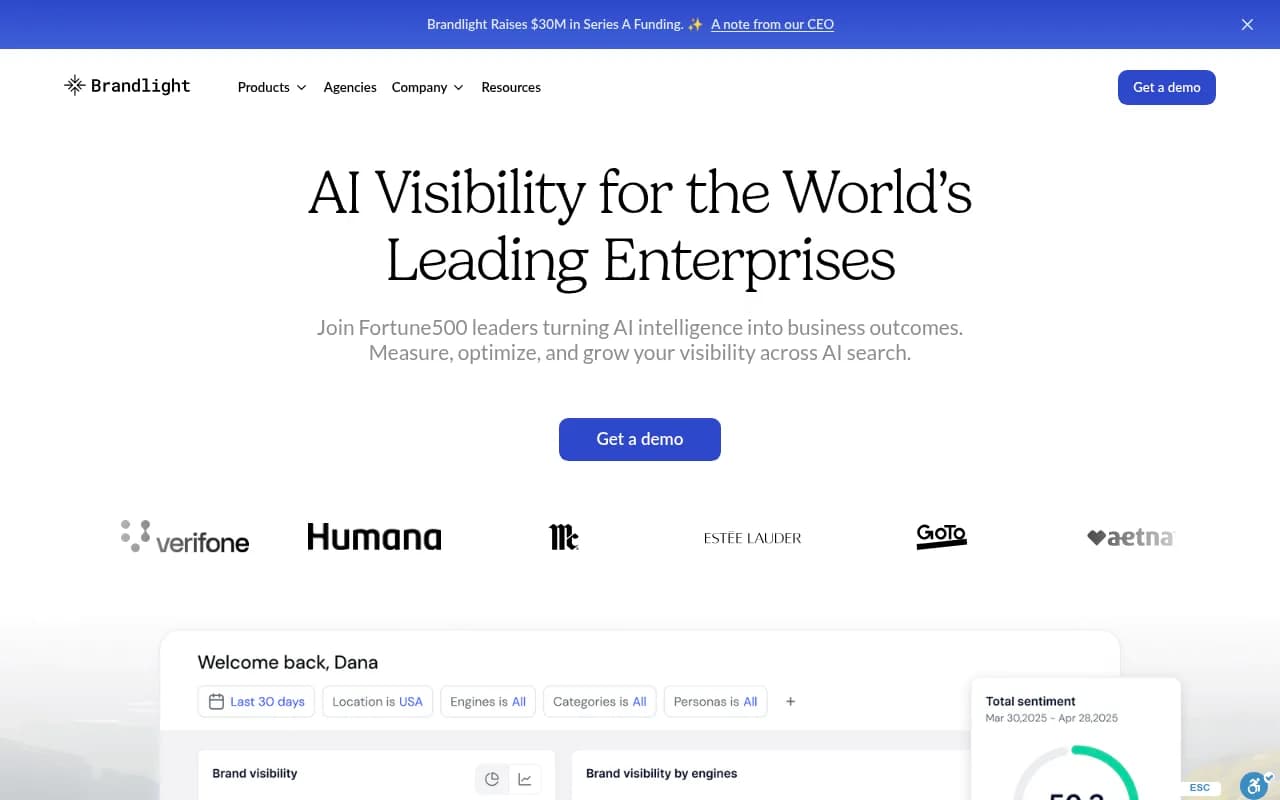
Brandlight.ai is an enterprise AI visibility platform that raised $30M in Series A funding and counts Mastercard, Humana, Estee Lauder, and Aetna among its customers. It monitors brand mentions, sentiment, citations, and competitive positioning across the major AI search engines. Brandlight has a free tier and paid plans starting at $199/mo, which makes it more accessible than most enterprise-focused competitors. The platform is squarely focused on brand perception -- how AI models describe your brand, which sources they cite, and how you compare to competitors in AI-generated responses.
Side-by-side comparison
| Feature | Goodie AI | Brandlight.ai |
|---|---|---|
| Pricing model | Custom/quote only | Free tier + $199-$750/mo public plans |
| Free plan | No | Yes |
| AI models tracked | 11 (incl. Amazon Rufus) | ~5-6 major models |
| Amazon Rufus tracking | Yes | No |
| Brand mention tracking | Yes | Yes |
| Sentiment analysis | Yes | Yes |
| Citation tracking | Yes | Yes |
| Competitor benchmarking | Yes | Yes |
| Content generation | No | No |
| Content gap analysis | Limited | Limited |
| AI crawler logs | Not confirmed | Not confirmed |
| Traffic attribution | Yes (claimed) | Yes (claimed) |
| Self-serve onboarding | No (demo required) | Yes |
| Enterprise focus | Yes | Yes (Fortune 500) |
| Funding/backing | Not disclosed | $30M Series A |
| Target customer | Enterprise brands, agencies | Fortune 500 marketing teams |
Head-to-head feature deep-dive
Pricing and accessibility
This is where the two tools diverge most sharply. Brandlight.ai publishes its pricing: a free version to get started, a basic monitoring plan at $199/mo, and an activation plan at $750/mo. Enterprise custom pricing is available for multi-brand deployments. You can sign up, poke around, and decide if it's worth paying -- without talking to a salesperson first.
Goodie AI gives you nothing. No pricing page, no trial, no self-serve option. You fill out a demo request form and wait. That's a real friction point for smaller teams or anyone who wants to evaluate tools quickly. It's not unusual for enterprise software to work this way, but in a market where Brandlight and others have moved toward transparency, Goodie's opacity feels like a deliberate choice to push everything through sales.
Verdict: Brandlight wins on accessibility. Goodie's pricing model suits large enterprise procurement cycles but excludes everyone else.
AI model coverage
| Model | Goodie AI | Brandlight.ai |
|---|---|---|
| ChatGPT | Yes | Yes |
| Perplexity | Yes | Yes |
| Google AI Overviews | Yes | Yes |
| Google AI Mode | Yes | Yes |
| Claude | Yes | Yes |
| Gemini | Yes | Yes |
| Grok | Yes | Yes |
| Meta AI | Yes | Yes |
| DeepSeek | Yes | Yes |
| Microsoft Copilot | Yes | Yes |
| Amazon Rufus | Yes | No |
Goodie's 11-model coverage is broader, and Amazon Rufus is the standout. If you're a retail or e-commerce brand, Rufus is where shoppers are increasingly getting product recommendations -- and most platforms ignore it entirely. That's a genuine edge for Goodie.
Brandlight covers the models that matter most for the majority of brands (ChatGPT, Perplexity, Gemini, Claude, Copilot), but if you're in retail and care about Amazon's AI layer, Goodie is the more complete option.
Verdict: Goodie AI wins on model breadth, especially for e-commerce brands.
Brand monitoring and analytics
Both platforms track brand mentions, sentiment, citation sources, and competitive share of voice across AI responses. The core monitoring experience is similar: you set up tracked prompts, the platform queries AI models, and you get data on how often your brand appears, what sentiment is attached, and which competitors are showing up instead of you.
Brandlight's pitch leans heavily on brand perception -- not just "are you mentioned" but "how are you described." That's a meaningful distinction for large brands where reputation management matters as much as raw visibility. The Fortune 500 client list suggests the product has been shaped by real enterprise feedback.
Goodie's monitoring covers the same ground and adds the research layer -- understanding prompt volumes and search patterns before you set up tracking. That's useful for teams building out their prompt strategy from scratch.
Verdict: Roughly even, with Brandlight slightly ahead on brand perception depth and Goodie ahead on research/discovery features.
Content optimization and gap analysis
Neither tool is strong here, and that's worth being direct about. Both platforms will show you where you're invisible -- which prompts your competitors rank for that you don't -- but neither has a built-in content generation engine to help you fix those gaps.
Goodie's "Action" step in its closed-loop framework is the weakest part of the product. The website talks about identifying optimization gaps and executing improvements, but the actual tooling for this is thin compared to what the marketing implies.
Brandlight is similarly monitoring-first. You get the data, but the "what to do about it" is largely left to you.
If content gap analysis and AI-native content generation are priorities for your team, it's worth knowing that platforms like Promptwatch are built specifically around that workflow -- finding gaps, generating content grounded in citation data, and tracking whether it works.

Verdict: Neither tool wins here. Both are monitoring platforms with limited optimization capability.
Enterprise features and integrations
Brandlight's $30M Series A has clearly gone into enterprise infrastructure. The client list -- Mastercard, Humana, Estee Lauder, Aetna, Charter -- is the kind of social proof that matters in enterprise sales cycles. Multi-brand deployments, custom enterprise pricing, and dedicated support are all part of the offering.
Goodie's enterprise credentials are less visible. The customer logos on the homepage (Dermalogica, Skylum, Vectara, Rathbones) are recognizable but not in the same tier. The demo-only model is enterprise-friendly in process, but the product depth isn't as clearly documented.
Verdict: Brandlight wins on enterprise credibility and client tier.
Reporting and attribution
Both platforms claim to connect AI visibility to business outcomes. Goodie's "Measure" step promises ROI attribution that links visibility to conversions. Brandlight similarly claims to turn AI intelligence into business outcomes.
In practice, AI traffic attribution is genuinely hard -- most platforms are still figuring out how to reliably connect an AI citation to a website visit or conversion. Neither tool has published detailed methodology for how they do this, so take both claims with some skepticism until you've seen it in a demo.
Verdict: Too close to call without hands-on testing. Both claim attribution; neither has published enough detail to verify.
Pricing comparison
| Plan | Goodie AI | Brandlight.ai |
|---|---|---|
| Free | No | Yes (limited) |
| Starter/Basic | Not disclosed | $199/mo |
| Pro/Activation | Not disclosed | $750/mo |
| Enterprise | Custom (demo required) | Custom |
| Self-serve | No | Yes |
| Annual discount | Unknown | Available |
The pricing gap here is stark. Brandlight gives you a free entry point and clear upgrade paths. Goodie gives you nothing until you've sat through a sales call. For teams with budget authority and a clear enterprise procurement process, Goodie's model is fine. For everyone else, it's a barrier.
Pros and cons
Goodie AI
Pros:
- Tracks 11 AI models including Amazon Rufus -- the broadest coverage in this comparison
- Research features help you understand prompt volumes before setting up tracking
- "Closed loop" framework covers research through measurement in one platform
- Appears to include Google AI Mode tracking, which many competitors miss
Cons:
- No public pricing -- you can't evaluate cost without a sales call
- No free trial or self-serve option
- Content optimization tooling is thin despite the marketing
- Smaller, less recognizable customer base than Brandlight
- No confirmed AI crawler logs or Reddit/YouTube tracking
Brandlight.ai
Pros:
- Free tier available -- low barrier to evaluate the product
- Transparent pricing from $199/mo
- Strong enterprise credentials with Fortune 500 clients
- $30M Series A funding means active product development
- Brand perception depth is genuinely useful for reputation-sensitive brands
Cons:
- No Amazon Rufus tracking -- a gap for retail and e-commerce brands
- Narrower AI model coverage than Goodie
- Content generation is absent -- monitoring-only platform
- No confirmed AI crawler logs
- Enterprise focus means smaller teams may feel underserved even on paid plans
Who should pick which tool
Choose Goodie AI if:
- You're in retail or e-commerce and Amazon Rufus visibility matters to your business
- You want the broadest AI model coverage, including newer models like DeepSeek and Grok
- You're in an enterprise with a formal procurement process and don't mind the demo-first model
- You want research and prompt discovery built into the same platform as monitoring
Choose Brandlight.ai if:
- You want to try before you buy -- the free tier is a real advantage
- You're a Fortune 500 brand or aspire to that tier of enterprise tooling
- Brand perception and sentiment depth matter as much as raw visibility metrics
- You want a platform backed by serious funding and a growing enterprise client base
- You need transparent pricing to get internal budget approval
Consider neither if:
- Content generation and gap analysis are core to your workflow -- both tools are monitoring-first and won't help you create content that ranks in AI search
- You're a small or mid-size team on a tight budget -- Goodie has no accessible entry point, and Brandlight's $199/mo minimum may not justify itself without the enterprise features
Final verdict
Brandlight.ai is the easier choice for most teams: it has a free tier, public pricing, a credible enterprise client list, and active investment behind it. Goodie AI is the better pick for retail and e-commerce brands that need Amazon Rufus coverage, or for teams that want broader model tracking across 11 platforms. The honest summary is that both tools are solid monitoring platforms -- and both stop short of helping you actually fix what they find.