Key Takeaways
- Gushwork is a lead generation engine that creates 100+ pages and builds backlinks to drive qualified B2B inquiries within 90 days. Gauge is a monitoring and analytics platform that tracks brand mentions across AI engines but doesn't create content for you.
- Pricing difference is significant: Gushwork starts at $800/mo with a 6-month minimum ($4,800 upfront commitment). Gauge starts at $95/mo annually with no long-term lock-in.
- Gushwork is fully hands-off -- AI agents handle keyword research, content creation, publishing, and backlink building. Gauge gives you the data and recommendations, but you execute the optimization yourself.
- Gauge monitors 7+ AI models (ChatGPT, Claude, Gemini, Perplexity, Copilot, AI Mode, AI Overviews). Gushwork focuses on Google and AI search engines but doesn't provide granular per-model tracking.
- Use case split: Pick Gushwork if you want a done-for-you lead gen system and have budget for a 6-month commitment. Pick Gauge if you want visibility analytics and control over your own content strategy.
- Neither platform offers a free trial -- Gushwork requires a paid 6-month contract, Gauge requires annual billing for the starter plan.
Overview
Gushwork: AI-powered lead generation engine
Gushwork
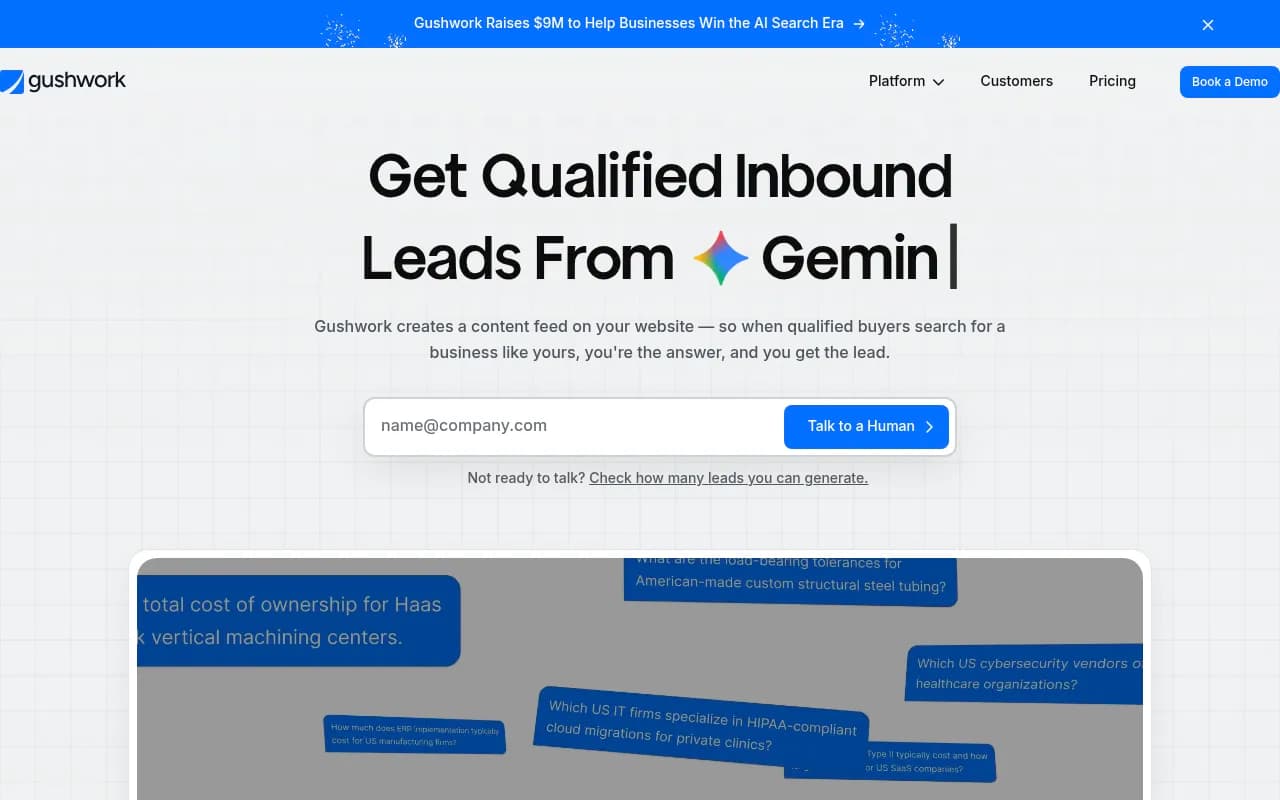
Gushwork positions itself as a complete inbound marketing system. You hand over your business context -- services, target customers, brand voice -- and their AI agents research buyer intent, generate 100+ optimized pages, publish them to your website, and build backlinks across the web. The promise: qualified B2B leads start flowing within 90-150 days, completely hands-off. It's designed for businesses tired of inconsistent lead flow who want a predictable pipeline without managing content production themselves.
Pricing starts at $800/mo (Launch plan) with a 6-month minimum commitment. Higher tiers (Grow $1,200/mo, Scale $2,200/mo) add more pages and faster delivery. No free trial.
Gauge: AI visibility monitoring and analytics platform
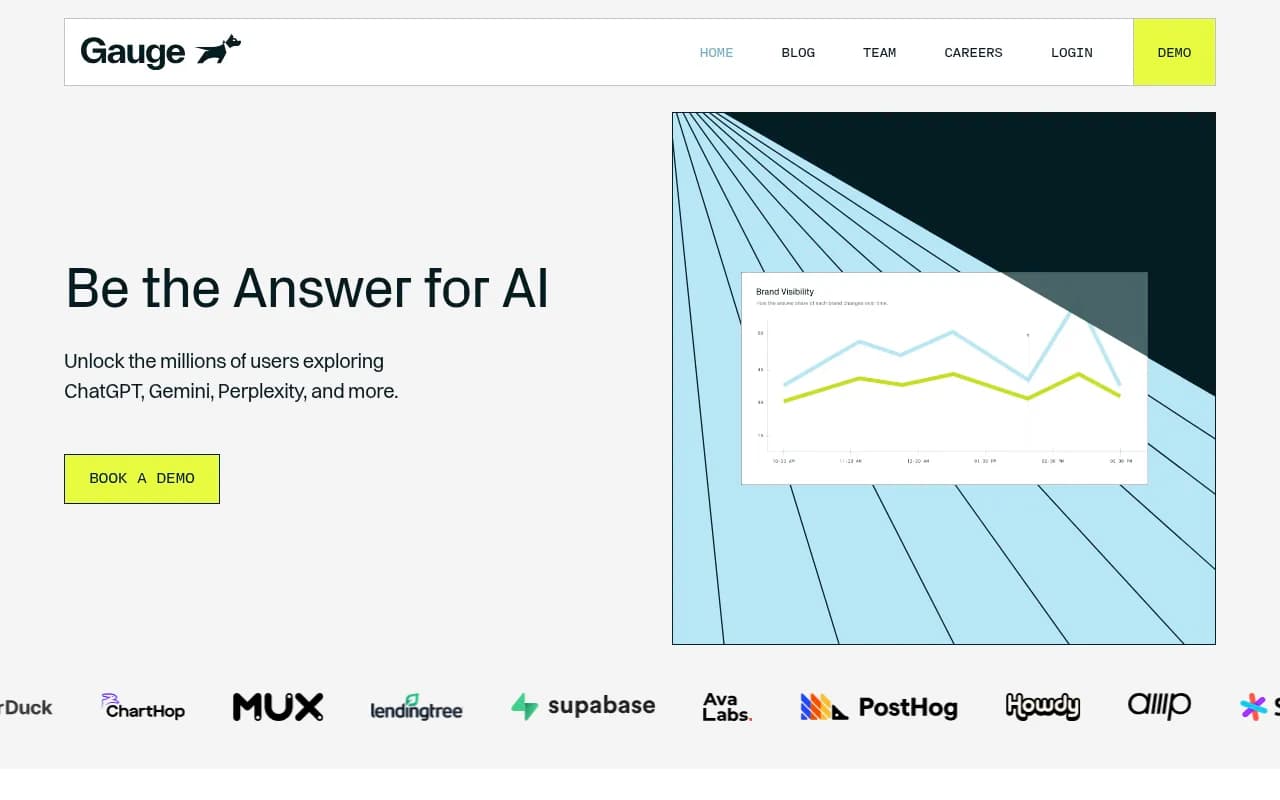
Gauge is a tracking and optimization platform for AI search visibility. It monitors how your brand appears in ChatGPT, Claude, Gemini, Perplexity, Copilot, AI Mode, and AI Overviews. You see which prompts mention your brand, what content gets cited, where competitors are beating you, and what gaps exist in your AI presence. Gauge provides actionable recommendations -- which pages to create, which affiliates to target, which Reddit threads to engage with -- but you're responsible for executing the strategy.
Pricing starts at $95/mo with annual billing. Growth plan is $399/mo. Enterprise pricing is custom. No free trial on the starter plan.
Side-by-Side Comparison
| Feature | Gushwork | Gauge |
|---|---|---|
| Starting price | $800/mo (6-month minimum) | $95/mo (annual billing) |
| Free trial | No | No |
| Content creation | 100+ pages generated and published | No -- recommendations only |
| AI models tracked | Google + AI search (not granular) | ChatGPT, Claude, Gemini, Perplexity, Copilot, AI Mode, AI Overviews |
| Backlink building | Yes -- automated citations and backlinks | No -- you handle offsite work |
| Hands-off execution | Fully automated | Self-service with guidance |
| Lead dashboard | Yes -- spam-filtered lead inbox | No -- tracking only |
| Keyword research | AI agents handle it | You bring your own prompts or use their suggestions |
| Competitor analysis | Reverse-engineers top results | Shows competitor mention rates and citation sources |
| Time to results | 90-150 days for first leads | Immediate data, optimization timeline depends on you |
| Target audience | B2B businesses wanting done-for-you lead gen | Marketing teams managing their own AI visibility strategy |
| Contract length | 6-month minimum | Monthly (annual billing for starter plan) |
| Reddit/social tracking | Not mentioned | Yes -- identifies high-value Reddit threads |
Core value proposition: lead generation vs visibility analytics
Gushwork and Gauge solve different problems.
Gushwork is a lead generation service. You're paying for results -- specifically, qualified B2B inquiries landing in your inbox. The AI system builds your content, publishes it, promotes it, and tracks conversions. You don't touch the content production process. The 6-month minimum commitment reflects the fact that SEO and AI search visibility take time to compound. Most customers see first inquiries within 3 months, then 5-10 qualified leads per month by month 4.
Gauge is a visibility analytics platform. You're paying for data and insights. It shows you where your brand is mentioned (or not mentioned) across AI engines, which content gets cited, what competitors are doing better, and what gaps exist. The platform gives you a roadmap -- create this page, target this affiliate, engage with this Reddit thread -- but you're responsible for executing. If you have an in-house content team or agency, Gauge arms them with the intelligence they need to optimize for AI search.
The pricing reflects this difference. Gushwork's $800/mo minimum buys you a full-service content engine. Gauge's $95/mo buys you the dashboard and recommendations.
Content creation and publishing
Gushwork: The entire platform is built around content production. AI agents analyze your business, research buyer intent across millions of searches, reverse-engineer what's ranking today, then generate 100+ landing pages, educational guides, and FAQ content. Everything gets published directly to your website in a resource center optimized for AI search engines to crawl. You don't write a single word.
The content isn't generic SEO filler. Gushwork's AI builds pages around real customer searches -- the exact questions your ideal buyers are typing. Each page is designed to answer a specific query and convert that visitor into a lead.
Gauge: No content creation. Gauge identifies what content you're missing -- which prompts competitors rank for but you don't, which topics AI models want answers to but can't find on your site -- then gives you recommendations. You (or your team) write the content, publish it, and optimize it. Gauge tracks the results and shows you if your visibility improves.
If you want a hands-off content engine, Gushwork is the only option here. If you want to control your content strategy and just need the data layer, Gauge fits.
AI model tracking and visibility analytics
Gauge: This is Gauge's core strength. It monitors 7+ AI models -- ChatGPT, Claude, Gemini, Perplexity, Copilot, AI Mode, and AI Overviews -- and shows you exactly how your brand appears in each one. You see:
- Which prompts mention your brand
- What content gets cited (your pages, competitor pages, Reddit threads, YouTube videos)
- How often you're mentioned vs competitors
- Sentiment and positioning in AI responses
- Citation sources and patterns
Gauge's competitor analysis is granular. You can see which domains AI models trust, which affiliates get cited most often, and where your competitors are winning. The platform also surfaces Reddit discussions and social sources that influence AI recommendations -- a channel most businesses ignore entirely.
Gushwork: Visibility tracking is less detailed. Gushwork mentions optimizing for "Google and AI search engines" but doesn't provide per-model breakdowns or citation analysis. The focus is on lead generation metrics -- how many inquiries are landing, where they're coming from, conversion rates. You get a lead dashboard, not a visibility dashboard.
If you need granular AI search analytics, Gauge is the clear winner. If you care more about lead volume than citation tracking, Gushwork's approach is fine.
For teams that want both -- deep visibility tracking and content creation -- Promptwatch bridges the gap with AI content generation grounded in citation data, plus page-level tracking across 10 AI models.

Backlink building and offsite optimization
Gushwork: Automated backlink building is part of the service. After publishing your 100+ pages, Gushwork's AI builds citations and backlinks across trusted websites. This signals to search engines and AI models that your content is credible. Rankings climb, mentions multiply. You don't manage outreach or link building -- it's handled for you.
Gauge: No backlink building. Gauge identifies high-value affiliates and sources you should target -- which websites AI models cite most often, which Reddit threads are influencing recommendations -- but you handle the outreach and relationship building yourself. The platform gives you the target list, not the execution.
If offsite SEO feels overwhelming or you don't have the resources, Gushwork's automated approach is a huge advantage. If you have an outreach team or agency, Gauge's affiliate intelligence is valuable but you're doing the work.
Pricing comparison
| Plan | Gushwork | Gauge |
|---|---|---|
| Starter/Launch | $800/mo (6-month min = $4,800) | $95/mo (annual billing) |
| Mid-tier | Grow: $1,200/mo | Growth: $399/mo |
| High-tier | Scale: $2,200/mo | Enterprise: Custom |
| Free trial | No | No |
| Contract length | 6 months minimum | Monthly (annual billing for starter) |
| What's included | 100+ pages, backlinks, lead dashboard, fully hands-off | Visibility tracking, competitor analysis, content gap recommendations |
Gushwork's pricing reflects a full-service model. You're paying for content production, publishing, backlink building, and lead generation -- not just software access. The 6-month minimum is a barrier if you're testing the waters, but it aligns with the reality that SEO and AI visibility take time to compound.
Gauge's pricing is software-as-a-service. You're paying for the dashboard, data, and recommendations. The $95/mo starter plan is accessible for small teams, though annual billing is required. Growth plan at $399/mo adds more prompts, deeper competitor analysis, and priority support.
Neither platform offers a free trial, which is frustrating if you want to test before committing. Gushwork's 6-month lock-in is a bigger risk -- you're committing $4,800 minimum before seeing results.
Lead generation and conversion tracking
Gushwork: Lead generation is the entire point. Every page Gushwork creates is designed to convert visitors into inquiries. The platform includes a lead dashboard where all inquiries land -- organized, spam-filtered, and tracked so you never lose an opportunity. Gushwork reports that most customers see first inquiries within 90 days, then 5-10 qualified leads per month by month 4.
The lead dashboard is a nice touch. You're not digging through form submissions or email -- everything flows into one clean interface.
Gauge: No lead tracking. Gauge monitors visibility and citations, not conversions. If you want to connect AI visibility to actual revenue, you'll need to set up your own attribution tracking (Google Analytics, CRM integration, etc.). Gauge shows you which content is getting cited, but it doesn't tell you if those citations are driving traffic or leads.
If lead generation is your primary goal, Gushwork is purpose-built for it. Gauge is a visibility tool, not a conversion tool.
Competitor analysis and benchmarking
Gauge: Competitor analysis is detailed. You can compare your brand's mention rate vs competitors across all tracked AI models. Gauge shows you:
- Which competitors are mentioned more often
- What content they're getting cited for
- Which domains and affiliates they're leveraging
- Sentiment and positioning differences
This is useful for identifying gaps. If a competitor is dominating a specific prompt or category, Gauge shows you exactly what they're doing and what you're missing.
Gushwork: Competitor analysis happens during the research phase. Gushwork's AI reverse-engineers what's ranking today for each target search -- analyzing top results on Google, ChatGPT, and other AI tools -- then builds something better. But you don't get an ongoing competitor dashboard. The analysis is baked into the content strategy, not exposed as a separate feature.
If you want ongoing competitive intelligence, Gauge gives you more visibility. If you just want your content to beat competitors without seeing the data, Gushwork's approach works.
Ease of use and hands-on involvement
Gushwork: Fully hands-off. You provide your business context (services, target customers, brand voice) during onboarding, then Gushwork's AI handles everything. You're not managing keyword research, content briefs, publishing schedules, or backlink outreach. The platform is designed for businesses that want results without touching the execution.
The trade-off: you have less control. If you want to tweak content, adjust targeting, or change strategy mid-campaign, you're dependent on Gushwork's team.
Gauge: Self-service with guidance. Gauge gives you the data and recommendations, but you're responsible for execution. You decide which content to create, which affiliates to target, which optimizations to prioritize. The platform is designed for marketing teams that want control over their strategy.
The trade-off: you need resources. If you don't have a content team or agency, Gauge's recommendations sit unused.
Pick Gushwork if you want a done-for-you system. Pick Gauge if you want to own the strategy and just need the intelligence layer.
Integration and workflow
Gushwork: Publishes directly to your website. During onboarding, you grant Gushwork access to your CMS (WordPress, Webflow, etc.), and their AI publishes the 100+ pages to a resource center on your domain. Lead forms are embedded, and inquiries flow into the Gushwork dashboard. No manual publishing, no content uploads.
Gauge: No CMS integration. Gauge is a standalone analytics platform. You export recommendations, create content in your own tools, publish it yourself, then Gauge tracks the results. If you want to automate workflows, you'll need to build custom integrations (Gauge mentions API access for enterprise plans, but details aren't public).
Gushwork's direct publishing is convenient if you're okay with handing over CMS access. Gauge's hands-off approach gives you more control but requires more manual work.
Reporting and dashboards
Gushwork: Lead-focused reporting. You see how many inquiries are landing, where they're coming from (which pages, which searches), and conversion trends over time. The dashboard is designed for sales and marketing leaders who care about pipeline, not SEO metrics.
Gauge: Visibility-focused reporting. You see mention rates across AI models, citation sources, competitor benchmarks, and content gap analysis. The dashboard is designed for SEO and content teams who care about rankings and brand presence, not conversions.
Neither platform is wrong -- they're optimized for different outcomes. Gushwork reports on leads, Gauge reports on visibility.
Pros and cons
Gushwork pros
- Fully hands-off -- AI handles content creation, publishing, and backlink building
- Lead generation focus with spam-filtered dashboard
- 100+ pages created and published automatically
- Predictable pipeline within 90-150 days
- Reverse-engineers what's working today for each target search
Gushwork cons
- Expensive -- $800/mo minimum with 6-month commitment ($4,800 upfront)
- No free trial
- Less control over content strategy and execution
- Visibility tracking is less granular than dedicated AI monitoring tools
- Not ideal if you want to manage content in-house
Gauge pros
- Affordable entry point -- $95/mo with annual billing
- Tracks 7+ AI models with granular per-model breakdowns
- Detailed competitor analysis and citation tracking
- Identifies high-value Reddit threads and social sources
- Gives you control over content strategy and execution
Gauge cons
- No content creation -- recommendations only
- No backlink building or offsite optimization
- No lead tracking or conversion analytics
- Requires in-house resources or agency to execute recommendations
- Annual billing required for starter plan
Who should pick which tool
Pick Gushwork if:
- You want a done-for-you lead generation system
- You have budget for a 6-month commitment ($4,800+)
- You don't have in-house content resources or want to free them up
- Your primary goal is qualified B2B inquiries, not visibility metrics
- You're okay with less control in exchange for hands-off execution
Pick Gauge if:
- You have a content team or agency and want to optimize their work
- You need granular AI visibility tracking across multiple models
- You want control over your content strategy and execution
- Your budget is tighter -- $95/mo is more accessible than $800/mo
- You care about citation analysis, competitor benchmarking, and Reddit/social intelligence
Pick neither if:
- You want both deep visibility tracking and AI-powered content creation -- in that case, look at Promptwatch, which combines citation-based content generation with page-level tracking across 10 AI models
- You're looking for a free tool -- neither Gushwork nor Gauge offers a free tier
Final verdict
Gushwork and Gauge aren't really competitors -- they solve different problems at different price points.
Gushwork is a lead generation engine. You pay for results (qualified inquiries), not software access. The AI handles everything from keyword research to backlink building. It's expensive ($800/mo minimum, 6-month commitment), but if you're a B2B business tired of inconsistent lead flow and you have the budget, it's a predictable system that delivers within 90-150 days. The trade-off: less control and no granular visibility analytics.
Gauge is a visibility analytics platform. You pay for data and recommendations, not execution. It tracks 7+ AI models, shows you exactly where your brand is mentioned (or missing), and gives you a roadmap to improve. It's affordable ($95/mo starter plan), but you need in-house resources or an agency to act on the insights. The trade-off: no content creation, no backlink building, no lead tracking.
If you want a done-for-you lead gen system and have the budget, Gushwork is the clear choice. If you want to control your AI visibility strategy and just need the intelligence layer, Gauge is the better fit. If you want both -- deep tracking and content creation -- neither platform fully delivers on its own.