Key takeaways
- AthenaHQ has transparent, self-serve pricing starting at $295/month. Meridian requires a demo and custom quote -- expect significantly higher costs.
- Meridian is a managed service model: their team does the work alongside the platform. AthenaHQ is a SaaS tool you operate yourself with your own team.
- AthenaHQ has named enterprise clients (Coinbase, ZoomInfo, SoFi, PagerDuty) and Y Combinator backing. Meridian has no publicly named clients or funding details.
- Both tools are primarily monitoring and optimization platforms -- neither offers the kind of self-serve AI content generation that closes the full gap-to-content loop.
- AthenaHQ uses a credit-based model (1 credit = 1 AI query), which can get expensive at scale. Meridian's all-in managed pricing may actually work out cheaper for high-volume enterprise use.
- If you want to get started today without a sales call, AthenaHQ wins on accessibility. If you want a team to run the strategy for you, Meridian is worth the conversation.
Overview
Meridian
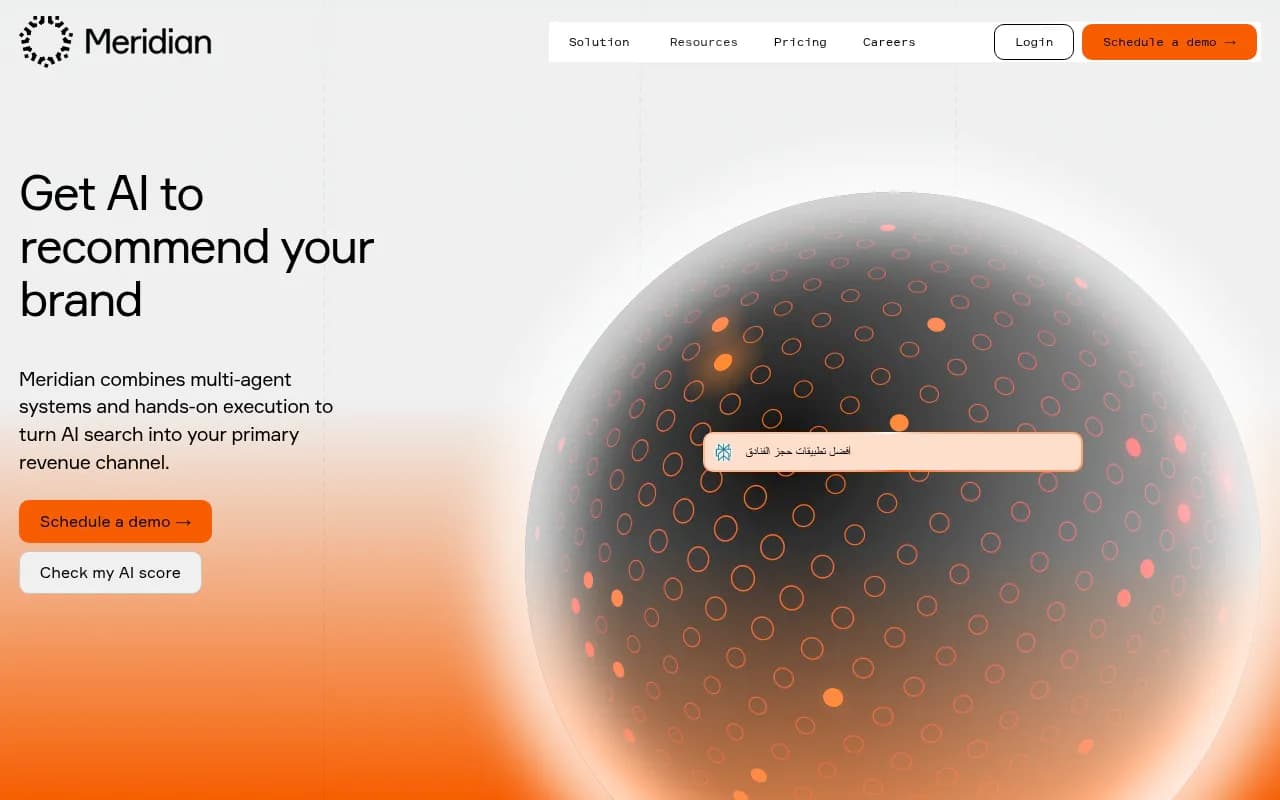
Meridian pitches itself as an "agentic AI platform" for AI search optimization, but the more accurate description is a managed growth service built on top of monitoring technology. The homepage talks about "multi-agent systems and hands-on execution" -- meaning you're not just buying software, you're buying a team that uses software on your behalf. They track visibility, sentiment, citations, and competitive benchmarking across the major AI models (ChatGPT, Perplexity, Gemini, Google AI, Claude, Copilot, Grok, DeepSeek, Meta AI). The demo-only pricing model signals this is aimed at mid-market and enterprise brands with real budgets.
AthenaHQ

AthenaHQ is a self-serve GEO/AEO platform backed by Y Combinator and featured in Forbes and the Wall Street Journal. It's built for in-house marketing and SEO teams who want to own their AI search optimization workflow. The platform covers 8+ LLMs, provides citation tracking, content optimization recommendations, and executive dashboards. Clients include Coinbase, ZoomInfo, SoFi, and PagerDuty -- a mix of fintech, SaaS, and enterprise brands. The $295/month self-serve tier makes it accessible without a sales call, though the credit-based query model means costs can climb as you scale up prompt tracking.
Side-by-side comparison
| Feature | Meridian | AthenaHQ |
|---|---|---|
| Pricing model | Custom (demo required) | $295/mo self-serve, enterprise custom |
| Free trial / audit | None public | Free 10-min audit, $95 first month |
| Delivery model | Managed service + platform | Self-serve SaaS |
| AI models tracked | 9 (ChatGPT, Perplexity, Gemini, Claude, Google AI, Copilot, Grok, DeepSeek, Meta AI) | 8+ (ChatGPT, Perplexity, Gemini, Claude, Google AI, Copilot, Grok, DeepSeek) |
| Visibility tracking | Yes | Yes |
| Sentiment tracking | Yes | Yes |
| Citation tracking | Yes | Yes |
| Competitive benchmarking | Yes | Yes |
| Content optimization | Hands-on execution by team | Automated recommendations |
| Self-serve content creation | No | No |
| Executive dashboards | Yes | Yes |
| Named enterprise clients | None public | Coinbase, ZoomInfo, SoFi, PagerDuty |
| Funding / backing | Not disclosed | Y Combinator |
| Multi-language / multi-region | Yes (shown in demo UI) | Not prominently featured |
| API access | Not disclosed | Not prominently featured |
| Onboarding | Demo + managed setup | Self-serve + free audit |
Head-to-head feature deep-dive
Pricing and accessibility
This is the sharpest difference between the two tools.
AthenaHQ publishes its pricing. $295/month gets you the self-serve tier, and there's a $95 first-month offer to lower the barrier. Annual billing cuts 17% off. The credit-based model (one credit per AI query) is worth understanding before you sign up -- if you're tracking hundreds of prompts across 8 models daily, credits add up fast. Enterprise pricing is custom, but at least the floor is visible.
Meridian tells you nothing until you book a demo. That's a deliberate choice, and it usually means the price is high enough that they want to qualify you first. The managed service component probably justifies a premium -- you're paying for strategy and execution, not just a dashboard. But if you're a marketing team that wants to evaluate tools independently before talking to sales, Meridian makes that impossible.
Verdict: AthenaHQ wins on transparency and accessibility. Meridian may be worth the call if you want a managed service, but you're going in blind on cost.
Delivery model and team involvement
This is where the two products are genuinely different in kind, not just degree.
AthenaHQ is software. You log in, you set up your prompts, you read the reports, you act on the recommendations. The platform gives you a "command center" for your GEO workflow, but the work is yours to do. That's fine if you have an SEO or content team with bandwidth. It's a problem if you don't.
Meridian wraps a managed service around its platform. Their positioning -- "expert-led, agent-powered growth systems" -- means their team is involved in execution. Think of it less like buying a tool and more like hiring a specialist who uses proprietary tools. For brands that don't have in-house GEO expertise, this is genuinely valuable. For brands that do, it might feel like paying for overhead you don't need.
Verdict: Depends entirely on your team. In-house capability? AthenaHQ. No internal GEO resources? Meridian is worth exploring.
AI model coverage
Both platforms cover the models that actually matter in 2026. Meridian's homepage shows nine model logos: ChatGPT, Perplexity, Gemini, Claude, Google AI, Copilot, Grok, DeepSeek, and Meta AI. AthenaHQ advertises 8+ LLMs with a similar lineup.
The real question isn't which logos appear on the homepage -- it's query depth and freshness. How often are prompts re-run? How quickly do visibility scores update after you publish new content? Neither platform publishes this information clearly, which is frustrating when you're trying to evaluate whether the data is actually actionable.
Verdict: Roughly equivalent on coverage. Neither has a clear edge here without hands-on testing.
Visibility and sentiment tracking
Both tools track visibility scores (how often your brand appears in AI responses) and sentiment (how positively AI models describe you). Meridian's demo UI shows specific metrics: a visibility score of 7 with +1% change, sentiment at 93 with +6% change, and a position ranking of #12. That granularity is useful for tracking progress over time.
AthenaHQ's approach is similar -- visibility tracking across LLMs with competitive benchmarking. Their executive dashboard is specifically designed for CMO-level reporting, which is a smart product decision. Getting buy-in for GEO investment is easier when you can show a clean ROI slide in a board meeting.
Verdict: Both are solid here. AthenaHQ's executive dashboard framing is a nice touch for teams that need to justify the spend internally.
Content optimization
This is where both tools show their limits -- and it's worth being honest about that.
AthenaHQ provides "automated content optimization recommendations." That means the platform tells you what to fix, but you still have to write the content yourself. It's useful guidance, but it's not a content engine.
Meridian's managed service model means their team presumably helps with content execution. But that's bundled into a custom engagement, not a self-serve feature you can use on demand.
Neither tool gives you a self-serve AI writing agent that generates content grounded in citation data and prompt volumes. If that kind of end-to-end workflow matters to you -- find the gap, generate the content, track the result -- it's worth looking at platforms like Promptwatch that are built around that full loop.

Verdict: AthenaHQ edges ahead for self-serve teams with its recommendations engine. Meridian's managed execution is valuable but opaque.
Social proof and credibility
AthenaHQ has a clear advantage here. Y Combinator backing, Forbes and Wall Street Journal coverage, and a client list that includes Coinbase, ZoomInfo, SoFi, PagerDuty, and DeVry University. That's a meaningful signal for enterprise buyers doing due diligence.
Meridian's website has no named clients, no case studies, and no disclosed funding. The product looks polished and the demo UI shows real data, but there's nothing to anchor trust for a buyer who hasn't spoken to their sales team yet.
Verdict: AthenaHQ wins on verifiable credibility. Meridian needs to publish case studies.
Multi-language and multi-region support
Meridian's demo UI actually shows this well -- one example prompt is in Japanese ("東京でホテルを予約するにはどこ?"), suggesting genuine multi-language tracking capability. For global brands, that's a real differentiator.
AthenaHQ doesn't prominently feature multi-language or multi-region tracking in its public materials. It may be available, but it's not a selling point they lead with.
Verdict: Meridian appears stronger here based on available evidence, though this should be confirmed in a demo for either tool.
Pricing comparison
| Plan | Meridian | AthenaHQ |
|---|---|---|
| Entry / self-serve | Custom (demo required) | $295/month ($95 first month) |
| Annual discount | Not disclosed | 17% off |
| Enterprise | Custom | Custom |
| Free tier | None | Free audit (10 min) |
| Credit model | Not disclosed | 1 credit = 1 AI query |
Pros and cons
Meridian
Pros:
- Managed service model means you're not doing this alone
- Multi-language tracking appears built-in
- Covers 9 AI models including Meta AI
- Agentic execution layer goes beyond passive monitoring
Cons:
- No public pricing -- you can't evaluate cost without a sales call
- No named clients or case studies publicly available
- No self-serve access -- everything goes through demos and onboarding
- Hard to evaluate independently before committing
AthenaHQ
Pros:
- Transparent pricing with a low-barrier entry point ($95 first month)
- Y Combinator backed with strong enterprise client list
- Free audit to test before buying
- Executive dashboards designed for CMO-level reporting
- Automated content optimization recommendations
- Featured in Forbes and WSJ -- easy to reference internally
Cons:
- Credit-based model can get expensive at scale
- Self-serve means you need internal GEO expertise to get value
- Multi-language/multi-region support not clearly documented
- Content recommendations still require your team to do the writing
Who should pick which tool
Pick Meridian if:
- You don't have an in-house GEO or SEO team and want experts to run the strategy
- You're a global brand that needs multi-language AI visibility tracking
- You're comfortable with a custom engagement and don't need self-serve access
- Budget is less of a constraint than execution capacity
Pick AthenaHQ if:
- You have an in-house marketing or SEO team that can own the workflow
- You want to evaluate the tool before talking to sales
- You need to show ROI to executives with clean dashboards
- You're a startup or mid-market company that needs transparent, predictable pricing
- Enterprise credibility matters for internal sign-off (Coinbase, ZoomInfo as reference points)
Final verdict
These two tools are solving the same problem but selling to different buyers. AthenaHQ is a self-serve SaaS platform for teams that want to own their AI search optimization -- it's accessible, credible, and you can start today. Meridian is a managed service for brands that want someone else to do the work, and the demo-only model means you need to be serious before engaging.
For most marketing teams evaluating options in 2026, AthenaHQ is the easier starting point: you can audit your AI visibility for free, test the platform for $95, and decide from there. Meridian is worth a conversation if you've already decided you need external execution support and budget isn't the primary filter.
Neither tool fully closes the loop from gap identification to content creation to traffic attribution -- that remains the gap in this part of the market.