Key takeaways
- All four platforms shipped significant AI features in 2025-2026, but the quality and depth varies considerably -- Amplitude and Mixpanel have the most mature AI layers, while PostHog and Heap are still catching up
- PostHog remains the best choice for engineering-led teams that want data control and an all-in-one stack at a lower price point
- Mixpanel is still the sharpest pure behavioral analytics tool for product managers who don't want to write SQL
- Amplitude has the most complete AI-native feature set but comes at a price that smaller teams will feel
- Heap's autocapture model is genuinely useful but the platform has felt somewhat stagnant since Contentsquare's acquisition
- Pricing gaps between these tools are significant -- PostHog can cost a fraction of what Amplitude charges for comparable event volumes
A year ago, every product analytics vendor announced they were going "AI-native." New dashboards, natural language queries, anomaly detection, AI-generated insights. The marketing was loud. The reality, as usual, was more complicated.
Now that the dust has settled and teams have had time to actually use these features in production, it's worth asking: which platforms delivered, which ones shipped AI as a thin veneer over existing functionality, and which tool is actually right for your team in 2026?
This guide covers Amplitude, Mixpanel, PostHog, and Heap -- the four platforms that come up most consistently when product teams are evaluating their stack. I've pulled from real user discussions, independent comparisons, and hands-on testing data to give you a grounded picture of where each tool stands today.
How the platforms compare at a glance
Before going deep on each tool, here's the high-level picture:
| Amplitude | Mixpanel | PostHog | Heap | |
|---|---|---|---|---|
| Best for | Growth teams, enterprise | Product managers | Engineers, startups | Teams wanting retroactive analysis |
| AI features maturity | High | High | Medium | Low-Medium |
| Autocapture | Partial | No | Yes | Yes (core feature) |
| Self-hosting | No | No | Yes | No |
| Session replay | Yes (add-on) | No | Yes (included) | Via Contentsquare |
| Feature flags | No | No | Yes (included) | No |
| A/B testing | Yes | No | Yes (included) | No |
| Free tier | Yes (limited) | Yes (limited) | Yes (generous) | No |
| Starting price | ~$49/mo | ~$28/mo | Free / usage-based | Custom (expensive) |
| SQL access | Yes | No | Yes | Yes |
Amplitude in 2026: the most complete AI layer, at a cost
Amplitude has invested more heavily in AI than any other platform in this comparison. Their "Ask Amplitude" natural language interface has matured considerably -- you can now ask questions like "why did retention drop in the cohort that signed up in March?" and get a reasonably useful answer without building a chart from scratch.
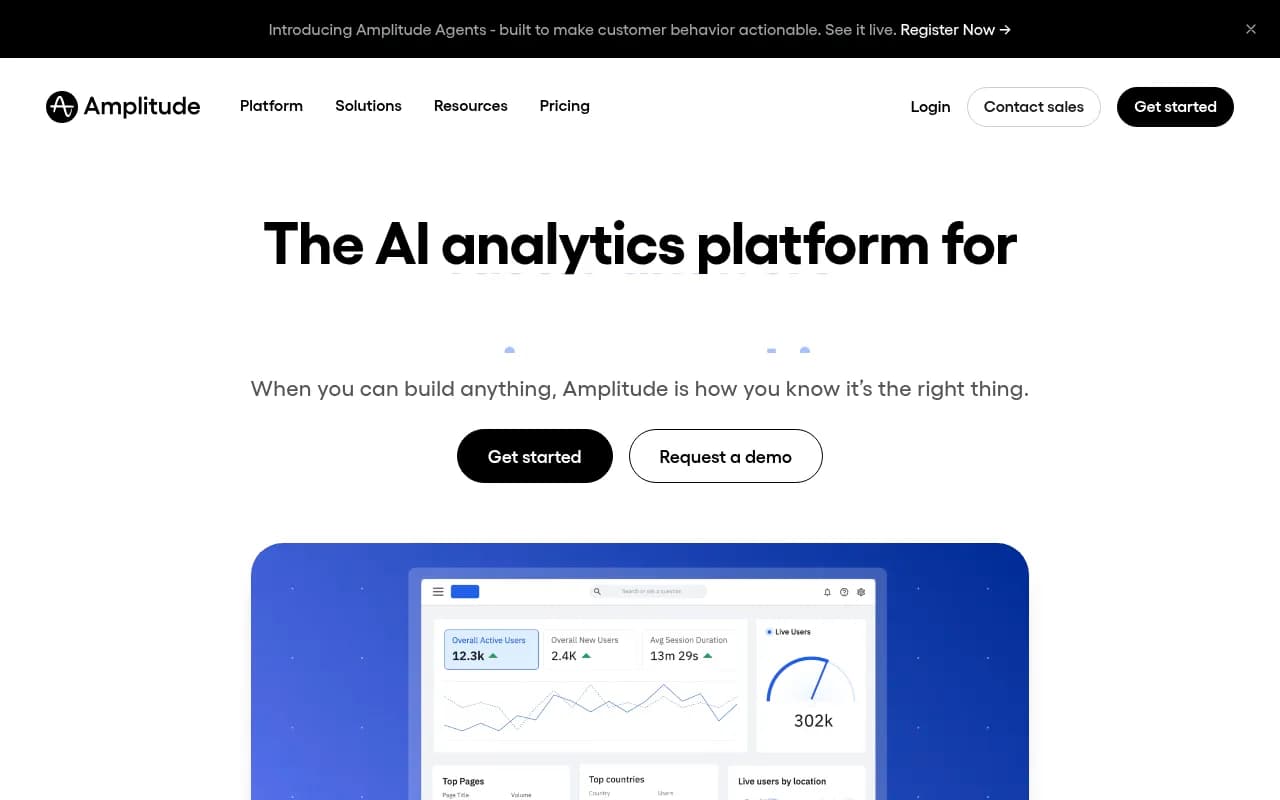
The AI anomaly detection is genuinely good. It surfaces unusual patterns in your data automatically, which means you're not just waiting for someone to notice that a metric moved. The platform also added AI-generated summaries for dashboards, which sounds gimmicky but turns out to be useful when you're sharing context with stakeholders who don't live in the tool.
What Amplitude does well beyond AI: it's the most complete platform for teams that need behavioral analytics, experimentation, and session replay in one place. The funnel analysis and retention charts are best-in-class. If you're running a growth team that needs to run experiments and measure their downstream impact on retention, Amplitude is still the most capable single tool for that workflow.
The catch is price. Amplitude's growth tier starts to hurt at scale, and the AI features are mostly gated behind higher plans. Teams paying $650-800/month for Amplitude are getting a lot, but smaller companies often find they're paying for capabilities they don't use.
Amplitude also doesn't support self-hosting, which matters for teams with strict data residency requirements.
Mixpanel in 2026: still the sharpest behavioral analytics tool
Mixpanel made a clear strategic choice years ago: be the best at behavioral analytics, not the most features. That bet looks smart in 2026. The product is genuinely polished in a way that Amplitude, with its broader surface area, sometimes isn't.
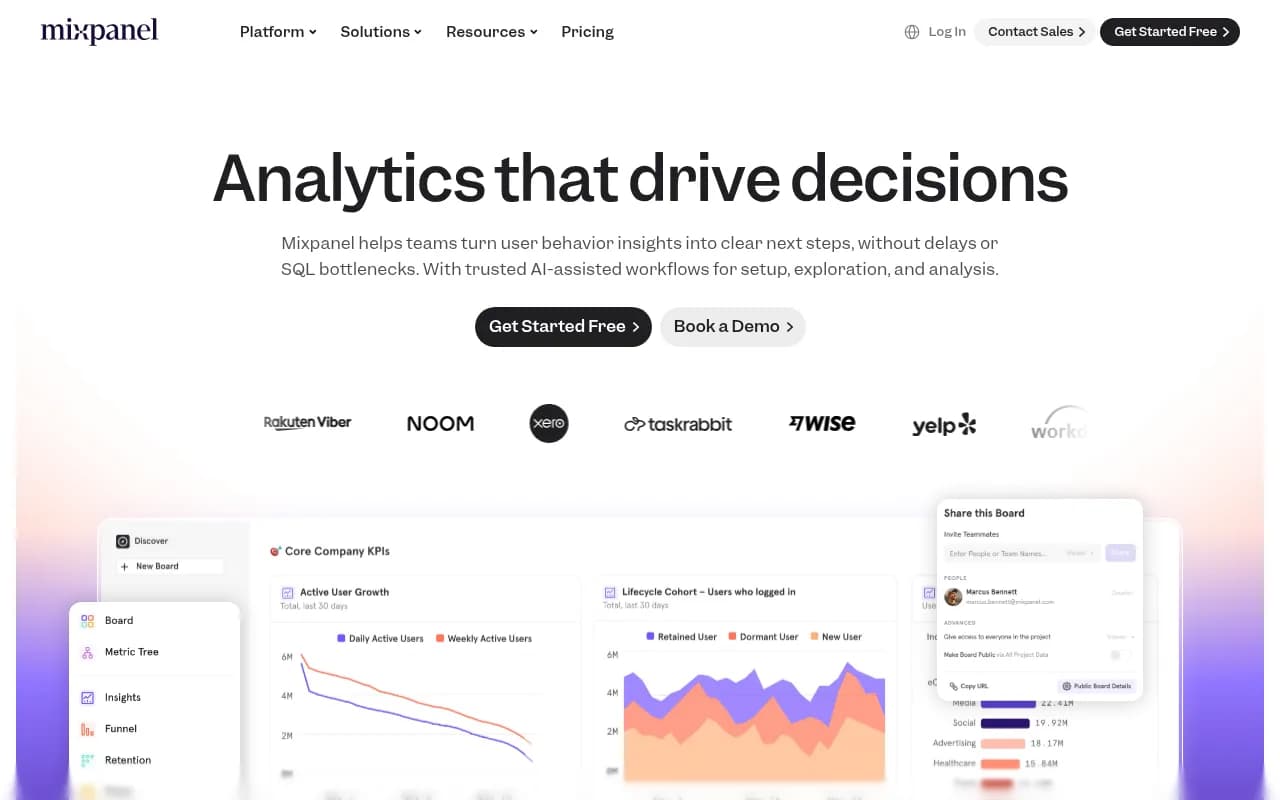
The AI features Mixpanel shipped focus on what the platform does best. Natural language querying works well for funnel and retention questions. The AI-powered "Spark" feature (their term for AI-generated insights) surfaces interesting segments and patterns without requiring you to know what you're looking for. It's not magic, but it's useful.
What Mixpanel doesn't have: session replay, feature flags, A/B testing, or SQL access. If you need those things, you're stitching together multiple tools. That's a real limitation for teams that want a unified stack.
Pricing is more accessible than Amplitude at the low end -- the free tier is usable for small teams, and the growth plan is reasonable. But like Amplitude, costs climb quickly as event volume increases.
The product manager persona is where Mixpanel shines. If your PM team wants to answer behavioral questions fast, without involving engineers for every query, Mixpanel's interface is the most intuitive of the four. Non-technical users can build meaningful analyses in minutes.
PostHog in 2026: the engineering team's Swiss Army knife
PostHog is the most interesting story in this comparison. It started as an open-source Mixpanel alternative and has since expanded into a genuinely comprehensive product stack: analytics, session replay, feature flags, A/B testing, surveys, and a data warehouse integration. All in one platform, with a generous free tier.
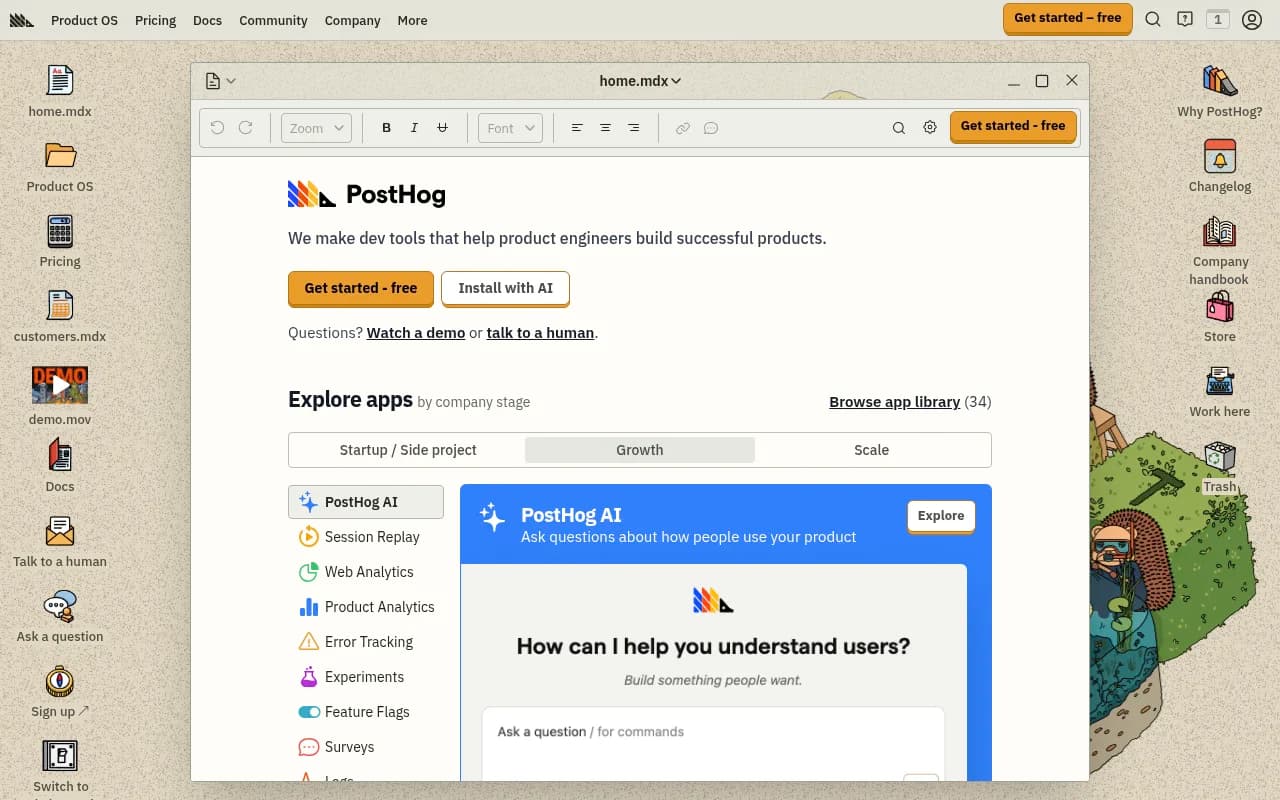
The AI features PostHog shipped are less mature than Amplitude or Mixpanel's. There's a natural language query interface, but it's more limited in scope. Where PostHog compensates is in the breadth of what you get for the price -- a team that would otherwise pay for Amplitude (analytics) + LaunchDarkly (feature flags) + a session replay tool can consolidate into PostHog at a fraction of the cost.
Self-hosting is PostHog's biggest differentiator. For teams in regulated industries or with strict data sovereignty requirements, the ability to run PostHog on your own infrastructure is genuinely valuable. No other platform in this comparison offers it.
The autocapture feature is good -- it tracks clicks, page views, and form submissions automatically, which reduces the instrumentation burden on engineering. You can layer manual event definitions on top for business-specific actions.
The honest limitation: PostHog's analytics depth doesn't match Amplitude or Mixpanel for complex behavioral analysis. The funnel and retention tools work, but they're not as flexible. If your team runs sophisticated cohort analyses or complex multi-step funnels regularly, you'll notice the gap.
PostHog is the right choice for engineering-led teams, startups watching costs, and anyone who values data control. It's not the right choice if your primary users are non-technical PMs who need to self-serve complex analyses.
Heap in 2026: autocapture pioneer, uncertain future
Heap's core insight -- capture everything automatically, then define events retroactively -- was genuinely innovative when it launched. The ability to go back and analyze user behavior from before you thought to track it is powerful.
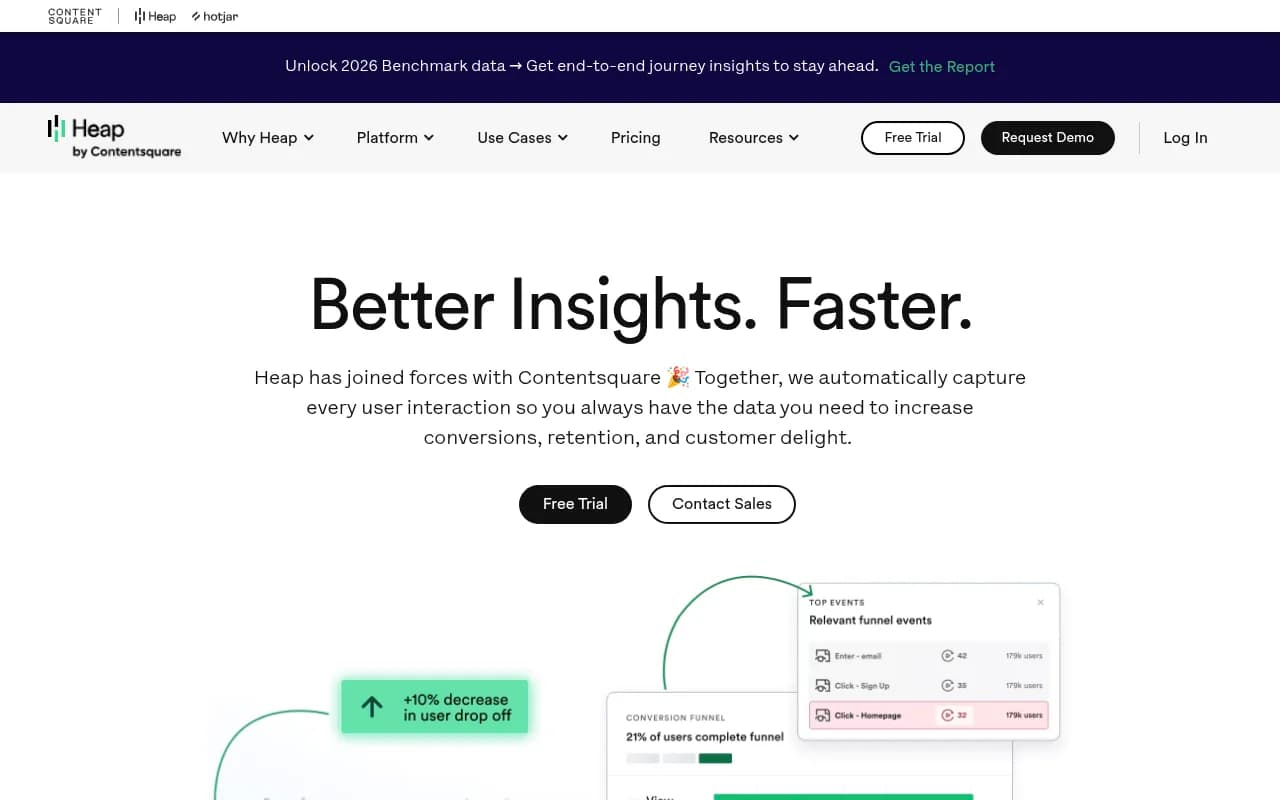
Since Contentsquare acquired Heap in 2023, the product roadmap has been harder to read. The AI features that shipped in 2025-2026 are real but feel less integrated than what Amplitude or Mixpanel delivered. Heap's "AI Insights" can surface patterns in your retroactive data, which is a natural fit for the platform's model, but the execution is uneven.
The pricing situation is the biggest problem. Heap doesn't publish pricing, which almost always means "expensive," and independent comparisons consistently put it at the high end of the market. For what you get -- analytics and retroactive event definition, without the feature flags, A/B testing, or session replay that PostHog bundles -- it's hard to justify unless you have a specific need for retroactive analysis at scale.
The Contentsquare integration does add behavioral analytics depth (heatmaps, session recordings) for teams that need it. But that's an additional cost layer, not something included in the base product.
Heap is worth evaluating if retroactive event analysis is a core requirement and you have budget. For most teams, the value proposition has weakened relative to the competition.
The AI features that actually matter
After a year of AI-native claims, here's what's genuinely useful across these platforms and what's mostly marketing:
Useful AI features:
- Natural language querying (all four platforms have this; Amplitude and Mixpanel's implementations are most mature)
- Anomaly detection and automated alerts (Amplitude leads here)
- AI-generated dashboard summaries for stakeholder sharing (Amplitude, Mixpanel)
- Suggested analyses based on your data patterns (Mixpanel's Spark, Amplitude's AI recommendations)
Less useful than advertised:
- "AI insights" that surface obvious correlations you'd find manually
- Automated report generation that requires significant cleanup before sharing
- Predictive features that need more data than most teams have to be accurate
The honest assessment: AI has made these tools meaningfully better for non-technical users who want to explore data without building charts from scratch. It hasn't replaced the need for a data-literate person on your team who understands what questions to ask.
Pricing reality check
The pricing landscape in 2026 looks roughly like this:
| Platform | Free tier | Entry paid | Mid-market | Notes |
|---|---|---|---|---|
| PostHog | 1M events/mo free | Usage-based | ~$450/mo at scale | Most generous free tier |
| Mixpanel | 20M events/mo free | ~$28/mo | ~$400-600/mo | Competitive at low end |
| Amplitude | 10M events/mo free | ~$49/mo | ~$650-800/mo | Costs climb fast |
| Heap | None | Custom | Custom | Consistently expensive |
PostHog's free tier is genuinely usable -- 1 million events per month covers most early-stage products. Mixpanel's free tier is also substantial. Amplitude's free tier is more limited in features than event volume.
The real cost comparison happens at scale. Teams with 50M+ monthly events are typically paying $600-1,000+/month for Amplitude or Mixpanel. PostHog's usage-based pricing can be more predictable, and self-hosting eliminates the per-event cost entirely (you pay infrastructure costs instead).
Which tool should you actually use?
The right answer depends on your team's composition, budget, and what you're trying to do.
Choose Amplitude if: You're a growth-stage or enterprise company with a dedicated data/analytics function, you need experimentation and behavioral analytics in one place, and you have budget. The AI features are the most mature, and the platform is the most capable for complex analysis.
Choose Mixpanel if: Your primary users are product managers who need to self-serve behavioral analysis without SQL. The interface is the most intuitive for non-technical users, and the AI features are well-integrated with the core analytics workflow.
Choose PostHog if: You're engineering-led, cost-conscious, or need data sovereignty through self-hosting. The all-in-one model (analytics + feature flags + session replay + A/B testing) is genuinely compelling, and the free tier is the most generous in the market.
Choose Heap if: Retroactive event analysis is a specific, core requirement for your team and you have the budget. Otherwise, the value proposition is harder to justify in 2026.
What's missing from all of them
One thing worth noting: none of these platforms does a great job of connecting product behavior to downstream revenue in a closed-loop way. You can track feature adoption, retention, and conversion within the product, but connecting that to actual ARR or pipeline requires stitching together your product analytics with your CRM and revenue data.
That's a gap that tools like Segment (for data unification) or dedicated attribution platforms address, but it means your product analytics tool is rarely the whole story.
The other gap: none of these tools tells you much about what's happening in AI search. If your product is being recommended (or not recommended) by ChatGPT, Perplexity, or Google AI Overviews, that's a different visibility problem -- one that product analytics tools aren't built to solve. For that, platforms like Promptwatch track how and where your brand appears in AI-generated responses, which is increasingly relevant as AI search drives more discovery traffic.

The bottom line
The AI features that shipped across these platforms in 2025-2026 are real improvements, not just marketing. Natural language querying and automated anomaly detection have meaningfully lowered the barrier to getting value from behavioral data. But they haven't changed the fundamental positioning of each tool.
Amplitude is the most capable and most expensive. Mixpanel is the most intuitive for non-technical users. PostHog is the best value for engineering teams. Heap is losing ground relative to the competition.
Pick the tool that matches how your team actually works, not the one with the most impressive demo. The best analytics platform is the one your team uses consistently -- and that usually means the one that fits your workflow, not the one with the longest feature list.