Heap (by Contentsquare) Review 2026
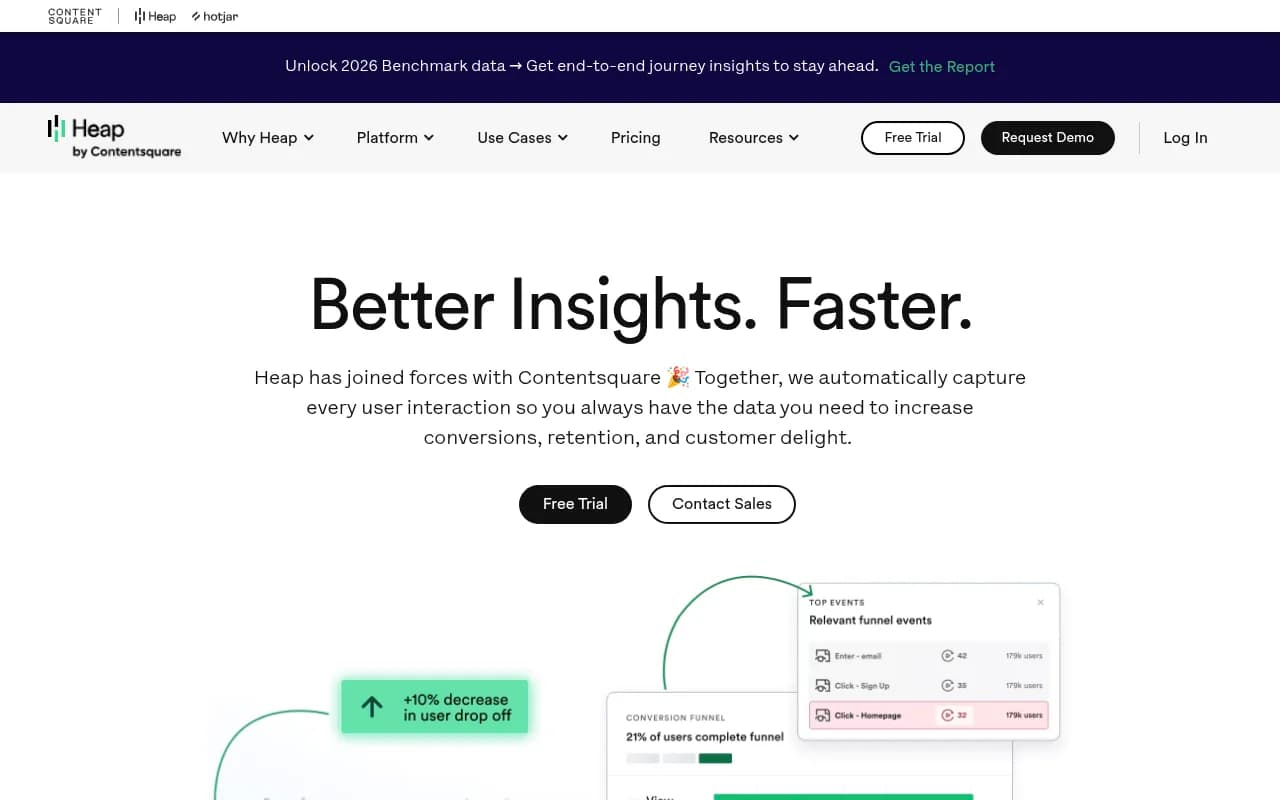
Heap by Contentsquare automatically captures every user interaction on your site or app without manual event tracking. Built for product, growth, and UX teams, it combines retroactive analytics, AI-powered insights, and session replay in one platform.
Key takeaways
- Heap's defining feature is retroactive, automatic event capture -- every click, tap, and form submission is recorded from day one, even before you define what to track
- The Contentsquare acquisition (2023) brought session replay and qualitative insights into the same platform, making it a more complete digital experience tool than it was as a standalone analytics product
- Pricing starts free (up to 10k monthly sessions) and scales through Growth, Pro, and Premier tiers -- but mid-market and enterprise pricing is opaque and requires a sales conversation
- Strong fit for product and growth teams at SaaS companies and e-commerce brands; less ideal for small teams that need simple dashboards or enterprises already deep in a Mixpanel or Amplitude workflow
- The AI CoPilot (Sense AI) is genuinely useful for non-technical users who want answers without writing queries, though it's still maturing
Heap has been around since 2013, founded by Matin Durrani and Ravi Parikh out of a frustration that most analytics tools required you to decide in advance what to track. That premise -- that you shouldn't have to instrument every event before you can analyze it -- became the core of Heap's identity. The company raised over $95 million in venture funding before being acquired by Contentsquare in 2023, at which point it became part of a broader "Experience Intelligence" platform alongside Contentsquare's heatmaps, session replays, and journey analysis tools.
The product today sits at an interesting intersection: it's a product analytics tool with the depth of Mixpanel or Amplitude, but with an autocapture philosophy that's closer to PostHog or FullStory. The Contentsquare integration has added qualitative layers -- session replay, friction detection -- that make it more of an end-to-end digital experience platform than a pure analytics tool. Whether that's a strength or a source of complexity depends on what you're trying to do.
The target audience is primarily product managers, growth teams, and UX researchers at mid-market SaaS companies and e-commerce brands. Heap claims over 10,000 companies use the platform, with customers including Dropbox Sign, Eventbrite, Walmart Labs, and Northwestern Mutual. That's a wide range, which reflects both the platform's flexibility and the fact that it's trying to serve multiple personas at once.
Key features
Autocapture and retroactive analysis
This is the feature that built Heap's reputation. When you install a single JavaScript snippet, Heap starts recording every user interaction -- clicks, taps, form submissions, page views, swipes -- without you defining a single event. The real power is retroactive: if you decide six months later that you want to analyze how many users clicked a specific button before converting, you can go back and query that data even though you never explicitly tracked it. Competitors like Mixpanel require you to instrument events before you can analyze them, which means gaps in your data whenever you forget to track something. Heap eliminates that problem entirely. The tradeoff is data volume -- capturing everything means you're storing a lot, and on lower tiers this can hit session limits quickly.
Heap Illuminate
Illuminate is Heap's data science layer, and it's genuinely differentiated. Rather than waiting for you to ask the right question, Illuminate proactively surfaces patterns in your data -- friction points, drop-off moments, and behavioral signals that correlate with conversion or churn. It can identify, for example, that users who encounter a specific error message are 3x more likely to abandon a checkout flow, even if no one on your team thought to look for that. The "unknown unknowns" framing in Heap's marketing is mostly about this feature. In practice, Illuminate works best when you have substantial traffic -- the signal-to-noise ratio improves significantly above a few thousand monthly active users.
Session replay integration
Post-Contentsquare acquisition, Heap now includes integrated session replay. The key differentiator here versus standalone replay tools like Hotjar or FullStory is that Heap connects quantitative events directly to replay sessions. If your funnel analysis shows a 40% drop-off on step 3, you can click through to watch actual session recordings of users who dropped off at that exact point. You're not hunting through thousands of random sessions -- Heap directs you to the relevant ones. This saves real time and makes qualitative investigation much more targeted.
Funnels and conversion analysis
Heap's funnel builder lets you define multi-step conversion flows and analyze drop-off at each stage. You can segment by user properties, compare cohorts, and look at time-to-convert. One useful capability is the ability to build funnels retroactively using autocaptured events -- you don't need to have had a funnel defined when the user went through the flow. The funnel analysis also shows "alternate paths," meaning it surfaces what users actually did between steps rather than just showing you the drop-off rate.
Retention and cohort analysis
Heap's retention charts show how often users return to perform key actions over time. You can define retention in terms of any event (not just logins), which is useful for product teams trying to measure feature-specific retention. Cohort analysis lets you group users by acquisition date, first action, or any behavioral property and compare retention curves across groups. This is table-stakes for a product analytics tool, and Heap's implementation is solid without being exceptional.
User journey and path analysis
Path analysis in Heap shows the actual routes users take through your product, including unexpected ones. You can set a start and end point and see all the paths users took between them, or you can start from a specific event and see where users go next. This is useful for understanding navigation patterns and identifying where users get lost. The visualization can get cluttered with complex products, but the ability to filter by segment helps.
Sense AI / CoPilot
Heap's AI layer, branded as Sense AI with a CoPilot interface, lets non-technical users ask questions in plain English and get analytics answers without building charts manually. "How many users completed onboarding last month?" or "What's the conversion rate for users who used feature X?" are the kinds of queries it handles well. It's genuinely useful for democratizing data access across teams -- a customer success manager can get answers without filing a data request. The quality of answers depends on how well your events are named and organized, which is a recurring theme with AI analytics tools.
Data governance and event management
One of Heap's practical strengths is its event management layer. Because autocapture generates a lot of raw data, Heap provides tools to organize, label, and govern that data. You can create "virtual events" by combining or filtering raw captured events, define properties, and set up a data dictionary. This is important for larger teams where multiple people are building analyses -- without governance, autocapture data can become chaotic. The governance tools are more mature than what you'd find in PostHog, though still not as enterprise-grade as what Amplitude offers.
Integrations ecosystem
Heap claims over 100 integrations. The most commonly used include Salesforce, HubSpot, Marketo, Segment, Amplitude, Slack, and various data warehouse connectors (Snowflake, BigQuery, Redshift). There's also a REST API for custom data pipelines. The Contentsquare integration is native and deep, which is the main benefit of the acquisition for existing Heap users.
Who is it for
The clearest fit is product managers and growth teams at B2B SaaS companies with 50 to 500 employees. These are teams that ship features regularly, care about activation and retention metrics, and don't have a dedicated data engineering team to instrument every event manually. Heap's autocapture removes the dependency on engineering for basic analytics, which is a real operational benefit. A PM who wants to know how users are interacting with a new feature can get that data immediately after launch, without waiting for a sprint to add tracking.
E-commerce and consumer apps are also a strong use case, particularly for conversion optimization. The combination of funnel analysis, session replay, and Illuminate's friction detection maps well onto the "why are users dropping off at checkout?" question that e-commerce teams ask constantly. Customers like Huel (30% conversion increase) and LendingClub ($1M+ loan volume increase) suggest the platform delivers real results in these contexts.
Teams that should probably look elsewhere: very small startups (under 5k monthly users) where the free tier's 10k session limit will feel constraining and the platform's complexity is overkill; pure data teams that want a warehouse-native analytics tool and prefer writing SQL; and enterprises already deeply invested in Amplitude or Mixpanel with years of instrumented events, where the switching cost is high and the autocapture advantage is less compelling.
Integrations and ecosystem
Heap's integration list is genuinely broad. Key connections include:
- CRM and marketing: Salesforce, HubSpot, Marketo, Intercom, Customer.io
- Data warehouses: Snowflake, BigQuery, Redshift, Azure Synapse -- Heap can push data to your warehouse for custom analysis
- CDPs: Segment (bidirectional), mParticle
- A/B testing: Optimizely, LaunchDarkly
- Support and success: Zendesk, Gainsight
- Collaboration: Slack (for alerts and sharing)
The REST API allows custom event ingestion and data export. Heap also supports server-side event tracking for cases where client-side capture isn't sufficient (backend events, mobile apps). Mobile SDKs are available for iOS and Android, which extends autocapture to native apps -- a meaningful advantage over web-only tools.
The Contentsquare ecosystem is the newer dimension. Heap users get access to Contentsquare's heatmaps, zone-based analysis, and journey mapping tools depending on their contract, which creates a more complete picture of the digital experience than either product offered alone.
Pricing and value
Heap's pricing structure has four tiers:
- Free: Up to 10,000 monthly sessions. Includes core analytics features. Good for early-stage products validating product-market fit.
- Growth: Designed for scaling startups. Pricing not publicly listed -- requires contacting sales or signing up to see. Includes more sessions, additional features.
- Pro: Mid-market tier with more advanced features, higher session limits, and priority support. Pricing on request.
- Premier: Enterprise tier with custom pricing, dedicated support, advanced security, and full Contentsquare integration.
The lack of transparent pricing above the free tier is a real friction point. Competitors like PostHog publish detailed pricing calculators, and Mixpanel has clear per-event pricing. Heap's approach means you can't evaluate cost without a sales conversation, which is annoying for teams doing vendor comparisons. Based on third-party sources, Growth plans typically start around $3,600/year and Pro plans can run $12,000-$36,000/year depending on session volume -- but these numbers are not confirmed by Heap directly.
For the free tier, 10,000 monthly sessions is enough to get started but will feel limiting for any product with real traction. The jump to paid is significant.
Strengths and limitations
What Heap does well:
- Retroactive analysis is genuinely unique at this price point. The ability to go back and analyze events you never explicitly tracked is a real competitive advantage over Mixpanel and Amplitude for teams without dedicated analytics engineers.
- Autocapture reduces time-to-insight significantly. New features are automatically tracked from the moment they ship, without any instrumentation work.
- The quantitative-qualitative bridge -- connecting funnel drop-offs directly to session replays -- is more seamless than stitching together separate tools like Mixpanel and Hotjar.
- Illuminate's proactive insights surface things you wouldn't have thought to look for, which is genuinely useful for teams that don't have time to run exhaustive analyses.
Honest limitations:
- Pricing opacity above the free tier makes it hard to evaluate without a sales call. For a tool competing with PostHog (which has transparent, usage-based pricing) and Mixpanel (clear per-event pricing), this is a real disadvantage.
- Data volume and governance complexity: Autocapturing everything is powerful but creates noise. Teams without a clear data governance process end up with hundreds of unnamed events and cluttered dashboards. This is manageable but requires discipline.
- The Contentsquare integration is still maturing: The acquisition happened in 2023, and while the products are increasingly connected, some workflows still feel like two separate tools bolted together rather than a native unified experience.
- Less suitable for complex custom analytics: Teams that need highly customized data models, warehouse-native analytics, or complex multi-touch attribution will find Heap's capabilities less flexible than building on top of a data warehouse with a tool like Looker or Metabase.
Bottom line
Heap is the right choice for product and growth teams at SaaS companies and e-commerce brands who want comprehensive behavioral analytics without the overhead of manual event instrumentation. The autocapture approach, combined with Illuminate's proactive insights and the session replay integration, makes it one of the more complete out-of-the-box analytics platforms available in 2026.
The best use case in one sentence: a mid-market SaaS product team that wants to understand exactly where users drop off, why, and what to fix -- without filing engineering tickets every time they want new data.
Tags:
Frequently asked questions
What makes Heap different from tools like Mixpanel or Amplitude?
Is there a free plan?
How much does Heap cost?
What is Heap Illuminate?
Does Heap include session replay?
Who is Heap best suited for?
Similar and alternative tools to Heap (by Contentsquare)