Key takeaways
- Peec AI has transparent, self-serve pricing starting at €89/month with a free trial. Meridian requires a demo call and offers no public pricing -- expect enterprise-level costs.
- Meridian positions itself as a managed growth service with human execution baked in. Peec AI is a pure analytics dashboard you run yourself.
- Both tools cover the major LLMs (ChatGPT, Perplexity, Gemini, Claude, Grok, DeepSeek, etc.), so model coverage isn't a meaningful differentiator.
- Neither tool includes self-serve content generation or answer gap analysis -- they're both primarily monitoring platforms.
- Peec AI is trusted by 2,000+ marketing teams and has a clear product roadmap visible in its UI. Meridian is newer and less transparent about its customer base.
- If your team wants to act on data (not just view it), both tools have real limitations -- and you'll likely need to pair either with a more optimization-focused platform.
Overview
Meridian
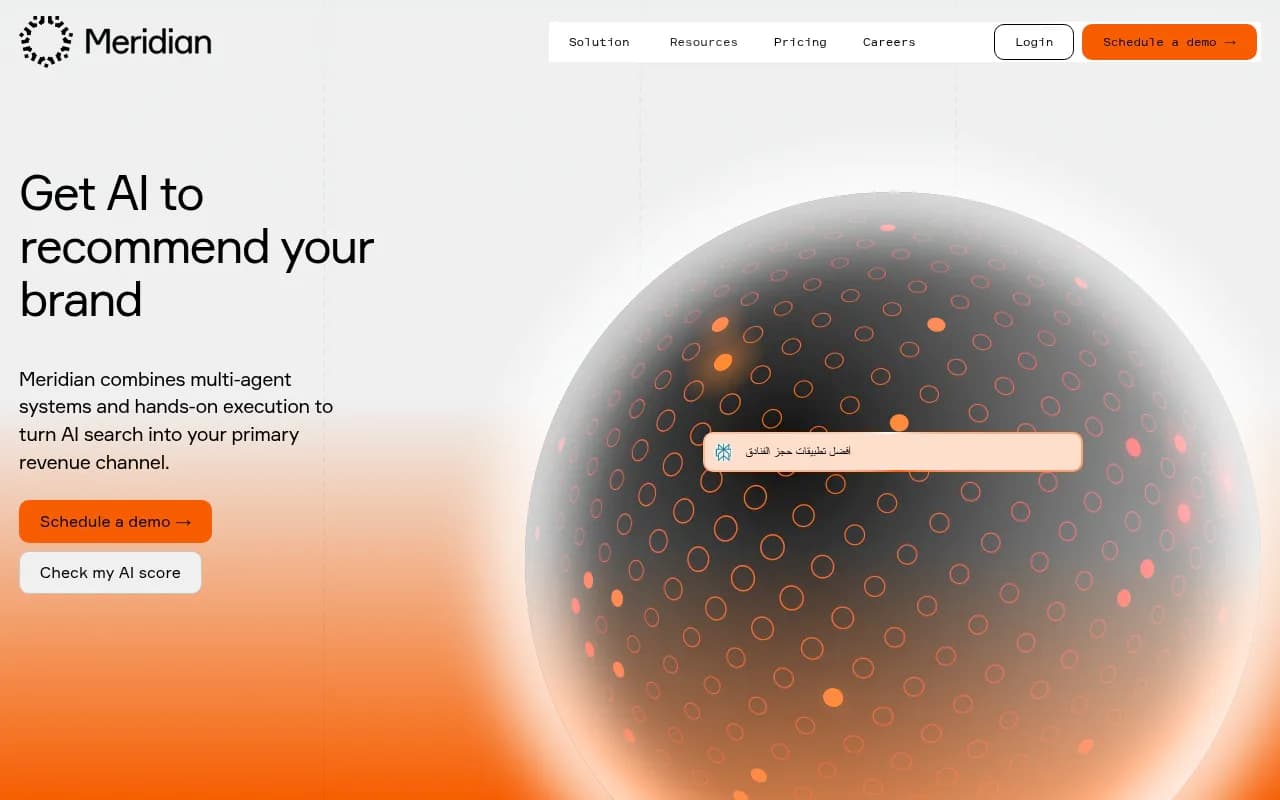
Meridian describes itself as an "agentic AI platform" for AI search optimization. The pitch is that it combines multi-agent systems with hands-on execution -- meaning you get both a monitoring dashboard and a team that helps you act on the data. It tracks visibility, sentiment, citations, and competitive benchmarking across ChatGPT, Perplexity, Gemini, Google AI, Grok, DeepSeek, Copilot, Meta AI, and Claude.
The "agentic" framing is interesting. Meridian isn't just selling you a tool -- it's selling a growth system. That's a meaningful distinction from most AI visibility platforms, which hand you a dashboard and wish you luck. The trade-off is that pricing is entirely opaque (demo required), which makes it hard to evaluate without committing time to a sales process.
Peec AI

Peec AI is a self-serve AI search analytics platform built for marketing teams. It tracks three core metrics -- visibility (share of chats where your brand appears), position (where you rank in AI responses), and sentiment (how AI models describe your brand) -- across the major LLMs.
The product is clean and focused. You add prompts, organize them with tags, track across countries, and benchmark against competitors. It's used by 2,000+ marketing teams and agencies, and the pricing is refreshingly transparent. It won't do the work for you, but it gives you solid data to work with.
Side-by-side comparison
| Feature | Meridian | Peec AI |
|---|---|---|
| Pricing model | Custom (demo required) | Transparent, from €89/mo |
| Free trial | No | Yes |
| Self-serve signup | No | Yes |
| AI models tracked | 9 (ChatGPT, Perplexity, Gemini, Claude, Google AI, Grok, DeepSeek, Copilot, Meta AI) | 10 (same + additional) |
| Visibility tracking | Yes | Yes |
| Sentiment tracking | Yes | Yes |
| Position tracking | Yes | Yes |
| Citation analysis | Yes | Yes (Sources tab) |
| Competitor benchmarking | Yes | Yes |
| Multi-language/region | Yes (shown in demo UI) | Yes (track across countries) |
| Content generation | No (human-assisted only) | No |
| Answer gap analysis | Not publicly documented | No |
| AI crawler logs | Not publicly documented | No |
| Managed execution layer | Yes (core differentiator) | No |
| API access | Not publicly documented | Not publicly documented |
| Target audience | Mid-market to enterprise brands | Marketing teams, agencies |
Head-to-head feature deep-dive
Pricing and accessibility
This is where the two tools diverge most sharply.
Peec AI publishes its pricing. Starter is €89/month (roughly $103) for 50 prompts and 10 models. Growth is €199/month for 150 prompts and 2 workspaces. Enterprise is custom. You can start a free trial without talking to anyone.
Meridian shows you nothing until you book a demo. No tiers, no ballpark figures, no "starting from." That's a deliberate choice -- it signals that Meridian is selling a service engagement, not a software subscription. For some buyers that's fine. For a marketing manager trying to evaluate options on a Tuesday afternoon, it's a friction point.
Verdict: Peec AI wins on accessibility. Meridian's pricing model is appropriate for its service-heavy positioning, but it makes comparison shopping difficult.
Monitoring and analytics
Both tools track the same core metrics: visibility (how often your brand appears in AI responses), position (where you rank), and sentiment (how AI models describe you). Both benchmark against competitors and track citations.
Peec AI's dashboard is clean and well-documented. The UI shows visibility trending over time, competitor comparisons side by side, and a Sources tab for citation analysis. You can organize prompts with tags, filter by model, and export data.
Meridian's monitoring appears comparable in scope -- its demo UI shows visibility scores, sentiment scores, position tracking, and competitor mentions across multiple LLMs. The multi-language capability is explicitly shown (Japanese-language prompts appear in their demo). Whether the underlying data depth differs is hard to assess without access to both platforms.
Verdict: Roughly comparable on core monitoring. Peec AI's transparency about features gives it an edge in evaluation -- you know what you're getting before you buy.
Execution and action-taking
This is Meridian's clearest differentiator. The platform explicitly combines monitoring with "hands-on execution" -- the idea being that Meridian's team helps you act on the data, not just look at it. Whether that means content recommendations, optimization playbooks, or actual content production isn't fully spelled out on the website, but the positioning is consistent: this is a growth system, not just a tracker.
Peec AI is a pure analytics tool. It shows you data. What you do with it is up to you. There's no built-in content generation, no gap analysis workflow, no optimization recommendations surfaced in the product.
Verdict: Meridian wins here -- but only if you actually need managed execution and are willing to pay for it. If you have an in-house team that can act on data, this advantage disappears.
AI model coverage
Both platforms cover the models that matter: ChatGPT, Perplexity, Gemini, Claude, Google AI, Grok, DeepSeek, Copilot, and Meta AI. Peec AI's Starter plan explicitly covers 10 models. Meridian's website shows the same set of logos.
Verdict: Effectively a tie. Neither platform has a meaningful edge here.
Multi-language and multi-region support
Meridian's demo UI explicitly shows non-English prompts (Japanese), which suggests real multi-language capability. Peec AI lets you track across countries and supports custom prompts in any language.
Verdict: Both handle multi-language tracking. Meridian's demo makes it more explicit, but Peec AI's country-level tracking is well-documented.
Ease of use and onboarding
Peec AI is self-serve. You sign up, add prompts, and start tracking. The interface is straightforward enough that a marketing manager can get value from it without a training session.
Meridian requires a demo call to even get started. That's not inherently bad -- complex tools often need onboarding -- but it does mean there's a sales process before you see the product.
Verdict: Peec AI is significantly easier to evaluate and onboard. Meridian's process is appropriate for enterprise buyers but creates friction for everyone else.
Pricing comparison
| Plan | Meridian | Peec AI |
|---|---|---|
| Free trial | No | Yes |
| Entry-level | Custom (demo required) | €89/mo (~$103) -- 50 prompts, 10 models |
| Mid-tier | Custom | €199/mo -- 150 prompts, 2 workspaces |
| Enterprise | Custom | Custom |
Peec AI's annual billing likely offers a discount (common for SaaS at this price point), though exact figures aren't published. Meridian's pricing is entirely undisclosed.
Pros and cons
Meridian
Pros:
- Managed execution layer means you're not left to figure out optimization on your own
- Multi-agent system framing suggests more sophisticated automation than a basic dashboard
- Multi-language support is explicitly demonstrated
- Covers all major LLMs
Cons:
- No public pricing -- you can't evaluate cost without a sales call
- No free trial
- Newer platform with less documented customer base
- Hard to assess data depth or feature completeness without a demo
- Content generation and gap analysis capabilities are not clearly documented
Peec AI
Pros:
- Transparent pricing starting at €89/month
- Free trial available -- no sales call required
- Clean, well-documented dashboard
- Trusted by 2,000+ teams
- Covers 10 AI models on all plans
- Multi-country tracking built in
Cons:
- Monitoring-only -- no content generation, no gap analysis, no optimization recommendations
- No AI crawler logs or traffic attribution
- Limited prompt volume on entry plan (50 prompts on Starter)
- No managed service or execution support
Who should pick which tool
Pick Meridian if:
- You're a mid-market or enterprise brand with budget for a managed service
- You want someone to help you execute on AI visibility improvements, not just hand you data
- You're comfortable with a demo-first sales process
- Your team lacks the bandwidth to act on raw analytics independently
Pick Peec AI if:
- You want to start tracking AI visibility quickly without a sales call
- Your budget is under $200/month
- You have an in-house marketing or SEO team that can interpret and act on data
- You want to evaluate the tool before committing -- the free trial makes this easy
- You're an agency managing multiple brands (the Growth plan's 2-workspace setup helps here)
Consider a third option if:
Both Meridian and Peec AI are primarily monitoring tools. If your goal is to actually improve your AI search visibility -- not just track it -- you'll want a platform that closes the loop between data and action. Promptwatch is worth looking at here: it combines visibility tracking with answer gap analysis and a built-in AI writing agent that generates content engineered to get cited by ChatGPT, Claude, and Perplexity. It's the difference between knowing you're invisible and doing something about it.

Final verdict
Peec AI is the more practical choice for most marketing teams in 2026. The pricing is transparent, the free trial removes risk, and the dashboard covers the core metrics you need. It won't help you act on the data, but it gives you a clear picture of where you stand.
Meridian is a better fit if you're buying a service, not just a tool -- the managed execution layer is a real differentiator for teams that need help beyond the dashboard. But the opaque pricing and demo-required model make it hard to recommend without knowing your budget and team size first.
The honest summary: if you can afford Meridian's likely price point and want hands-on support, it's worth a demo. If you want to start tracking today without a sales call, Peec AI is the faster, lower-risk path.