Key takeaways
- Procurement managers and logistics buyers increasingly use ChatGPT, Perplexity, and Google AI Overviews to research vendors before ever contacting sales — if your brand isn't cited, you're not in consideration.
- Most AI visibility tools are built for B2C or SaaS; logistics brands need tools that handle long buying cycles, technical queries, and multi-region monitoring.
- The best tools in 2026 go beyond monitoring: they identify content gaps, help you create content that gets cited, and track whether it's working.
- Promptwatch is the only platform rated "Leader" across all GEO categories in a 2026 comparison of 12 platforms — and it's the only one with a full action loop: find gaps, create content, track results.
- For logistics brands specifically, prompt intelligence (volume + difficulty scoring), crawler logs, and multi-region support are non-negotiable features.
Why logistics brands have an AI visibility problem
Here's a scenario that's playing out right now across the industry. A VP of Operations at a mid-size manufacturer needs a new 3PL partner. She opens ChatGPT and types: "What are the best third-party logistics providers for cold chain distribution in the Midwest?"
ChatGPT gives her five names. If yours isn't one of them, you've already lost the deal — before a single sales call, before a single RFP.
This is the new reality for logistics and supply chain brands. AI models have become the first stop in B2B research, especially for complex, high-stakes decisions where buyers want a shortlist fast. The problem is that most logistics companies have zero insight into how AI models describe them, position them against competitors, or whether they're even mentioned at all.
Traditional SEO doesn't solve this. Ranking on page one of Google doesn't guarantee you'll appear in a ChatGPT answer. The signals AI models use to decide who to cite — authoritative content, structured data, third-party mentions, Reddit discussions, industry publications — are different from classic ranking factors.
That's what Generative Engine Optimization (GEO) addresses. And it's why the right AI visibility tool matters so much for logistics brands in 2026.
What makes logistics and supply chain a uniquely hard GEO problem
Before getting into the tools, it's worth being specific about why logistics is harder than, say, SaaS.
The buying cycle is long and involves multiple stakeholders. A procurement manager, a logistics director, a CFO, and an operations lead might all be researching the same vendor decision — each asking AI tools different questions at different stages. You need visibility across informational queries ("how does cross-docking work"), comparison queries ("DHL vs XPO for last-mile delivery"), and decision queries ("best freight forwarder for Asia-Pacific trade lanes").
The queries are highly technical and often regional. "Best cold chain logistics provider in the Netherlands" is a completely different prompt from "top refrigerated freight carriers in the US Southeast." Multi-region monitoring isn't optional — it's the whole game.
Competitors are often massive. You might be competing for AI citations against DHL, Maersk, or DB Schenker, who have enormous content libraries and brand authority. Knowing exactly where they're winning and why is the only way to find gaps you can realistically close.
Content is often thin or locked behind sales decks. Most logistics companies have great case studies — buried in PDFs that AI crawlers can't read. Getting that content into formats AI models can actually cite is a core part of the GEO challenge.
The 10 best AI visibility tools for logistics and supply chain brands
1. Promptwatch
Promptwatch is the most complete GEO platform available in 2026, and for logistics brands specifically, the combination of features is hard to beat.
The Answer Gap Analysis shows you exactly which prompts your competitors are appearing for that you're not — including highly specific logistics queries like "best freight audit software" or "3PL providers with WMS integration." You see the content gap, not just the visibility gap.
The built-in AI writing agent then generates content engineered to get cited — articles, comparisons, and listicles grounded in 880M+ citations analyzed. For logistics brands, this means content that matches the technical depth and specificity that AI models reward.
The AI Crawler Logs are particularly valuable here. You can see exactly which pages ChatGPT, Perplexity, and Claude are crawling on your site, how often they return, and what errors they're hitting. If your case studies are in a JavaScript-heavy format that GPTBot can't parse, you'll see it immediately.
Multi-region support with customizable personas means you can monitor how AI models respond to a procurement manager in Germany asking about European freight forwarding versus a supply chain director in Singapore asking about APAC logistics networks.
Pricing starts at $99/month (Essential: 1 site, 50 prompts), $249/month (Professional: 2 sites, 150 prompts, crawler logs), and $579/month (Business: 5 sites, 350 prompts). For logistics companies managing multiple regional brands or service lines, the Business tier is where the real value is.

2. Profound
Profound is a strong choice for enterprise logistics brands with dedicated analyst teams. It offers high-frequency AI answer tracking, raw data access via API, and multi-region support — all useful for complex supply chain organizations monitoring dozens of service categories.
The main limitation: Profound is primarily a monitoring tool. It shows you where you stand but doesn't help you fix it. For a logistics brand that needs to close content gaps fast, you'll need to pair it with a separate content strategy and writing workflow.
Pricing starts at $99/month (Starter, ChatGPT only) and scales to $399/month (Growth, adds Perplexity and Google AI Overviews) with Enterprise plans for full model coverage.
Profound

3. Semrush (AI Toolkit)
Semrush has been adding AI search capabilities to its existing platform, and for logistics brands already using it for traditional SEO, the AI Toolkit is a natural extension. It covers question and topic discovery, AI visibility dashboards, and some prompt tracking.
The limitation is that Semrush uses fixed prompts — you can't easily customize for the specific, technical queries that logistics buyers actually use. And there's no AI traffic attribution, so you can't connect AI visibility to actual pipeline or revenue.
Still, if your team is already in Semrush daily, the AI Toolkit reduces the number of tools you need to manage.
4. Ahrefs
Ahrefs added Brand Radar for AI search tracking, and it's useful for logistics brands that want to see brand mentions across AI models alongside their existing backlink and keyword data. The integration with Ahrefs' content gap analysis is genuinely helpful for identifying topics where competitors have authority you don't.
Like Semrush, the fixed prompt structure limits customization. And there's no AI traffic attribution — you can see visibility but can't tie it to business outcomes.
5. Otterly.AI
Otterly.AI is a monitoring-focused platform that tracks brand mentions across ChatGPT, Perplexity, and Google AI Overviews. It's simpler to set up than enterprise platforms and works well for logistics brands that are just starting to understand their AI visibility baseline.
The honest limitation: Otterly.AI stops at monitoring. No content gap analysis, no content generation, no crawler logs. It's a good starting point, but you'll outgrow it quickly once you want to actually improve your visibility rather than just measure it.
Otterly.AI

6. Peec AI
Peec AI is another monitoring-focused tool with a clean interface and reasonable pricing. For logistics brands with smaller marketing teams that need a simple way to track brand mentions across AI models, it's worth evaluating.
The gap analysis features are more limited than Promptwatch's Answer Gap Analysis, and there's no content generation capability. But for teams that just need to know "are we being mentioned, and how often," Peec AI gets the job done without overwhelming complexity.

7. AthenaHQ
AthenaHQ positions itself as an enterprise AI visibility platform with strong monitoring capabilities. For large logistics enterprises — think global freight forwarders or major 3PLs — the depth of tracking across multiple AI models is genuinely useful.
The gap between AthenaHQ and Promptwatch is the action layer. AthenaHQ shows you the data; it doesn't help you act on it. For a logistics brand that has a content team ready to execute, that's fine. For teams that need the full loop — find gaps, generate content, track results — it's a meaningful limitation.

8. Evertune AI
Evertune is built for enterprise and Fortune 500 brands, and some of the largest logistics companies in the world fit that profile. It offers strong GEO insights and brand perception tracking across AI models, with reporting depth that suits large organizations with complex stakeholder reporting needs.
The price point reflects the enterprise focus — it's not the right fit for mid-market logistics brands or regional carriers. But for a global 3PL or freight network that needs to monitor AI visibility across dozens of markets and service categories, Evertune is worth evaluating.
9. Scrunch AI
Scrunch AI tracks brand mentions and AI search visibility with a focus on making the data accessible to marketing teams without deep technical expertise. For logistics brands where the marketing team is small and the SEO function is shared with other responsibilities, Scrunch's simpler interface is an advantage.
Coverage across AI models is solid, and the competitive comparison features help logistics brands understand where they stand relative to specific competitors — useful when you're trying to close the gap on a specific rival in a specific service category.
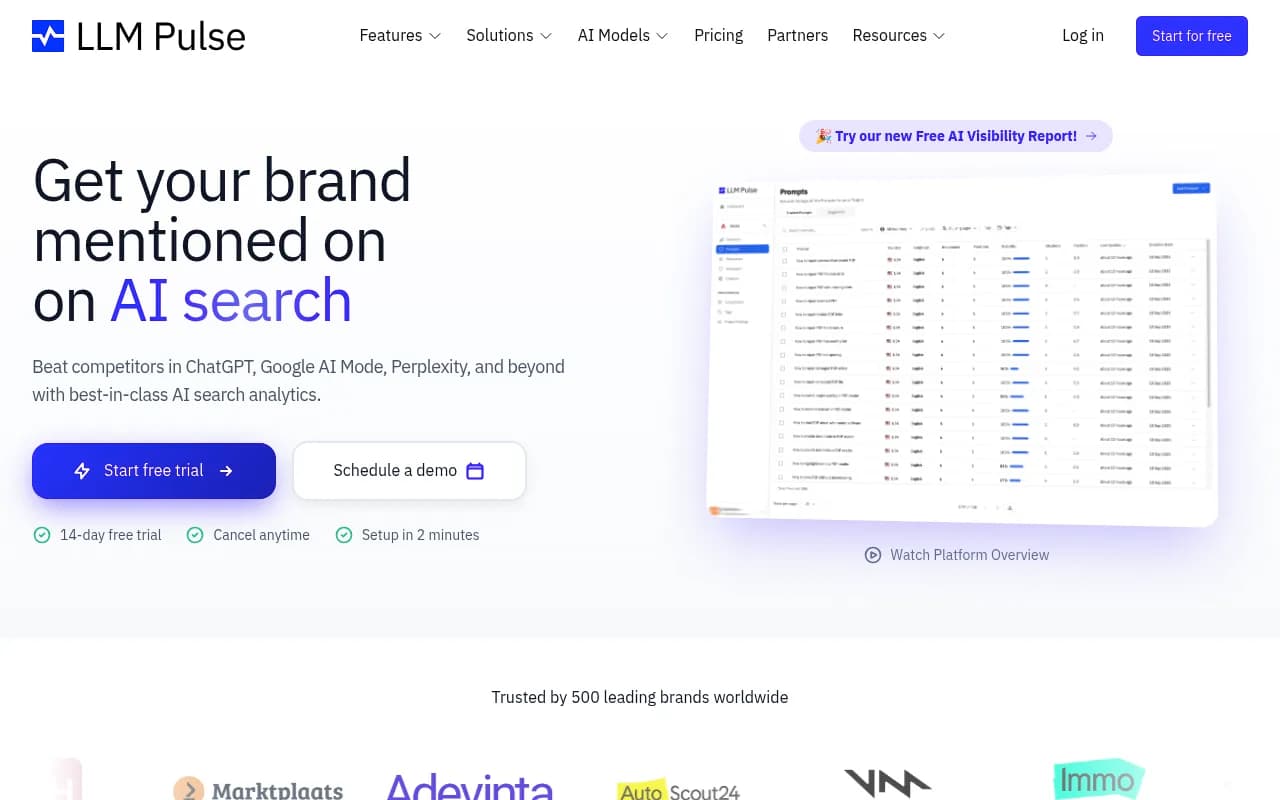
10. LLM Pulse
LLM Pulse is a straightforward AI search visibility tracker that covers ChatGPT, Perplexity, and other major models. For logistics brands that want basic monitoring without a large budget commitment, it's a reasonable entry point.
The feature set is limited compared to the platforms above — no crawler logs, no content generation, no deep prompt intelligence. But the pricing reflects that, and for a logistics brand that's just beginning to think about GEO, starting with a lightweight tool and upgrading later is a legitimate strategy.
Tool comparison: what matters for logistics brands
| Tool | Content gap analysis | Content generation | Crawler logs | Multi-region | Prompt volume/difficulty | Reddit/YouTube tracking | Pricing (starting) |
|---|---|---|---|---|---|---|---|
| Promptwatch | Yes | Yes (AI writing agent) | Yes | Yes | Yes | Yes | $99/mo |
| Profound | Limited | No | No | Yes | No | No | $99/mo |
| Semrush AI Toolkit | Partial | No | No | Partial | No | No | Bundled |
| Ahrefs Brand Radar | Partial | No | No | Partial | No | No | Bundled |
| Otterly.AI | No | No | No | Limited | No | No | ~$49/mo |
| Peec AI | No | No | No | Limited | No | No | ~$49/mo |
| AthenaHQ | Limited | No | No | Yes | No | No | Custom |
| Evertune AI | Yes | Partial | No | Yes | No | No | Enterprise |
| Scrunch AI | Limited | No | No | Limited | No | No | ~$99/mo |
| LLM Pulse | No | No | No | No | No | No | ~$29/mo |
GEO strategies specifically for logistics and supply chain brands
Build content around the prompts buyers actually use
The most common mistake logistics brands make with GEO is optimizing for generic queries. "Best logistics company" is not how a real buyer prompts an AI model. Real prompts look like:
- "What 3PL providers specialize in pharmaceutical cold chain logistics?"
- "How do I evaluate a freight forwarder for cross-border EU-UK shipments?"
- "Which TMS software integrates with SAP for mid-size manufacturers?"
Tools with prompt intelligence (Promptwatch's volume and difficulty scoring, for example) help you find the specific prompts that have real search volume and are actually winnable — not the ones dominated by DHL's content team.
Get your case studies out of PDFs
AI crawlers can't read PDFs well. Your best proof points — the case study where you reduced a client's freight costs by 23%, the white paper on cold chain compliance — are invisible to ChatGPT if they're locked in PDF format. Convert them to web pages with proper structured markup. This is one of the highest-ROI technical changes a logistics brand can make for GEO.
Crawler log data (available in Promptwatch's Professional tier and above) will show you exactly which pages AI crawlers are visiting and which they're missing — so you can prioritize what to fix.
Target the comparison queries
Logistics buyers use AI to build shortlists. Queries like "XPO vs Coyote for spot freight" or "best freight audit companies compared" are high-intent and often underserved by content. If you can get cited in comparison responses, you're in the consideration set before the buyer even knows they're building one.
The Answer Gap Analysis in Promptwatch shows you exactly which comparison queries your competitors are winning that you're not — and the AI writing agent can generate comparison content engineered to get cited.
Monitor Reddit and industry forums
A surprising amount of what AI models cite about logistics companies comes from Reddit, industry forums, and LinkedIn discussions. Procurement managers asking "has anyone used [carrier] for cross-border freight?" on r/supplychain get real answers — and those answers influence what AI models say about you.
Promptwatch's Reddit tracking surfaces these discussions so you can understand the narrative being built about your brand in the places AI models actually learn from.
Think multi-region from day one
A logistics brand operating in Europe, North America, and Asia-Pacific is effectively three different brands from an AI visibility perspective. The AI models that dominate in Germany (where Perplexity has strong adoption) differ from those dominant in the US. The prompts a German procurement manager uses differ from those of a Singapore-based supply chain director.
Set up separate monitoring for each region, with personas that match how buyers in each market actually prompt. This is where Promptwatch's multi-region and multi-language support pays off.
How to choose the right tool for your logistics brand
The honest answer depends on where you are in the GEO journey.
If you're just starting out and want to understand your baseline visibility, Otterly.AI or LLM Pulse give you a low-cost way to see where you stand. Expect to outgrow them within six months.
If you're a mid-market logistics brand with a marketing team that wants to actively improve visibility, Promptwatch's Professional tier ($249/month) is the most complete solution. The crawler logs, Answer Gap Analysis, and AI writing agent give you everything you need to find gaps and close them — not just measure them.
If you're a large enterprise 3PL or freight network with dedicated analyst resources, Profound or Evertune AI might fit your reporting and data access needs. But budget for a separate content strategy to act on what you find.
The key question to ask any vendor: "After you show me where I'm invisible, what do I do next?" Most tools don't have a good answer. The ones that do are worth the investment.
The bottom line
Logistics and supply chain brands are losing deals before they even know they're in a sales process. Procurement managers are asking AI models for vendor shortlists, and the brands that show up in those answers have a structural advantage that compounds over time.
GEO is not a future concern for logistics brands — it's a present one. The buyers are already there. The question is whether your content is.
Start by understanding where you stand. Then find the gaps. Then create content that closes them. Then track whether it's working. That loop — repeated consistently — is what separates logistics brands that win in AI search from those that don't.