Key takeaways
- First confirm what you are buying. InSpace publishes SEO and AI content marketing material, and I could not verify a documented AI-visibility feature set or public pricing, so ask whether it is software or an agency service.
- Data collection method matters most. Real user-interface monitoring and API calls can return different answers and citations.
- Engines behave differently and change abruptly. Your tool needs per-engine tracking and fast detection of shifts.
- Monitoring alone is the cheap part. The question that separates tools is whether they help you fix gaps and prove the fix worked.
- Test any tool with a pilot on your own prompts before committing to an annual plan.
Why this checklist exists
AI visibility is a young category and the buying process is messy. Vendors call themselves trackers, platforms, agencies and engines, sometimes all in the same paragraph. Pricing pages are hit and miss. Rankings of the best tools are very often written by one of the vendors being ranked.
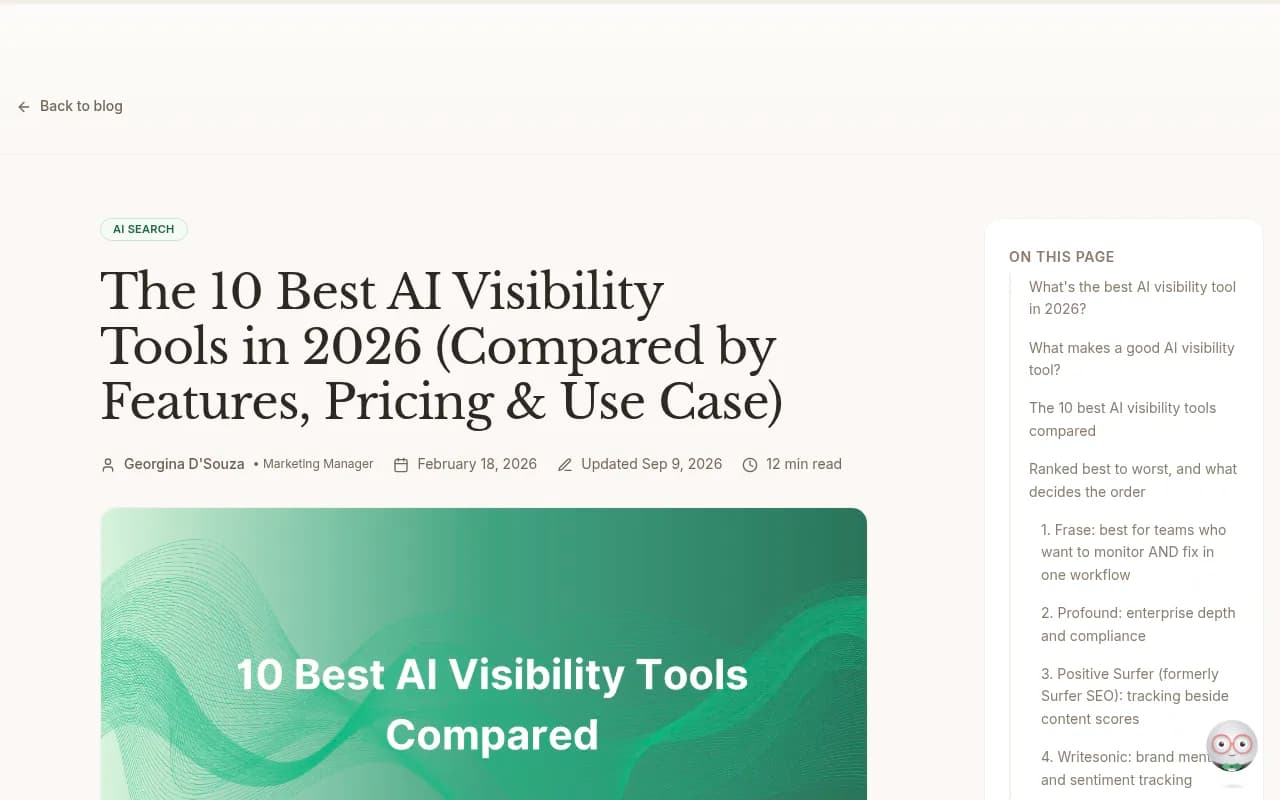
That last point is worth sitting with. The Frase article "10 Best AI Visibility Tools in 2026" names Frase as the winner. It still makes a useful point, though: the real dividing line between tools is whether they stop at the alert or help you fix what they found. I will use that lens throughout.
The backdrop is real. Frase cites SparkToro and Similarweb data showing about 68% of Google searches ended without a click in early 2026, and ChatGPT reaching roughly 900 million weekly users in February 2026. When the answer is the destination, being cited inside it matters. So you need a tool. You just need to pick the right one.
Here are ten questions, in the order I would ask them.
1. What exactly is this product?
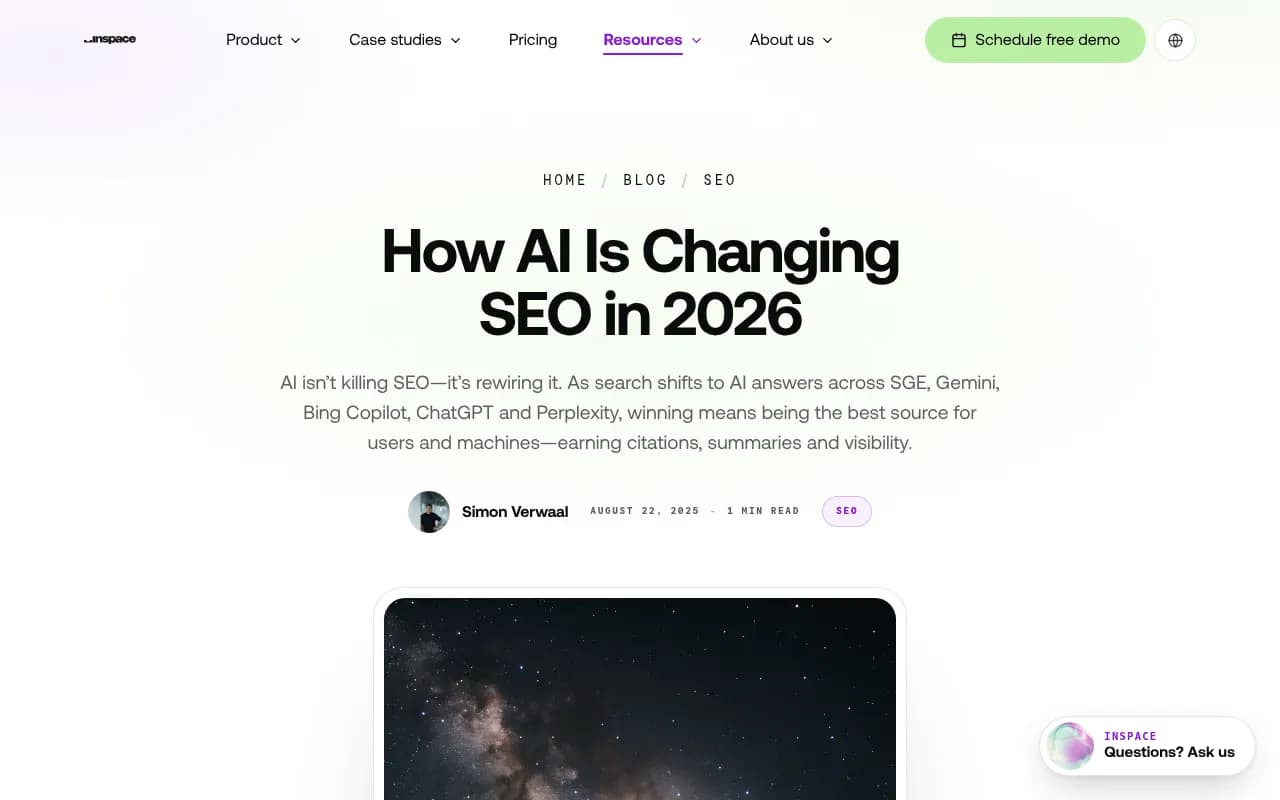
This is the question I would ask first for InSpace.io specifically. Its public pages read as content and SEO marketing: a blog on AI content tools, a piece on how AI is changing SEO, a 90-day plan, and something called NOVA by InSpace. The pages I reviewed did not show a pricing page or a clearly documented AI-visibility feature set. I did not verify either one.
So before any demo, get plain answers to these:
- Is it software you log into, a service run by consultants, or a hybrid?
- If it is software, which modules track AI visibility versus create content?
- If it is a service, who does the work, and what do you own at the end?
A "schedule a free demo" button is fine. Just make sure the demo shows the product doing visibility tracking on a real domain, not a slide deck about the future of SEO.
The same question applies to every vendor. A pure tracker, a content writer with a dashboard bolted on, and a full optimization platform are three different purchases at three different price points.
2. How does it collect its data?
This is the most technical question and probably the most important. There are two ways to see what an AI engine says about your brand: call its API, or monitor the actual user interface that people use.
They are not the same. User-facing answers, citations and shopping recommendations can differ from API outputs, because the consumer product layers on search, ranking and formatting that the raw model does not. If a tool only hits APIs, you may be measuring something your customers never see.
Ask the vendor directly:
- Do you monitor real UIs (ChatGPT, Gemini, Perplexity, AI Overviews, Claude) or call APIs?
- Can you show me a raw response alongside what I see when I type the same prompt?
- How large is the underlying dataset?
Promptwatch monitors the real interfaces and says its data covers 26B+ data points, which is the sort of disclosure you should expect from any vendor.

3. Which engines does it track, and separately?
Engines do not behave alike, so one blended "AI visibility score" can hide a lot. Promptwatch's data on average sources per response shows the spread: ChatGPT cites about 5 sources per web-search answer, Google AI Overviews about 10, and Perplexity almost exactly 10. Copilot's average swung from under 2 to nearly 17 within a few weeks before settling low.
If a tool lumps these together, you cannot tell whether a change came from your content or from the engine itself. Ask whether each engine is reported separately and whether the vendor flags engine-side shifts.
Also check the list against where your buyers actually are. Many cheap trackers cover ChatGPT and Perplexity only. If Google AI Overviews or AI Mode drives your category, that gap matters.
4. Does it capture query fan-outs?
When someone asks ChatGPT a question, it often runs its own web searches behind the scenes. Those are fan-outs. A tool that tracks only the user's prompt misses what the engine actually searched for, and that is usually where the optimization opportunity lives.
Promptwatch's ChatGPT query fanout data shows these patterns moving. Average fanouts per response fell from 2.15 in early December to about 1.84 by early March, and average query length shrank from about 117 characters to the high 80s. The same page says a single prompt can trigger 3 to 8 or more searches, which sits oddly next to those averages, so treat any single number with care. More recently, ChatGPT began using the site: operator at scale on August 8, 2026, taking it from about 0.4% to about 17% of fanout queries.
If fan-outs change that fast, a tool that ignores them is flying half blind.
5. How quickly does it notice engine changes?
AI engines change abruptly, and advice goes stale overnight. The clearest example: reddit.com's share of ChatGPT citations fell from about 4% to about 0.5% on August 14, 2026. In the Sep 28 to Oct 4, 2026 window, social platforms made up just 0.46% of ChatGPT citations while Google AI Overviews drew 12.2% from them. YouTube alone was 4.28% in AI Overviews.
A tool still telling you to "get on Reddit for ChatGPT" is out of date. Ask the vendor:
- How do you detect shifts like this?
- How often do your recommendations refresh?
- Can you show me a past example where you caught an engine change?
Similar logic applies to model rollouts. Promptwatch recorded a drop in average citations per response around the GPT-5.3 rollout on March 4, 2026. A good tool separates that kind of platform-level movement from your own results.
6. Can it show why you are or are not cited?
Mentions tell you what happened. They do not tell you why. The tools that help most expose the mechanics: whether AI crawlers can read your pages, which pages get cited, what content types win.
Useful signals to ask about:
- AI crawler logs, verified by IP so spoofed bots are filtered out
- Citation data by page, not only by domain
- Content type breakdowns. Promptwatch's data shows product pages were the most cited type in ChatGPT at 22.4% from Sep 28 to Oct 4, 2026
- Crawler traffic trends such as Meta-WebIndexer rising from about 2% to about 38% of tracked crawler requests between mid-July and August 9, 2026
Most trackers have none of the crawler side. If a vendor says "we see your brand in answers" but cannot say whether GPTBot even reached your site, you have a thermometer, not a diagnosis.
6b. A note on freebies
Before paying, run free checks to get a baseline. Frase offers a free AI Visibility Checker and a GEO Score, and Promptwatch has a free AI Visibility Report. They will not replace a paid tool but they give you something to compare a vendor's demo against.
7. Does it connect visibility to traffic and revenue?
Mentions are not money. Ask whether the tool shows AI-referred visits and conversions, and whether it can join crawls, citations, clicks and search console data per page. Without that, you will be explaining a visibility score to a CFO who wants to know what it did for pipeline.
It is worth asking for a case with a number in it. Crisp, for example, reported 2x higher conversion rates from AI traffic than traditional channels. A vendor with no attribution story is asking you to take the value on faith.
8. Does it help you fix gaps, or only report them?
This is the Frase article's dividing line, and I agree with it. Monitoring is a commodity. The expensive part of GEO work is deciding what to write, writing it, publishing it, and checking whether it worked.
Look for:
- Content gap analysis tied to real prompts
- A prioritized action list, not just charts
- Content generation grounded in citation data, not generic drafting
- CMS publishing and a way to track whether the new page gets crawled and cited
This is where categories split. Pure content writers like Jasper or Writesonic generate text but have no visibility data behind it. Monitoring tools like Otterly.AI or Peec AI show the gap but leave the work to you. Promptwatch's pitch is the closed loop: its Action Board and Content Agent plan, write and publish, then track results.

Otterly.AI


9. What does it actually cost per response?
Sticker prices mislead. A $99 plan with 25 prompts and one engine is not the same as $95 for 50 prompts across every model. Ask for:
- Prompts included, and how often they run (daily or weekly)
- Responses per month
- Engines, countries and languages included
- Seats, projects and whether agency or client access costs extra
- What happens when you exceed limits
Pricing changes often, so confirm on each vendor's own page. For reference, Promptwatch's entry plan is $95 a month with a free tier available, and annual billing gives 12 months for the price of 10. For InSpace I did not verify any pricing, so that is a first thing to request in writing.
A quick comparison of what to look for across common options:
| Tool type | Examples | Strength | Typical gap |
|---|---|---|---|
| Monitoring-only trackers | Otterly.AI, Peec AI, Rankscale | Cheap, quick setup | No crawler logs, no content help |
| Enterprise monitors | Profound, Scrunch | Depth, reporting | Higher price, limited execution |
| SEO suite add-ons | Semrush, Ahrefs Brand Radar | Familiar workflow | Fixed prompt sets, shallow AI data |
| Content tools | Jasper, Writesonic | Fast drafting | No visibility data to ground it |
| End-to-end platforms | Promptwatch | Track, fix and measure | More to learn up front |
| Agency or service offers | InSpace (to be confirmed) | Hands-on work | Less transparency on tooling |
Profound

10. How will we test it, and how do we leave?
The last question is about you, not the vendor. Run a pilot on one real use case: say 30 prompts across two engines for one product line. Compare the tool's answers to what you see in the live interface. Check how many recommendations are specific enough to act on.
Then ask about exit terms:
- Monthly versus annual billing, and trial length
- Can you export prompts, responses and citations?
- Is there an API or MCP access so your data is not locked in?
- Security basics: ISO/IEC 27001, GDPR, roles and audit logs, if procurement will ask
That last list matters more for agencies and enterprises, but even small teams benefit from clean exports. If you do end up wanting outside help rather than software, a full-service agency such as 1001 SEO Media is the kind of option to price against any tool-plus-staff approach.
A scorecard you can copy
Score each vendor from 0 to 2 on every line. Anything under 14 out of 20 deserves a hard second look.
| # | Question | What a good answer sounds like |
|---|---|---|
| 1 | What is the product? | Clear software or service, with a live demo on your domain |
| 2 | Data collection | Real UI monitoring, dataset size disclosed |
| 3 | Engine coverage | Each engine reported separately |
| 4 | Fan-outs | Captures the searches the engine runs |
| 5 | Change detection | Concrete examples of caught shifts |
| 6 | Diagnosis | Crawler logs, page-level citations |
| 7 | Attribution | AI traffic and conversions tied to pages |
| 8 | Fixing gaps | Gap analysis, content and publishing workflow |
| 9 | Cost per response | Itemized limits in writing |
| 10 | Pilot and exit | Trial, exports, API |
For wider comparison shopping, the GEO software directory at bestgeosoftware.com lists dozens of options side by side.
Where this leaves you with InSpace.io
I would not rule InSpace out. Its content on AI and SEO is competent, and a hands-on partner can be the right call for teams without in-house capacity. But based on what is publicly visible, the honest status is unverified: no confirmed AI-visibility feature set, no pricing. Send the ten questions above, ask for a demo on your own domain, and get answers in writing. If the replies are vague on data collection and attribution, move on.
If you want a benchmark to hold every vendor to, start with a tool that answers most of these questions openly, run its free report, and use that as your yardstick. Then decide whether any alternative earns the extra spend.