Key takeaways
- Most "best AI visibility tools for startups" lists are written by vendors who rank themselves. Read them as marketing, then verify everything on the vendor's own pricing page.
- InSpace.io is a content-production service priced by pages per month, not a visibility dashboard. Its deepest discount needs a 2-year upfront commitment, which is a lot to ask of a young vendor.
- Before paying anyone, run a free 30-minute manual audit so you know which prompts, competitors and sources matter to you.
- Demand per-engine reporting. Citation behavior differs a lot between ChatGPT, Perplexity and Google AI Overviews, and it shifts over time.
- Prefer monthly terms, a trial or refund policy, and exportable data. Lock-in is the real risk with a vendor that may not exist in 18 months.
Why vetting matters more with young vendors
The AI visibility category is new, crowded and noisy. Dozens of tools launched within a year or two, and many catalog entries are barely distinguishable from each other. That is fine for a $30 a month monitor you can cancel. It is a problem when a vendor asks for a year of upfront payment.
Three risks come up again and again with young vendors:
- Pricing drift. Plans, prompt limits and seat counts change quickly. The tier you read about in a blog post may not exist when you sign up.
- Survival. A seed-stage tool can pivot, get acquired or shut down. Annual or multi-year prepayment turns that into your problem.
- Unproven methodology. Many tools query models through APIs, which can differ from what a user sees in the real interface. Few explain how they handle noise.
The goal of vetting is not to avoid young vendors. Some of the best products come from them. It is to size your commitment to the evidence you actually have.
Read the listicles with a skeptical eye
Search for the best tools in this category and you will find a pile of ranked lists. Look at who wrote them. In the research behind this guide, nearly every "best AI visibility tools for startups" article came from a vendor that also appears in its own ranking. Sightivo's list puts Sightivo first and says so in a disclosure. Presenc AI's guide is written by its co-founder. Other lists come from fogtrail.ai and VisibAI, which are both tools in the space.
That does not make the advice wrong. The buyer criteria they share are sensible. But rankings are a different matter, and so are claims like "best for solo founders."
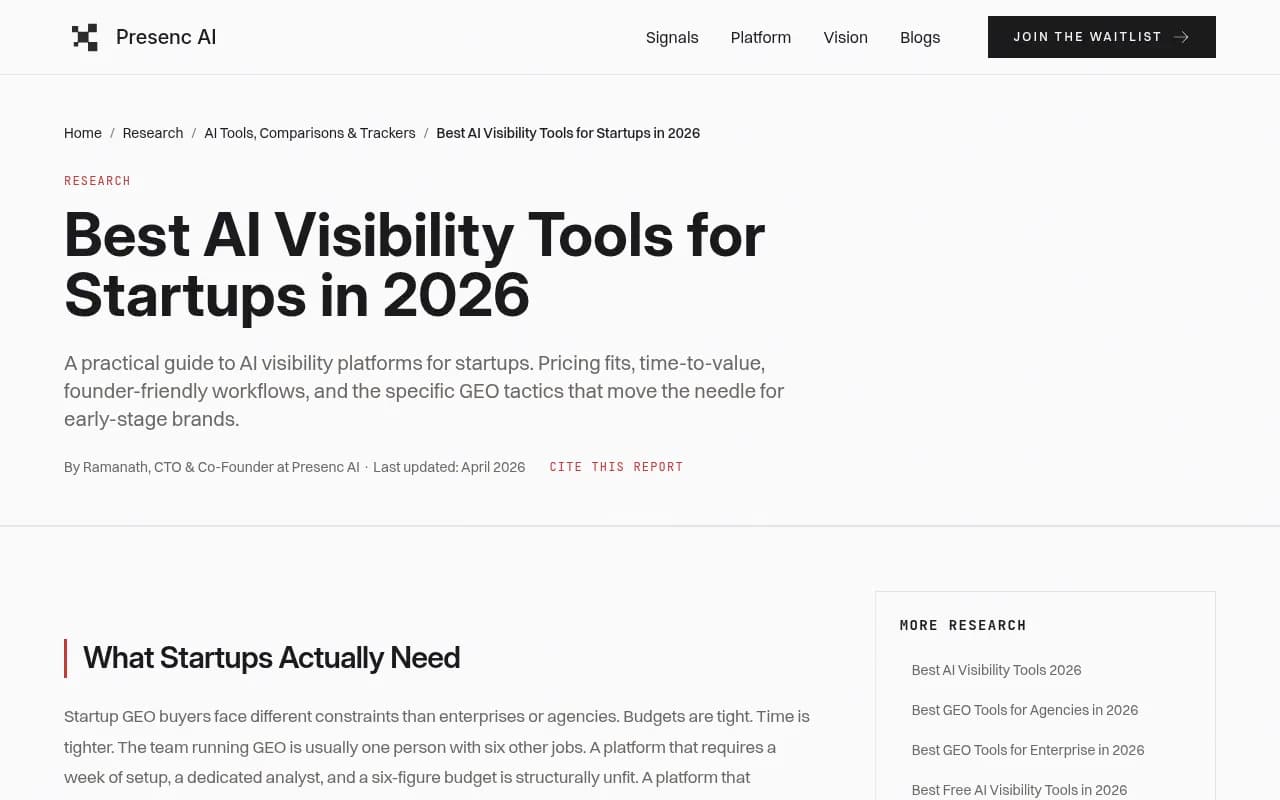
The Presenc checklist is a good example. It asks for a first report within an hour, minimal setup, named competitors, actionable recommendations and growth-path pricing. All reasonable. It also suggests $500 to $2,000 a month entry points suit startups, which conveniently describes the vendor's own price band. Many founders will find $30 to $100 a month tools plenty at the start.
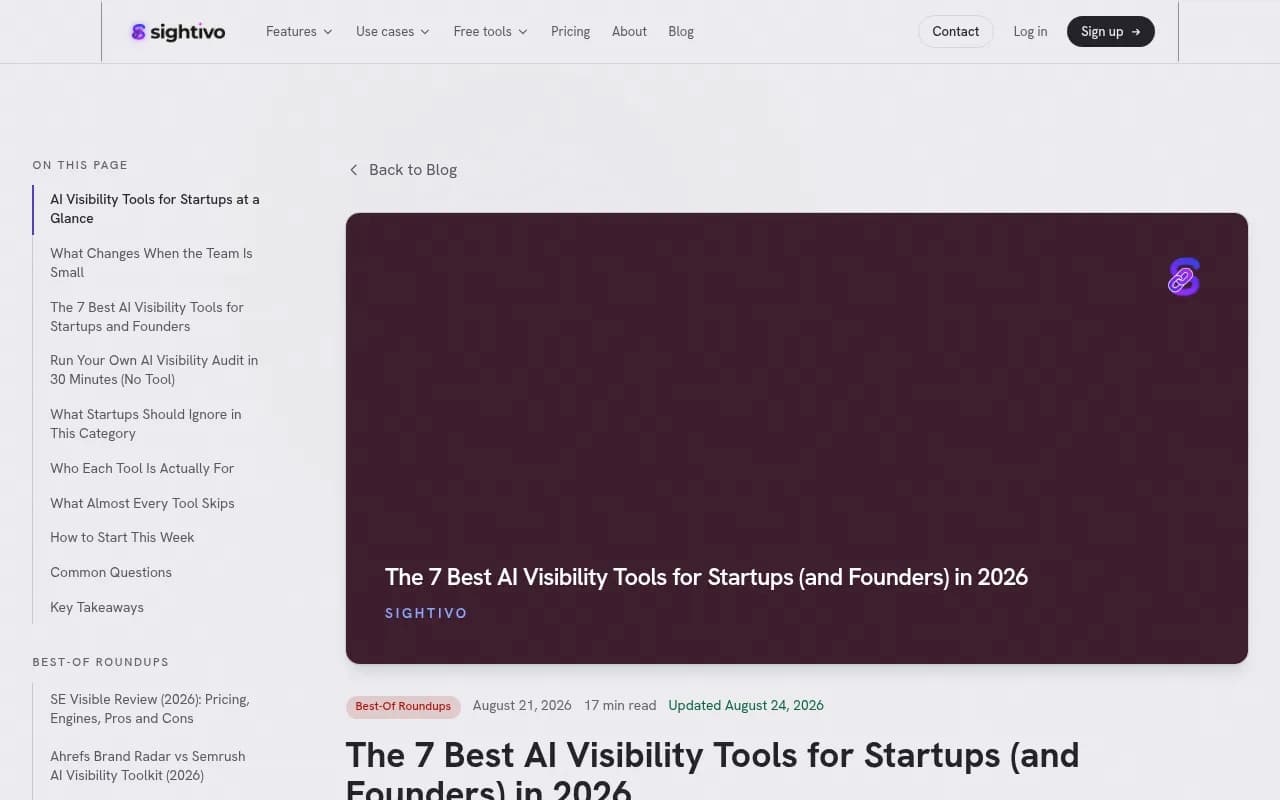
Sightivo at least discloses that it builds the first tool on its list and that prices were checked in August 2026. Treat that kind of disclosure as the minimum, not a bonus.
Case study: vetting InSpace.io
InSpace.io comes up in this category and is a good test case, because it is easy to misclassify. Here is what its pricing page shows.
What it is
InSpace positions itself as an AI SEO platform and service for small and mid-sized businesses. Its engine, called NOVA, automates content, structure and publishing for Google and for answer engines such as ChatGPT and Gemini. Plans are measured in pages per month. Visibility tracking is not listed as a plan feature on the pricing page.
So this is closer to a content production service than to a monitoring dashboard. Comparing it to Peec AI or Otterly on price per tracked prompt would be apples to oranges.
What it costs
| Plan | List price per month | Lowest shown with max discount | What is included |
|---|---|---|---|
| Stratosphere | $1,000 | $700 | 10 pages per month, long-tail and question articles, personal onboarding |
| Milky Way (most popular) | $1,700 | $1,190 | 20 pages per month, cluster-optimized category hubs, conversion-focused service pages |
| Universe | $3,000 | $2,100 | 40 pages per month, location-based landing pages, automated content scaling, dedicated strategist |
| Multiverse | From $6,900, custom | Custom | For businesses in 4+ countries, local SEO and GEO per market, reporting by country |
These figures come from the live pricing page. I did not check its publication date, so confirm on the vendor's site before you plan around them.
Flags worth raising
- Lock-in. The discounts are 10%, 20% or 30%, and the page says the 30% saving needs a 2-year term with upfront payment. The page also shows 1-year and 2-year toggles plus monthly, yearly-upfront and 2-years-upfront payment options. I could not tell exactly how each toggle maps to each discount. That ambiguity is itself a question to put to the vendor.
- No visible terms. No refund, cancellation or trial terms appear on the pricing page.
- No self-serve checkout. Signing up goes through a contact form or a demo booking, which is normal for service businesses but means you get terms only after a sales call.
- Output-based pricing. You pay for pages, not for results. Pages that nobody cites cost the same as pages that get cited.
- No independent evidence found. I found no independent reviews, funding information or customer references for InSpace. That is not proof of anything bad. It means you would be relying on the vendor's own claims.
To be fair, InSpace also offers free tools, a Tech Scan and an ROI Calculator, that need no account or payment. Use those first. They cost nothing and tell you how the vendor thinks.
My read: if you want to buy content production, treat InSpace like any content agency. Ask for a monthly term, a pilot, sample pages and references. If you want measurement, buy a measurement tool separately so you can check whether the content is actually getting cited.
A vetting checklist you can reuse
Apply this to InSpace or any peer. Score each line yes, no or unknown. Unknowns are questions for the sales call.
Commercial terms
- Can you pay monthly? What is the price versus annual?
- Is there a free trial, free tier or refund window?
- What happens to your data if you cancel? Can you export prompts, responses and citations?
- Do plan limits (prompts, seats, engines, countries) match the tier you would actually buy?
- Is the price tied to volume you can predict, or does it jump at a threshold?
Methodology
- Does the tool track real user interfaces or API outputs only? The two can differ.
- Are results shown per engine, or blended into one score?
- How often do prompts run, and how many runs per prompt are averaged?
- How does the vendor separate changes in your visibility from changes in the engines themselves?
That last question matters more than it sounds. Promptwatch Data's report on how many sources AI search engines cite shows that ChatGPT cites about 5 sources per web-search answer, while Google AI Overviews cites about 10 and Perplexity sits almost exactly at 10 every day. Microsoft Copilot has swung from under 2 to nearly 17 sources per response within a few weeks. If a vendor blends these into one number, you cannot tell whether a move came from your content or from the engine. Judge Copilot on monthly trends, not weekly snapshots.
Citation behavior also changes when models are updated. Promptwatch's data on the ChatGPT citation drop after GPT-5.3 shows average citations per response falling across several models around the March 4, 2026 rollout. A good vendor can explain events like that to you before you ask.
Company evidence
- Are there named customers you can contact, not just logos?
- Is there any independent review (G2, Capterra, a community thread) that the vendor did not write?
- Who is behind the company, and how long has the product been live?
- Is funding or ownership visible? A bootstrapped tool can be perfectly fine, but you should know.
Actionability
- Does the tool tell you which source URLs are cited, which competitors are named, and where you are absent?
- Does it recommend work, or only chart numbers?
- If it produces content, can you see how those pages get crawled, cited and clicked afterward?
Run your own audit before you pay anyone
The best advice in the vendor listicles is also the cheapest. Authoritytech's guidance is to buy the cheapest tool that reliably shows where your brand is absent, which competitors are named, and which source URLs are cited, and to spend the saved budget on the work that changes those answers. Startups, it notes, often overbuy dashboards before they know their prompt set.
A 30-minute manual audit gets you most of the way:
- Write 15 to 25 prompts a buyer would ask: brand queries ("what is [your company]"), category queries ("best tool for X") and comparison queries ("A vs B").
- Run them in ChatGPT, Perplexity and Google AI Overviews. A free account is enough.
- Log whether you are mentioned, who else is, and which URLs are cited.
- Note which competitors show up repeatedly. That is your named competitor list.
- Repeat weekly for a month and see how stable the answers are.
You can do this in a spreadsheet. Tools like ChatGPT itself are fine for the first pass.
Only after this should you shop. You will know your prompt set, so you can judge whether a tool's prompt limit is enough, and you will have a baseline to compare the tool's output against. If a paid dashboard disagrees wildly with your manual results, ask why.
Peers worth comparing against
If you decide you want measurement rather than content production, here are the usual young and mid-stage options. I have not verified current pricing for these, so treat the notes as positioning only and confirm on each vendor's page.
| Tool | Positioning | Watch for |
|---|---|---|
| Otterly.AI | Low-cost monitoring across ChatGPT, Perplexity and AI Overviews | Monitoring only, check prompt limits |
| Peec AI | Clean monitoring for small marketing teams | Confirm engine coverage in your tier |
| Profound | Enterprise AI visibility platform | Enterprise pricing, likely overkill early |
| AthenaHQ | Track and optimize visibility across AI search | Check what "optimize" actually includes |
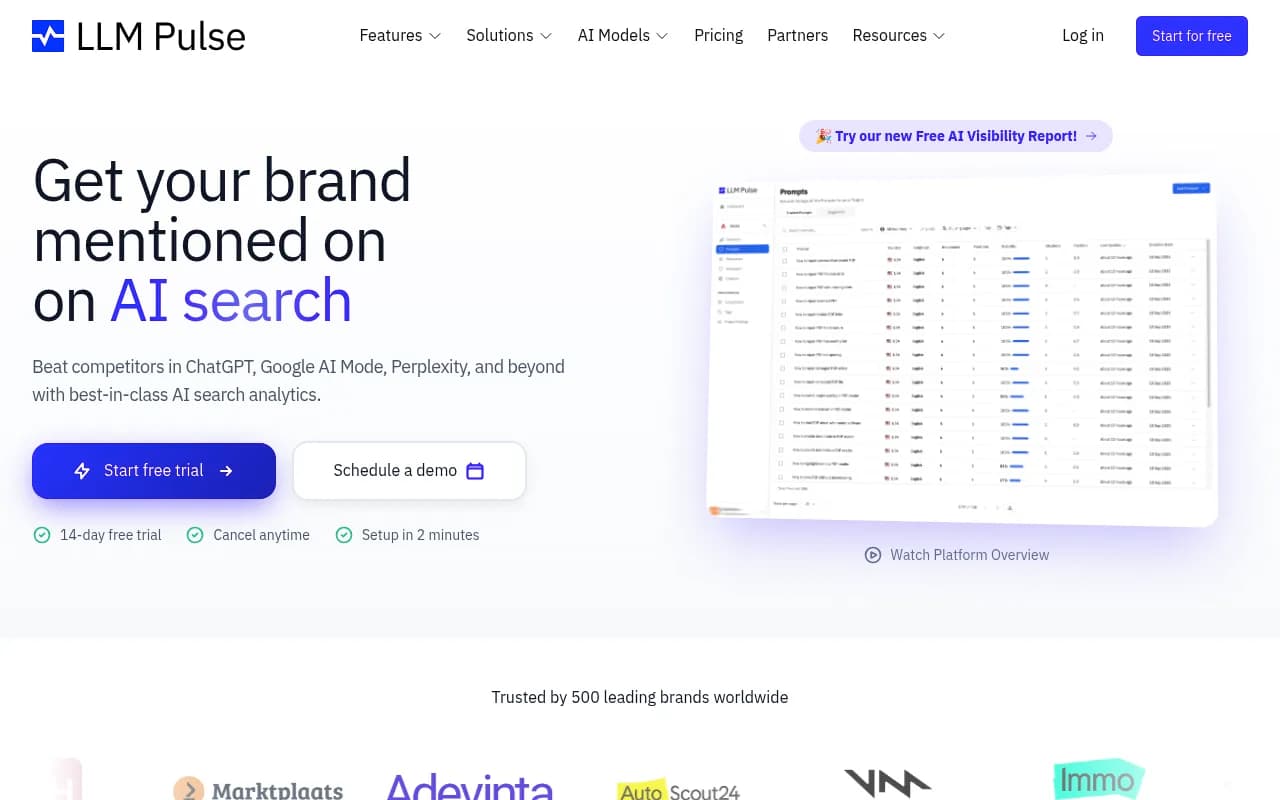
| LLM Pulse | Visibility tracking across ChatGPT, Perplexity and more | Monitoring-focused |
| Semrush | Established SEO suite with AI search features | Fixed prompt sets, AI is an add-on |
Otterly.AI


Profound


If you want a wider list, the GEO software directory at bestgeosoftware.com and the AI rank tracking directory at ai-rank-tools.com are useful starting points.
A platform that goes past monitoring
The split that matters most for a startup is between tools that tell you what is wrong and tools that help fix it. Promptwatch sits in the second group. It tracks real interfaces of ChatGPT, Perplexity, Google AI Overviews and others, shows IP-verified AI crawler logs so you can see whether bots can read your site, and has a content agent that writes and publishes against the gaps it finds, then tracks whether those pages get cited. It has a free Explore tier (ChatGPT only, 10 prompts) and paid plans from $95 a month with a 7-day trial on monthly Essential, so you can test it before committing. Confirm current terms at promptwatch.com/pricing.

Note that I would apply the same checklist to Promptwatch as to anyone else. Its publisher relationship with this site means you should verify claims yourself too.
Questions to ask on the sales call
Whatever the vendor, these questions separate solid companies from shaky ones:
- Can I start on a monthly plan and move to annual later at the same discount?
- What exactly happens to my data and published content if I cancel?
- Show me a customer in my size band who has been with you for over six months.
- How do you tell a content-driven visibility change from a model update?
- Do you track the actual user interface or an API? For which engines?
- Which part of the price is fixed and which scales with my usage?
A vendor that answers these plainly in writing is a better bet than one with a prettier dashboard.
A simple decision rule
- Under 20 prompts to track and a founder doing it all: run the manual audit, then try a low-cost monitor on a monthly plan.
- You need content produced and have budget: evaluate content services like InSpace on a pilot, with a monthly term, and measure results with a separate tool.
- You need tracking plus fixes and crawler visibility: look at an end-to-end platform with a trial.
- A vendor pushes a multi-year prepayment before you have seen one month of results: walk away or negotiate.
Keep the commitment small until the vendor has earned a bigger one. For a company that has existed for a year or two, that is just good procurement.