Key takeaways
- Basic AI visibility tracking answers one question: was my brand mentioned? Most teams outgrow that within a quarter and need to know why, and what to do next.
- Pick a tool by what happens after the dashboard: crawler logs, traffic attribution, content gap analysis, and publishing.
- Budget trackers (Otterly, Peec AI, Rankscale) are fine for monitoring. SEO suites (Semrush, Ahrefs, SE Ranking) make sense if you want one bill. Optimization platforms are the pick if you want fixes, not just reports.
- Track each AI engine separately. Promptwatch Data shows ChatGPT cites about 5 sources per answer while Google AI Overviews and Perplexity cite about 10.
- Check InSpace.io's current product pages before comparing. I could not verify its AI visibility pricing or feature list, so this guide focuses on what to look for rather than claims about it.
Why people look for InSpace.io alternatives
A quick disclosure first. I could not find a public page describing InSpace.io's own AI visibility product or pricing. What turned up was its blog, including a roundup of Surfer SEO alternatives, which suggests it is positioned around content and SEO. So I am not going to tell you what it does or doesn't do. Check its product pages directly.
What I can do is describe the reasons people typically leave any entry-level AI visibility tool:
- The tool reports mentions but not causes. You see a score drop and have no idea why.
- Prompt volume or engine coverage caps out too early.
- No connection between AI mentions and actual site traffic or conversions.
- No help producing the content that would fix the gaps.
- Agency needs: client workspaces, white-label reports, multi-brand pricing.
If any of those sound familiar, the rest of this guide is for you.
What separates monitoring from optimization
There are two categories of tool here, and mixing them up is the most common buying mistake.
Monitoring tools run a set of prompts across ChatGPT, Perplexity, Gemini and others, then report whether your brand appeared, where, and next to which competitors. Useful, but it stops there.
Optimization platforms add the layers underneath: which pages AI crawlers actually read, which of your URLs get cited, what traffic those citations send, and what content you should write to close the gap. Some then draft and publish it.
One detail that matters when you evaluate either type: query fanouts. According to Promptwatch Data on ChatGPT query fanouts, a single prompt can trigger 3 to 8+ background searches, and the measured average fell from about 2.15 per response in December 2025 to about 1.84 by early March 2026. A tool that only watches the prompt a user typed misses the searches ChatGPT actually ran to build its answer.
Another: engines behave differently. Promptwatch's sources-per-response data shows ChatGPT averaging about 5 cited sources on web-search answers, Google AI Overviews about 10, and Perplexity almost exactly 10 every day. Microsoft Copilot swung from under 2 to nearly 17 within weeks. Results from one engine do not predict another, so any tool that blends them into a single number is hiding information.
Quick comparison table
| Tool | Type | Strength | Watch out for |
|---|---|---|---|
| Promptwatch | Optimization platform | Crawler logs, traffic attribution, content agent, action board | More depth than a solo marketer may need |
| Semrush | SEO suite + AI toolkit | One vendor for SEO and AI | Tracking feels bolted on to some users |
| Ahrefs Brand Radar | SEO suite add-on | Fits existing Ahrefs workflow | Shallower AI-specific data |
| SE Ranking | SEO suite | Combined SEO and AI at lower cost | Lighter on optimization |
| Otterly.AI | Monitor | Affordable, simple | No crawler logs or content tools |
| Peec AI | Monitor | Clear suggestions | Monitoring-focused |
| ZipTie | Monitor | Deep analysis and reporting | Not an execution tool |
| Profound | Enterprise monitor | Wide engine coverage | Priced high; agency workspaces cost extra |
| Rankscale | Agency monitor | Built for agency workflows | Monitoring-led |
| Omnia | Monitor + workflow | Citation URLs, country and topic segmentation | Check depth against your needs |
The best InSpace.io alternatives in 2026
Promptwatch: for teams that want to fix visibility, not just watch it
Promptwatch is the one I would put first if your problem is that tracking has not translated into results. It monitors the real interfaces of ChatGPT, Google AI Overviews, AI Mode, Gemini, Perplexity, Copilot, Meta AI and others, then connects that to the things most trackers skip: IP-verified AI crawler logs, visitor analytics for AI-referred traffic, and weekly site audits.
The action side is what separates it. Content gap analysis maps your pages against the prompts AI answers, the Action Board turns findings into a prioritized to-do list, and the Content Agent can plan, write and publish to WordPress, Webflow or Framer, then track whether each page gets crawled, cited and clicked. It also covers Reddit, YouTube and LinkedIn citations, which a lot of competitors ignore.
Pricing starts with a free Explore plan (ChatGPT only, 10 prompts), then Essential at $95/month, Professional at $245/month and Business at $579/month. Agency plans start at $199/month. Confirm current numbers at promptwatch.com/pricing.

Semrush: for teams already living in an SEO suite
If your team already pays for Semrush, adding its AI Visibility Toolkit keeps everything under one login. Third-party snippets put the toolkit at roughly $199/month (Starter), $299/month (Pro+) and $549/month (Advanced), though I could only verify those from search snippets, so check the page. The trade-off, echoed in a Reddit thread on budget GEO tools, is that AI tracking in SEO suites can feel bolted on rather than built in. You get prompt sets and mentions, but little on crawlers or AI traffic attribution.
Ahrefs Brand Radar and SE Ranking: the combined-bill options
One roundup's conclusion was that Ahrefs, Semrush or SE Ranking combine SEO and AI visibility for less than Profound charges for AI-only monitoring. That is a fair point if you need both. SE Ranking also has a separate AI-only product, SE Visible, which tracks mentions but, by its own positioning, does not include the tools to fix issues.

Otterly.AI: for cheap, simple monitoring
Zapier's roundup picks OtterlyAI for affordability, and that matches its reputation. It tracks brand mentions across ChatGPT, Perplexity and Google AI Overviews with minimal setup. It will not tell you what crawlers do on your site or write content for you. If all you need is a regular report, that is fine.
Otterly.AI

Peec AI: for clear suggestions at a modest price
Peec AI earned the "smart suggestions" label in the same Zapier list. It is a good middle ground for marketing teams who want some direction, not just charts. Like Otterly, it sits on the monitoring side of the line.

ZipTie: for deeper analysis and reporting
ZipTie is built for people who want to dig into the data and produce detailed reports. If an analyst on your team enjoys slicing citations and sentiment, it fits well.
Profound: for enterprise coverage
Profound tracks a wide range of engines and is aimed at larger brands. The cost is the sticking point. According to Rankability's comparison, its agency client-workspace add-on is $399 on top of the base subscription. Compared with Promptwatch, it lacks Reddit tracking, ChatGPT Shopping coverage and agentic execution.
Profound

Rankscale: for agencies on a budget
Rankscale is built around agency workflows and is worth a look if you manage several clients and mainly need tracking and reporting.
Omnia: for citation-level detail
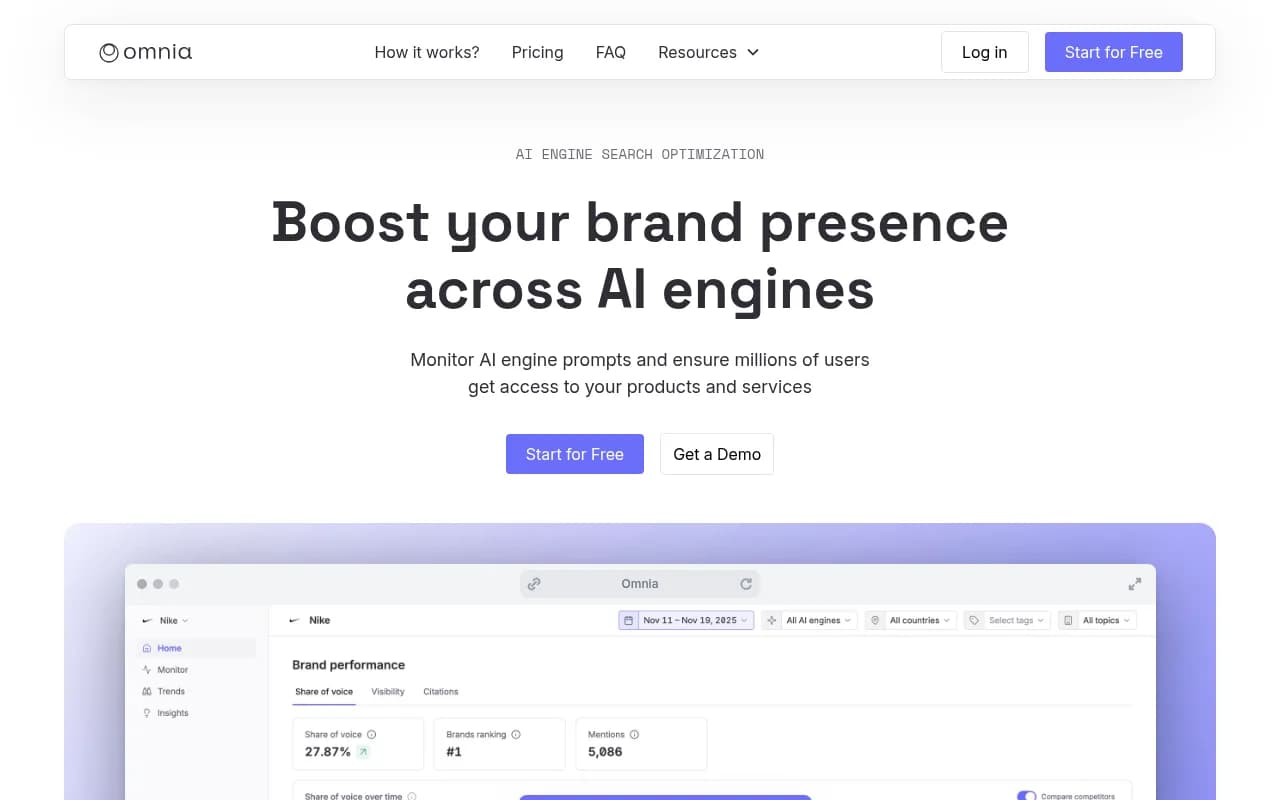
Omnia extracts exact citation URLs, segments performance by country and topic, and adds workflow automation. Its own guide to 26 AI visibility platforms is a decent starting point for a wider shortlist, though remember it is written by a vendor.
Budget snapshot
Rankability compared the same 100-prompt workload across several tools. Treat this as a vendor-published snapshot and verify before buying.
| Tool | Price per month | Prompts | Engines |
|---|---|---|---|
| Rankability Starter | $97 | 100 | 11 platforms |
| Geoptie Professional | $99 | 100 | 4 |
| Searchable Pro | $125 | 100 | 3 |
| Orchly Pro | $125 | 100 | 3 |
Prompt count is only half the story. Look at responses per month, how many engines are included at your tier, and whether country or city tracking costs extra.
How to choose
If you need answers to "why"
Pick something with crawler logs and page-level data. When your pages are not cited, the cause is often technical: a bot blocked, an error on a key URL, content that never got read. Monitoring-only tools cannot show you that.
If you need to prove revenue
Look for AI traffic attribution. Mentions are a vanity number until you can tie them to visits and conversions. Promptwatch has this built in via visitor analytics; most trackers do not.
If you run an agency
Check client workspaces, white-label reporting, and how pricing scales with clients. Hidden add-ons are where agency budgets go to die.
If you just need a pulse check
Otterly or Peec AI will do the job. Do not overbuy.
A short evaluation checklist
- Does it track the actual interfaces of each engine or just APIs? Answers can differ.
- Does it report each engine separately?
- Does it capture query fanouts, not only your seed prompts?
- Can it show crawler activity and errors?
- Can it connect visibility to traffic?
- What happens after it finds a gap?
- What are the real limits on prompts, responses, seats and countries?
For wider browsing, the GEO software directory at bestgeosoftware.com lists more options by category.
Bottom line
If InSpace.io covers what you need, stay. If you have hit the ceiling where reports tell you what happened but not what to do, move to a platform that closes the loop: Promptwatch for the full optimization stack, an SEO suite if consolidation matters most, or Otterly and Peec AI if cheap monitoring is truly enough. Start with a free trial or free tier, run the same 20 prompts through two tools, and compare which one tells you something you could act on tomorrow.