
Key takeaways
- Most AEO tools are dashboards. They find gaps well and stop there. Fixing the gap (writing, publishing, refreshing, then checking it worked) is where platforms really differ.
- Score any tool on five jobs: find the gap, prioritize fixes, create or edit content, publish, and measure impact. A tool that covers two of five is a monitor, whatever its marketing says.
- Vendor comparison tables mostly mark "tests before publishing" as "not stated" for nearly every tool. Treat that as a genuine open question to ask in demos.
- Match content to prompt intent. Promptwatch Data shows product pages and landing pages take about 39% of ChatGPT citations, so a tool that only reports gaps leaves the hard part to you.
- Pick a monitor if you only need reporting. Pick an execution platform if you have people shipping fixes every week.
Why execution is the right yardstick
Open any "best AEO tools" roundup and you will find the same pattern. Visibility score, share of voice, a list of prompts where competitors appear and you do not. Useful. Also the easy part.
The hard part starts after the dashboard. Someone has to decide which page to write, write it in a format AI engines quote, publish it, and confirm that the next crawl and the next answer reflect the change. One of the roundups in our research put it bluntly: a tool that closes a citation gap scores far above one that just points at it. I agree, and I think it is the only fair way to compare these products, because tracking has become a commodity. Dozens of tools do it competently.
This guide scores tools on what they do about the gap, not how pretty the chart is. A caveat up front: I did not verify per-tool pricing or every feature claim, and several of the sources are written by vendors who rank themselves first. Where a claim comes from a vendor, I say so.
The five-job execution rubric
A platform that improves results has to handle five jobs. This framework mirrors how Bodhium's own comparison frames the problem, though I have adjusted it to be vendor-neutral.
- Find the gap. Show prompts where AI names competitors and not you, plus the sources it cites instead.
- Prioritize. Rank the fixes so a team does not drown in recommendations.
- Create or edit content. Draft new pages or rewrite existing ones with specific instructions.
- Publish. Get the content live, ideally through your CMS without copy-pasting.
- Measure. Show whether the fixed page was crawled, cited, and whether it sent traffic.
Score each job from 0 to 2 (absent, partial, full) and you get a 10-point execution score. Anything under 4 is a monitor. Anything over 7 is an execution platform.

The Bodhium comparison above is worth a read for its framing, even though Bodhium ranks itself first. Notice how many rows say "Partly" or "Not stated." That tells you something about the category.
Content type matters more than most tools admit
Execution is only useful if you fix the right thing. Promptwatch Data tracked ChatGPT citations from Sep 28 to Oct 4, 2026. Product pages were the most cited type at 22.4%, landing pages followed at 16.8%, listicles took 13.6%, and how-tos 8.7%.
Broken down by intent, it gets more useful:
- Commercial prompts: product pages 26.0%, landing pages 20.6%, listicles 15.0%, comparisons 7.9%
- Informational prompts: product pages 19.1%, landing pages 13.9%, listicles 13.6%, how-tos 10.7%, docs 8.5%
- Branded prompts: product pages 23.3%, landing pages 22.8%, reviews 5.6%, FAQ pages 4.8%
So a tool that tells you "write more blog posts" for a commercial prompt gap is giving you weak advice. A good execution platform should point you at the page type that wins for that intent.
Freshness matters too. In Promptwatch's content half-life study, 78% of landing pages and 76% of docs were still cited after 30 days. News was far worse: half of news pages were gone after 36 days. Product pages, reviews and how-tos reached half-life around 74 to 77 days. The practical read is that execution is not a one-time publish. You need refresh workflows, and you need a tool that tells you which pages are decaying.
The scorecard
Here is how the major platforms line up on the five jobs. Scores come from the sources in my research plus product positioning. Treat "partial" as "exists but needs manual work" and verify in a trial.
| Tool | Find gaps | Prioritize | Create content | Publish to CMS | Measure impact | Verdict |
|---|---|---|---|---|---|---|
| Promptwatch | Full | Full (Action Board) | Full (Content Agent) | Full (WordPress, Webflow, Framer) | Full (crawler logs, citations, traffic) | Execution platform |
| Profound | Full | Partial | Full (content agents, per vendor) | Not verified | Full (attribution, per vendor) | Execution platform, enterprise-priced |
| AthenaHQ | Full | Full (Action Center) | Partial | Not stated | Partial | Prescriptive monitor |
| Peec AI | Full | Full (ranked actions) | Partial | Not stated | Partial | Strong monitor |
| Scrunch | Full | Partial | Partial | Not stated | Partial | Monitor plus agent-readability |
| Writesonic | Full | Partial | Full | Not stated | Partial | Writer with tracking |
| HubSpot AEO | Full | Partial | Partial | Within HubSpot | Not stated | Good for HubSpot shops |
| AirOps | Partial | Partial | Full | Full | Partial | Content engine |
| Frase | Partial | Partial | Full | Partial | Not stated | Small-team writer |
| Otterly.AI | Full | Minimal | None | None | Minimal | Monitor |
Two patterns stand out. First, the tools with the strongest content generation (AirOps, Frase, Writesonic) are weaker on gap detection and measurement, because they started as writers. Second, the tools with the strongest tracking (Otterly, Peec) are weaker on creation. Very few cover both ends.
Platforms that execute
Promptwatch
Promptwatch is the one I would put at the top of an execution ranking, with the obvious disclosure that 1001 SEO Media, which publishes this site, uses it as its GEO platform. What earns it the spot is that all five jobs live in one product and feed each other.
It finds gaps through prompt tracking across ChatGPT, Gemini, Claude, Perplexity, Google AI Overviews and AI Mode, with answer-gap and content-gap analysis. The Action Board turns that into a prioritized to-do list. The Content Agent plans, writes and publishes pieces to WordPress, Webflow or Framer, either through a review inbox or hands-off. Then the measurement half closes the loop: IP-verified AI crawler logs show whether bots read the page, Page Tracker shows whether AI cites it, and visitor analytics show whether it sends traffic.

That last step is what most dashboards skip. Crisp reported 2x higher conversion rates from AI traffic compared with other channels after scaling output with the platform, and TreeHouse (Pararius) reached roughly 25% of organic conversions from AI search. Those are customer-reported results, so weigh them accordingly.
Pricing is public: Essential is $95/mo, Professional $245/mo, Business $579/mo. The Content Agent and Agentic AI Search Optimization start at Business, so if execution is the point, budget for that tier. Confirm current numbers at promptwatch.com/pricing. There is a 7-day free trial on monthly billing, and a free AI visibility report if you want a baseline first. If you compare it against a specific rival, the head-to-head pages like Promptwatch vs Profound lay out the differences.
Profound
Profound's own guide claims tracking on 1.9B+ real prompts, content creation to close gaps, crawler analytics and attribution. That is a full-stack pitch, and the research notes flag it as vendor self-description, so I would not treat it as verified. In practice it targets enterprises and prices accordingly. Worth a demo if you have the budget and want one contract.
Profound

Read the guide for the category map, but remember it ranks Profound first among 19 tools.
AirOps
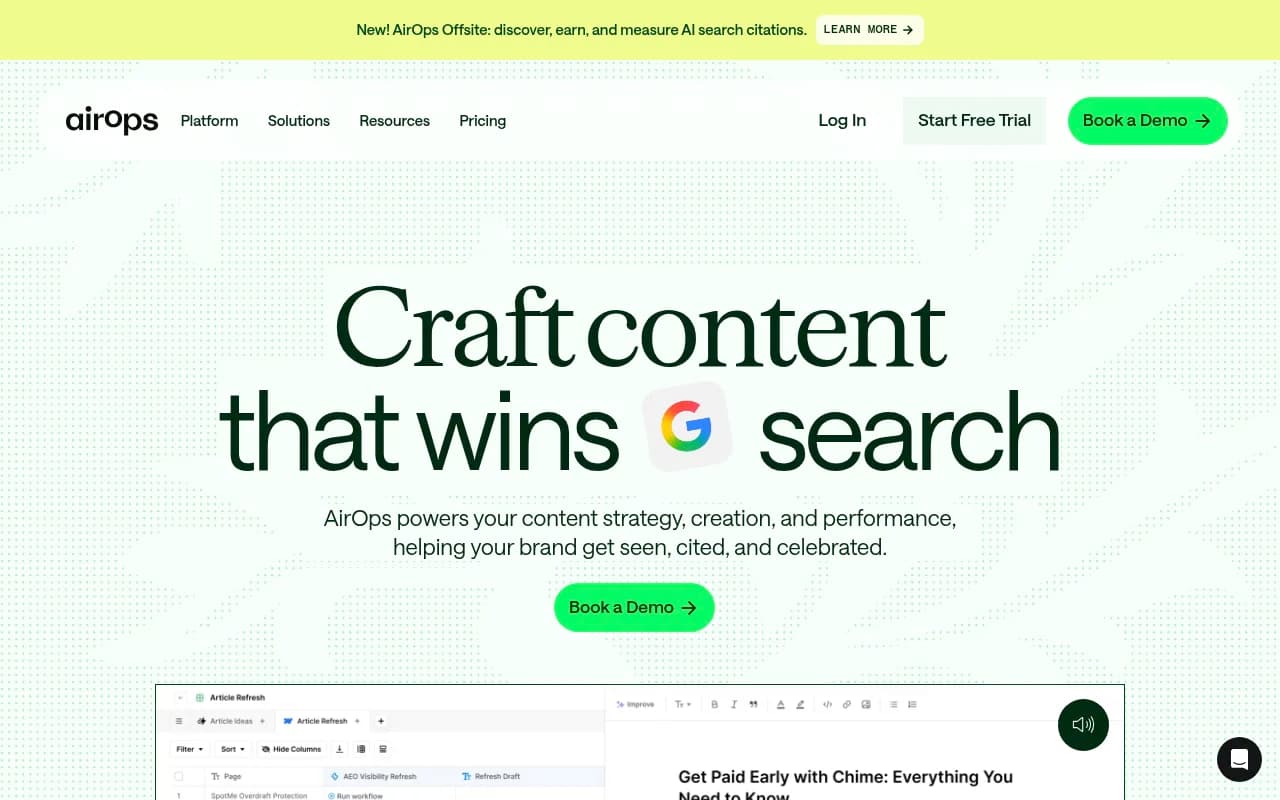
AirOps is genuinely strong at execution in the writing sense: agents that research, write and publish at volume. Its weakness, based on how roundups describe it, is the front of the funnel. It is a content engine more than a visibility platform, so you may need a separate tracker feeding it.
Platforms that mostly report
Peec AI and AthenaHQ
Peec AI is popular with mid-size teams for ranked actions and unlimited seats. AthenaHQ pushes further with an Action Center and an action agent. Both are better than pure trackers, since they tell you what to do next. But in the Bodhium table, content creation is only "partly" for Peec and publishing is not stated for either. You will still be the one writing and shipping.


Scrunch, Otterly.AI and the pure monitors
Scrunch adds a useful angle on how AI agents read your site, but it leans toward monitoring and recommendations. Otterly.AI is a clean, affordable monitor. If all you need is a weekly visibility number for a stakeholder deck, that is fine. Just do not expect it to fix anything.
Otterly.AI

HubSpot AEO
HubSpot AEO is the budget option for teams already in HubSpot. The xseek roundup lists it at $50/mo ($45 annually) for 25 prompts, though I could not verify that. It does prompt tracking, citation analysis and recommendations. Reasonable inside the HubSpot ecosystem, limited outside it.
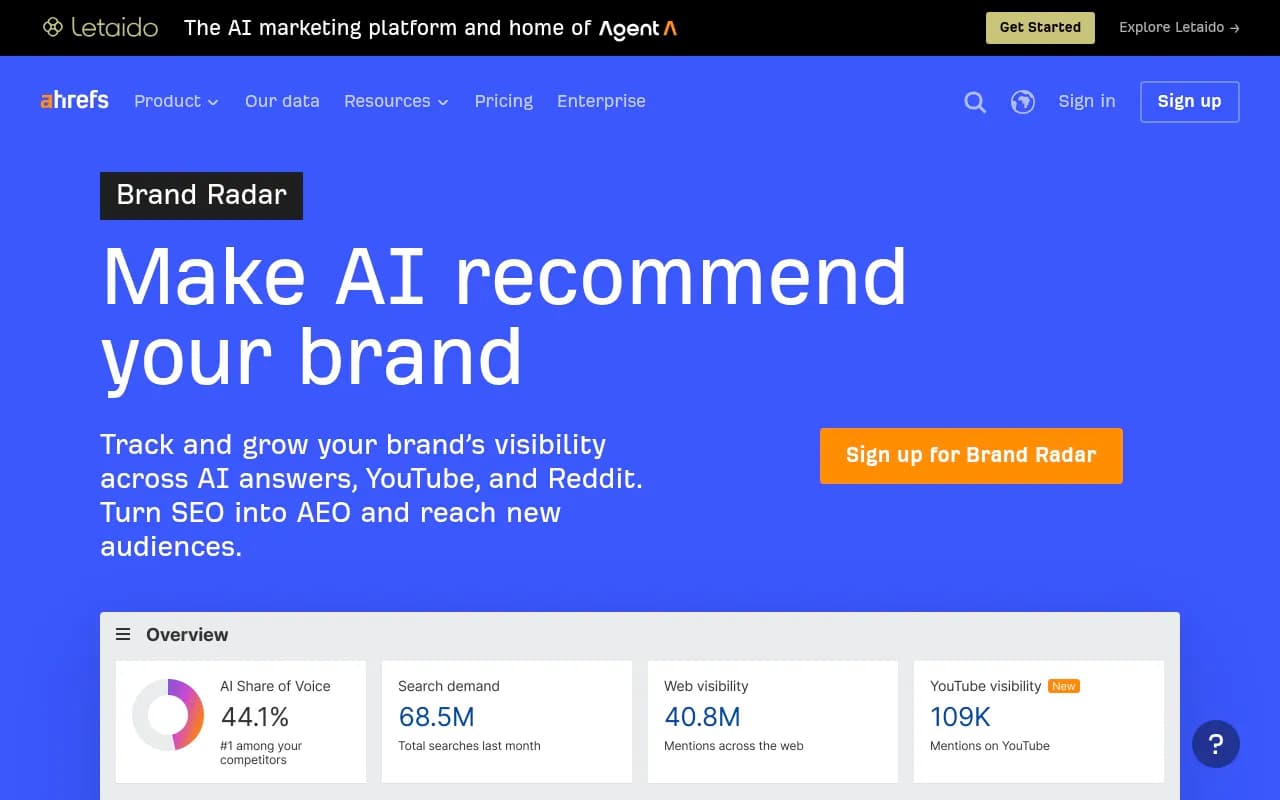
Semrush and Ahrefs Brand Radar
Both bolt AI visibility onto an existing SEO suite. If you already live in these tools, the convenience is real. The tradeoff is shallower AI-specific data and no crawler-level evidence of what AI bots actually read.
The measurement gap nobody scores
Here is the part I find most telling. In that Bodhium comparison, the "tests before publishing" column reads "Not stated" for almost every tool, and "measures impact against a comparison" is mostly "Partly." Even the vendors rarely claim they can prove a fix worked.
That matters because AEO outcomes are noisy. AI answers vary run to run. If a tool cannot separate "our fix worked" from "the model reshuffled," you are guessing. Practical ways to cover this yourself:
- Check AI crawler logs to confirm the bot actually fetched the updated page
- Track the specific page's citation rate before and after, not just the brand-level score
- Compare against prompts you did not target, as a control
- Watch AI referral traffic and conversions, not only mentions
Crawler logs are the underrated one. If GPTBot or ChatGPT-User never reached the page, no amount of content polish helps. That is an access problem, not a content problem, and only tools with crawler analytics can tell the two apart.
How to choose
Pick a monitor if
- You need reporting for stakeholders and have no one to ship fixes
- Your budget is under a couple hundred dollars a month
- You plan to hand recommendations to an agency or in-house writers anyway
Peec AI, Otterly.AI and HubSpot AEO fit here. Compare more options in the AI rank tracking directory.
Pick an execution platform if
- You publish weekly and want gaps turned into pages without a handoff
- You need to prove AI traffic and conversions, not just mentions
- You manage several sites or clients and cannot hand-write everything
Promptwatch and Profound are the main full-loop options, with AirOps as a content-first alternative. The GEO software directory lists more.
Questions to ask in every demo
- After you find a gap, what exactly does the tool produce: a recommendation, a brief, or a published page?
- Can it publish to my CMS, and does it track the live URL afterward?
- How do I know the fix worked? Show me crawl, citation and traffic data for one page.
- Are results from real AI interfaces or APIs? User-facing answers can differ from API outputs.
- What happens to pages that decay? Is there a refresh workflow?
If a vendor cannot answer number 3 with a live example, score the tool low on measurement and move on.
A simple scoring template
Copy this into a spreadsheet and score each shortlisted tool from 0 to 2 per row:
Find gaps               0 / 1 / 2
Prioritize fixes        0 / 1 / 2
Create or edit content  0 / 1 / 2
Publish to CMS          0 / 1 / 2
Measure page-level lift 0 / 1 / 2
-------------------------------
Total (max 10)
0-3  = monitor
4-6  = assisted workflow
7-10 = execution platform
Weight the rows if your situation calls for it. An agency with in-house writers might double the weight on prioritization and measurement and ignore content creation. A lean in-house team with no writers should do the opposite.
Bottom line
Tracking is cheap and everywhere. Execution is rare. Before you buy, decide honestly whether someone on your team will act on a dashboard every week. If yes, a good monitor saves money. If not, pay for a platform that writes, publishes and checks its own work, and ask to see one page's full journey from gap to citation to click before you sign.