Key takeaways
- An agent skill is a saved playbook: which data to pull, in what order, what good output looks like, and when to stop and ask a human. You run it on demand or on a schedule instead of retyping a long prompt every Monday.
- Promptwatch's Agent Chat ships with ready-made skills for a 7-day GEO briefing, competitor gap analysis, citation research, content sprints and newsjacking, and chats can be scheduled in-app or in Slack.
- Skills are only as good as the data under them. A skill that reads your live prompts, citations, crawler logs and traffic produces analysis. One that only browses the web produces a nicely formatted guess.
- Match the skill to the content's shelf life. Promptwatch Data shows news pages lose half their ChatGPT citations in 36 days, while landing pages and docs last far longer.
- Use fixed date windows in every briefing, because platform changes can look like competitor moves.
What an agent skill actually is
A skill is a packaged set of instructions. It tells a general-purpose agent how to do one job the way you would do it. Developers have used the idea for coding agents for a while, and the marketing version is the same thing with different data underneath.
GEO has a friction problem. The numbers live in a dozen places: visibility, position, sentiment, citations, crawler hits, AI-referred traffic, Search Console. Nobody has the time every week to pull all of it, compare competitors, check what AI cited, and decide what to write. A skill removes the pulling and the deciding-what-to-look-at. The human reviews and decides.
The skill is half of it. The data layer is the other half, and most write-ups skip that part. If you are weighing tools on this, ask what the agent can actually call. A skill with no citation or crawler connector is a prompt wrapper around a spreadsheet you export by hand.
Where skills fit in Promptwatch
Promptwatch is an end-to-end AI visibility platform. It monitors how ChatGPT, Gemini, Claude, Perplexity, Google AI Overviews and others mention and cite your brand, traces where the answers come from, and has agents that write and publish content against the gaps. Agent Chat is the conversational analyst on top of that data. It reads prompts, citations, competitors, crawler logs, traffic and search data, runs multi-step workflows, renders charts, and builds dashboards and PDF reports.

The ready-made Agent Skills sit on top of Agent Chat. Scheduled chats deliver in-app or in Slack, and there is a page-aware side panel (Cmd+J) next to dashboards, Trends, Prompts, the Action Board and the content editor. Agent Credits (500 to 6,500 per month depending on plan) are included on every paid plan, so every skill run draws from that pool. Check promptwatch.com/pricing for current plan details.
One honest caveat. Public write-ups list the ready-made skills as the 7-day GEO briefing, competitor gap analysis, citation research, content sprints and newsjacking. That is five named skills. The title promises seven workflows, so below I cover those five and add two I would build as custom skills: a crawler health check and a sentiment and claims review. Both use data Agent Chat already has.
The 7 workflows at a glance
| Workflow | Core question | Main data | Cadence |
|---|---|---|---|
| 7-day GEO briefing | What changed in how AI talks about us this week? | Visibility, position, sentiment, citations, traffic | Weekly |
| Competitor gap analysis | Where are rivals cited that we are not? | Citations per prompt, page inventory, competitor pages | Monthly or per sprint |
| Citation research | Which pages and sources does AI actually use? | Citation data, URL positions, source types | Biweekly |
| Content sprint | What should we publish or refresh next? | Content gaps, Search Console, query fan-outs | Per sprint |
| Newsjacking | Is there a fast-moving topic we can own now? | News and prompt trends, fresh citations | Daily or on event |
| Crawler health check (custom) | Can AI bots read our key pages? | Crawler logs, site audit | Weekly |
| Claims and sentiment review (custom) | What is AI saying about us, and is it right? | Brand Narrative, sentiment, Fact Check | Monthly |
1. The 7-day GEO briefing
This is the skill to schedule first. It answers one question: what changed in how AI talks about us this week?
A good briefing is short and evidence-backed. I would want it to contain:
- Visibility Score and Share of Voice versus the prior week, by model
- Position changes on the prompts that matter commercially
- Sentiment movement, with the specific claims behind it
- New and lost citations, by page
- AI-referred traffic and conversions
- Three or four recommended actions, each tied to a piece of data
The typical failure is noise mistaken for signal. A two-point wobble in visibility is not a story. Tell the skill to flag only changes beyond a threshold you set, and to say "nothing notable" when that is the truth.
The other failure is shifting windows. Promptwatch Data's social media citations report compares a 30-day window (Oct 11 to Nov 9, 2026) against an earlier 7-day window, and it flags that month-over-month comparisons are imperfect for that reason. Your briefing has the same trap. Pin the date range in the skill's instructions.
2. Competitor gap analysis
The briefing is the wide view. Gap analysis is the deep dive: where are rivals cited or covered that you are not?
Compare by content type and prompt intent, not only by domain. Promptwatch Data's content type report (Sep 28 to Oct 4, 2026) found product pages are 22.4% of ChatGPT citations and landing pages 16.8%, about 39% together. For commercial prompts the share is higher: product pages 26.0%, landing pages 20.6%, listicles 15.0%, comparisons 7.9%, almost 70% combined. So if a competitor wins a commercial prompt, the first question is whether they have a better product or comparison page, not whether they have more blog posts.
The usual failure here is a long list of gaps with no priority. Ask the skill to rank gaps by prompt volume and difficulty, and to name the exact competitor page AI cites instead. Promptwatch's content gap analysis maps your pages against the prompts AI answers, with coverage scores, which gives the skill something concrete to rank.
Worth knowing: Promptwatch Data shows ChatGPT's Reddit citations fell from about 4% to 0.5% on August 14, 2026. A competitor who "lost" Reddit visibility that day did not do anything wrong. Gap analysis should separate platform shifts from competitor moves.
3. Citation research
Citation research asks which pages and source types AI actually leans on for your prompts. It is the skill I would run before any content decision, because it shows what the answer engines consider a good source in your category.
Break results down by source type. Categories differ a lot. Promptwatch Data's industry reports show it clearly:
- Software prompts: GitHub, Microsoft's docs and G2 lead, and documentation and help centers earn the largest share.
- Travel prompts: Skyscanner, Going and Tripadvisor lead, and booking and search sites earn more than half.
- Healthcare: NIH, the FDA and the NHS lead, and government and public health sites earn almost half.
A citation research skill that treats these categories the same will give generic advice. Tell it your industry, and have it compare your self-citation rate (the share of citations pointing at your own domain) against the third-party sources AI prefers. Mentions without self-citations usually mean a content or crawlability problem, not a reputation one. Promptwatch's citations vs mentions guide explains the distinction.
4. Content sprint
The content sprint skill turns gaps into a publishing plan. It pulls content gaps, pages with many Search Console impressions but few clicks, and the query fan-outs behind your tracked prompts, then proposes a batch of new pages and refreshes.
This is where shelf life matters. Promptwatch Data's content half-life study tracked every page ChatGPT cited on July 6, 2026 for 90 days:
| Content type | Still cited after 30 days | Still cited after 60 days |
|---|---|---|
| Landing pages | 78% | 69% |
| Docs | 76% | 67% |
| Comparisons | 72% | 63% |
| Listicles | n/a | 60% |
| Product pages, reviews, how-tos | n/a | 55% |
| News | Half gone by day 36 | 41% |
The practical rule for your sprint skill: tie the recommendation to the content type. Treat landing, docs and pricing pages as long-term assets. Keep product specs and prices current. Invest in comparisons and listicles. Use news for short bursts. The report's authors note that the longest-lived types only cross 50% in the last week because the window ends, so their true half-life is probably beyond 90 days.
From there, Promptwatch's Content Agent can plan, write and publish to WordPress, Webflow or Framer on the Business plan and above, with a review inbox if you want a human in the loop. Content Refresh gives git-diff-style updates for existing pages.
5. Newsjacking
Newsjacking is the shortest-lived workflow and the one most likely to waste effort. The skill watches for a fast-moving topic in your space, checks whether AI answers are already shifting, and drafts a quick, factual piece.
Be realistic about the payoff. News is the fastest-decaying type in the half-life data: about a quarter of news pages are never cited again after day 0, and half are gone after 36 days. That is fine if you treat newsjacking as a burst play. It is a poor use of effort if you expect it to hold a position for months. A sensible rule is to newsjack only when the topic connects to a durable page you can link to or update at the same time.
6. Crawler health check (custom skill)
This one is not on the public list, but Agent Chat has the data. Many visibility drops are access problems, not content problems. Promptwatch's AI crawler logs are IP-verified, so spoofed bots are filtered out, and they show which pages GPTBot, ClaudeBot, PerplexityBot and others read and which errors they hit.
A weekly skill can check three things: key pages with crawl errors, pages crawled but never cited, and sudden shifts in bot mix. The last one is worth watching. Promptwatch Data found Meta-WebIndexer grew from about 2% to nearly 38% of tracked AI crawler requests between mid-July and August 9, 2026, so a baseline from last quarter is already out of date. The weekly crawler traffic report gives a benchmark.
7. Claims and sentiment review (custom skill)
The second custom skill is monthly. Brand Narrative pulls the individual claims AI makes about you, groups them by theme (pricing, features, support, reputation) and scores each theme from 0 to 100. Fact Check, on Business and above, lets you mark a claim inaccurate and finds the pages on your site that state it. A review skill walks through the biggest claim changes and flags the ones that look wrong, so a human can decide what to fix.
How to design your own skill
Whether you build in Agent Chat or elsewhere, a good skill answers a short list of questions:
- Context: who is the audience, which monitor, which models, which date window?
- Steps: which data gets pulled, in what order?
- Output: a fixed format, with a length cap. Slack digests that run long do not get read.
- Quality checks: every claim needs a number or a URL behind it.
- Stop conditions: when should the agent ask a human instead of guessing?
Agent Chat already asks a short multiple-choice question when a request is unclear, and asks for every value before it changes anything. Keep that behavior in your skill: read-only analysis can run unattended, but changes to monitors or the Action Board should wait for approval.
How skills compare across tools
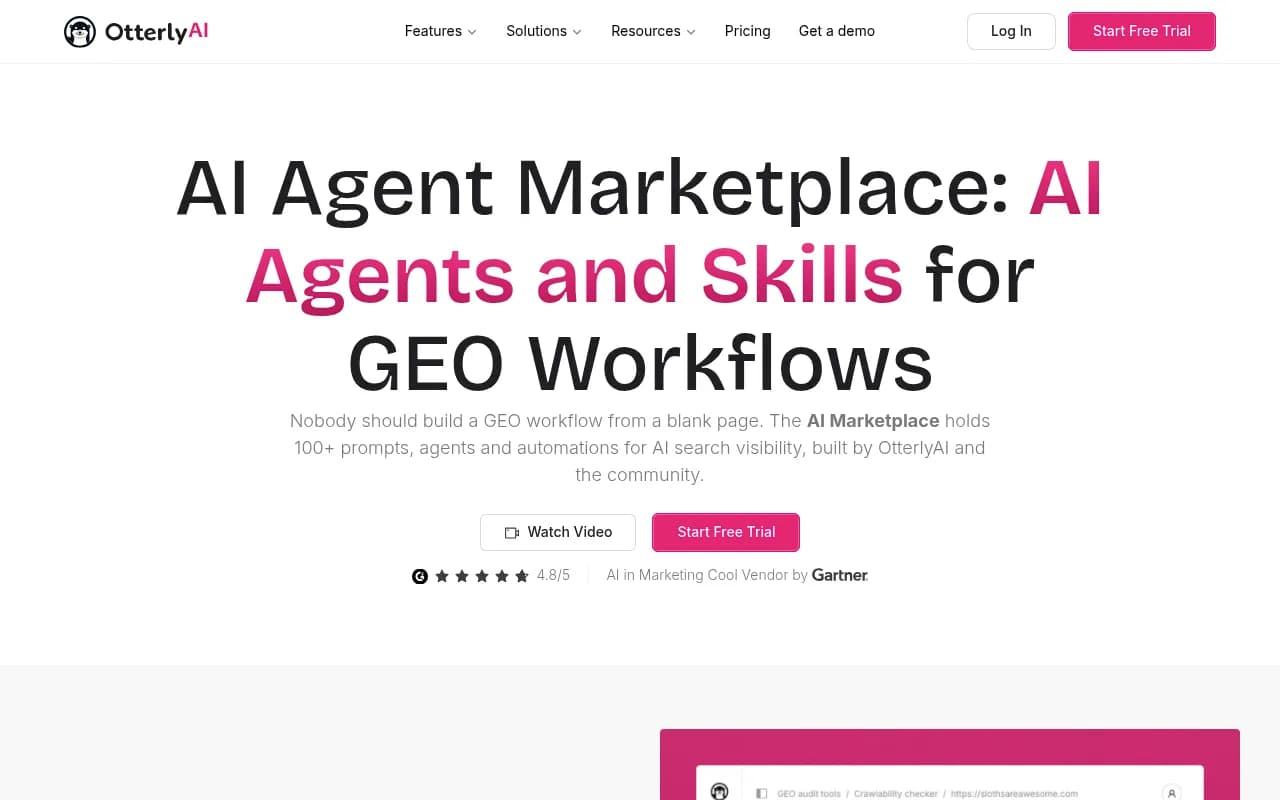
Promptwatch is not the only product with a workflow library. OtterlyAI runs an Agent Marketplace of 100+ ready-made workflows, many as Claude skills or n8n templates on top of its public API.
Otterly.AI

The approaches differ. A marketplace gives breadth and community submissions. The built-in skill approach gives tighter integration with the platform's own data and actions. Open-source options also exist, such as GitHub repos packaging GEO skills for Claude Code, Cursor and Codex, which are useful if you want to own the logic but leave data access to you.
| Approach | Strength | Watch out for |
|---|---|---|
| Promptwatch Agent Skills | Runs on live prompt, citation, crawler and traffic data, with scheduling and Slack delivery | Credits are consumed per run, so schedule deliberately |
| OtterlyAI Marketplace | Large library, community submissions, n8n and Claude skill formats | Workflows depend on the tracker's API data, and the tool stops at monitoring |
| Open-source skill repos | Free, editable, portable across agents | You supply the data connections and quality control |
If you want to compare more platforms, the GEO software directory at bestgeosoftware.com lists them by category.
A weekly rhythm that works
Here is the cadence I would start with:
- Monday morning: the 7-day briefing lands in Slack. Five minutes to read.
- Weekly: crawler health check, only escalated if something fails.
- Biweekly: citation research, feeding the next sprint.
- Per sprint: gap analysis, then the content sprint skill.
- Monthly: claims and sentiment review.
- On event: newsjacking, used sparingly.
Start with just the briefing for two or three weeks. Tune its length and thresholds until your team stops skipping it. Then add the others one at a time. Adding all seven at once is how you end up with a Slack channel nobody opens.
To try it, Promptwatch offers a 7-day free trial on monthly billing, and the free AI visibility report gives a quick baseline first.
What skills will not do
A skill does not replace judgment. It will not know that your pricing changed last Tuesday unless the data or Brand Book says so. It cannot fix thin content or a blocked crawler on its own. And it can only report on what your tracked prompts cover, so a badly chosen prompt set produces a confident briefing about the wrong questions.
Review the first few outputs line by line against the raw dashboards. If the numbers match and the recommendations make sense, you can trust the routine. If not, fix the skill's instructions, not the data.
Frequently asked questions
Do I need to be technical to use Agent Chat skills?
No. The ready-made skills run from a plain-language request, and custom skills are instructions written in ordinary sentences.
How often should the GEO briefing run?
Weekly is the right default. Daily briefings mostly show noise, unless you are following a launch or campaign on a faster monitor.
Which skill should I start with?
The 7-day briefing. It touches every data source, so you learn quickly which parts of your setup are missing.