
Key takeaways
- In finance, healthcare, insurance, and legal, the hard question about a GEO platform is what it does to your compliance posture, not how many prompts it tracks. Look at review gates, audit logs, role-based access, and certifications first.
- Content that AI engines quote is mostly product and landing pages. Promptwatch Data puts them at 39% of ChatGPT citations combined (Sep 28 to Oct 4, 2026), so those are the pages that need a human approval step.
- Pages that stay cited for months keep any non-compliant claim alive. You need a re-review schedule, not just a one-time sign-off.
- Most GEO tools only monitor. If a platform writes and publishes for you, check that the approval inbox, draft-versus-live states, and change logs exist before you turn on automation.
- Much of the 2026 "AI governance for regulated industries" content is about AI agents and gateways, not search visibility. Do not mix up the two categories when you build a shortlist.
Why regulated industries need a different checklist
A SaaS marketing team can evaluate a GEO platform on tracking coverage and price. A bank, insurer, hospital group, or law firm cannot. Every sentence an AI assistant quotes about you might be treated as a marketing claim. It also might be wrong, outdated, or something your compliance officer would never have approved.
Two separate problems get lumped together here, and it helps to pull them apart.
- Governing the AI search platform itself. Who can log in, what can the tool change, is there an audit trail, is the vendor certified, where does data live.
- Governing what the platform produces or influences. Content drafted by an agent, pages refreshed in bulk, claims about your brand that AI repeats and you need to correct.
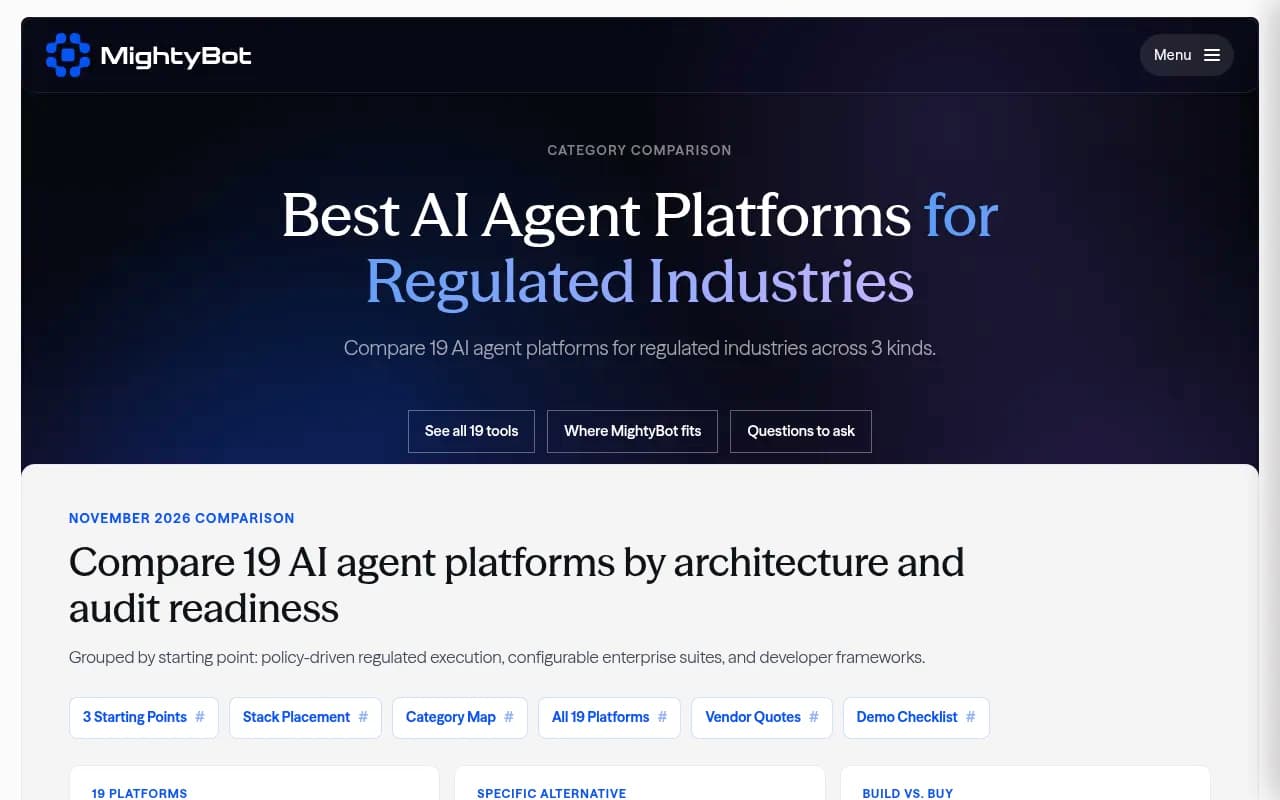
Most of the buyer guides published this year cover a third thing: runtime governance for AI agents and gateways. The OvalEdge compliance software comparison, the Speakeasy governance roundup, and MightyBot's list of 19 agent platforms are all useful for the framework thinking. None of them evaluate AI search visibility tools. Several are vendor-authored too (Speakeasy says so openly: "We build Speakeasy, so we aren't neutral"). Read them for criteria, not for shortlists.
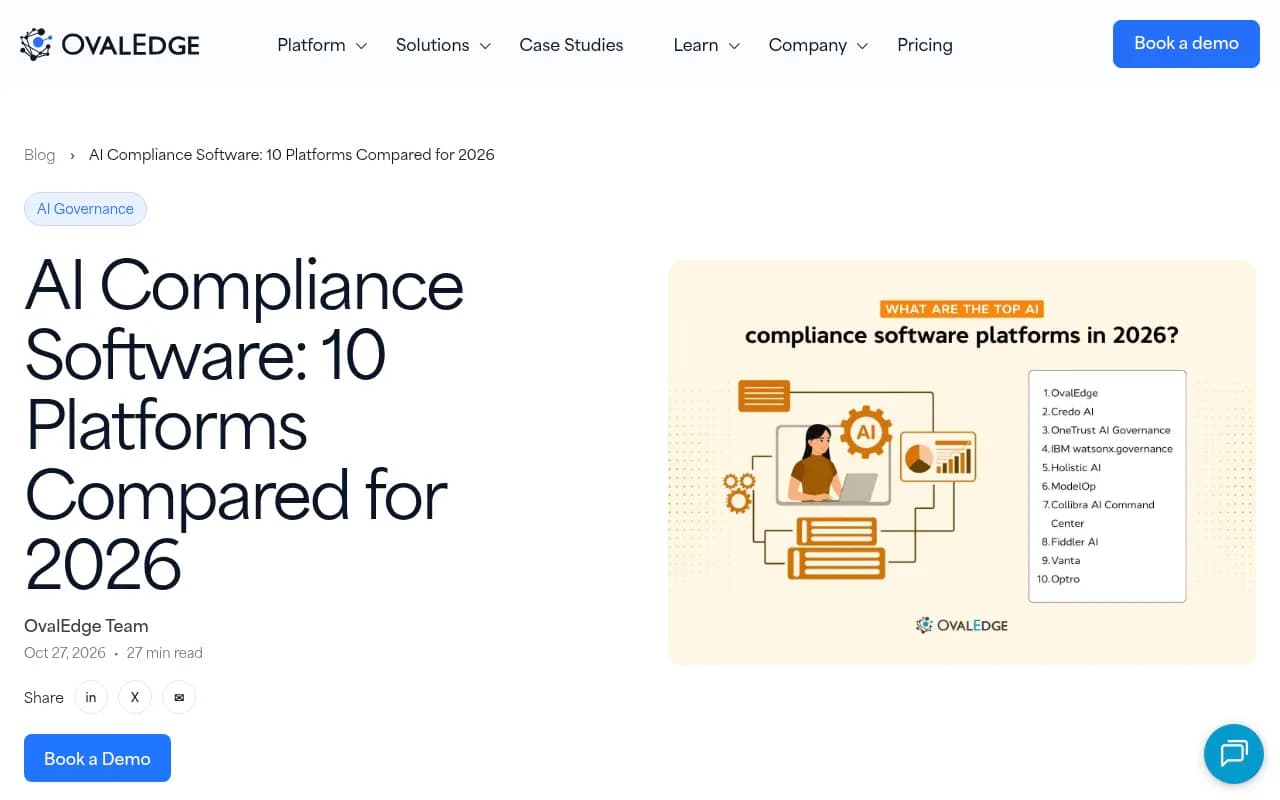
One line from the OvalEdge guide is worth stealing for any vendor evaluation: obligations only count when they map to specific assets, controls, owners, and evidence. Swap "assets" for "pages" and you have a workable GEO governance rule.
What AI engines actually quote, and why that sets your review scope
You cannot review everything, so start with the pages AI quotes most.
Promptwatch's content-type report (Sep 28 to Oct 4, 2026) shows where ChatGPT's citations land:
| Content type | Share of ChatGPT citations |
|---|---|
| Product pages | 22.4% |
| Landing pages | 16.8% |
| Listicles | 13.6% |
| How-to guides | 8.7% |
| Documentation | 7.5% |
| Comparisons | 5.9% |
| News | 5.7% |
| FAQ pages | 3.3% |
Product and landing pages together are 39%. For a lender or insurer, those are the pages with rates, eligibility language, coverage terms, and performance claims. They are also the pages that get quoted nearly verbatim. If you gate only one content type behind compliance review, gate those.
Longevity matters just as much. According to Promptwatch's content half-life data, landing pages and docs stay cited for months, while news pages lose half their citations in roughly five weeks (the catalog figure is 36 days). The practical reading: a risky claim on a landing page does not fade quickly. It keeps being cited until someone fixes it. That is the argument for scheduled re-reviews and a change log, not a single approval at publish time.
What the healthcare data says about sources
In regulated verticals ChatGPT leans on authoritative public sources. In Promptwatch's healthcare citation report (Sep 9 to Oct 8, 2026), NIH leads at 5.46% of citations across six nih.gov subdomains, with PubMed Central at 2.38% and PubMed at 2.33%. The FDA is second at 1.76% and the NHS third at 1.1%. Government and public health sites together earn 7.06%. Mayo Clinic (0.49%) and Cleveland Clinic (0.4%) are the only hospitals in the chart.
Two things follow for compliance teams. First, your reviewed content should cite and agree with those sources, so a review gate should include a check against official guidance (FDA, CDC, NHS, NICE). Second, commercial healthcare brands are competing for a small slice, so claims that contradict public guidance are both risky and unlikely to earn citations anyway.
The controls to demand from any GEO platform
Here is the checklist I would hand to a security reviewer. Not every platform will pass every line, and that is fine as long as you know which gaps you are accepting.
Access control and identity
- Role-based access (owner, editor, viewer) with project-level scoping, so a regional compliance lead sees only their market.
- SSO for anything that touches publishing.
- Scoped API keys, ideally read-only options, since API and MCP access is how data leaks out of dashboards into other tools.
Audit logs
Ask three questions. Does the log record every change? Does it say where the change came from (dashboard, API, integration, or an AI agent)? Can you export it? The Speakeasy guide frames the audit trail as "what it records, how it is structured, and whether it exports to the SIEM" your security team already runs. That is the right bar. A log that exists but cannot leave the tool is a screenshot, not evidence.
In the GEO category, audit logs are often gated to higher tiers. Promptwatch, for example, includes an organization audit log on Business, Agency Scale, and Enterprise, listing every change and whether it came from the dashboard, the API, an MCP client, or Agent Chat. Confirm current tier details on the vendor's pricing page before you commit.
Review gates for generated content
If the platform can write and publish, the gate is the single most important control. What you want to see:
- A review inbox where every generated piece is approved, edited, or declined before anything leaves the system.
- A clear difference between draft, staged, published, and live states, with the live URL tracked.
- The ability to run hands-off for low-risk content and hold everything for review on regulated topics.
- Style and house-rule enforcement (a style guide or mandatory disclaimer language) applied to every article, including refreshes.
- Diff-style views for updates to existing pages, so a reviewer sees exactly which sentences changed.
MightyBot's framing of "Audit, Assist and Automate" modes is a handy mental model even though it is an agent platform: start at Audit (everything reviewed), move to Assist (agent drafts, human approves), and only reach Automate for content classes your compliance team has explicitly cleared.
Certifications and data handling
Look for ISO/IEC 27001 and SOC 2, GDPR compliance, and a clear statement of where data is processed. HIPAA and PCI claims matter only if the tool would ever touch protected data, which a GEO platform should not. If a vendor wants customer records or patient data to do its job, treat that as a red flag. Competing categories do carry heavier compliance lists. Lorikeet's customer-service roundup, for instance, cites SOC 2, HIPAA, GDPR, PCI DSS Level 1, FedRAMP High, ISO 27001, and ISO 42001 for support platforms, but those tools handle customer conversations, which a visibility tool does not.
Monitoring what AI says about you is itself a compliance control
There is a defensive side that gets overlooked. Regulators care about what is said about your products, and AI assistants now say plenty. A claim like "no fees" or "guaranteed returns" generated by a model, citing a stale third-party page, is a problem you did not write but may still own.
Useful capabilities here:
- Claim-level extraction: the individual statements AI makes about you, grouped by theme (pricing, features, support, reputation), so compliance sees the specific sentence and not an abstract sentiment score.
- Fact-checking those claims against your own pages and the third-party sources AI cites, to find which page is teaching the model the wrong thing.
- Citation source tracking so you can see which outside pages shape your narrative, including Reddit, YouTube, and directories.
Promptwatch covers this with Brand Narrative on every plan and Fact Check on Business and above, which can then queue refreshes for flagged pages with the exact sentences to rewrite.

How the main options compare for regulated use
I am only comparing what is documented. Where I could not verify a specific control, the table says so, because guessing is worse than a blank cell. Treat the other rows as a starting point for your own security questionnaire.
| Platform | Type | Review gate for generated content | Audit log | Notes for regulated teams |
|---|---|---|---|---|
| Promptwatch | Monitor, content, measure | Review inbox (approve, edit, decline, or hands-off); draft vs live tracking | Org audit log on Business, Agency Scale, Enterprise | ISO/IEC 27001, GDPR, EU-based; SSO on Enterprise; roles and scoped API keys |
| Profound | Enterprise monitoring | Verify in vendor docs | Verify in vendor docs | Enterprise positioning; request security pack |
| Scrunch AI | Monitoring and optimization | Verify in vendor docs | Verify in vendor docs | Request security pack |
| Otterly.AI | Prompt tracking | Not a content publisher | Verify in vendor docs | Lightweight monitoring |
| Semrush | SEO suite with AI add-ons | Verify in vendor docs | Verify in vendor docs | Broad suite; AI data is a module |
| AirOps | Content engineering | Verify in vendor docs | Verify in vendor docs | Workflow-based content generation |
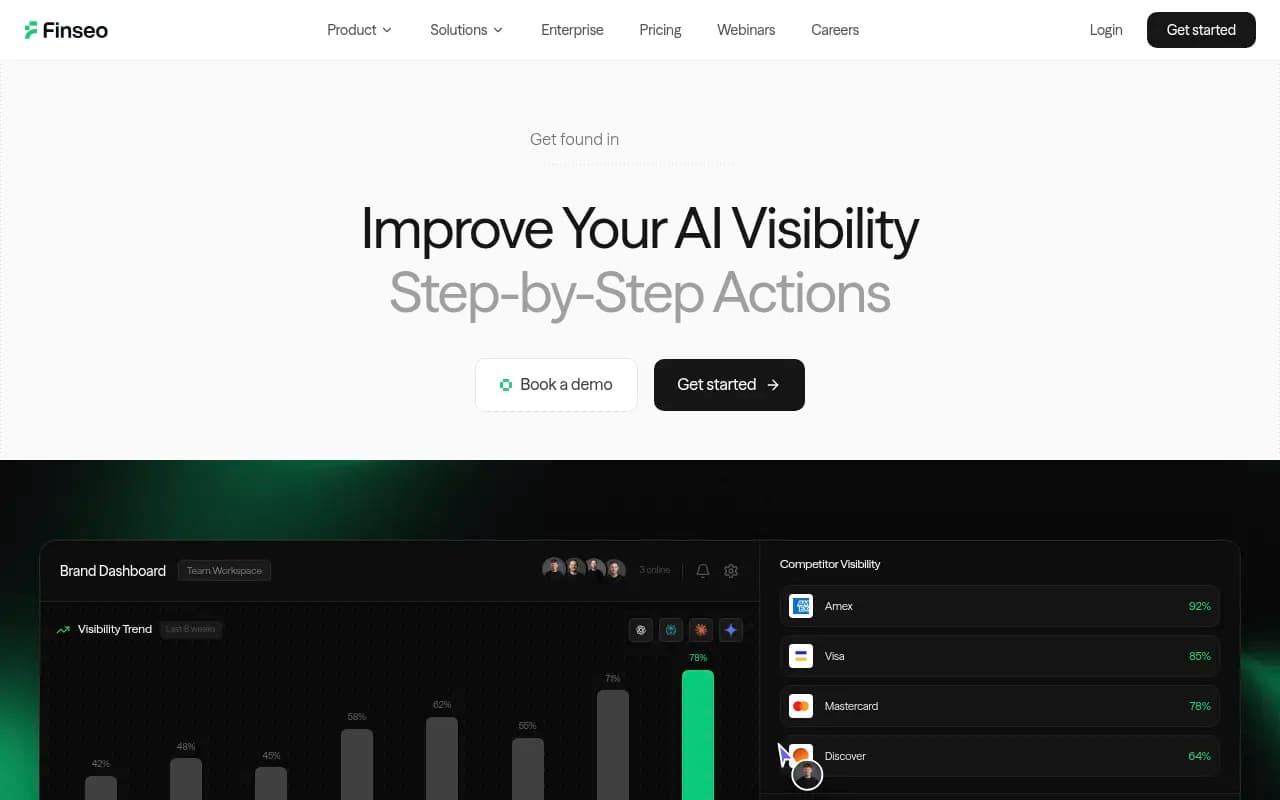
| Finseo.ai | AI visibility for financial brands | Verify in vendor docs | Verify in vendor docs | Vertical focus on finance |
For Promptwatch, a head-to-head with the closest enterprise alternative is at Promptwatch vs Profound.
Profound

Otterly.AI


A few honest observations. Monitoring-only tools are the easiest to approve because they cannot publish anything. The trade-off is that they leave remediation to humans, which is fine if you have a content team and a slow approval process anyway. Tools that write and publish raise your control requirements but shorten the time from finding a problem to fixing it. Neither is wrong. Match the tool to the speed your compliance process can really handle.
A review workflow that survives an audit
Here is a workflow I would be comfortable defending to an examiner or internal audit team.
1. Classify pages by risk
Split your site into three tiers. Tier 1: pages with rates, returns, coverage, eligibility, or clinical claims. Tier 2: educational content and comparisons. Tier 3: news and general brand content. Use the citation data above to prioritize: product and landing pages are tier 1 because they are both high-risk and heavily cited.
2. Set autonomy by tier
Tier 1 gets a mandatory human review gate with named approvers. Tier 2 gets agent drafting and a lighter review. Tier 3 can run with sampling. Write this down. An approval policy that lives only in someone's head fails the first time an auditor asks.
3. Keep a content record per page
For each published piece you want the brief or prompt it came from, the draft, the reviewer, the approval timestamp, and the live URL. Platforms that track draft, staged, published, and live URLs per document make this nearly automatic. If yours does not, you need a spreadsheet and discipline.
4. Check crawl and citation evidence
After publishing, confirm AI bots actually read the approved version and that the page is cited as intended. Verified crawler logs (checked against each operator's published IP ranges) separate real AI bots from spoofed ones and show which version of a page was fetched. This matters for disputes: you can show what an AI crawler could have seen and when. See Promptwatch's AI crawler logs for one implementation.
5. Re-review on a schedule
Because landing pages and docs stay cited for months, put tier 1 pages on a quarterly review, and trigger an out-of-cycle review whenever a regulation, product term, or rate changes. Weekly site audits that flag changes help here, since you see what shifted between runs.
6. Close the loop on AI claims about you
Once a month, pull the negative or inaccurate claims AI repeats, check them against your sources, and either update the page or publish authoritative corrections. Document the decision either way, including "no action, claim is accurate."
Where governance platforms fit, and where they do not
If your procurement team starts the search with "AI governance," they will find gateways (Bifrost, TrueFoundry), GRC and compliance suites (OvalEdge, Credo AI, OneTrust, IBM watsonx.governance), and agent platforms (Palantir AIP, Copilot Studio, Agentforce, Bedrock, Vertex AI). Those tools govern how your own AI systems behave. They are relevant if you are building chatbots or internal agents, and the EU AI Act, NIST AI RMF, and ISO 42001 mapping they advertise is real work.
They do not tell you whether ChatGPT recommends your competitor, or which page of yours Gemini cites. That is a separate budget line. Be clear about this early so security reviews are scoped to the right category, and so a GRC platform does not get blamed for something it was never built to do.
The Speakeasy guide cites Gartner expecting AI governance platform spending to pass $1 billion by 2030. Fine, but that is a different market from GEO. For tool discovery within our network, the GEO software directory lists visibility and optimization platforms side by side.
Questions to ask every vendor
Paste these into your security questionnaire.
- Which actions can an AI agent take without human approval, and can we disable all of them?
- Does the audit log record API, integration, and agent-initiated changes, and can we export it?
- What plan tier includes audit logs, SSO, and review gates? (Gating is common, so get it in writing.)
- Which certifications do you hold today, with report dates?
- Where is data processed and stored?
- Do you need any customer personal data, patient data, or credentials to operate?
- How do you collect AI answers: real user interfaces or APIs only? (Answers can differ, which affects evidence quality.)
- Can we restrict a user or a client to specific projects?
- How are retired AI model versions handled, and do collected responses stay in our data?
Practical rollout plan
Week 1 to 2: run a free scan to see current exposure, such as the free AI visibility report, and inventory your tier 1 pages. Week 3 to 4: send the security questionnaire to two or three vendors and run a pilot in monitoring-only mode. Month 2: turn on agent drafting for tier 2 content with the review inbox mandatory. Month 3: review audit log output with your compliance lead and decide whether any content class can move toward lighter review.
If you want a partner to run this program rather than staffing it, an agency that handles GEO alongside technical SEO can help; 1001 SEO Media works with Promptwatch for AI visibility and operates with transparent reporting and no long-term contracts.
Bottom line
Pick the platform whose controls match your slowest approver, not your fastest marketer. Gate product and landing pages first, since they make up 39% of ChatGPT citations. Plan re-reviews because those pages stay cited for months. Demand an exportable audit log that records agent actions, and ask for tier details in writing. Verify every row in the comparison table against current vendor documentation, and check Promptwatch's pricing page for current plan limits before you budget.
FAQ
Do regulated companies need a special GEO platform?
Not a special category, but a stricter evaluation. The same tools apply. You just weigh review gates, audit logs, access control, and certifications much more heavily than prompt counts.
Is a monitoring-only tool safer than one that publishes content?
It is simpler to approve because it cannot change your site. Publishing tools are fine when the approval inbox, draft states, and change logs are in place and your policy says who signs off.
Which pages should compliance review first?
Product and landing pages. They earn 39% of ChatGPT citations combined in Promptwatch's October 2026 content-type data and carry the claims regulators care about most.
How often should regulated content be re-reviewed?
Quarterly for tier 1 pages is a reasonable default, plus an immediate review when rates, terms, or rules change. Landing pages and docs stay cited for months, so stale claims do not expire on their own.
Can AI governance platforms replace a GEO tool?
No. Governance platforms control how your own AI systems behave. GEO platforms measure and improve how external AI engines represent your brand. You may need both.